
Summarize this post with AI
Most CRO guide to mas feat conversations start in the wrong place, with a compliance checklist instead of a risk ownership question. The MAS FEAT principles, Fairness, Ethics, Accountability, and Transparency, were never written as a technical spec for data science teams to implement alone. They were written as an accountability standard, and in 2026, that accountability sits with the Chief Risk Officer as much as with the model owner. This guide sets out what a CRO actually needs to own, evidence, and report under FEAT, and how that ownership is changing as MAS layers new AI risk guidelines on top of it.
CRO Guide to MAS FEAT:
A CRO guide to mas feat starts with one fact: FEAT is a principles based standard, not a control checklist, so the CRO's job is translating Fairness, Ethics, Accountability, and Transparency into a risk appetite statement, a governance committee structure, and board reporting that an MAS examiner can trace end to end. Under the MAS FEAT Principles, published in 2018, accountability for AI outcomes cannot be delegated entirely to a technical team, it must sit with a named, senior owner, which in most institutions now means the CRO or a risk committee reporting to the CRO.
What the MAS FEAT principles actually require
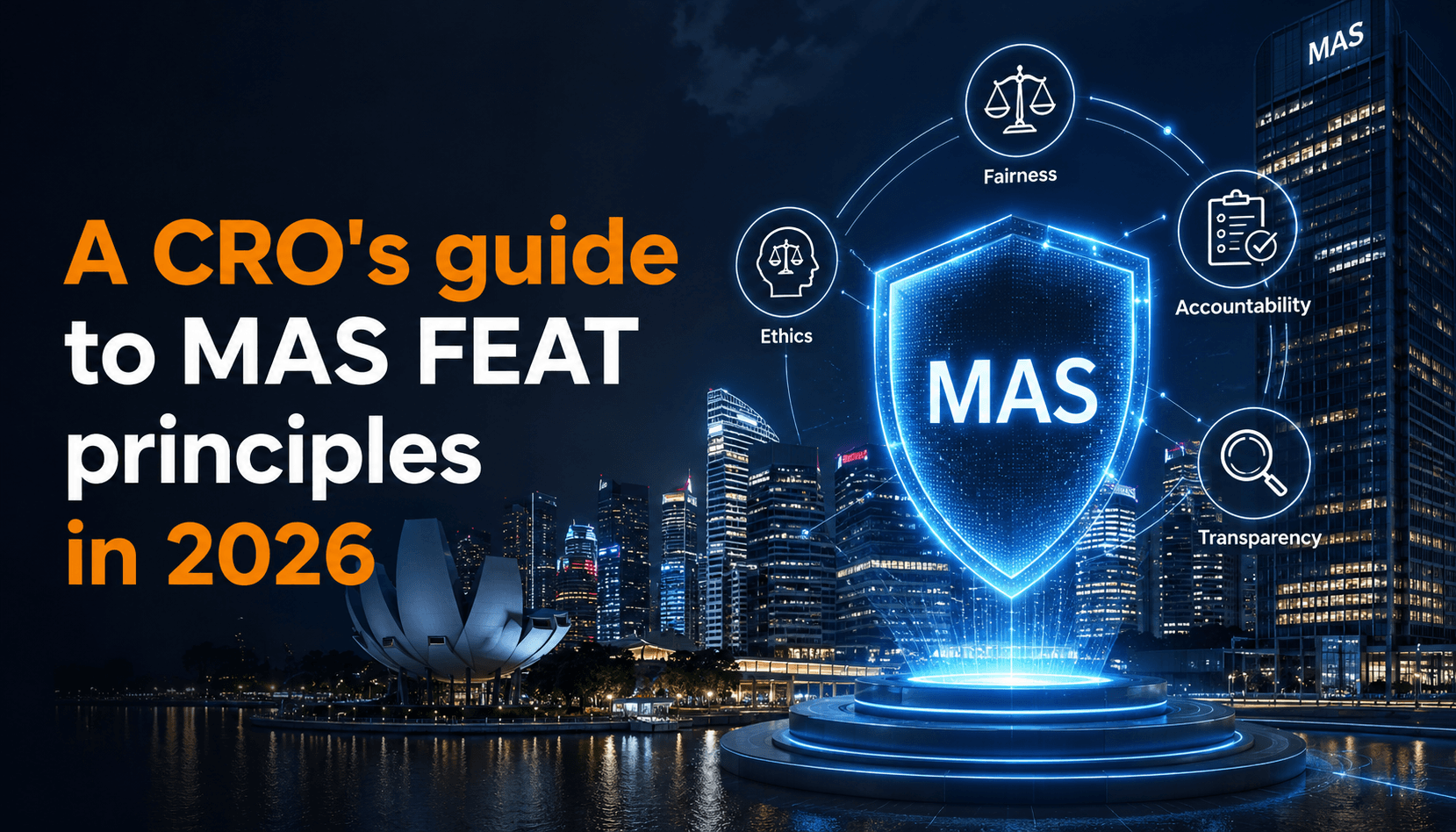
The MAS FEAT Principles set out four pillars for the use of AI and data analytics in financial services decision making.
Fairness. Data and models used in decisions should be appropriate, and outcomes should not systematically disadvantage protected groups without justification.
Ethics. AI use should align with the institution's ethical standards and broader societal norms, not just legal minimums.
Accountability. Internal governance must assign clear ownership for AI outcomes, from data sourcing through deployment and monitoring.
Transparency. Customers and regulators should be able to understand, at an appropriate level, how AI influences decisions that affect them.
For a CRO, the fourth pillar is often the hardest to operationalize, since transparency requirements now extend to explaining agentic AI decisions, not just static credit or fraud models. Our complete guide to the MAS FEAT principles breaks down each pillar in more technical depth than this guide covers.
Why FEAT accountability sits with the CRO now
Why AI governance for financial institutions has shifted from a technology question to a risk ownership question comes down to three developments in 2026.
MAS is layering formal guidelines on top of FEAT. The Guidelines on Artificial Intelligence Risk Management, out for consultation since November 2025 and expected to finalize this year, extend FEAT's principles into formal expectations for board oversight, AI inventory, and lifecycle controls.
Agentic AI has outpaced static model governance. A CRO signing off on a model risk framework built for static credit scoring models has no equivalent sign off process for an AI agent that can act autonomously in real time.
Boards are asking CROs directly, not CIOs, for FEAT assurance. Since FEAT is framed as a governance and accountability standard, board risk committees increasingly route AI risk questions to the CRO rather than treating it as a pure technology briefing.
Understanding why MAS FEAT principles were designed this way, as a governance standard rather than a technical one, helps explain why the accountability question keeps landing on the CRO's desk rather than staying with engineering.
Find Your AI Gaps with a Free Assessment
The FEAT implementation framework for CROs
A CRO does not need to run the technical bias testing personally, but does need a framework that makes each pillar auditable. The inline diagram for this section should sit directly under this heading, since it is the step by step process a reader needs to see visually.
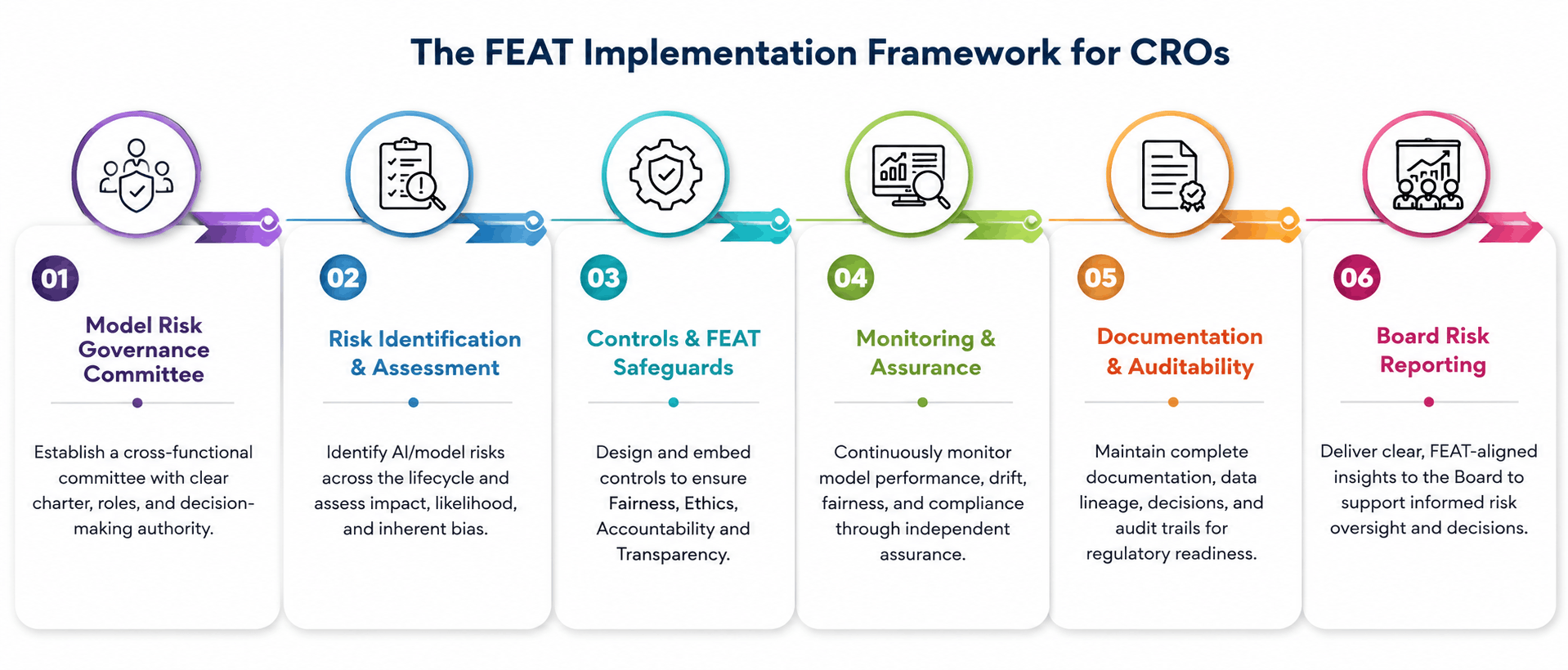
Establish a model risk governance committee. This committee, reporting to the CRO, owns the AI inventory and signs off on new model or agent deployments against the risk appetite statement.
Classify every model and agent by risk materiality. Impact, complexity, and reliance determine how much scrutiny a given AI system needs before deployment.
Assign named accountable owners. Every model or agent needs a business owner and a technical owner, both visible in board risk reporting.
Run fairness and explainability testing before deployment. This produces the evidence the transparency pillar requires, not just a one time sign off.
Apply the three lines of defence model. The business unit owns the risk day to day, an independent model risk function reviews it, and internal audit provides the final check, all reporting up through the CRO.
Report to the board on a defined cycle. Board risk reporting should include AI specific metrics, not just a general technology update.
This is where the engineering execution layer matters. Samta.ai builds the ai risk and governance infrastructure that turns this six step framework into a working system, an automated AI inventory, fairness testing pipelines, and board ready reporting dashboards, often integrating with existing Databricks, Snowflake, or Microsoft data infrastructure through our data integration consulting services. Firms building this out should also read our guide on why AI governance for financial institutions has become a board level priority, and how an AI risk management model governance committee should actually operate day to day.
Risk teams that want a single system of record for their AI inventory, fairness testing evidence, and board reporting typically evaluate the VEDA AI decision analytics platform, since it centralizes exactly the evidence a CRO needs when an MAS examiner asks for FEAT documentation.
MAS FEAT principles at a glance for CROs
FEAT Pillar | What It Requires | CRO Accountability | Key Evidence | Common Failure Mode |
Fairness | Non discriminatory outcomes from AI and data analytics decisions | Sign off on fairness testing methodology | Bias testing reports across protected groups | Testing run once at launch, never repeated |
Ethics | Alignment with institutional values, not just legal minimums | Set the risk appetite statement for AI use cases | Ethics review minutes tied to specific deployments | Ethics treated as a legal checkbox, not a risk decision |
Accountability | Named ownership across the AI lifecycle | Chair the model risk governance committee | AI inventory with named business and technical owners | Ownership assigned to a team, not a named individual |
Transparency | Explainable outcomes for customers and regulators | Approve customer facing explanation standards | Model documentation an examiner can trace end to end | Explainability documented for developers, not examiners |
Real world enterprise use cases
BFSI: a bank building its model risk governance committee from scratch
A bank preparing for its first MAS FEAT focused examination had fairness testing running informally inside its data science team, with no CRO visibility. Standing up a model risk governance committee chaired by the CRO, backed by AI security and compliance services, gave the bank a documented chain from testing results to board risk reporting within one quarter.
General enterprise: a proptech firm answering BFSI procurement questions
A proptech firm selling into BFSI clients does not report to MAS directly, but its enterprise buyers now ask FEAT style governance questions during procurement. Reviewing its approach against our enterprise AI engineering in Singapore overview helped the firm answer accountability and transparency questions with the same structure a bank's CRO would expect to see.
Assess Your AI Model Risk Exposure Today
Key risks and failure modes for CROs
Delegating accountability entirely to a technical team. FEAT requires a named senior owner, and a CRO who has not personally reviewed the AI inventory cannot credibly claim that ownership during an examination.
Treating fairness testing as a one time event. A model retrained on new data needs re testing, not a reference to a report from launch.
Board risk reporting that omits AI specific metrics. A general technology update does not satisfy an examiner looking for FEAT specific evidence.
No clear escalation path for agentic AI. The three lines of defence model built for static models often has no equivalent process for an agent that can act without waiting for a review cycle.
Assuming FEAT is legal's responsibility. FEAT accountability under MAS sits with risk governance, not solely with legal or compliance functions.
When a CRO should escalate a FEAT gap to the board
Escalate to the board when:
No named accountable owner exists for a model or agent already in production
Fairness testing has not been repeated since the last material data or model change
An agentic AI system can act without a documented human escalation path
A committee level fix is enough when:
The gap is a documentation issue rather than a missing control
Testing exists but reporting has not reached the required board cadence
The AI inventory needs updating rather than a new governance structure entirely
Our why MAS FEAT principles guide covers the reasoning MAS examiners typically apply when deciding whether a gap is a documentation issue or a genuine control failure.
What a governance platform needs to support a CRO's FEAT obligations
A CRO's evidence burden under FEAT is different from a general business intelligence need, since an examiner asks for a specific model's fairness testing history and named owner, not an aggregate dashboard. Firms evaluating vendors for this should look closely at how VEDA compares to other data intelligence platforms, since most analytics platforms were not built to produce examiner ready, per model evidence. The VEDA platform is built around that inventory and evidence requirement directly, rather than as an add on to a general dashboard. Teams that have implemented this kind of governance layer, including Samta.ai case studies across BFSI and proptech, generally find that the hardest part is not the fairness testing itself, it is getting a complete, board ready AI inventory in place first, which is exactly the accountability layer FEAT expects a CRO to own. For a broader look at the six building blocks most institutions still need, see the six components of a mature AI governance program, which extends this framework beyond FEAT alone.
Explore the Right AI Strategy for Your Enterprise
Conclusion
A CRO guide to mas feat ultimately comes down to ownership, not technology. Fairness, Ethics, Accountability, and Transparency only hold up under examination if a named senior owner can trace testing, documentation, and board reporting end to end. CROs who build that chain now will not be rebuilding it once MAS's newer AI risk guidelines finalize.
About Samta
Samta.ai is a Singapore-headquartered AI Product Engineering & Data Intelligence partner helping enterprises build production-grade AI systems for regulated and data-intensive environments.We help organizations move beyond experimentation by engineering scalable, explainable, and enterprise-ready AI solutions from data foundations and model development to workflow automation and deployment.
Our capabilities combine deep AI expertise, data engineering, and product engineering to deliver measurable business impact across FinTech, BFSI, cybersecurity, regulatory technology, and enterprise operations.
Our enterprise AI products power real-world intelligence systems:
• TATVA : AI-driven data intelligence platform for governed analytics, monitoring, and operational insights
• VEDA : Explainable and audit-ready AI decisioning engine built for compliance-sensitive enterprise workflows
• CORA-Property Management Solutions: : Predictive intelligence platform for real-estate pricing, portfolio optimization, and investment analytics
Backed by ecosystem partnerships with Microsoft, Databricks, Snowflake, and AWS, Samta.ai delivers agile, cost-efficient AI engineering with faster turnaround and enterprise-grade scalability. Trusted by enterprises across FinTech, BFSI, and digital transformation initiatives, Samta.ai embeds AI governance, data privacy, and compliance-by-design principles directly into the AI lifecycle , enabling organizations to scale AI with transparency, accountability, and operational control.
Enterprises leveraging Samta.ai automate 65%+ of repetitive data, analytics, and decision workflows while maintaining governance, explainability, and measurable business outcomes. Samta.ai provides the strategic consulting, AI engineering, and data modernization expertise needed to align enterprise operations with next-generation AI transformation goals.
Frequently asked questions
What are the MAS FEAT principles?
The MAS FEAT principles are Fairness, Ethics, Accountability, and Transparency, four pillars MAS set out in 2018 for the responsible use of AI and data analytics in financial institutions. They form the foundation that newer guidelines, including the AI Risk Management Guidelines, now build on.
Is the CRO personally accountable for FEAT compliance?
Accountability sits with a named senior owner, which in most institutions is the CRO or a risk committee reporting to the CRO. This does not mean the CRO runs technical testing personally, but does mean the CRO must be able to evidence oversight during an examination.
What is a model risk governance committee?
A model risk governance committee is a formal body, typically chaired by or reporting to the CRO, that owns the AI inventory, reviews fairness and explainability testing, and signs off on new model or agent deployments against the institution's risk appetite statement.
How does the three lines of defence model apply to AI risk?
The business unit owns AI risk day to day, an independent model risk function reviews it, and internal audit provides a final check, all reporting up through the CRO. Agentic AI often breaks this model unless a runtime escalation path is added explicitly.
How often should fairness testing be repeated?
Fairness testing should be repeated whenever a model or agent is retrained on new data or redeployed with materially different scope, not only at initial launch. A single point in time test does not satisfy ongoing accountability requirements under FEAT.