
Summarize this post with AI
Singapore's financial institutions that deploy AI without a documented governance framework are not just taking on technology risk they are taking on regulatory risk that MAS is now examining at the model level, not just the policy level. An AI governance framework for BFSI Singapore is no longer a compliance checkbox. It is the operating infrastructure that determines whether your AI program is examinable, defensible, and sustainable. This guide covers what a complete BFSI AI governance framework must include in 2026 across MAS TRM, FEAT, and VERITAS requirements and how to implement it without rebuilding your entire AI program from scratch.
AI Governance Framework Singapore BFSI:
A compliant AI governance framework for BFSI Singapore in 2026 must address five regulatory anchors: MAS Technology Risk Management guidelines for model risk accountability, the FEAT principles (Fairness, Ethics, Accountability, Transparency) for consumer-facing AI decisions, the MAS VERITAS framework for fairness assessment methodology, PDPA obligations for data used in AI training and inference, and internal model risk management standards aligned to the MAS AI Risk Management Toolkit. Institutions that embed these requirements at the engineering layer not the documentation layer consistently pass regulatory examination with fewer remediation findings.
What an AI Governance Framework for BFSI Means in Practice
AI governance framework template discussions in BFSI too often produce policy documents that satisfy a filing requirement but do not change how models are built, validated, or monitored. A genuine AI security governance framework for financial institutions covers four operational layers:
Model risk management: pre-deployment validation, model cards, performance benchmarking against defined thresholds, and post-deployment drift monitoring
Fairness and ethics controls: FEAT-aligned assessment of consumer-facing AI decisions for bias, disparate impact, and explainability
Data governance: lineage tracking, consent management, and quality controls on data used to train and retrain models
Accountability structures: named ownership of each model's risk profile, audit trail generation, and Board-level AI risk reporting
AI for compliance in banking requires all four layers working together. A model risk policy without drift monitoring, or an ethics assessment without a named accountable owner, creates compliance gaps that MAS examinations are increasingly designed to surface. Understanding how BFSI AI governance solutions are structured operationally not just documented is the starting point for any institution building or rebuilding its framework.
Benchmark Your Enterprise AI Readiness
Why 2026 Is the Tipping Point for BFSI AI Governance in Singapore
Three regulatory developments have shifted AI in BFSI sector governance from advisory to enforceable:
1. MAS TRM examination depth has increased
MAS now examines model risk management at the individual model level requesting model cards, validation reports, and drift monitoring records not just at the enterprise policy level. Institutions without model-level documentation are receiving remediation findings, not just guidance letters.
2. FEAT compliance is being verified, not assumed
The FEAT principles Fairness, Ethics, Accountability, Transparency are no longer self-certified. MAS expects institutions to demonstrate the methodology used to assess consumer-facing AI decisions against each principle. The MAS VERITAS framework provides the technical methodology for FEAT fairness assessment, and regulators are beginning to ask which VERITAS assessment track applies to specific use cases.
3. The MAS AI Risk Management Toolkit is now a baseline reference
Published as a practical companion to existing TRM guidelines, the MAS AI Risk Management Toolkit gives institutions specific controls and documentation standards to implement. Institutions that cannot map their governance controls to this toolkit face increasing examination risk. Review the MAS FEAT compliance checklist for a detailed breakdown of FEAT requirements by use case category.
Download the Agentic AI Governance Checklist Get the complete governance checklist for BFSI AI deployments in Singapore mapped to MAS TRM, FEAT, and VERITAS requirements →
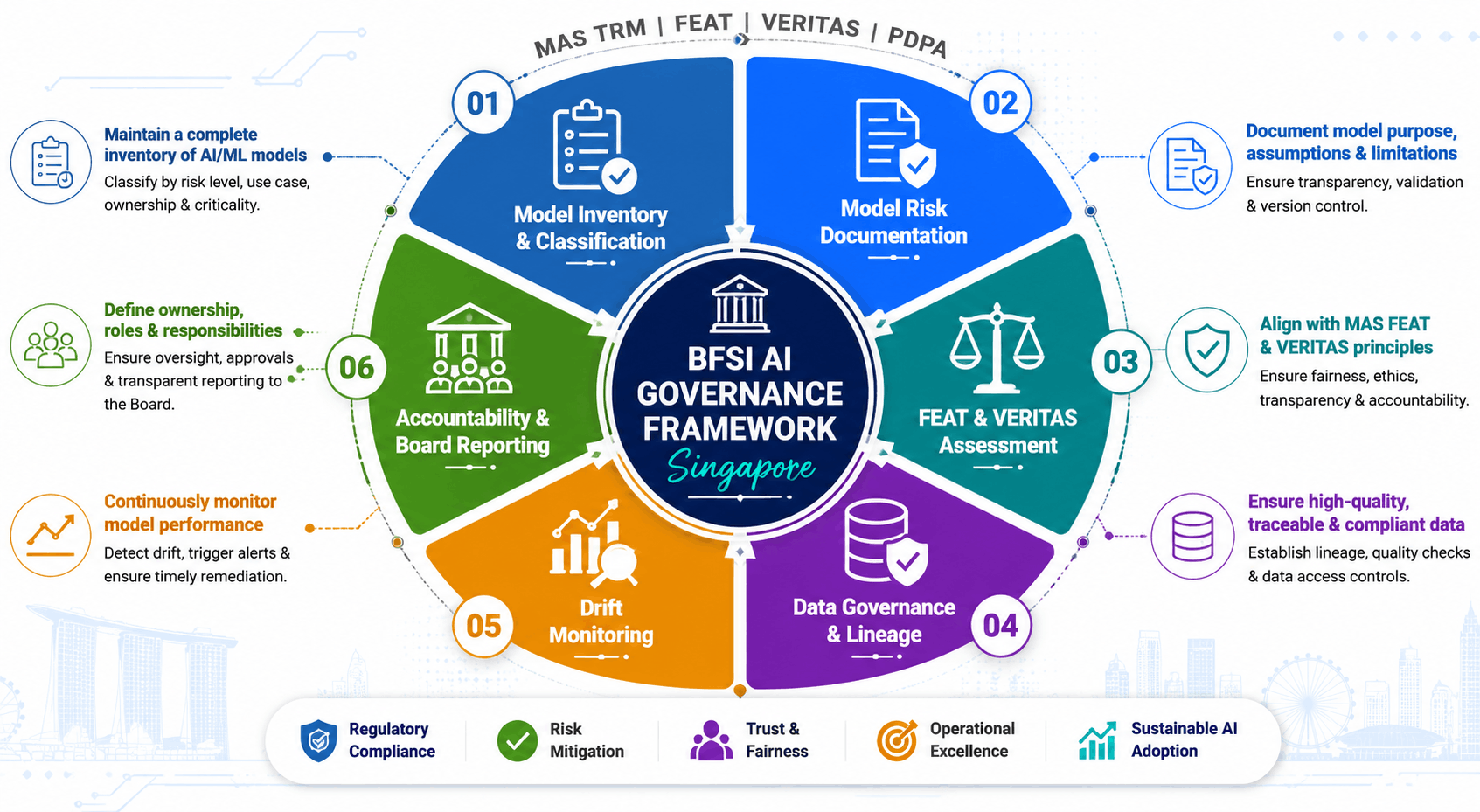
The 6-Component AI Governance Framework for BFSI Singapore
Use this framework to structure or audit your institution's current AI governance posture:
Component 1: Model Inventory and Classification
Maintain a complete, current inventory of every AI model in production including shadow models and vendor-supplied models. Classify each by risk tier: high-risk (credit decisions, fraud detection, insurance underwriting), medium-risk (customer segmentation, operational automation), and lower-risk (internal analytics, reporting). Risk classification determines the depth of governance controls required for each model. Without a complete inventory, governance controls are applied inconsistently covering the models you know about and missing the ones that create the most exposure. Samta.ai's AI security and compliance services include model inventory as a foundational implementation step.
Component 2: Model Risk Management Documentation
For every high and medium-risk model, produce and maintain: a model card documenting purpose, training data, known limitations, and performance thresholds; a validation report from a team independent of the model development team; and a change log covering every retraining cycle and parameter update. These documents are the primary artefacts MAS examiners request when reviewing model risk management. Institutions that cannot produce them on demand face findings regardless of how well their underlying models perform.
Component 3: FEAT and VERITAS Assessment
Apply FEAT principles to every consumer-facing AI decision. For fairness assessment, use the MAS VERITAS framework to determine which assessment track applies the VERITAS framework provides three tracks depending on the nature of the decision (credit, insurance, or general financial services). Document the assessment methodology, outcomes, and any remediation actions taken. The MAS VERITAS framework implementation guide provides a step-by-step process for determining which VERITAS track applies to your specific use cases and how to document the assessment.
Component 4: Data Governance and Lineage
All training data must have documented lineage source, collection date, consent basis under PDPA, and any preprocessing transformations applied. For models that retrain on live operational data, the lineage requirements extend to every new data batch used in retraining cycles. Samta.ai's data integration consulting services implement data lineage tracking on Databricks and Snowflake as part of the AI governance build ensuring the lineage infrastructure is embedded in the data platform, not maintained manually in spreadsheets.
Component 5: Drift Monitoring and Model Performance Management
Every production model requires automated monitoring for input drift (changes in the distribution of incoming data) and output drift (changes in model decision patterns). Alert thresholds and escalation procedures must be documented before go-live, not configured reactively when drift is detected. The VEDA AI Data Analytics Platform embeds continuous drift monitoring and automated performance reporting directly into the production layer — providing the model performance records that MAS examinations require.
Component 6: Accountability Structures and Board Reporting
Name a model owner for every production model. That owner is accountable to the Chief Risk Officer or equivalent for model performance, governance documentation currency, and escalation decisions. Board-level AI risk reporting should cover model inventory status, high-risk model performance against thresholds, and any open remediation items on a quarterly cycle. The enterprise AI analytics framework provides a reporting structure template that connects model-level monitoring data to Board-level risk dashboards.
AI Governance Framework BFSI Singapore: 5-Column Compliance Comparison
Governance Component | MAS TRM Requirement | FEAT Principle Mapped | VERITAS Track | Samta.ai Implementation |
Model Inventory | Complete inventory of all AI models, risk-tiered | Accountability | All tracks | Model registry with automated classification |
Model Risk Documentation | Model cards, validation reports, change logs | Transparency | Tracks 1, 2, 3 | Standardised model card templates, audit trail generation |
Fairness Assessment | FEAT-aligned assessment for consumer decisions | Fairness, Ethics | Track 1 (credit), Track 2 (insurance) | VERITAS-mapped assessment workflows |
Data Lineage | Source, consent, transformation documentation | Accountability | All tracks | Databricks / Snowflake lineage tracking |
Drift Monitoring | Post-deployment performance management | Transparency | All tracks | VEDA continuous monitoring, automated alerts |
Know Your AI Risk Before It Grows
Real-World Use Cases: BFSI AI Governance in Practice
Use Case 1: Credit Decisioning Model Governance, Singapore Bank
A Singapore-licensed bank deployed an ML credit scoring model without a complete FEAT assessment or documented VERITAS track selection. During a subsequent MAS technology risk examination, the examiner requested: model card, independent validation report, FEAT assessment methodology documentation, and 12 months of drift monitoring records. The institution could produce only partial documentation, resulting in a formal remediation requirement with a 90-day resolution deadline. The retroactive governance build cost SGD 380,000 more than three times what embedding governance during the original build would have cost. This is AI in banking governance failure at its most expensive: not a model that performed badly, but a model that performed well with no documentation to prove it. The BFSI AI consulting services framework Samta.ai implements is specifically designed to prevent this sequence.
Use Case 2: Insurance Underwriting AI, Regional Insurer
A Singapore-based insurer deploying an AI underwriting model correctly identified the VERITAS Track 2 assessment requirement before deployment. The FEAT assessment and VERITAS Track 2 fairness analysis were completed as part of the build, with documentation produced by the model risk team before go-live. When MAS requested documentation 14 months post-deployment, the insurer produced all required artefacts within 48 hours. No remediation findings were issued. The governance investment during build SGD 95,000 was recovered in avoided remediation cost and examination time within the first examination cycle.
AI Model Risk Management Playbook Get the complete playbook for building MAS TRM, FEAT, and VERITAS-compliant AI governance in Singapore financial institutions →
Key Risks and Failure Modes in BFSI AI Governance
Governance as documentation only: producing model cards and FEAT assessments as filing exercises rather than as live, maintained artefacts that reflect the current model state; examiners verify currency, not just existence
Missing VERITAS track selection: institutions that apply generic fairness assessment without determining which VERITAS track applies to their specific use case produce assessments that do not satisfy MAS expectations
Vendor model blind spots: third-party and vendor-supplied AI models are in scope for FEAT and TRM requirements; institutions that govern only their internally built models create the most common examination gap
No independent validation: model validation conducted by the same team that built the model does not satisfy MAS independence requirements; validation must be organisationally separated from development
Drift monitoring configured post-incident: institutions that set up drift alerts after a model begins producing anomalous outputs have already created the exposure; monitoring must be in place from go-live
Compare how AI vs traditional development companies handle governance integration in this framework comparison to understand where the most common structural gaps arise.
Decision Checklist: Is Your BFSI AI Governance Framework Examination-Ready?
Your framework is examination-ready when:
A complete, current model inventory exists with risk classification for every production model
Model cards and independent validation reports exist for all high and medium-risk models
FEAT assessment has been completed with VERITAS track selection documented for every consumer-facing use case
Drift monitoring is active on every production model with defined alert thresholds and escalation owners
Board-level AI risk reporting covers model inventory status and open remediation items quarterly
A named model owner exists for every production model accountable to the CRO
Your framework has examination risk when:
Any production model lacks a current model card or validation report
FEAT assessment has been completed without documented VERITAS track selection
Vendor-supplied AI models are excluded from your model inventory
Drift monitoring is manual, periodic, or absent
Board AI risk reporting relies on narrative summaries rather than model-level performance data
Solve Your AI Challenges with Expert Advice

Conclusion
An AI governance framework for BFSI Singapore in 2026 is not a documentation exercise it is an operational discipline that must be embedded at the model layer from the first line of training code. Institutions that govern at the policy level without engineering-layer controls consistently face the most expensive outcome: retroactive remediation under regulatory deadline. Map your current governance posture against MAS TRM, FEAT, and VERITAS requirements now before an examination surfaces the gaps. The cost of embedding governance during build is a fraction of the cost of retrofitting it afterward.
About Samta
Samta.ai is a Singapore-headquartered AI Product Engineering & Data Intelligence partner helping enterprises build production-grade AI systems for regulated and data-intensive environments.We help organizations move beyond experimentation by engineering scalable, explainable, and enterprise-ready AI solutions from data foundations and model development to workflow automation and deployment.
Our capabilities combine deep AI expertise, data engineering, and product engineering to deliver measurable business impact across FinTech, BFSI, cybersecurity, regulatory technology, and enterprise operations.
Our enterprise AI products power real-world intelligence systems:
• TATVA : AI-driven data intelligence platform for governed analytics, monitoring, and operational insights
• VEDA : Explainable and audit-ready AI decisioning engine built for compliance-sensitive enterprise workflows
• CORA-Property Management Solutions: : Predictive intelligence platform for real-estate pricing, portfolio optimization, and investment analytics
Backed by ecosystem partnerships with Microsoft, Databricks, Snowflake, and AWS, Samta.ai delivers agile, cost-efficient AI engineering with faster turnaround and enterprise-grade scalability. Trusted by enterprises across FinTech, BFSI, and digital transformation initiatives, Samta.ai embeds AI governance, data privacy, and compliance-by-design principles directly into the AI lifecycle , enabling organizations to scale AI with transparency, accountability, and operational control.
Enterprises leveraging Samta.ai automate 65%+ of repetitive data, analytics, and decision workflows while maintaining governance, explainability, and measurable business outcomes. Samta.ai provides the strategic consulting, AI engineering, and data modernization expertise needed to align enterprise operations with next-generation AI transformation goals.
Frequently Asked Questions
What is an AI governance framework for BFSI in Singapore?
An AI governance framework for BFSI Singapore is the structured set of policies, controls, documentation standards, and accountability structures that a financial institution uses to manage AI model risk, ensure regulatory compliance, and demonstrate responsible AI use. In Singapore, it must align to MAS TRM guidelines, the FEAT principles, the MAS VERITAS framework, and PDPA data obligations. A complete framework covers model inventory, validation, fairness assessment, data lineage, drift monitoring, and Board reporting.
What is the MAS VERITAS framework and when does it apply?
The MAS VERITAS framework is MAS's technical methodology for assessing the fairness of consumer-facing AI decisions in financial services. It provides three assessment tracks: Track 1 for credit decisions, Track 2 for insurance underwriting, and Track 3 for general financial advisory. Institutions must determine which track applies to each consumer-facing AI use case, complete the assessment using VERITAS methodology, and document the outcome as part of their FEAT compliance evidence.
What is the FEAT framework in Singapore AI governance?
FEAT stands for Fairness, Ethics, Accountability, and Transparency. It is MAS's principle-based framework for responsible AI use in financial services. Every consumer-facing AI decision must be assessed against all four principles. AI for compliance in banking under FEAT requires documented methodology not self-certification with the MAS VERITAS framework providing the technical approach for the Fairness principle specifically.
What does the MAS AI Risk Management Toolkit cover?
The MAS AI Risk Management Toolkit provides practical implementation guidance for AI model risk management in Singapore financial institutions, including control objectives, documentation templates, and risk assessment approaches. It functions as a companion to the MAS TRM guidelines, giving institutions specific reference standards to map their governance controls against. Institutions whose governance frameworks cannot be mapped to the Toolkit's control structure face increasing examination risk in 2026.
How is AI in banking governed differently from general enterprise AI?
AI in banking carries additional governance obligations that general enterprise AI does not: FEAT assessment for consumer-facing decisions, VERITAS track selection and fairness methodology documentation, MAS TRM model risk management standards, and PDPA consent obligations for customer data used in training. The ai security governance framework requirements for a bank are therefore more demanding than for a non-regulated enterprise, requiring independent validation, named model ownership, and Board-level reporting structures that general enterprise AI governance does not mandate.