
Summarize this post with AI
Waiting for MAS to finalise its rules is not a strategy. Most institutions that wait end up scrambling once the transition clock starts. The mas ai risk management guidelines are not law yet, but the direction is already clear enough to self assess against. This piece gives Singapore financial institutions a structured way to check their own readiness now, before the finalisation date is set.
MAS AI risk management guidelines:
The MAS AI risk management guidelines, known as the AIRG, were published for public consultation on 13 November 2025 and set out expectations across four areas: board oversight, risk management systems and policies, AI lifecycle controls, and organisational capability. A readiness self check scores an institution against each of these four areas, using concepts such as model inventory, materiality assessment, fairness testing and explainability. Institutions can already benchmark themselves using MAS's own MindForge AI Risk Management Toolkit, published in March 2026 with input from 24 banks, insurers and capital markets firms, well ahead of the guidelines being finalised.
What are the MAS AI risk management guidelines?
The mas ai risk management guidelines, commonly called the MAS AIRG, are a proposed set of supervisory expectations for how financial institutions govern, manage and monitor AI systems. MAS published them as a consultation paper on 13 November 2025. This differs from MAS's earlier FEAT principles, covering fairness, ethics, accountability and transparency in AI and data analytics, which the AIRG is designed to complement rather than replace.
Related terms include mas ai governance consulting, the advisory support institutions seek to close AIRG gaps, and mas ai readiness assessment, the structured evaluation this piece walks through. For the full background on what the guidelines cover, see MAS AI risk management and why AI governance matters for financial institutions specifically.
Discover a Smarter Approach to Decision-Making
Why this matters now for Singapore financial institutions
Three developments make a self check urgent rather than optional in 2026.
The guidelines are not finalised, but industry already has a working toolkit. On 20 March 2026, MAS announced the completion of Project MindForge's second phase, publishing an AI Risk Management Toolkit developed with 24 banks, insurers and capital markets firms, including an Operationalisation Handbook organised around the same four areas as the proposed AIRG.
The transition window, once it starts, moves fast. MAS has proposed a 12 month transition period once the guidelines are finalised, which is a short runway if board oversight, model inventory and lifecycle controls are not already in motion.
This builds on, not replaces, existing principles. The AIRG complements MAS's 2018 FEAT principles, so institutions already practising fairness testing and explainability under FEAT have a real head start on the self check below.
See how this connects to broader risk modelling practice in AI risk management as a model and the full governance picture in the complete guide to AI compliance for financial institutions.
The readiness self check: four areas, scored honestly
Score your institution on each area, using named evidence rather than impression.
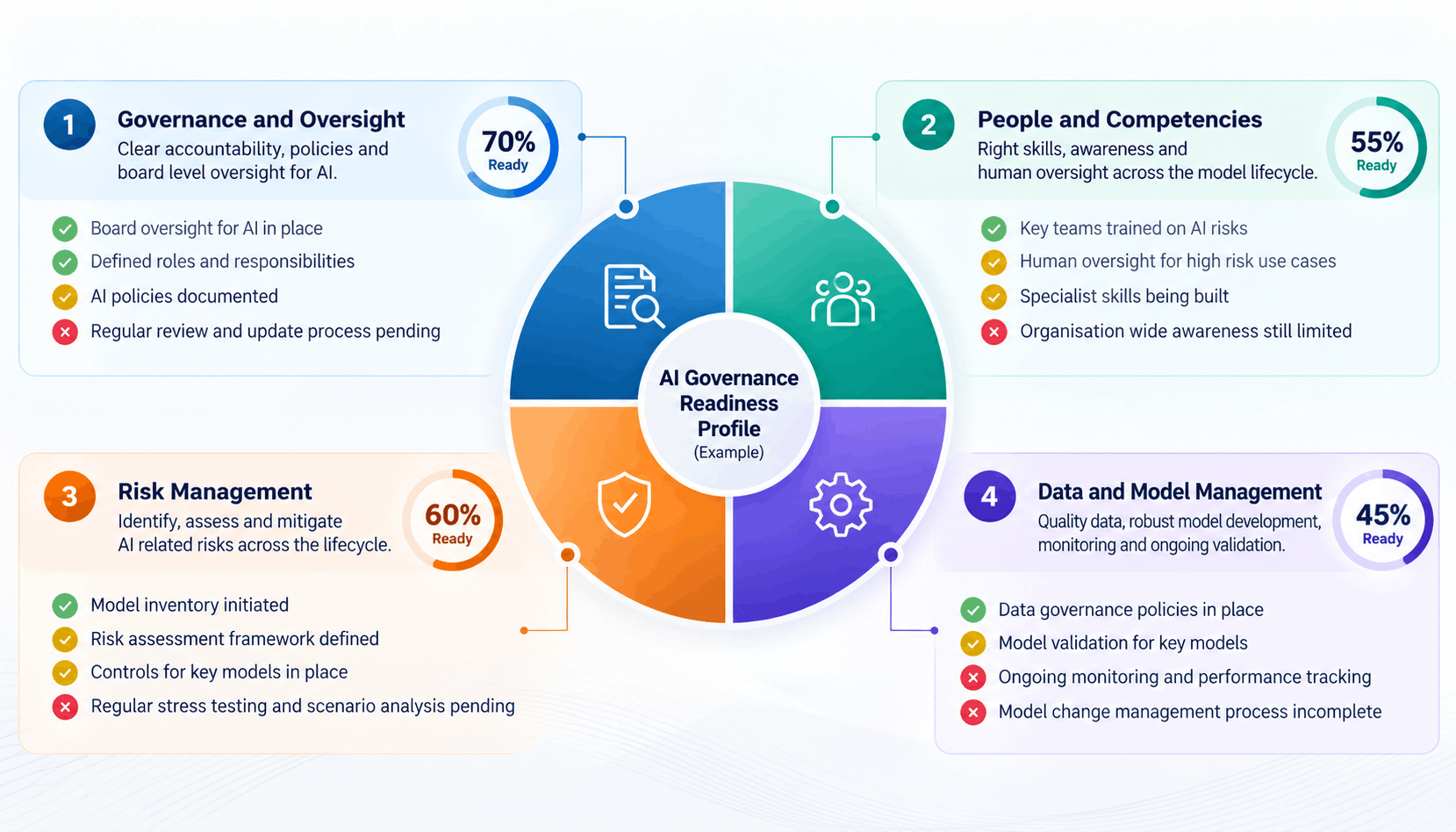
Board oversight. Do you have named senior management accountability for AI risk, not just a technical owner. Check whether your board oversight structure can currently answer which AI systems are deployed, who approved them, and who monitors them ongoing.
Risk management systems, policies and procedures. Do you maintain a complete model inventory, including third party and vendor supplied systems. This is also where materiality assessment happens, classifying each model by impact so oversight effort matches actual risk, and where third party AI risk gets the same inventory treatment as internally built models.
AI lifecycle controls. Can you produce fairness testing and explainability evidence for each model before deployment, not retrofitted afterward. Check whether monitoring thresholds and rollback procedures exist for models already in production.
Organisational capability. Do you have staff who understand both the models and the regulatory expectations, and can your institution generate audit evidence automatically rather than reconstructing it by hand. AI security and compliance services support institutions closing this gap directly.
MAS's own MindForge Toolkit, referenced above, gives institutions real case studies from DBS, Julius Baer, Prudential and others to benchmark this self check against, rather than starting from a blank page. Samta.ai's Veda platform and the Veda AI decision analytics product support area two and three directly, keeping model inventory and lifecycle data traceable across connected systems, acting as the engineering execution layer once gaps are identified rather than just scored.
Comparing five approaches to MAS AI readiness assessment
Approach | Coverage of the four AIRG areas | Evidence quality | Speed to complete | Best fit |
No formal self check | None | None | Immediate, but worthless | Not recommended for any regulated institution |
Informal internal review | Partial, self reported | Low, no named evidence | Fast, days | Very early orientation only |
MindForge Toolkit self benchmarking | Full, aligned to AIRG structure | Medium, based on published case studies | Medium, weeks | Institutions wanting a credible starting baseline |
External mas ai governance consulting engagement | Full, scored with named evidence | High, independently verified | Medium, several weeks | Institutions needing board ready documentation |
Integrated platform supported readiness programme | Full, with ongoing monitoring built in | High, generated automatically over time | Slower to build, fastest to sustain | Institutions with multiple models scaling AI use |
The last row avoids re running the self check manually every cycle. For a platform level view of how this scales, see Veda versus a general Data Intelligence Platform.
Benchmark Your Enterprise AI Readiness
Real world use cases
Regulated bank: credit model missing third party coverage
A bank's internal AI inventory covered every model built in house but excluded a vendor supplied credit scoring tool used across retail lending. Running the self check against area two exposed this gap immediately. Bringing the vendor model into the inventory, with the same materiality assessment and oversight applied to internally built models, closed the gap before an external review could flag it. This mirrors the kind of case study MAS itself published through the MindForge Toolkit.
General enterprise angle: insurer scoring well on policy, weak on lifecycle evidence
An insurer had strong written AI policy documentation, scoring well on area two, but could not produce fairness testing evidence for a claims triage model already in production, scoring poorly on area three. Running fairness testing retroactively and documenting the results closed the immediate gap, though the insurer also committed to building testing into every future deployment from the start, rather than repeating the retrofit each time.
Key risks and failure modes
Scoring yourself without named evidence. A self reported "yes" on board oversight means little without a named accountable executive and a documented inventory they actually review.
Excluding vendor and third party models from inventory. The AIRG's proposed scope covers third party AI risk the same as internally built systems.
Treating FEAT compliance as automatic AIRG compliance. FEAT and AIRG overlap but are not identical. Fairness testing under FEAT does not automatically satisfy AIRG's lifecycle control expectations.
Running the self check once and shelving it. Readiness changes as new models deploy, so a score from early 2026 may not reflect your institution's position now.
Assuming the 12 month transition period starts from today. It starts only once the guidelines are finalised, which has not happened yet, so institutions waiting for that date to begin preparation lose real runway.
No connection between the self check and an action plan. A scored gap without an assigned owner and a path to close it provides no real benefit.
When to run this self check, and how often
Run it now if:
You are a MAS regulated financial institution with any AI system in production or planned
You have not reviewed your AI inventory against vendor and third party systems specifically
You cannot currently produce fairness testing or explainability documentation on demand
A previous internal review already flagged governance gaps that remain unresolved
Repeat it:
At minimum annually, and immediately after any new AI system moves into production
As soon as MAS finalises the AIRG, to confirm alignment before the transition period begins
Whenever MAS updates the MindForge Operationalisation Handbook, since it is designed to be periodically revised
Assess Your AI Model Risk with Confidence
Conclusion
A readiness self check against the MAS AI risk management guidelines is not about predicting an exact finalisation date. It is about closing gaps that already exist, using evidence MAS itself has pointed to through the MindForge Toolkit. Score honestly across all four areas, assign an owner to each gap, and reassess regularly. The next step is finding out exactly where your institution stands.
About Samta
Samta.ai is a Singapore-headquartered AI Product Engineering & Data Intelligence partner helping enterprises build production-grade AI systems for regulated and data-intensive environments.We help organizations move beyond experimentation by engineering scalable, explainable, and enterprise-ready AI solutions from data foundations and model development to workflow automation and deployment.
Our capabilities combine deep AI expertise, data engineering, and product engineering to deliver measurable business impact across FinTech, BFSI, cybersecurity, regulatory technology, and enterprise operations.
Our enterprise AI products power real-world intelligence systems:
• TATVA : AI-driven data intelligence platform for governed analytics, monitoring, and operational insights
• VEDA : Explainable and audit-ready AI decisioning engine built for compliance-sensitive enterprise workflows
• CORA-Property Management Solutions: : Predictive intelligence platform for real-estate pricing, portfolio optimization, and investment analytics
Backed by ecosystem partnerships with Microsoft, Databricks, Snowflake, and AWS, Samta.ai delivers agile, cost-efficient AI engineering with faster turnaround and enterprise-grade scalability. Trusted by enterprises across FinTech, BFSI, and digital transformation initiatives, Samta.ai embeds AI governance, data privacy, and compliance-by-design principles directly into the AI lifecycle , enabling organizations to scale AI with transparency, accountability, and operational control.
Enterprises leveraging Samta.ai automate 65%+ of repetitive data, analytics, and decision workflows while maintaining governance, explainability, and measurable business outcomes. Samta.ai provides the strategic consulting, AI engineering, and data modernization expertise needed to align enterprise operations with next-generation AI transformation goals.
Frequently asked questions
Summarise MAS AI risk management expectations for banks
MAS expects banks to maintain board level oversight of AI risk, a complete model inventory including third party systems, documented lifecycle controls such as fairness testing and explainability, and organisational capability to sustain compliance as AI use scales. These expectations are set out in the proposed AIRG, published for consultation on 13 November 2025, and are supported in practice by the MindForge AI Risk Management Toolkit published in March 2026.
How ready is my bank for MAS AI guidelines?
Readiness depends on scoring honestly against four areas: board oversight, risk systems and policies, lifecycle controls, and organisational capability. A bank with strong written policy but no fairness testing evidence for production models is not actually ready, despite looking compliant on paper. Running a structured self check with named evidence, rather than a self reported impression, is the only reliable way to know.
How do MAS FEAT principles apply to AI models?
FEAT, covering fairness, ethics, accountability and transparency, applies to how AI and data analytics models are designed and used in financial services. The AIRG builds on FEAT by adding specific supervisory expectations around oversight, lifecycle controls and capability. Institutions already practising fairness testing under FEAT have a head start, but FEAT compliance alone does not automatically satisfy every AIRG expectation.
How should a Singapore bank prepare for MAS AI guidelines?
Start with a readiness self check against all four AIRG areas, using named evidence rather than self reported scores. Close the highest priority gaps first, typically third party model inventory and lifecycle control documentation, since these are commonly incomplete. Benchmark against MAS's own MindForge Toolkit case studies, and reassess once the guidelines are formally finalised.
Is the MAS AIRG finalised yet?
Not as of this writing. MAS published the AIRG as a consultation paper on 13 November 2025, with the consultation period closing 31 January 2026. As of the most recent public statement available, MAS has said the guidelines are expected to be finalised soon, without giving a specific date, so institutions should treat preparation as an active priority rather than wait for a confirmed deadline.
Unlock Verifiable Insights Across All Data Stores
VEDA connects siloed data sources and empowers business leaders with real-time, governed AI decision analytics.
Explore VEDA Platform >