
Summarize this post with AI
Most Singapore financial institutions are treating mas airg 2026 compliance as a future problem, something to plan once MAS actually issues the finalized guidelines. That assumption is the risk itself. MAS confirmed in a written parliamentary reply on 5 August 2026 that the Guidelines on Artificial Intelligence Risk Management apply to all AI use cases by financial institutions, including agentic AI, and will be finalized soon, with a proposed twelve month transition period starting from issuance. Institutions waiting for that issuance date before starting readiness work will spend the transition period catching up rather than executing a plan already in motion.
MAS AIRG 2026 Compliance:
Mas airg 2026 compliance requires financial institutions to have board and senior management oversight, an AI inventory with risk materiality assessments, lifecycle controls, and third party AI management in place within twelve months of the guidelines being issued, which industry sources following the consultation expect in the fourth quarter of 2026. MAS Chairman and Deputy Prime Minister Mr Gan Kim Yong confirmed in a parliamentary reply that the guidelines will apply to agentic AI specifically, and that MAS is taking a principles based, proportionate approach rather than a fixed technical checklist.
For institutions evaluating MAS AIRG readiness, the central question is not simply whether an AI policy exists. It is whether the organization can demonstrate that its AI systems are inventoried, risk-assessed, monitored, and governed through documented and operational processes.
What the MAS AI Risk Management Guidelines actually cover
The mas ai risk management guidelines set supervisory expectations across four domains, based on the consultation paper MAS published on 13 November 2025.
Board and senior management oversight. Institutions need clear accountability structures for AI risk, including a potential requirement for a dedicated cross functional committee where overall AI risk exposure is material.
AI risk management systems, policies, and procedures. This covers the internal frameworks institutions use to identify, assess, and manage AI risk on an ongoing basis, not a one time policy document.
AI lifecycle controls. Controls spanning development, deployment, monitoring, and retirement apply to both internally built models and third party AI solutions, a scope MAS has been explicit about since the consultation was first published.
Capabilities and resources. Institutions need the internal capability, not just documentation, to actually operate these controls day to day.
The scope is broad by design. It covers AI based on machine learning, deep learning, and reinforcement learning techniques, as well as Generative AI, AI agents, and newer AI technologies as they emerge, rather than naming specific technologies that would quickly go out of date. Our guide on whether MAS AIRG applies to AI you buy covers the third party scope question in more depth, since it is the part of this framework most institutions still underestimate.
Is Your Organization Ready for AI Adoption?
Why 2026 is the year this becomes real
Ai risk management guidelines singapore have moved from consultation to confirmed direction this year, for three specific reasons.
The parliamentary reply confirmed agentic AI is explicitly in scope. In the 5 August 2026 reply, MAS stated the guidelines apply to all AI use cases by financial institutions, including agentic AI, closing any ambiguity institutions may have assumed existed for autonomous systems.
AIRG finalisation is expected in Q4 2026. Multiple sources following the consultation process expect finalization before year end, which would start the twelve month transition clock immediately.
SAFR and AIRG now have a confirmed, distinct relationship. MAS has been explicit that SAFR does not itself constitute regulatory guidance, it is a technical reference architecture, while AIRG will provide the actual supervisory expectations institutions are assessed against. Our SAFR vs AIRG comparison breaks down exactly where each one applies.
Institutions still treating this as a future planning item should read our overview of AI governance for MAS supervised institutions, which covers how the examination cycle already assumes this direction of travel even before the guidelines formally issue.
The 12 month AIRG readiness framework
Institutions do not need to wait for the guidelines to finalize before starting this work, since the proposed structure is already detailed enough to build against.
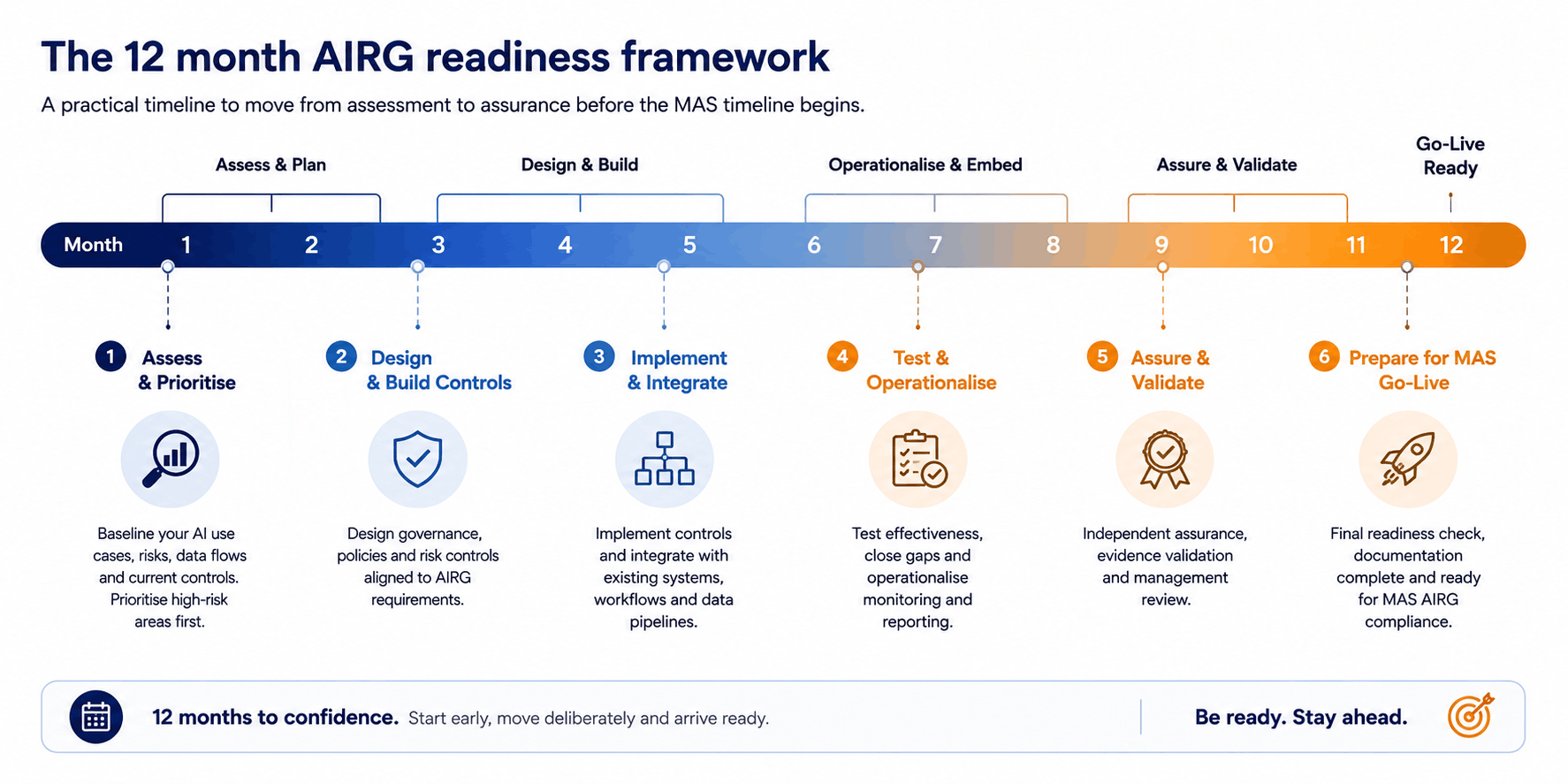
Establish board and senior management accountability now. Confirm whether your AI risk exposure is material enough to warrant a dedicated cross functional oversight committee, and name it if so.
Build a complete AI inventory. Include internally built models, third party AI tools, and embedded copilots, since AIRG's scope explicitly reaches procured AI, not only systems built in house.
Run risk materiality assessments across the inventory. Classify each system by impact, complexity, and reliance to determine how much scrutiny it needs under a proportionate approach.
Apply lifecycle controls from development through retirement. This includes third party AI, where due diligence and contractual protections need to be in place, not only internally built systems.
Document AI risk management policies and procedures as a living framework. A static policy written once will not satisfy an examiner looking for evidence the framework is actually operating.
Build the internal capability to operate all of the above. Documentation without the staffing and tooling to execute it does not meet the capabilities and resources domain MAS has set out.
This is where the engineering execution layer matters. Samta.ai builds the VEDA AI decision analytics platform to turn this six step framework into a working system, an automated AI inventory, risk materiality tagging, and board ready reporting, rather than a static compliance document that goes stale the moment a model is retrained. For institutions building out the broader governance structure this framework requires, our overview of the six components of a mature AI governance program covers the organizational side of this work, and our MAS FEAT compliance checklist covers the foundational principles AIRG builds directly on top of.
Institutions weighing whether a general analytics tool can double as an AIRG inventory system should see how VEDA compares to other data intelligence platforms, since most were not built to track risk materiality or lifecycle controls specifically. The VEDA platform treats board reporting, AI inventory, and lifecycle monitoring as one connected system rather than three separate tools that need manual reconciliation before every examination.
AIRG domains and readiness priorities at a glance
AIRG Domain | What It Requires | 12 Month Transition Priority | Governance Owner | Common Readiness Gap |
Board and Senior Management Oversight | Named accountability and, where material, a cross functional AI risk committee | High, needed before other domains can be evidenced | CRO or board risk committee | Oversight exists informally but is not documented |
AI Risk Management Systems, Policies, and Procedures | Living frameworks for identifying and managing AI risk, not a one time policy | High, underpins every other domain | Model risk governance function | Policy exists on paper but is not operationally followed |
AI Lifecycle Controls | Controls across development, deployment, monitoring, and retirement | Medium, phased by risk materiality | Model owners and risk function jointly | Controls applied to internal models but not third party AI |
Third Party AI Management | Due diligence, contractual protections, and ongoing vendor review | Medium to high, often the least mature area | Vendor risk management function | No inventory of embedded or procured AI exists |
Capabilities and Resources | Staffing, tooling, and operational capacity to run the framework | Ongoing, builds throughout the transition period | Technology and risk functions jointly | Framework documented but no team resourced to operate it |
Assess Your AI Model Risk Before It Becomes a Compliance Issue
Real world enterprise use cases
BFSI: an insurer building its AI inventory ahead of finalization
An insurer running a pre emptive readiness exercise discovered its AI inventory had never been consolidated across underwriting, claims, and customer service functions, each of which had adopted AI tools independently. Working through AI security and compliance services gave the insurer a single inventory and risk materiality baseline before the twelve month clock even started, rather than scrambling to build one after issuance.
General enterprise: a proptech firm anticipating BFSI client requirements
A proptech firm selling into BFSI clients anticipated that its enterprise buyers would soon expect evidence of AIRG aligned governance as part of vendor due diligence, even though the firm itself is not directly MAS supervised. Reviewing enterprise AI engineering in Singapore helped the firm build governance documentation ahead of that requirement appearing in a procurement questionnaire.
Key risks and failure modes
Waiting for the final text before starting. The consultation paper is detailed enough to build against now, and institutions that wait will compress a twelve month effort into whatever time remains after issuance.
Treating agentic AI as outside scope. The parliamentary reply explicitly confirmed agentic AI is included, which surprises institutions that assumed autonomous systems would get a separate, later framework.
Building an AI inventory that excludes third party tools. AIRG's lifecycle controls apply to procured AI as much as internally built systems, a scope gap many institutions have not yet closed.
Assuming SAFR compliance satisfies AIRG. SAFR is a technical reference architecture, not regulatory guidance, and does not itself substitute for the supervisory expectations AIRG will set.
No resourcing plan for ongoing operation. A framework built for the examination but not staffed for daily operation tends to decay within a few quarters of going live.
When to accelerate your AIRG readiness timeline
Accelerate immediately when:
Your institution runs agentic AI in production for payments, underwriting, or advisory tasks
You do not yet have a consolidated AI inventory spanning internal and third party systems
Board level AI risk oversight has not been formally established or documented
A standard readiness pace is enough when:
Your AI use is limited in scope and materiality, and baseline controls are already documented
You already have a model risk governance function that can extend naturally to cover AI
Your third party AI vendor contracts already include the due diligence clauses AIRG expects
Reviewing Samta.ai's case studies alongside your own AI inventory gives a useful benchmark for how other institutions have sequenced this readiness work ahead of finalization.
Need Expert Guidance for Your AI Strategy?

Conclusion
Mas airg 2026 compliance is not a future deadline, it is a twelve month clock that starts the moment the guidelines are issued, expected before the end of this year. Institutions that build their AI inventory, governance accountability, and lifecycle controls against the consultation text now will spend the transition period executing a plan already in motion, not building one from scratch.
Financial institutions can start by assessing their current governance arrangements, prioritizing gaps, and creating an evidence-based implementation plan. For banks evaluating support with strategy and execution, Samta.ai’s AI Consulting for Banks in Singapore is a relevant starting point.
About Samta
Samta.ai is a Singapore headquartered AI product engineering and data intelligence partner helping enterprises build production grade AI systems for regulated and data intensive environments. We help organizations move beyond experimentation by engineering scalable, explainable, and enterprise ready AI solutions, from data foundations and model development to workflow automation and deployment.
Our capabilities combine deep AI expertise, data engineering, and product engineering to deliver measurable business impact across FinTech, BFSI, cybersecurity, regulatory technology, and enterprise operations.
Our enterprise AI products power real world intelligence systems:
TATVA: AI driven data intelligence platform for governed analytics, monitoring, and operational insights
VEDA: Explainable and audit ready AI decisioning engine built for compliance sensitive enterprise workflows
CORA Property Management Solutions: Predictive intelligence platform for real estate pricing, portfolio optimization, and investment analytics
Backed by ecosystem partnerships with Microsoft, Databricks, and Snowflake, Samta.ai delivers agile, cost efficient AI engineering with faster turnaround and enterprise grade scalability. Samta.ai embeds AI governance, data privacy, and compliance by design principles directly into the AI lifecycle, enabling organizations to scale AI with transparency, accountability, and operational control. Institutions evaluating fit should ask for measurable outcomes from a comparable prior engagement rather than headline automation figures alone.
Frequently asked questions
When will the MAS AI Risk Management Guidelines be finalized?
MAS has not given a specific finalization date. In a parliamentary reply on 5 August 2026, MAS confirmed the guidelines will be finalized soon, and multiple sources following the consultation process expect finalization in the fourth quarter of 2026.
How long is the AIRG transition period?
MAS has proposed a twelve month transition period starting from the date the guidelines are formally issued, not from the consultation close date of 31 January 2026, giving institutions a defined but limited runway to implement the required controls.
Does AIRG apply to agentic AI?
Yes. MAS confirmed directly in its 5 August 2026 parliamentary reply that the guidelines apply to all AI use cases by financial institutions, including agentic AI, closing any ambiguity about whether autonomous systems would be covered separately.
Is SAFR the same as AIRG compliance?
No. MAS has been explicit that SAFR is a technical reference architecture for agentic AI runtime safeguards, not regulatory guidance or supervisory expectations. AIRG provides the actual supervisory framework institutions will be assessed against.
What should institutions do before the guidelines are finalized?
Institutions should build a complete AI inventory covering internal and third party systems, establish board level AI risk accountability, and begin lifecycle controls now, since the consultation paper already provides enough detail to act on ahead of the final text.