
Summarize this post with AI
Agentic AI transformation is no longer a roadmap item it is a present-day competitive separator. Seventy-two percent of enterprise AI projects stall not because the models are weak, but because no one built the orchestration layer. Agentic AI solves this by moving AI from answering questions to completing multi-step work autonomously pulling data, making decisions, and triggering downstream systems without a human in the loop. This guide covers what autonomous agents actually are, why they matter more in 2026 than they did in 2024, and a practical framework for deploying them without blowing up your governance posture.
Agentic AI Transformation:
Agentic AI transformation refers to re-architecting enterprise workflows around LLM-powered agents that plan, act, and iterate across systems with minimal human intervention. Unlike conventional automation, agentic systems use tool-calling, memory, and multi-agent orchestration to handle tasks that span multiple platforms and decision points. Enterprises deploying agentic architectures on platforms like Databricks and Snowflake report 30–60% reduction in manual hand-offs (Source Required: Gartner, 2025 Magic Quadrant for AI Orchestration).
What is agentic AI?
What is agentic AI? An AI agent is a software system that perceives its environment, reasons about goals, selects tools, and executes actions in a loop retrying or replanning until the objective is met or an escape condition fires.
Three properties distinguish agents from conventional AI models:
Goal persistence: the agent pursues a multi-step objective, not a single completion.
Tool use: the agent calls external APIs, queries databases, writes code, or triggers workflows.
Memory: short-term context and long-term retrieval (vector search) allow it to carry state between steps.
Multi-agent systems extend this further: a planner agent breaks down goals, executor agents act on sub-tasks, and a critic agent checks outputs. Samta.ai's multi-agent system design framework provides a structured approach to this orchestration layer.
Why 2026 is the tipping point for agentic AI business transformation
Three forces converged to make agentic AI business transformation operationally viable this year:
Model reliability crossed the enterprise threshold. Tool-use accuracy on complex, multi-hop tasks now exceeds 85% on leading models the floor for production use. (Source Required: Stanford HAI, AI Index 2025)
Regulatory clarity in APAC. MAS's Notice on AI Governance (2024) and Singapore's Model AI Governance Framework v2 gave BFSI institutions a compliance scaffold to build on reducing legal ambiguity that previously blocked deployment.
Infrastructure parity. Databricks Agent Framework, Snowflake Cortex Agents, and Microsoft Copilot Studio all hit general availability in late 2024–2025, removing the need for bespoke orchestration stacks.
Enterprises that waited for "AI maturity" are now watching peers automate entire process chains. Samta.ai's AI maturity model shows that organisations at Level 4 or above are deploying full agentic pipelines today.
Know Where Your AI Strategy Stands
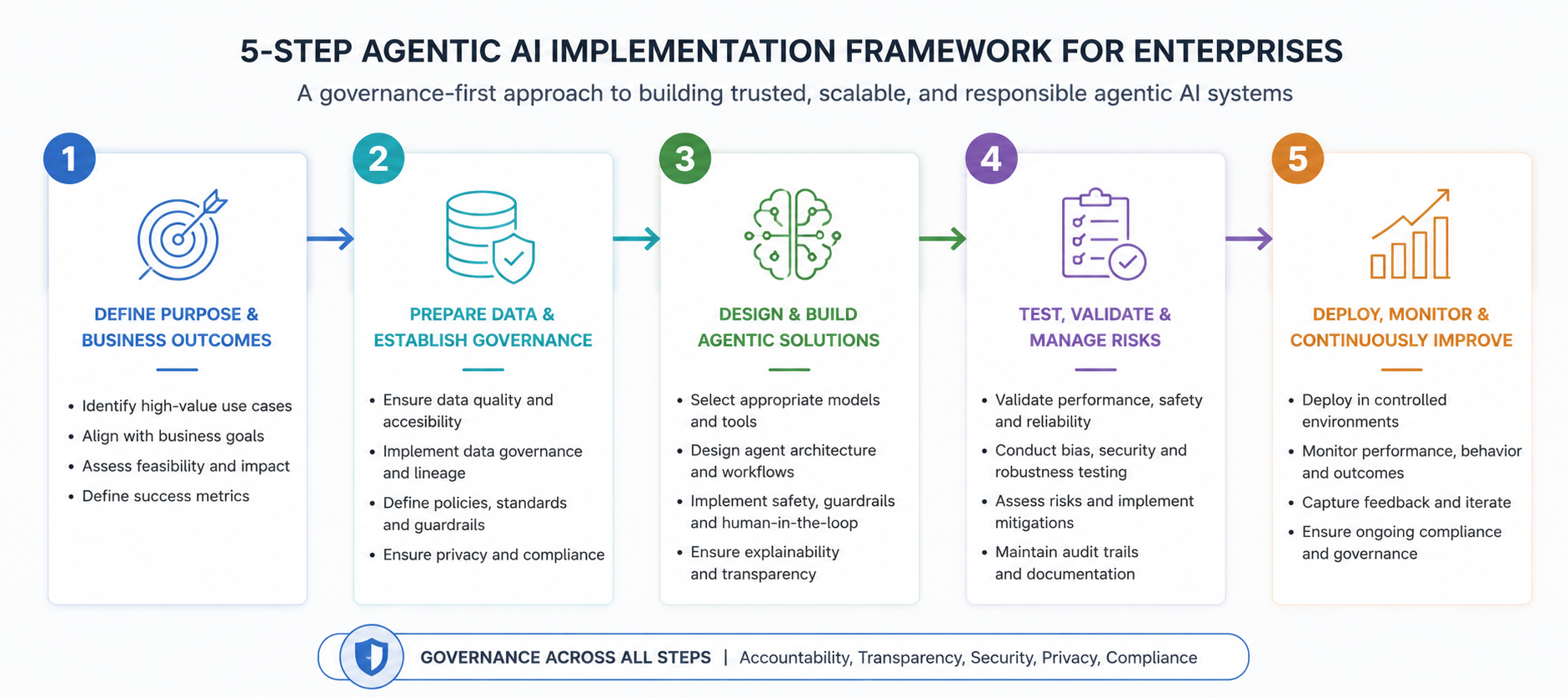
A 5-step framework for implementing agentic AI
How to implement agentic AI without compressing timelines dangerously:
Process audit: identify workflows with ≥5 hand-offs, high error rates, or data scattered across ≥3 systems. These are the highest-ROI entry points.
Agent boundary design: define what each agent can and cannot do. Hard rules (never approve a transaction above $X without human sign-off) must be coded as guardrails, not prompts.
Tool registry: build a governed catalogue of APIs, databases, and RPA connectors agents are permitted to call. Use Snowflake or Databricks Unity Catalog for lineage and access control.
Pilot on a contained workflow: pick one end-to-end process (e.g., vendor invoice reconciliation) and run agent + human-in-the-loop in parallel for 4–6 weeks.
Governance layer before scale: instrument agent logs, set escalation thresholds, and connect to your SIEM before expanding
Agentic AI vs. other automation approaches: 5-column comparison
Dimension | Traditional RPA | ML Workflow Automation | Generative AI (chat) | Agentic AI Systems |
Decision capability | Rule-based only | Prediction, no planning | Single-turn reasoning | Multi-step planning + replanning |
Handles unstructured data | No | Partially (structured outputs) | Yes (text/image) | Yes (text, image, code, APIs) |
Cross-system orchestration | Limited (fragile) | No | No | Yes (native tool-calling) |
Human-in-loop flexibility | Hardcoded | Manual integration | Always required | Configurable per risk threshold |
Governance complexity | Low | Medium | Medium | High (requires agent audit trails) |
Setup cost | Low–Medium | Medium–High | Low | Medium–High |
Best fit | Repetitive structured tasks | Predictive analytics pipelines | Q&A, content drafting | Complex, multi-system workflows |
For a deeper look at where agents sit versus traditional pipelines, see Samta.ai's analysis of automated AI workflows vs. agentic approaches.
Enterprise use cases: where enterprise AI agents for transformation create real ROI
BFSI: autonomous credit underwriting pipeline
A Singapore-based retail bank deployed a 4-agent pipeline (document extraction → credit bureau enrichment → risk scoring → decision memo drafting) on Databricks + Samta.ai's Veda AI Data Analytics Platform. Decision time dropped from 3 days to 4 hours; human review was retained only for edge cases above a defined risk score. Compliance with MAS Notice 655 (internal controls) was maintained via full agent audit trails.
Manufacturing: predictive maintenance + procurement trigger
Agentic AI in manufacturing typically starts with anomaly detection but the highest-value deployments chain it to action. One Southeast Asian OEM linked a sensor-monitoring agent to a procurement agent: when a part failure probability crossed 70%, the procurement agent automatically generated a purchase order, checked supplier lead times, and surfaced a recommendation to the plant manager requiring one click to approve.
Assess AI Model Risks Before They Impact Your Business
Key risks and failure modes in agentic AI transformation consulting engagements
Prompt injection via external data: an agent reading an email or PDF can be manipulated by adversarial content embedded in that document. Mitigation: sandboxed tool execution and input validation layers.
Cascading errors: a wrong decision at step 2 gets amplified across 5 downstream steps before a human sees it. Mitigation: checkpoint assertions at defined stages, not just at the end.
Over-permission creep: agents are granted write access "just in case" and it never gets revoked. Mitigation: least-privilege tool scopes, reviewed quarterly.
Observability debt: teams ship agents without logging agent reasoning traces, making audits impossible. For regulated industries, this is a compliance failure, not just a technical one.
Misaligned KPIs: measuring task completion rate without measuring decision quality creates a false sense of success. Always tie agent performance to downstream business outcomes.
When to use (and when not to use) AI agent for digital transformation
Deploy agentic AI when:
The workflow involves ≥3 systems and ≥5 hand-offs.
Decisions require data synthesis from multiple sources in real time.
Volume is high enough that human review of every case is economically unsustainable.
Errors are recoverable (low irreversibility).
Do not deploy agentic AI when:
The process is fully structured and deterministic standard RPA is cheaper.
Regulatory rules require a named human to be accountable for every decision.
Your data quality is below 85% accuracy agents amplify data problems, not fix them.
Your team has no observability or MLOps capability governance must come before autonomy.
Use the Samta.ai Digital Transformation Managed Services team to run this assessment if your architecture is ambiguous.
Conclusion
Agentic AI transformation is not a future-state vision it is a current engineering decision. The enterprises pulling ahead in 2026 are the ones that scoped tightly, governed rigorously, and shipped a working pilot before finalising the roadmap. The risks are real but manageable when observability and least-privilege design are treated as first-class requirements, not afterthoughts. Start with one workflow, measure ruthlessly, and use that proof point to fund the next.
Turn Your AI Vision into an Execution Plan
About Samta
Samta.ai is a Singapore-headquartered AI Product Engineering & Data Intelligence partner helping enterprises build production-grade AI systems for regulated and data-intensive environments.We help organizations move beyond experimentation by engineering scalable, explainable, and enterprise-ready AI solutions from data foundations and model development to workflow automation and deployment.
Our capabilities combine deep AI expertise, data engineering, and product engineering to deliver measurable business impact across FinTech, BFSI, cybersecurity, regulatory technology, and enterprise operations.
Our enterprise AI products power real-world intelligence systems:
• TATVA : AI-driven data intelligence platform for governed analytics, monitoring, and operational insights
• VEDA : Explainable and audit-ready AI decisioning engine built for compliance-sensitive enterprise workflows
• CORA-Property Management Solutions: : Predictive intelligence platform for real-estate pricing, portfolio optimization, and investment analytics
Backed by ecosystem partnerships with Microsoft, Databricks, Snowflake, and AWS, Samta.ai delivers agile, cost-efficient AI engineering with faster turnaround and enterprise-grade scalability. Trusted by enterprises across FinTech, BFSI, and digital transformation initiatives, Samta.ai embeds AI governance, data privacy, and compliance-by-design principles directly into the AI lifecycle , enabling organizations to scale AI with transparency, accountability, and operational control.
Enterprises leveraging Samta.ai automate 65%+ of repetitive data, analytics, and decision workflows while maintaining governance, explainability, and measurable business outcomes. Samta.ai provides the strategic consulting, AI engineering, and data modernization expertise needed to align enterprise operations with next-generation AI transformation goals.
Frequently asked questions
What is the difference between agentic AI and traditional automation?
Traditional automation (RPA) executes fixed rules on structured data. Agentic AI reasons about goals, adapts to unexpected inputs, and calls tools dynamically. The result is a system that handles exceptions the work that RPA breaks on. This makes agents suitable for high-variability, cross-system workflows that RPA consistently fails on.
How long does an agentic AI transformation project take?
A contained pilot on one workflow typically runs 6–12 weeks: 2 weeks for process audit and agent design, 4–6 weeks for build and parallel testing, 2 weeks for governance review and cutover. Enterprise-wide rollout is a separate programme, typically 12–18 months depending on integration complexity.
What infrastructure is required to deploy enterprise AI agents?
At minimum: a vector store for retrieval (Pinecone, Weaviate, or Snowflake Cortex Search), an orchestration layer (LangGraph, Autogen, or Databricks Agent Framework), a tool registry with access controls, and an observability stack (LangSmith or custom). Cloud-agnostic deployments are possible but add integration overhead.
How do we maintain regulatory compliance when AI agents make decisions?
Design agents with human-in-the-loop gates at every irreversible action above a defined risk threshold. Maintain full reasoning traces in an immutable log. In BFSI contexts, align to MAS's Model AI Governance Framework and document agent decision logic as you would any internal model. See the Age of Agentic overview for APAC compliance context.
Can small and mid-size enterprises benefit from agentic AI transformation?
Yes, but scope matters. SMEs typically start with a single high-volume workflow (customer onboarding, invoice processing) rather than enterprise-wide orchestration. The cost of orchestration infrastructure has fallen significantly since 2023; managed service options like Samta.ai reduce the engineering overhead further.