.jpeg&w=3840&q=75)
Summarize this post with AI
Most enterprise security conversations about AI focus on the wrong threat. The debate circles around adversarial attacks, data poisoning, and model hallucinations. These are real concerns. But the risk that will define the next decade of enterprise security is not coming from outside your perimeter. It is being built into your decision architecture, one autonomous workflow at a time.
TL;DR
Agentic AI systems are executing decisions at machine speed, often without auditable human oversight. The cognitive offloading they enable quietly erodes the institutional judgment enterprises depend on. Accountability gaps emerge when no single human owns the outcome of an AI chain. SOC teams are especially vulnerable because autonomy without trust frameworks creates new attack surfaces. And the investment imbalance between AI infrastructure and human intelligence governance is compounding every one of these risks.
AI Agents vs. Agentic AI: The Distinction That Changes Everything
Most enterprises conflate these two concepts and that confusion is expensive. An AI agent is a discrete tool that performs a bounded task, such as summarizing a ticket or flagging an anomaly. Agentic AI is a system architecture where multiple agents coordinate, plan, execute, and adapt across complex workflows with minimal human checkpoints.
The difference is not technical. It is operational. When an AI agent acts, a human can review and reverse. When an agentic AI system acts across a multi step workflow, the causal chain is often irreversible, unauditable, and distributed across systems no single team owns. In a SOC context, this means an agentic system can query threat intelligence, correlate historical data, enrich alerts, and initiate a response, all before a human analyst reads the first notification.
The Paradigm Shift Nobody Put on the Roadmap
Security leaders built their governance models around a simple assumption: humans make decisions, tools assist. Agentic AI inverts that relationship. Tools now make decisions, and humans are relegated to reviewing outcomes after the fact, if review happens at all.
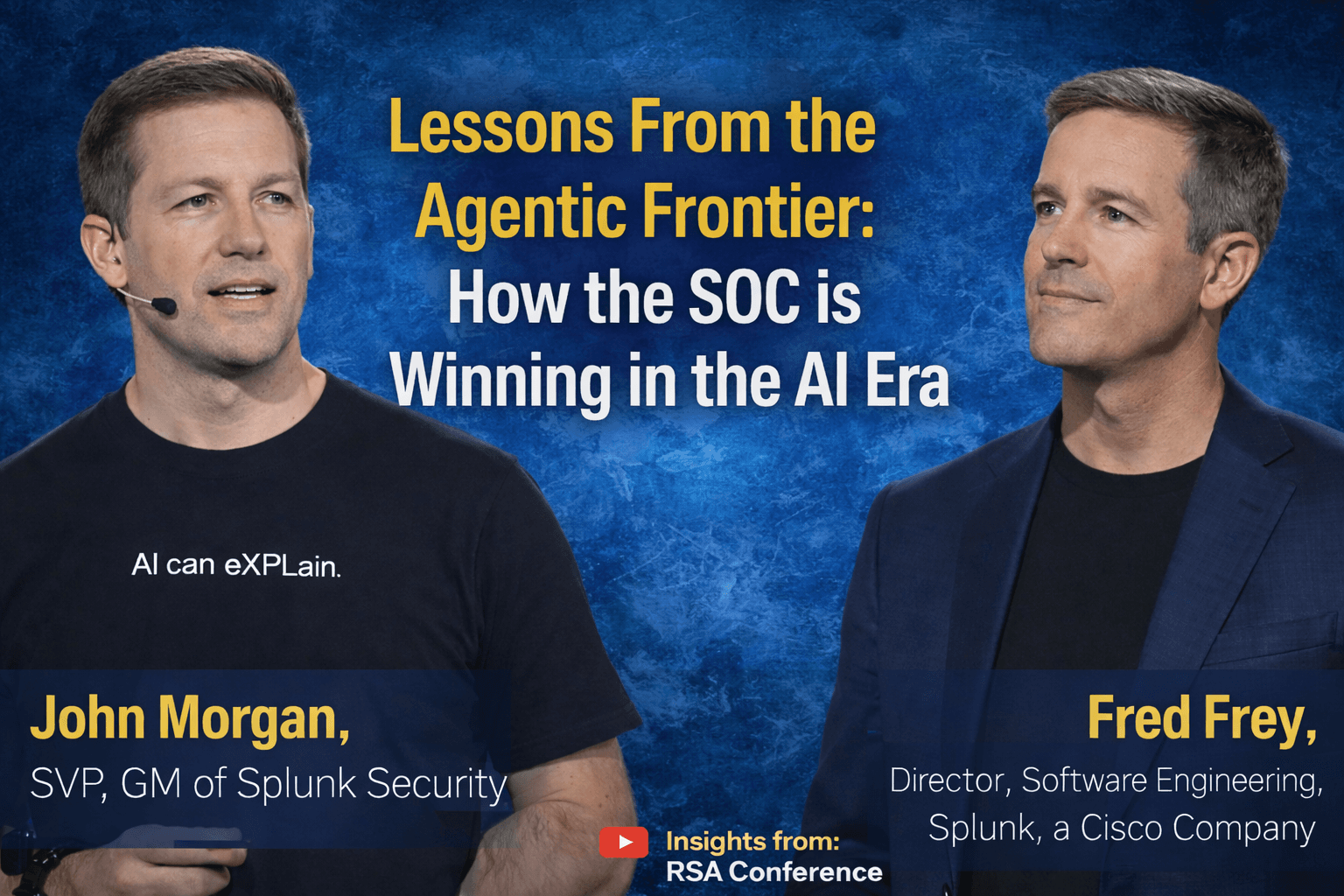
Watch: Lessons From the Agentic Frontier: How the SOC is Winning in the AI Era
As “John Morgan”, SVP and General Manager of Splunk Security, observed in Splunk's Lessons From the Agentic Frontier presentation, agents can function as "the biggest insider threats." His framing is deliberate. The risk is not malicious intent. It is structural. Morgan compared AI to air: essential for survival, but dangerous when it accumulates without the right containment architecture around it. The governance model does not come standard with the technology. It must be designed in.
The Core Risks of Agentic AI in Enterprise Security
Cognitive Offloading at Scale When agentic systems handle triage, enrichment, and initial response, analysts stop building the pattern recognition that comes from doing that work manually. Over time, the team's ability to function without the system degrades. This is not a training gap. It is institutional memory erosion happening in real time.
Unauditable Autonomy Agentic pipelines often produce outcomes that are technically traceable but practically impossible to reconstruct in a board level incident review. When regulators or insurance underwriters ask who approved a decision, "the system" is not a defensible answer. Fred Frey, Director of Software Engineering at Splunk, demonstrated this challenge directly in the Agentic Frontier session, walking through a 3AM impossible traveler scenario where an agentic SOC autonomously handled authentication timelines, threat intelligence enrichment, and historical correlation. The capability was impressive. The governance question it raised was equally serious: at what point in that chain does human accountability formally attach?
Accountability Gaps Across Agent Chains In a multi agent architecture, no single agent owns the outcome. The orchestrating model defers to specialists. Specialists operate within their defined scope. The aggregate decision emerges from the interaction, not from any individual actor. Traditional risk frameworks assign accountability to humans or systems. Agentic architectures produce outcomes that belong to neither cleanly. See Who Owns AI Risk for a deeper examination of this accountability architecture problem.
Human Judgment Targeting Sophisticated adversaries are already studying how agentic systems influence human decision making. If an analyst learns to trust an AI enrichment recommendation, that trust becomes an attack vector. Manipulating the upstream data that informs the agent's recommendation is more scalable than attacking the analyst directly. The human is no longer the first line of defense. The agent is, and the agent's judgment can be shaped.
AI Mediated Reality Fragmentation Different teams operating different agentic systems, each with different data sources and confidence thresholds, will construct different operational pictures of the same threat landscape. This fragmentation does not look like a failure. It looks like teams doing their jobs with the tools they have. The organizational blind spot it creates is precisely the kind of gap sophisticated threat actors exploit. Explore how AI governance frameworks address cross team coherence.
This Is Not a Tooling Problem
Reframe the problem entirely. The conversation about agentic AI security risks is dominated by tool evaluation: which agents to deploy, which orchestration layer to use, which guardrails to configure. That framing treats this as an infrastructure challenge. It is not. It is a cognitive infrastructure challenge.
Think of it in cockpit terms. Aviation did not become safer because aircraft became more automated. It became safer because automation was paired with rigorous human factors engineering, procedural governance, and clear authority gradient frameworks that defined exactly when the human takes control and why. The aircraft industry spent decades learning that lesson. The enterprise AI industry is compressing that learning curve into a three year adoption window.
The Verifiable Agency Framework
Enterprises need a governance architecture built around what we call Verifiable Agency, a model where every agentic action can be attributed, audited, and interrupted at a defined point in the decision chain.
The four pillars are as follows. First, Bounded Scope: every agent operates within a formally defined action envelope, aligned with the separation of duty principles Morgan detailed in Splunk's governance stack. Second, Auditability by Design: decision chains are logged not just for compliance review but for operational reconstruction, treating data as code in the way Frey described, with GDPR grade integrity standards applied to agent outputs. Third, Trust Progression: systems earn autonomy incrementally. As Frey noted, the path runs from human in the loop toward greater autonomy only as measurable trust is established through track record, not deployment schedule. Fourth, Human Authority Anchoring: specific decision classes remain permanently under human authority, regardless of agent confidence levels. These are defined in advance, reviewed quarterly, and cannot be delegated through configuration drift.
For implementation guidance aligned to enterprise risk functions, see AI Risk Management and AI Governance for GenAI.
Strategic Mistakes Enterprises Are Making Right Now
Deploying agents before defining the authority gradient means no one knows when the human takes back the wheel. Treating agent customization as optional is a critical misstep. Frey was explicit: out of the box agents are insufficient. Organizations must customize agents to understand their specific business practices, query structures, and data sets. Measuring success by automation rate rather than decision quality creates an incentive to reduce oversight rather than improve it. Siloing agent governance inside IT while the business units that deploy agents operate without those constraints creates a gap that is invisible until it is not. And investing in AI infrastructure without proportional investment in human intelligence governance produces a capability imbalance that grows more dangerous as the systems scale.
The Human Dimension
Analyst skill degradation is not hypothetical. It is already observable in organizations where agentic tools have been deployed without structured human practice requirements. The skills most at risk are exactly the ones most valuable in a novel threat scenario: lateral thinking, contextual judgment, and the ability to recognize when the system's framing of a problem is itself incorrect. Frey's demonstration of junior analysts acting as orchestrators is a promising model, but it requires deliberate design. Orchestration is a skill. It needs to be trained, evaluated, and developed with the same rigor applied to technical competencies.
The Societal Layer
Beyond the enterprise, agentic AI systems operating at scale across industries are producing a new kind of risk: AI mediated reality. When multiple institutions rely on agentic pipelines that share upstream data sources, correlated failures become systemic failures. The information environment that enterprise security teams operate in is increasingly shaped by AI systems whose confidence scores are taken as ground truth. The organizations that will be most resilient are those that maintain independent human intelligence capabilities alongside their agentic infrastructure, not as a backup, but as a parallel system of record. See Third Party AI Risk for the supply chain dimension of this challenge.
The Investment Imbalance
Enterprise AI budgets are overwhelmingly weighted toward capability: compute, tooling, integration, and deployment. Governance, human factors engineering, and analyst development receive a fraction of that investment. This is not a criticism of any particular organization. It reflects a market dynamic where capability is visible and differentiating while governance is invisible until it fails. The organizations that will lead in the agentic era are those that treat human intelligence investment as a strategic asset, not an overhead line item.
How US Enterprises Approach Agentic AI Security Frameworks
US enterprises are standardizing on the Artificial Intelligence Risk Management Framework (AI RMF) to build scalable Agentic AI security frameworks. This approach integrates AI risk management frameworks directly into the AI lifecycle covering model validation, monitoring, and governance. CTOs and Heads of AI are aligning security, compliance, and engineering teams around a unified AI compliance framework to ensure audit readiness. Strong emphasis is placed on AI data governance, particularly for regulated sectors like finance and healthcare.
See Where Your AI Governance Breaks
Download Your Free AI Assessment Report
How Singapore Companies Implement AI Compliance Frameworks
Singapore enterprises adopt a governance-first approach by aligning Agentic AI security frameworks with MAS and PDPC regulations. A strong AI compliance framework is critical, especially in financial services where auditability and accountability are mandatory. Organizations emphasize AI data governance and transparency while integrating the Artificial Intelligence Risk Management Framework (AI RMF) into decision-making processes. This ensures that AI systems remain compliant, explainable, and scalable across enterprise operations.
Conclusion
The hidden risk of agentic AI is not the agent. It is the assumption that deploying capable technology is equivalent to building a resilient system. Agentic AI done well, with verifiable authority structures, earned trust progression, and proportional human intelligence investment, represents a genuine leap forward for enterprise security. Agentic AI done carelessly produces a new class of systemic vulnerability that no endpoint tool will detect, because it is embedded in how your organization thinks, decides, and acts. The window to design governance in rather than retrofit it is closing.
Ready to Govern Your Agentic AI Before It Governs You?
If your enterprise is deploying agentic systems and your governance architecture has not kept pace, the gap between capability and accountability is already a risk. Samta.ai's security and governance experts work with CISOs and AI leaders to build Verifiable Agency frameworks tailored to your operational context, not generic compliance checklists. Talk to our team today and let us show you what accountable agentic AI actually looks like in practice.
FAQ
What is the hidden risk of agentic AI in enterprise security?
The hidden risk of agentic AI is the gradual erosion of human judgment and institutional accountability as autonomous systems take over more of the decision chain in security operations. Unlike known risks such as data breaches, this risk is structural and accumulates silently.
What is the difference between agentic AI and AI agents?
An AI agent performs a bounded, single task with human review available. Agentic AI refers to architectures where multiple agents coordinate autonomously across complex workflows, often producing outcomes that no single human reviewed or approved. The governance requirements are fundamentally different.
How can AI be a risk in SOC operations?
In a SOC, agentic AI can create unauditable decision chains, erode analyst skill through cognitive offloading, and introduce new attack surfaces where adversaries manipulate upstream data to influence agent recommendations rather than targeting analysts directly.
What is AI governance and why does it matter for agentic systems?
AI governance is the set of policies, frameworks, and controls that define how AI systems are authorized to act, how their decisions are audited, and how human accountability is maintained. For agentic systems, governance must be designed into the architecture before deployment, not added after an incident.
What is human in the loop AI and is it sufficient for agentic systems?
Human in the loop AI means a human reviews or approves AI outputs before action is taken. For early stage agentic deployments this is the right starting point, but it is not a permanent governance model. As Fred Frey noted at Splunk, the goal is to progress toward greater autonomy as trust is earned through demonstrated performance, not to keep humans in every loop indefinitely.
What are the top agentic AI security risks enterprises should prioritize?
The top risks are cognitive offloading and analyst skill degradation, unauditable autonomy in multi agent pipelines, accountability gaps across agent chains, human judgment targeting by adversaries, and AI mediated reality fragmentation across teams operating different agentic systems with different data sources.