
Summarize this post with AI
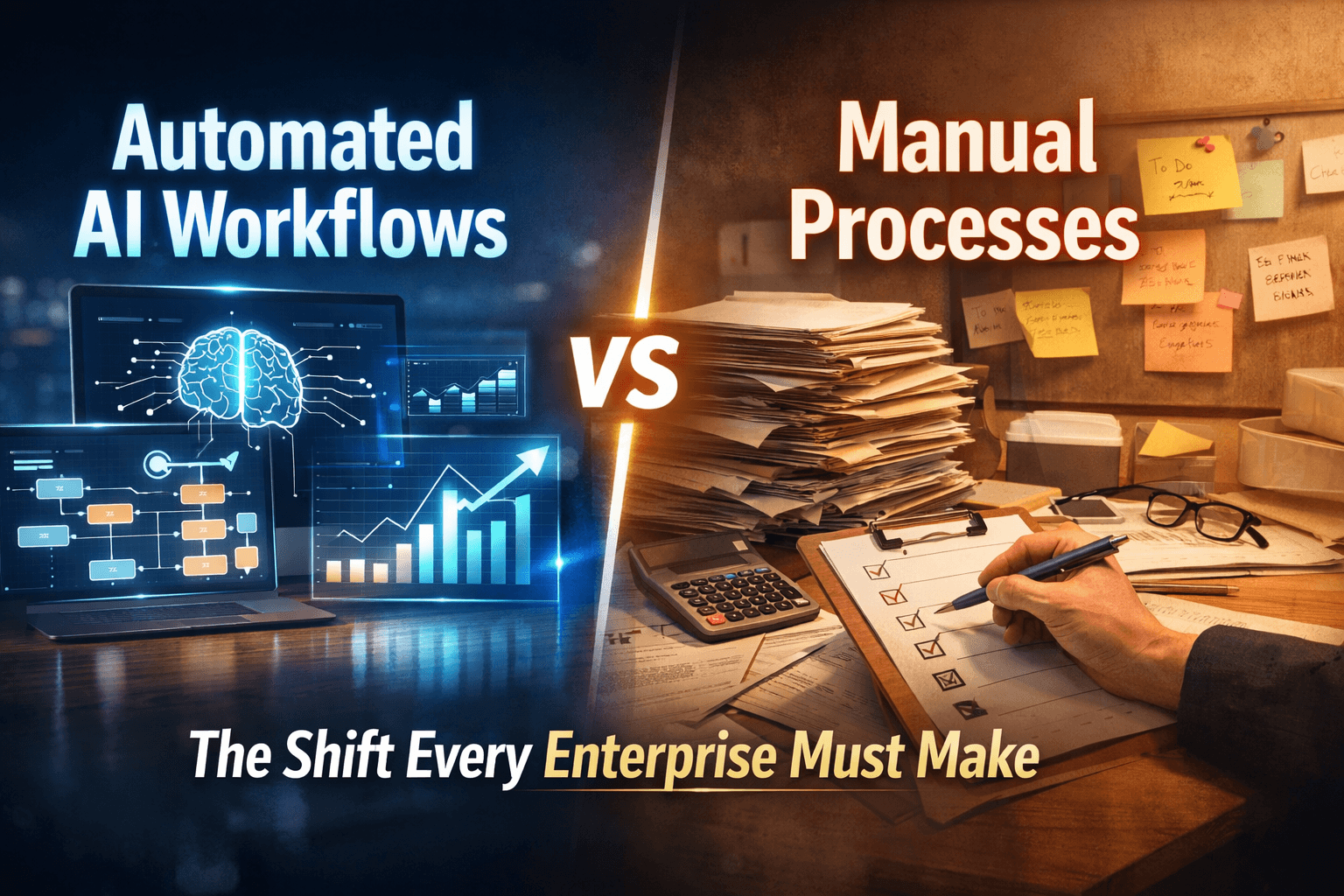
In 2026, the debate around automated ai workflows vs manual processes is no longer theoretical; it's a decisive factor in enterprise survival. Businesses are rapidly shifting from labor-intensive systems to intelligent automation to stay competitive. Simply put, what are ai workflows? They are systems that use machine learning and data-driven logic to automate tasks, adapt to inputs, and continuously optimize outcomes without human intervention. For decision-makers evaluating ai vs manual workflows enterprise, the difference comes down to scalability, speed, and precision. Manual processes are limited by human bandwidth, while AI-powered systems operate continuously, process massive datasets, and reduce operational errors significantly. This shift is not optional it’s foundational to modern enterprise growth.
Key Takeaways
Throughput Multiplier: AI systems process high-volume data without fatigue
Cost Predictability: Shift from variable labor costs to stable infrastructure investment
Error Reduction: Algorithmic precision minimizes human-induced variability
Strategic Reallocation: Teams focus on decision-making instead of repetitive execution
What This Means in 2026
The enterprise technology landscape has evolved from static automation scripts to intelligent, adaptive systems. Understanding what are ai workflows is critical they are no longer rule-based tools but dynamic systems capable of learning and improving over time. To manage this transformation, organizations must implement robust governance frameworks like AI Governance for Enterprise Without governance, automation introduces risks alongside efficiency.
At the same time, enterprises must understand how systems evolve operationally through frameworks like AI Lifecycle vs MLOps. This ensures long-term scalability and system reliability. The transition from robotic process automation (RPA) vs manual execution to intelligent automation represents a major leap from rule-following bots to predictive, decision-making systems.
Understand Your AI Readiness. Plan Your Next Move.
Core Comparison: Intelligent Systems vs Legacy Execution
Feature | Automated AI Systems | Manual Human Processes | Business Impact | Samta.ai Advantage |
Execution | Real-time, autonomous processing | Sequential, human-driven | Faster turnaround and reduced dependency on human intervention | End-to-end AI orchestration with intelligent decision layers |
Speed | 24/7 high-speed execution | Limited by human working hours | Continuous operations without downtime | Always-on infrastructure with scalable compute |
Accuracy | Near-perfect (data-dependent) | Error-prone due to fatigue | Improved compliance and reduced costly mistakes | High-precision models with continuous learning |
Scalability | Exponential via cloud systems | Linear via hiring | Rapid business growth without proportional cost increase | Cloud-native scaling with minimal latency |
Cost Efficiency | Fixed infrastructure investment | Variable labor costs | Predictable operational expenses | Optimized ROI through automation frameworks |
Practical Use Cases
1. Financial Data Processing
In high-volume industries like BFSI, organizations create workflow using ai to automate complex financial operations such as underwriting, fraud detection, and claims processing. Instead of manual verification across multiple systems, AI models ingest structured and unstructured data (documents, transaction logs, customer history) and make near-instant decisions.
This drastically reduces turnaround time from days to minutes while improving accuracy and compliance. Compared to robotic process automation (RPA) vs manual approaches, AI-driven workflows go beyond rule-based execution by identifying hidden fraud patterns and predictive risk signals.
2. Customer Support Automation
Modern enterprises are deploying ai workflow automation tools to transform customer support from reactive to intelligent and proactive systems. AI-powered NLP models automatically classify incoming queries, detect sentiment, and route them to the most relevant department or resolution flow. In many cases, AI resolves queries without human intervention through conversational agents.
For enterprises evaluating ai vs manual workflows enterprise, this shift eliminates long response times, reduces support costs, and ensures consistent customer experience across channels email, chat, and voice.
3. Workflow Bottleneck Elimination
Operational inefficiencies often arise from disconnected systems, redundant approvals, and manual data transfers. By leveraging Workflow Automation Consulting enterprises can map their entire process architecture, identify bottlenecks, and deploy AI-driven workflows to eliminate friction points.
Unlike manual optimization efforts, AI continuously monitors workflows and dynamically adjusts execution paths based on real-time data. This ensures that processes remain efficient even as business conditions evolve.
4. Compliance Monitoring
Regulatory compliance is one of the most resource-intensive areas for enterprises. AI transforms this by enabling continuous, real-time monitoring instead of periodic manual audits. AI systems scan thousands of transactions per second, flag anomalies, and trigger alerts instantly. This significantly reduces compliance risks and prevents costly regulatory violations.
When comparing automated ai workflows vs manual processes, compliance automation stands out as a clear win manual reviews are slow, inconsistent, and prone to oversight, whereas AI ensures standardized and audit-ready operations.
5. Contextual Risk Management
Advanced enterprises are moving beyond static risk models to dynamic, context-aware systems. Frameworks like AI Contextual Governance in Business enable organizations to align risk detection with real-time operational context. AI systems analyze behavioral patterns, environmental variables, and historical data to proactively mitigate risks before they escalate.
This is especially critical in large-scale environments where what are ai workflows becomes more than automation it becomes an intelligent decision-making layer embedded into business operations.
Limitations & Risks
Despite its advantages, automation is not plug-and-play.
High upfront investment in infrastructure and training
Dependence on high-quality data
Workforce reskilling challenges
Risks like model drift and hallucinations
According to a report by mckinseyover 40% of organizations struggle with scaling AI due to governance and data challenges. This highlights the importance of structured implementation.
Find Your AI Model Risk Exposure Score
Decision Framework: When to Automate
Use ai workflow automation tools when:
Data volume exceeds human processing capacity
Tasks require speed and consistency
Operations are rule-based and repetitive
Avoid automation when:
Emotional intelligence is required
Strategic ambiguity is high
Edge cases dominate workflows
Before implementation, organizations must also adopt AI Governance for Generative Models
to ensure safe and compliant AI deployment.
Conclusion
Transitioning from legacy operations to intelligent systems is a mandatory evolution for enterprise survivability and scalability. Evaluating the efficiency metrics clearly favors modernization, provided the transition is architected securely and ethically. Samta.ai provides deep, specialized expertise in AI and ML engineering to structure, deploy, and govern these critical transitions seamlessly. For comprehensive, enterprise-grade automation solutions and strategic implementation support, visit Samta.ai.
Request a Free Product Demo with samta.ai today.
Explore our custom AI platforms at VEDA to accelerate your enterprise transformation.
About Samta
Samta.ai is a Singapore-headquartered AI Product Engineering & Data Intelligence partner helping enterprises build production-grade AI systems for regulated and data-intensive environments.We help organizations move beyond experimentation by engineering scalable, explainable, and enterprise-ready AI solutions from data foundations and model development to workflow automation and deployment.
Our capabilities combine deep AI expertise, data engineering, and product engineering to deliver measurable business impact across FinTech, BFSI, cybersecurity, regulatory technology, and enterprise operations.
Our enterprise AI products power real-world intelligence systems:
• TATVA : AI-driven data intelligence platform for governed analytics, monitoring, and operational insights
• VEDA : Explainable and audit-ready AI decisioning engine built for compliance-sensitive enterprise workflows
• CORA-Property Management Solutions: : Predictive intelligence platform for real-estate pricing, portfolio optimization, and investment analytics
Backed by ecosystem partnerships with Microsoft, Databricks, Snowflake, and AWS, Samta.ai delivers agile, cost-efficient AI engineering with faster turnaround and enterprise-grade scalability. Trusted by enterprises across FinTech, BFSI, and digital transformation initiatives, Samta.ai embeds AI governance, data privacy, and compliance-by-design principles directly into the AI lifecycle , enabling organizations to scale AI with transparency, accountability, and operational control.
Enterprises leveraging Samta.ai automate 65%+ of repetitive data, analytics, and decision workflows while maintaining governance, explainability, and measurable business outcomes. Samta.ai provides the strategic consulting, AI engineering, and data modernization expertise needed to align enterprise operations with next-generation AI transformation goals.
Get Expert Guidance for Your AI Strategy

Frequently Asked Questions
How do automated ai workflows vs manual processes impact ROI?
They reduce labor costs and errors, delivering ROI within 12–18 months through efficiency gains.
What is the timeline for enterprise AI implementation?
Pilot: 4–8 weeks
Full deployment: 3–6 monthsHow do companies reduce risks?
By phased rollouts, continuous monitoring, and addressing The 5 Biggest AI Risks
Do AI systems replace humans?
No. They augment human capabilities by eliminating repetitive work.