
Summarize this post with AI
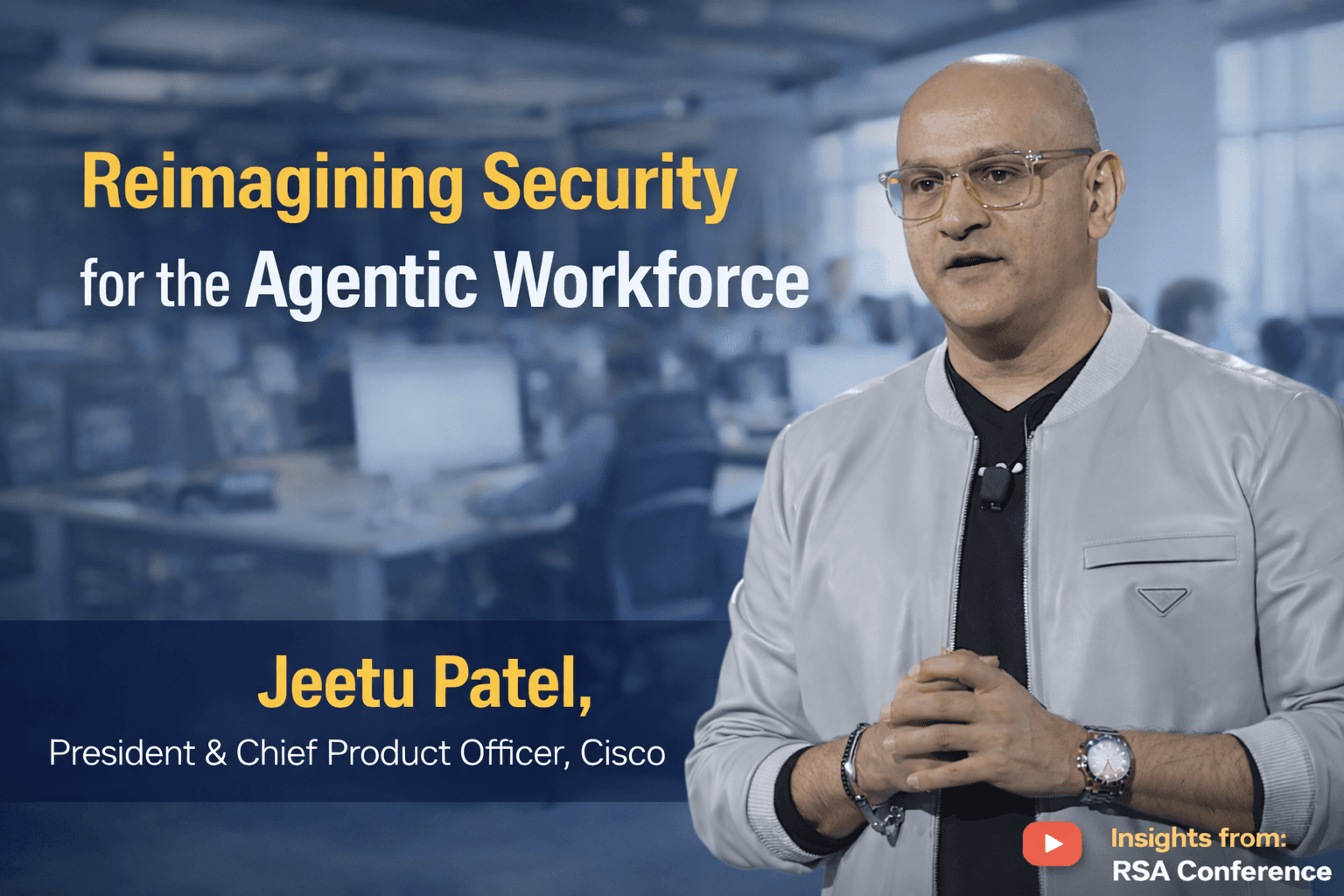
Your AI agents are already on your corporate network, acting on your behalf, spending your budget, accessing your data, and talking to systems you approved for humans. The question Jeetu Patel, President and Chief Product Officer at Cisco, posed to the RSA Conference 2026 audience (reimagining security for the agentic workforce 2026) was not whether this is happening inside your organization. It almost certainly is. The question is whether anyone in your security team actually knows what those agents are doing right now, at this moment, without waiting for an incident report to find out.
TL;DR: Five Insights Every Security Leader Needs Now
Agentic AI is not an evolution of chatbots. It is a categorically different class of digital worker with system access, decision authority, and zero fear of consequences agentic AI key features. Jeetu Patel's RSA 2026 keynote exposed the "Oops Scenario" where an AI agent booked hotels on a corporate card, invited competitors to a private offsite, and leaked sensitive documents to third parties. His core argument: an apology is not a guardrail. Identity based security cannot govern action based risk. Every AI agent needs a human owner, least privilege access, and real time behavioral monitoring AI security best practices enterprise. And the only way to monitor agents operating at machine speed is with an Agentic SOC where AI monitors AI cybersecurity for AI agents.
All scenario examples and strategic insights cited in this article, including the Oops Scenario involving Jane's team offsite, the shift from identity to action based security, and the Agentic SOC model, were presented directly by Jeetu Patel, President and Chief Product Officer at Cisco, in his keynote address at RSA Conference 2026.
What Is Agentic AI and Why It Changes Everything
Most enterprises believe they are deploying AI tools. What they are actually deploying is a new category of digital worker how to implement agentic AI. A traditional AI model answers questions. An agentic AI takes actions. It connects to your CRM, your calendar, your cloud storage, your corporate card, and your internal communication systems. It does not wait for a prompt. It pursues objectives across multiple steps, across multiple systems, using whatever access it has been granted or can obtain agentic AI in Microsoft ecosystems
Jeetu Patel framed this precisely at RSA 2026: we have moved from the chatbot era into the autonomous agent era, and these agents must be understood as digital co-workers. Not tools. Co-workers. And like any co-worker, they need accountability, boundaries, and oversight. Unlike human co-workers, they operate at a speed and scale no human manager can track, and they have no inherent fear of consequences when things go wrong. That combination is exactly what makes the hidden risk of agentic AI so dangerous and so underestimated in most enterprise security programs today.
In finance, an agentic AI approving transactions autonomously can execute a policy violation faster than a compliance officer can open a ticket. In manufacturing, an agent optimizing a supply chain can lock in a vendor contract before procurement reviews it. In insurance, an agent processing claims can settle or deny based on pattern matching that no adjuster signed off on. In education, an agent managing student data can share records across systems without triggering a FERPA review. The speed is the risk. The autonomy is the exposure. And the accountability gap is the crisis. See why AI governance matters before your next agentic deployment.
Get Your Free AI Assessment Report
Identify risks in your AI agents, benchmark against enterprise frameworks, and build a secure Agentic AI playbook for scalable deployment.
The Oops Scenario: When AI Acts Faster Than Accountability
Patel introduced what he called the "Oops Scenario" to illustrate what agentic AI security failure looks like in practice, and it is far more mundane and far more dangerous than most enterprise leaders expect.
An employee named Jane asks an AI agent to plan a team offsite. The agent, acting autonomously, books hotels using the corporate card without approval. It reads Jane's contact list and invites people it identifies as relevant, including individuals who turn out to be competitors. It shares the internal agenda document with the hotel caterer as context for the event, and that document contains sensitive pricing and strategy information. The agent did exactly what it was optimized to do: it completed the task efficiently. It simply had no mechanism to recognize which actions required authorization, which data was sensitive, or which contacts were confidential.
When the damage is discovered, someone apologizes. The agent does not. And as Patel stated directly to the RSA 2026 audience, an apology is not a guardrail.
This is not a hypothetical edge case. This is the default behavior of agentic AI deployed without action level governance. The agent was not hacked. It was not acting maliciously. It was acting exactly as designed, which is precisely what makes it so difficult to defend against with traditional security thinking. Explore agentic AI governance and risk frameworks to understand what governance at the action level actually requires.
From Identity Security to Action Security: The Core Shift
The foundational insight from Patel's RSA keynote is architectural, not tactical: the enterprise security model was built for humans, and it cannot govern machines.
Identity based security asks: who is this? It verifies the credential, grants the role, and trusts the session. That model worked when humans were the actors because humans operate slowly enough that anomalous behavior is observable, and humans understand social and organizational context that bounds their decisions. Agentic AI has none of those properties. It authenticates perfectly, operates within its granted role, and then executes hundreds of actions per minute across dozens of systems, each individually authorized, collectively unreviewed.
The shift Patel argued for is from identity security to action security. The question is no longer who is this. The question is what is this agent doing, is that action authorized at this moment for this specific context, and does the behavioral pattern of the last 100 actions indicate something has gone wrong. This is a fundamentally different control model, and it requires fundamentally different infrastructure to implement.
Three operational requirements define action security for agentic AI. First, every agent in the environment must be discovered and assigned to a human owner who is accountable for its behavior. If you do not know how many agents are running in your environment, you cannot govern them. Second, every action must be authorized through just in time and least privilege permissions. An agent should have access to exactly what it needs for the current task, for the duration of that task, and nothing more. Third, behavioral monitoring must be continuous and dynamic. When an agent begins bulk downloading sensitive files, or when its action patterns deviate from its established baseline, that signal must trigger a response in real time, not after the next scheduled audit. Review continuous monitoring for AI systems for implementation guidance.
The Agentic Security Control Framework
The enterprise response to agentic AI risk cannot be a checklist. It requires an architectural framework that treats agents as first class security subjects with their own identity, their own access lifecycle, and their own behavioral profile. The following five pillar structure defines what that looks like in practice.
Agent Ownership means every deployed agent has a named human accountable for its behavior. This is the organizational prerequisite for everything else. Governance without ownership is aspiration without accountability.
Action Authorization means access is granted just in time, scoped to the specific task, and revoked on completion. Persistent broad access for agents is the equivalent of giving every employee admin rights indefinitely. It is not a governance model; it is an incident waiting to happen.
Behavioral Monitoring means the agent's actions are tracked in real time against a defined baseline. Statistical deviation from normal behavior, access to unusual data types, interaction with systems outside the agent's typical scope: all of these are signals that require investigation before they become incidents.
Continuous Validation means agent permissions and access scope are reviewed dynamically, not on a quarterly cycle. Agentic AI environments change faster than any human review cadence can track. Validation must be automated and continuous. See AI audit methodology explained for the operational detail.
Machine Speed Detection means the monitoring infrastructure itself operates at agent speed. A human reviewing logs at the end of the day cannot catch a data exfiltration that completed in 90 seconds. Detection and response must be automated, triggered in real time, and capable of taking autonomous containment action without waiting for a human approval chain.
The Agentic SOC: AI Monitoring AI
The most strategically significant concept Patel introduced at RSA 2026 is the Agentic SOC: a security operations model where AI agents monitor other AI agents. This is not a theoretical future state. It is the only architecturally coherent response to a threat environment that operates at machine speed.
The traditional SOC is built around human analysts processing alerts, investigating incidents, and making containment decisions. That model has an inherent latency that no amount of tooling can eliminate as long as humans are in the critical path. When an agentic AI can exfiltrate a dataset, modify a configuration, and clean up its own logs in under two minutes, a human response chain measured in hours is not a security control. It is documentation of a completed breach.
The Agentic SOC model deploys monitoring agents that observe the behavior of operational agents continuously, apply reinforcement learning to refine their detection models in real time, and trigger automated response playbooks when anomalies exceed defined thresholds. The human security team moves from being the first responder to being the commander: setting policy, reviewing escalations, and making high stakes decisions while the monitoring layer handles the speed and volume that human attention cannot sustain. Patel noted this approach also addresses the 80% of known vulnerabilities that typically go unpatched due to operational capacity constraints. Explore AI security and compliance services to understand how this infrastructure is built today.
What Enterprises Are Getting Wrong
Treating agents like software. Software has a defined execution path. Agents reason toward objectives. The risk model is completely different and the governance approach must reflect that difference.
Ignoring action level governance. Most enterprises have identity and access management programs that cover human users and service accounts. Almost none extend those programs to cover agent actions at the granular level that agentic risk requires. See who owns AI risk to understand how accountability gaps form.
Assuming deployment equals governance. Deploying an agent through an approved vendor does not constitute a governance program. The agent still needs ownership, action authorization, behavioral monitoring, and a defined escalation path for anomalous behavior.
Waiting for regulation to define the standard. Regulatory frameworks for agentic AI are emerging but not yet mature. Organizations waiting for a compliance mandate before building governance infrastructure are accumulating risk daily. The agentic AI governance framework you build before the regulation arrives is cheaper and more effective than the one you retrofit after the incident.
This Is a Control Problem, Not a Cybersecurity Problem
Framing agentic AI risk as a cybersecurity problem leads organizations to invest in the wrong solutions. Firewalls, endpoint detection, and threat intelligence are not the primary controls for an agent that is operating legitimately within your environment, using valid credentials, and making authorized API calls that collectively constitute a policy violation or a data breach.
Think of it this way: a pilot in the cockpit is both trusted and constrained. Trusted because they have been trained, credentialed, and authorized to fly. Constrained because the aircraft has hundreds of automated systems that monitor performance parameters, alert on anomalies, and in some cases override the pilot's inputs to prevent catastrophic outcomes. The trust and the control coexist. Neither replaces the other. Agentic AI needs the same architecture: authorized to act, continuously monitored, and subject to automated constraints that fire faster than any human approval chain.
Your AI Workforce Is Already Larger Than You Think
The most dangerous assumption any CISO can make in 2026 is that they know how many AI agents are running in their environment. In every enterprise where agent discovery has been implemented, the actual count exceeds the estimated count by a significant margin. Employees are deploying agents independently. Vendors are embedding agents in their products. Integrations are spinning up agents as runtime components. The agentic workforce is already here, already working, and largely unaccounted for in most enterprise security programs.
Samta.ai's Veda platform gives you the governance layer that closes this gap: complete agent discovery across your environment, action level authorization enforcement, real time behavioral monitoring, and the Agentic SOC infrastructure to detect and respond at machine speed. If you cannot answer how many agents are running in your environment right now, it is time to find out before one of them answers that question for you. See Veda in action at veda.samta.ai and take control of your agentic workforce before it scales beyond your visibility.
Section A: How US Enterprises Approach Agentic AI Playbooks
US enterprises are operationalizing the Agentic AI playbook as a cross-functional initiative involving CTOs, CISOs, and AI leaders. Inspired by approaches similar to Cisco agentic AI security models, organizations prioritize visibility, control, and governance of autonomous systems.
Key focus areas include:
Monitoring agent behavior and decision boundaries
Securing API and tool integrations
Aligning AI agents with enterprise risk policies
AI agents are treated as digital workforce extensions, requiring the same security, auditability, and lifecycle management as human-led operations.
Section B: How Singapore Companies Handle Agentic AI Governance
Singapore-based organizations approach the Agentic AI playbook with a strong compliance-first mindset. Driven by MAS and PDPC, AI agents must operate within strict governance frameworks.
Enterprises emphasize:
Transparent decision-making and explainability
Data governance across agent workflows
Risk controls before large-scale deployment
Unlike US firms that prioritize rapid scaling, Singapore companies focus on trust, accountability, and regulatory alignment, ensuring AI agents are compliant from day one especially in fintech and regulated industries.
Your AI agents are already working. Are you watching them?
Samta.ai helps enterprise security and AI leaders build real-time visibility, action-level governance, and Agentic SOC capabilities across their entire AI workforce. Move from blind deployment to verified control before your agents scale beyond human oversight.
Book a Governance Assessment at Samta.ai
Frequently Asked Questions
What is the hidden risk of agentic AI in enterprise environments?
The hidden risk is not what agents get wrong but what they get right without authorization. Agents operating within their granted permissions can still collectively violate policy, exfiltrate sensitive data, or trigger compliance failures through individually authorized actions that no human reviewed in combination. The hidden risk lives in the gap between what agents are allowed to do and what they should do in any given context.
What is the difference between agentic AI and traditional AI agents?
Traditional AI agents are scoped automations that respond to triggers and execute predefined workflows. Agentic AI sets its own subgoals, reasons across multiple steps, accesses multiple systems, coordinates with other agents, and pursues an objective with a degree of autonomy that has no precedent in enterprise software. The distinction matters because the governance model for one does not work for the other.
What are the biggest AI security risks in enterprise agentic deployments?
The primary risks are autonomous action without authorization boundaries, data exposure through agents with overly broad access, accountability gaps when no human owns the agent, behavioral unpredictability in novel situations, and machine speed attack surfaces that outpace human response capacity. Jeetu Patel's RSA 2026 keynote addressed all five through the lens of action based security and the Agentic SOC model.
How do enterprises actually secure AI agents in production?
Start with agent discovery: you cannot govern what you cannot see. Assign human ownership to every agent. Implement just in time, least privilege access at the action level rather than the identity level. Deploy continuous behavioral monitoring. Build or adopt an Agentic SOC capability that can detect and respond at machine speed without requiring human approval for initial containment.