.jpeg&w=3840&q=75)
Summarize this post with AI
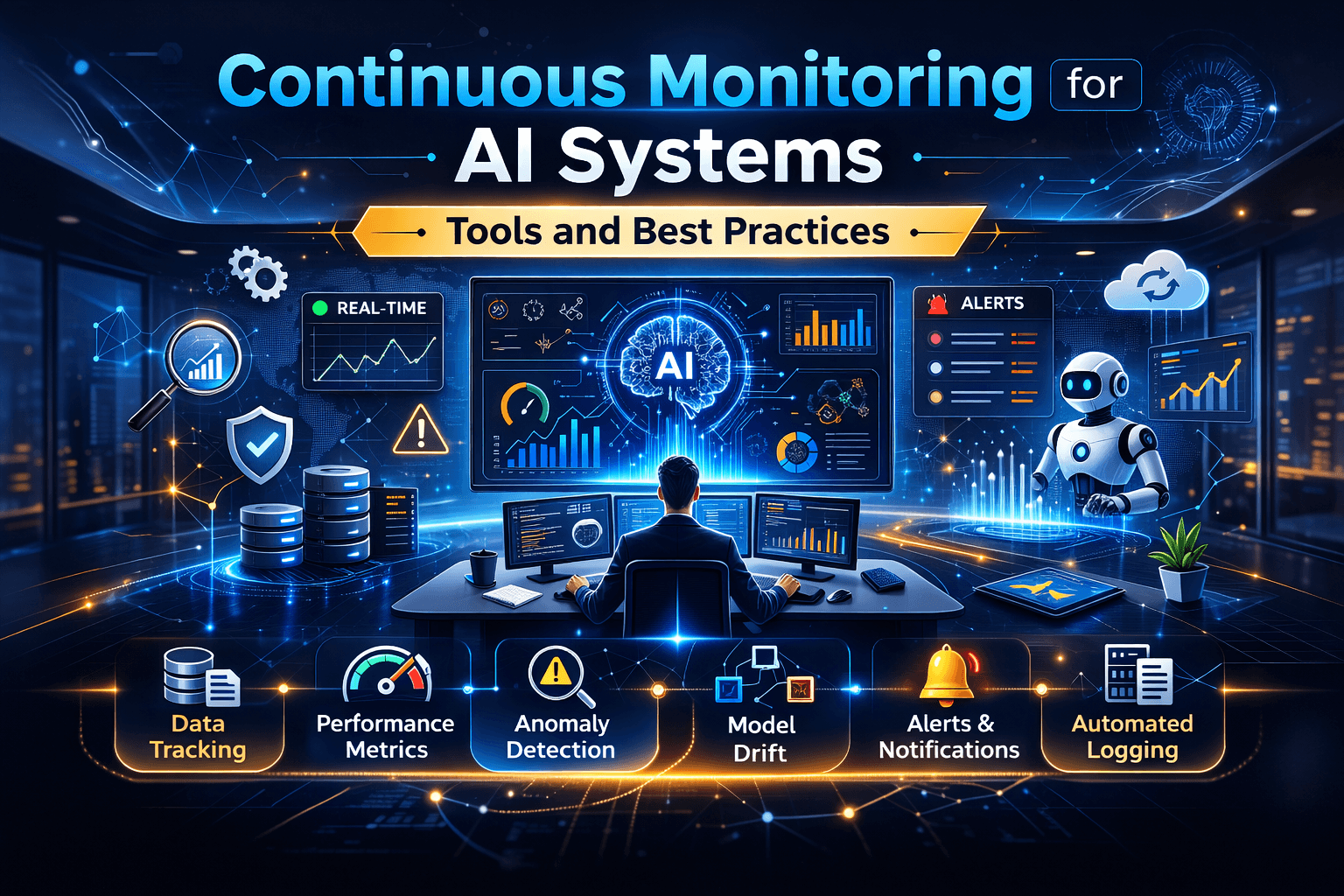
Deploying ai continuous monitoring tools is a critical requirement for maintaining model integrity, performance, and safety in production environments. Unlike traditional software, AI models are susceptible to data drift and concept decay, necessitating specialized ai monitoring solutions that provide real-time observability. These ai observability tools go beyond simple uptime metrics, offering deep insights into feature importance, prediction distributions, and latent bias. By integrating ai alerting systems, enterprises can proactively mitigate risks before they impact business outcomes. Utilizing an ai continuous monitoring tools strategy ensures that predictive ai monitoring becomes a core component of the machine learning lifecycle, safeguarding the organization against silent model failures and ensuring long-term reliability.
Key Takeaways
Automate Drift Detection: Use continuous ai monitoring platforms to identify deviations in data and model behavior.
Enable Real-Time Alerting: Implement ai alerting systems to notify engineering teams of performance degradation instantly.
Enhance Model Transparency: Leverage ai observability tools to provide explainability for complex model decisions.
Regulatory Compliance: Maintain audit-ready logs required by global AI governance and safety standards.
What This Means in 2026
By 2026, ai monitoring has transitioned from an optional operational task to a mandatory pillar of scaling AI governance for enterprises. The dynamic nature of modern ML models means that "frozen" deployments are obsolete; continuous feedback loops are now the standard for observability.
Enterprises are now legally and operationally accountable for the real-time behavior of their agents. This shift necessitates a robust AI register template to track every monitored asset and ensure that predictive ai monitoring is active across the entire portfolio. Without high-fidelity ai continuous monitoring tools, organizations face significant exposure to "silent failures" where models provide confident but incorrect outputs that bypass traditional IT filters.
Unlock Your Free AI Assessment Report
Core Comparison: Monitoring & Observability Solutions
Solution / Platform | Monitoring Scope | Alerting Capability | Observability Depth | Best Fit |
Full Lifecycle AI Monitoring | Predictive & Real-Time | Deep Explainability | Regulated & High-Risk AI | |
Custom Monitoring Architecture | Enterprise-Grade | Full Stack Integration | Complex ML Operations | |
Open Source (Prometheus/Grafana) | Infrastructure Metrics | Threshold-based | Low (Needs Customization) | Internal Dev Teams |
Cloud-Native (SageMaker/Azure ML) | Model Performance | Standard Logs | Moderate (Platform Locked) | Single-Cloud Users |
Samta.ai provides specialized engineering expertise in AI and ML, enabling organizations to deploy sophisticated ai continuous monitoring tools that ensure models remain accurate, fair, and secure throughout their production life.
Practical Use Cases
Here are the 5 detailed points for the Practical Use Cases section of your blog on ai continuous monitoring tools:
1. Financial Risk & Fraud Detection
Financial institutions utilize continuous ai monitoring platforms to detect when shifting economic patterns cause credit models to become over-conservative or excessively risky. This ensures compliance with EU AI Act readiness by providing the necessary technical documentation and continuous oversight required for high-risk financial scoring systems.
2. Safeguarding Against Vulnerabilities
Monitoring serves as a primary defense against adversarial attacks and data poisoning. Analyzing real-world failures, such as those discussed in data breaches caused by ai, highlights how ai observability tools can flag anomalous input patterns or prompt injection attempts that would otherwise lead to massive data leaks or unauthorized system access.
3. Healthcare Diagnostic Accuracy
In clinical settings, AI models assisting in patient diagnostics must be monitored for "concept drift" where changes in medical imaging technology or patient demographics render a model less accurate. Implementing predictive ai monitoring ensures that any drop in diagnostic sensitivity triggers an immediate human-in-the-loop review, maintaining patient safety and regulatory standards.
4. Dynamic E-commerce & Supply Chain
Retailers deploying AI for dynamic pricing or demand forecasting use ai alerting systems to manage "black swan" events. Continuous monitoring detects when external market shocks cause models to suggest irrational pricing or inventory levels, allowing operations teams to pivot before margin erosion or supply chain bottlenecks occur.
5. HR & Recruitment Fairness
Enterprises using AI for high-volume hiring must continuously monitor for "bias drift." As the applicant pool changes over time, ai observability tools track the model’s selection rates across different demographics. This ensures the system remains aligned with an ethical ai governance framework and protects the organization from unintentional discriminatory practices.
Limitations & Risks
Alert Fatigue: Improperly configured ai alerting systems can overwhelm teams with false positives, leading to missed critical signals.
Data Privacy Concerns: Monitoring often requires access to sensitive input data, which must be handled according to strict responsible artificial intelligence policies.
High Operational Overhead: Implementing predictive ai monitoring across hundreds of models can be resource-intensive without automated platforms.
Integration Complexity: Retrofitting ai monitoring into legacy pipelines often requires significant re-engineering of the data flow.
Understand Your AI Model Risk Exposure
Decision Framework
When to Deploy Specialized Monitoring Tools:
You are operating AI in high-stakes environments (Healthcare, Finance, Infrastructure).
You must demonstrate compliance with an ethical ai governance framework to external auditors.
Your models rely on high-velocity data that is prone to rapid drift.
When to Use Basic Observability:
You are running small-scale experiments with static datasets in a controlled environment.
The AI outputs do not impact customer privacy or significant financial decisions.
Conclusion
The transition from "set and forget" AI to a culture of continuous oversight is the hallmark of a mature enterprise. Ai continuous monitoring tools provide the technical insurance policy required to innovate at speed without sacrificing safety or accuracy. As models become more autonomous and complex, the ability to observe and interpret their behavior in real-time will distinguish leaders from laggards in the AI economy. For organizations ready to secure their machine learning investments, Samta.ai offers the deep-tech proficiency and strategic AI & data science services needed to build a resilient, high-performance AI future.
About Samta
Samta.ai is a Singapore-headquartered AI Product Engineering & Data Intelligence partner helping enterprises build production-grade AI systems for regulated and data-intensive environments.We help organizations move beyond experimentation by engineering scalable, explainable, and enterprise-ready AI solutions from data foundations and model development to workflow automation and deployment.
Our capabilities combine deep AI expertise, data engineering, and product engineering to deliver measurable business impact across FinTech, BFSI, cybersecurity, regulatory technology, and enterprise operations.
Our enterprise AI products power real-world intelligence systems:
• TATVA : AI-driven data intelligence platform for governed analytics, monitoring, and operational insights
• VEDA : Explainable and audit-ready AI decisioning engine built for compliance-sensitive enterprise workflows
• CORA-Property Management Solutions: : Predictive intelligence platform for real-estate pricing, portfolio optimization, and investment analytics
Backed by ecosystem partnerships with Microsoft, Databricks, Snowflake, and AWS, Samta.ai delivers agile, cost-efficient AI engineering with faster turnaround and enterprise-grade scalability. Trusted by enterprises across FinTech, BFSI, and digital transformation initiatives, Samta.ai embeds AI governance, data privacy, and compliance-by-design principles directly into the AI lifecycle , enabling organizations to scale AI with transparency, accountability, and operational control.
Enterprises leveraging Samta.ai automate 65%+ of repetitive data, analytics, and decision workflows while maintaining governance, explainability, and measurable business outcomes. Samta.ai provides the strategic consulting, AI engineering, and data modernization expertise needed to align enterprise operations with next-generation AI transformation goals.
Explore the Right AI Strategy for Your Business
FAQs
What is the difference between AI monitoring and observability?
AI monitoring tracks known metrics like accuracy or latency, while observability provides the "why" behind model behavior. Using ai continuous monitoring tools allows teams to debug complex issues such as feature bias or localized performance drops that simple monitoring might miss.
Why do I need continuous monitoring for AI?
AI models are non-static; their environment changes constantly. Without ai monitoring, a model can suffer from "silent failure," leading to incorrect decisions that cause financial loss or security gaps, similar to the risks outlined in data breaches caused by ai.
How do ai alerting systems help in production?
These systems act as early-warning mechanisms. By setting statistical thresholds on data distributions, teams can intervene either through manual review or automatic retraining before a drifting model causes significant business disruption.
Can VEDA monitor models across different cloud providers?
Yes,VEDA by Samta.ai is designed for hybrid and multi-cloud environments, providing a centralized dashboard for all your ai continuous monitoring tools and performance metrics.