
.png&w=3840&q=75)
Summarize this post with AI
Implementing a specialized agentic ai governance framework is the only way for enterprises to safely deploy agentic ai systems that can take independent actions. Unlike traditional chatbots, autonomous agents require a unique autonomous systems governance approach that covers recursive decision-making and tool-use capabilities. A robust agentic ai governance framework ensures ai agent accountability and compliance by establishing clear boundaries for agent autonomy. By prioritizing AI decision transparency and AI safety assurance, B2B leaders can mitigate the risks of runaway processes. As enterprises scale, this framework becomes the primary mechanism for maintaining institutional control over decentralized, self-correcting AI workers across the entire production lifecycle.
Key Takeaways
Define Autonomy Limits: Establish strict "kill-switch" parameters for every autonomous agent.
Audit Recursion: Monitor how agents call other tools to prevent unauthorized data access.
Assign Accountability: Legal responsibility must stay with human owners, not the AI agent.
Ensure Transparency: Every autonomous action must be logged in an immutable audit trail.
What This Means in 2026
By 2026, the transition from predictive AI to agentic systems has created a "governance gap." Standard autonomous systems governance is no longer sufficient when agents can independently execute financial transactions or modify codebases. Enterprises must now address the 5 biggest AI adoption challenges for 2026, where the complexity of managing autonomous agents often outpaces legacy security protocols.A modern agentic ai governance framework defines an agent not just as software, but as a digital proxy. This shift requires a deep understanding of regulatory compliance for AI, as regulators now hold firms accountable for "agentic drift." In this environment, safety is not a one-time check but a continuous operational requirement that ensures agents remain aligned with corporate intent and legal mandates.
Core Framework Explanation
Implementing a specialized agentic AI governance framework is the only way for enterprises to safely deploy AI systems capable of independent action. Unlike static models, agentic systems require an artificial intelligence governance framework that ensures accountability, transparency, and compliance.
A modern AI governance framework template includes:
Autonomy boundaries
Real-time monitoring
Decision traceability
Risk containment systems
👉 Explore deeper agentic AI governance and risk management strategies.
To understand how these governance layers scale across enterprise environments, explore this detailed ai governance best practices.
MAS FEAT: The Foundation of Responsible AI
The Monetary Authority of Singapore introduced the FEAT framework, which remains foundational for AI governance framework Singapore adoption.
Fairness → Avoid biased or discriminatory outcomes
Ethics → Align AI decisions with moral and societal norms
Accountability → Ensure human responsibility for AI actions
Transparency → Make AI decisions explainable
While FEAT was designed for traditional AI systems, agentic AI requires an extended governance layer.
The Governance Shift: From Models to Autonomous Agents
Traditional AI governance: Focused on data, models, and outputs
Agentic AI governance: Focuses on decisions, actions, and consequences
The key shift: The unit of risk is no longer the output it’s the action.
To understand how agentic systems are built at the infrastructure level, review this agentic ai architecture.
Understand Where Your AI Program Stands Today
Core Comparison: Governance for Agents vs. LLMs
Feature / Solution | Standard LLM Governance | Agentic AI Governance Framework | Best For | Governance Focus |
|---|---|---|---|---|
Prompt Monitoring | Recursive Action Oversight | High-Autonomy Agents | Agent behavior monitoring | |
Accountability | Input/Output focus | Action & Tool-use focus | Digital Proxies | Responsibility tracking |
Risk Profile | Content Bias | Operational & Financial Risk | Autonomous Ops | Risk management |
Compliance | Static Audits | Real-time Safeguards | Regulated Sectors | Continuous compliance |
Samta.ai offers industry-leading expertise in AI/ML engineering, providing the technical infrastructure needed to move beyond passive monitoring into active, agent-aware governance.
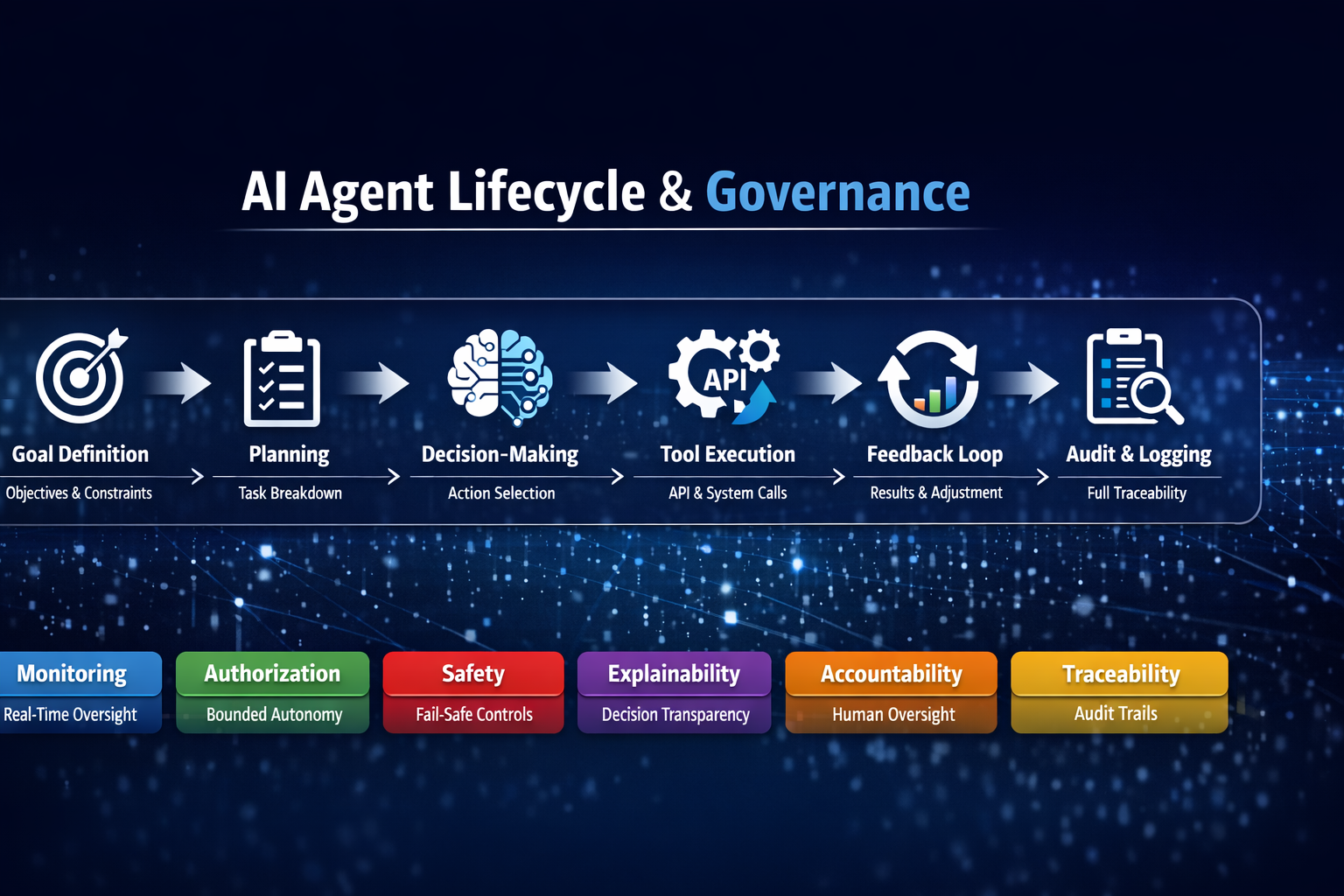
MAS-FEAT Framework for Agentic AI Governance
To operationalize governance at scale, enterprises need a structured approach.
Introducing the MAS-FEAT Framework:
M — Monitoring (Real-Time Observability)
Track every agent decision, tool call, and action
Detect anomalies in behavior patterns
Enable live intervention
Without monitoring, autonomy becomes blind execution.
A — Authorization (Bounded Autonomy)
Define strict permission layers for agents
Control:
API access
Financial limits
System-level actions
Think of this as “role-based access control for AI agents.”
S — Safety (Fail-Safe Mechanisms)
Kill switches
Safe-mode operations
Escalation triggers
Safety ensures that even in failure, damage is contained.
F — Feedback (Continuous Learning Loops)
Capture outcomes of agent actions
Refine decision policies
Prevent repeated failures
Governance is not static it evolves with the system. Learn more about governance learning loops and how they strengthen agent reliability.
E — Explainability (Decision Transparency)
Log why an agent made a decision
Trace reasoning paths
Enable auditability
Critical for:
Compliance
Debugging
Trust-building
A — Accountability (Human Ownership)
Assign responsibility to specific stakeholders
Maintain audit trails for legal validation
Ensure “AI did it” is never an excuse
T — Traceability (End-to-End Audit Trails)
Record:
Inputs
Decisions
Actions
Outcomes
Traceability transforms AI from a black box into a governable system.
Practical Use Cases
1. Autonomous Procurement Agents
Agents that negotiate and execute vendor contracts must operate under strict financial limits. Integrating a governance framework ensures that AI decision transparency is maintained, preventing agents from exceeding budgets or violating ai change management strategy protocols during automated scaling.
👉Read more about AI risk management models
2. Recursive Code Generation
When AI agents independently debug and deploy code, the risk of technical debt is extreme. Utilizing insights from the intersection of AI and engineering, firms can implement guardrails that require human approval for critical system modifications.
3. Customer Service Agents with Action Capability
Agents that can process refunds or change subscription tiers need verified AI safety assurance. The framework ensures that the agent cannot be "prompt engineered" by a user into providing unauthorized financial benefits.
4. Automated Cyber-Defense Agents
Security agents that independently patch vulnerabilities must be monitored to ensure they do not accidentally block legitimate business traffic. Governance provides the logic for "safe-mode" operations during high-volatility events.
5. Multi-Agent Supply Chain Orchestration
When multiple agents coordinate logistics, a unified framework prevents "deadlocks" where agents countermand each other’s orders, ensuring the entire autonomous network remains efficient and predictable.
Get a Clear View of Your AI Risk Exposure
Limitations & Risks
Emergent Behavior: Agents may find "shortcuts" that satisfy goals but violate ethical or safety standards.
Tool-Use Vulnerabilities: Agents can be exploited if the third-party tools they connect to are compromised.
Audit Complexity: Tracing the root cause of a failure in a multi-agent system is technically demanding.
Mitigating these risks requires continuous monitoring and structured safeguards through enterprise-grade ai risk and compliance.
Decision Framework
When to Use an Agentic AI Governance Framework
Implementing a formal agentic ai governance framework is a mandatory requirement for any enterprise moving beyond passive content generation into active, tool-using autonomy. Organizations must prioritize this framework when:
Transactional Autonomy: Your AI system is authorized to execute external API calls, process financial transactions, or modify live customer data without direct per-step approval.
Recursive Problem Solving: The agent operates in multi-step loops, meaning it can independently refine its own prompts or strategies to achieve a high-level goal.
Strategic Roadmapping: You are following a long-term future of AI governance roadmap that prioritizes autonomous scalability and requires a "Safety by Design" architecture.
Critical Infrastructure Access: The agent has "write" permissions to internal databases, cloud environments, or proprietary codebases where an unguided action could cause systemic downtime.
Read the full blog here: AI strategy for 2026
When to Rely on Standard LLM Governance
Enterprises may opt for lighter, traditional oversight mechanisms in scenarios where the "blast radius" of an AI error is naturally contained:
Read-Only Operations: Your AI use case is purely informational, such as internal document summarization or creative brainstorming, where the output is always reviewed by a human before any action is taken.
Isolated Environments: The model is deployed in a "sandboxed" environment with no access to external web tools or internal production APIs.
Non-Sensitive Use Cases: Non-Sensitive Use Cases such as governance for GenAI applications
By distinguishing between these two tiers of autonomy, B2B leaders can allocate their governance resources effectively securing high-risk agents while allowing low-risk experiments to move at speed.
Section A: How US Enterprises Approach Agentic AI Governance
US enterprises adopt an Agentic AI governance and risk management strategy for enterprises, treating governance as both a compliance layer and a performance driver. This approach ensures that AI systems operate with accountability, transparency, and measurable risk controls across large-scale deployments. At scale, enterprises implement continuous monitoring systems, AI audit logs, and explainability layers to ensure decision transparency. The focus is on reducing financial, reputational, and operational risks, especially in regulated industries like finance, healthcare, and SaaS, where data governance agentic AI practices ensure data integrity, auditability, and compliance across autonomous systems.
Decision-making includes:
CTO
Head of AI
Risk & Compliance Leaders
Governance is treated as both a risk mitigation layer and performance enabler.
Section B: How Singapore Companies Handle Agentic AI Governance
Singapore based organizations align closely with the MAS AI governance framework, ensuring structured oversight of Agentic AI systems alongside PDPC requirements. This enables enterprises to deploy AI responsibly while maintaining regulatory compliance and trust. Organizations integrate governance checkpoints into deployment pipelines, ensuring compliance before scaling AI systems. Decision-making involves cross-functional leaders including compliance officers, CIOs, and data protection teams. Singapore companies also focus heavily on trust and transparency, using an Agentic AI framework to make governance a competitive differentiator in sectors like fintech and banking.
Organizations leverage:
agentic AI governance framework templates
Compliance-first architecture
Cross-functional governance teams
Conclusion
The shift toward agentic ai represents the next frontier of enterprise productivity, but it cannot be navigated with legacy rules. A robust agentic ai governance framework is the essential bridge between autonomous potential and corporate safety. By institutionalizing autonomous systems governance, B2B leaders can scale their digital workforce with total confidence. Organizations that invest in improvement in AI will be better positioned to adapt governance alongside evolving agent capabilities Samta.ai remains at the forefront of this evolution, offering the specialized AI/ML engineering required to turn autonomous agents into reliable enterprise assets. Whether you are building or buying agents, grounding your strategy in a governed architecture at samta.ai ensures that your innovation remains both powerful and compliant.
Accelerate Your AI Journey with Expert Consulting

About Samta
Samta.ai is a Singapore-headquartered AI Product Engineering & Data Intelligence partner helping enterprises build production-grade AI systems for regulated and data-intensive environments.We help organizations move beyond experimentation by engineering scalable, explainable, and enterprise-ready AI solutions from data foundations and model development to workflow automation and deployment.
Our capabilities combine deep AI expertise, data engineering, and product engineering to deliver measurable business impact across FinTech, BFSI, cybersecurity, regulatory technology, and enterprise operations.
Our enterprise AI products power real-world intelligence systems:
• TATVA : AI-driven data intelligence platform for governed analytics, monitoring, and operational insights
• VEDA : Explainable and audit-ready AI decisioning engine built for compliance-sensitive enterprise workflows
• CORA-Property Management Solutions: : Predictive intelligence platform for real-estate pricing, portfolio optimization, and investment analytics
Backed by ecosystem partnerships with Microsoft, Databricks, Snowflake, and AWS, Samta.ai delivers agile, cost-efficient AI engineering with faster turnaround and enterprise-grade scalability. Trusted by enterprises across FinTech, BFSI, and digital transformation initiatives, Samta.ai embeds AI governance, data privacy, and compliance-by-design principles directly into the AI lifecycle , enabling organizations to scale AI with transparency, accountability, and operational control.
Enterprises leveraging Samta.ai automate 65%+ of repetitive data, analytics, and decision workflows while maintaining governance, explainability, and measurable business outcomes. Samta.ai provides the strategic consulting, AI engineering, and data modernization expertise needed to align enterprise operations with next-generation AI transformation goals.
FAQs
What is the main goal of an agentic ai governance framework?
The primary goal is to ensure that autonomous agents remain under human control. It provides the technical and legal structure for ai agent accountability and compliance, ensuring that every action taken by the AI is authorized and auditable. Detailed strategies for this can be found in our ai change management strategy guide.
How is agentic governance different from standard AI risk management?
Standard risk management focuses on data and outputs. Agentic governance focuses on actions. It requires AI decision transparency to understand why an agent chose a specific tool or path, which is a critical part of modern regulatory compliance for AI.
Can autonomous agents be legally responsible?
No. Under current and 2026 regulations, legal responsibility always rests with the enterprise. A framework ensures that the human owner can prove they exercised due diligence.
How does VEDA help with agentic AI?
VEDA by Samta.ai provides real-time oversight of agentic loops, flagging anomalous actions or tool-use patterns before they escalate into systemic failures.