
Summarize this post with AI
Over half of enterprises have AI agents in production, yet 88 percent of agent projects never ship. For SaaS companies, that gap is not a technology problem. It is an architecture and governance problem: the feature looked good in the demo, worked in the sandbox, and then stalled when someone asked what happens when the agent writes to a production database with the wrong permissions, or when a customer in a regulated industry asks for an explainability report the system was never designed to produce. ai engineering for saas companies in 2026 is the discipline of closing that gap between impressive demo and trusted production feature. This guide covers what ai engineering for saas companies actually requires at the architecture, multi-tenancy, and governance layer, and where the build versus embed decision changes the economics of getting there.
AI Engineering for SaaS Companies:
According to Gartner, by 2026, more than 80 percent of enterprises will have deployed generative AI APIs or applications, and customers who do not see AI in your platform are already evaluating alternatives. Building a production-grade AI feature requires infrastructure for model inference, multi-tenant context isolation, conversation memory, compliance guardrails, escalation logic, and ongoing model maintenance easily a 12 to 18 month engineering investment before a single customer benefits. ai engineering saas in 2026 is therefore not a build-from-scratch problem for most companies; it is a strategic decision about which layers to own as competitive differentiation and which layers to embed from proven infrastructure, with the six-layer production stack requiring compute and sandboxing, memory, tools and actions, model routing, multi-step orchestration, and observability and governance as the complete requirement.
What Is AI SaaS and What Does Production-Grade Actually Mean
What is ai saas in the 2026 market is a meaningful distinction from the 2023 version. The era of the simple AI wrapper, products that merely pass user prompts to basic foundation models via a thin interface, is entirely over. Today's sophisticated enterprise buyers demand deep, verticalized, and context-aware business systems that do not just facilitate tasks but actively execute complex workflows autonomously. Build saas with ai at the production level means the AI layer is not a feature bolted onto an existing product. It is a set of capabilities that require six engineering layers to function reliably at enterprise scale. Production-grade agentic AI infrastructure means compute and sandboxing, memory, tools and actions, model routing, multi-step orchestration, plus observability and governance. Skip any one of them and the rollout stalls.
The SaaS companies that ship working AI features in 2026 are not the ones with the most sophisticated AI research capability. The companies that are succeeding with AI agents are not the ones with the flashiest tech. They are the ones who started narrow, measured honestly, and kept iterating. The difference between trying out AI agents and having an agent handle 70 percent of support inquiries is six months of focused, heads-down work. For enterprises assessing how modern SaaS infrastructure connects to AI readiness, the how modern enterprises build AI-ready operations guide and the enterprise data integration engineering guide cover the foundational data architecture this AI layer depends on.
Get a Clear Picture of Your AI Maturity and Opportunities
Why the AI Engineering Decision Is More Consequential for SaaS in 2026
Three developments make adding ai features to saas product a competitive urgency, not a roadmap aspiration.
1. The build-versus-embed decision has a cost ceiling most SaaS companies cannot clear internally: Building production-grade AI is not just about calling an LLM API. You need multi-tenant data isolation, governance frameworks, feedback loops, model fine-tuning pipelines, and safety guardrails, especially when deploying AI to thousands of customers with varying needs. The infrastructure cost alone can run into seven figures before you ship a single feature.
2. AI-native competitors are compressing your time window: Products that can demonstrate autonomous, outcome-driven AI workflows are winning deals, retaining customers, and commanding premium pricing. Products that offer AI as a supporting feature are increasingly on the defensive. The competitive gap between AI-native and AI-enabled SaaS is now visible in churn data, not just roadmap positioning.
3. The monetization model for AI features is consolidating around usage-based premium tiers: Notion launched Custom Agents in February 2026 with integrations for Linear, Figma, HubSpot, Stripe, GitHub, and Intercom, charging $10 per 1,000 credits as an add-on. This is probably the pattern most SaaS products will follow: agents as premium features with usage-based pricing. For SaaS companies comparing their AI engineering approach against what competitors have shipped, the Samta.ai vs traditional dev companies comparison and the AI vs traditional dev companies comparison document the delivery model differences that determine which approach ships faster.
The AI Engineering Framework for SaaS: Step by Step
Use this sequence to scope, architect, and deliver ai engineering saas features that reach production rather than staying in the proof of concept stage.
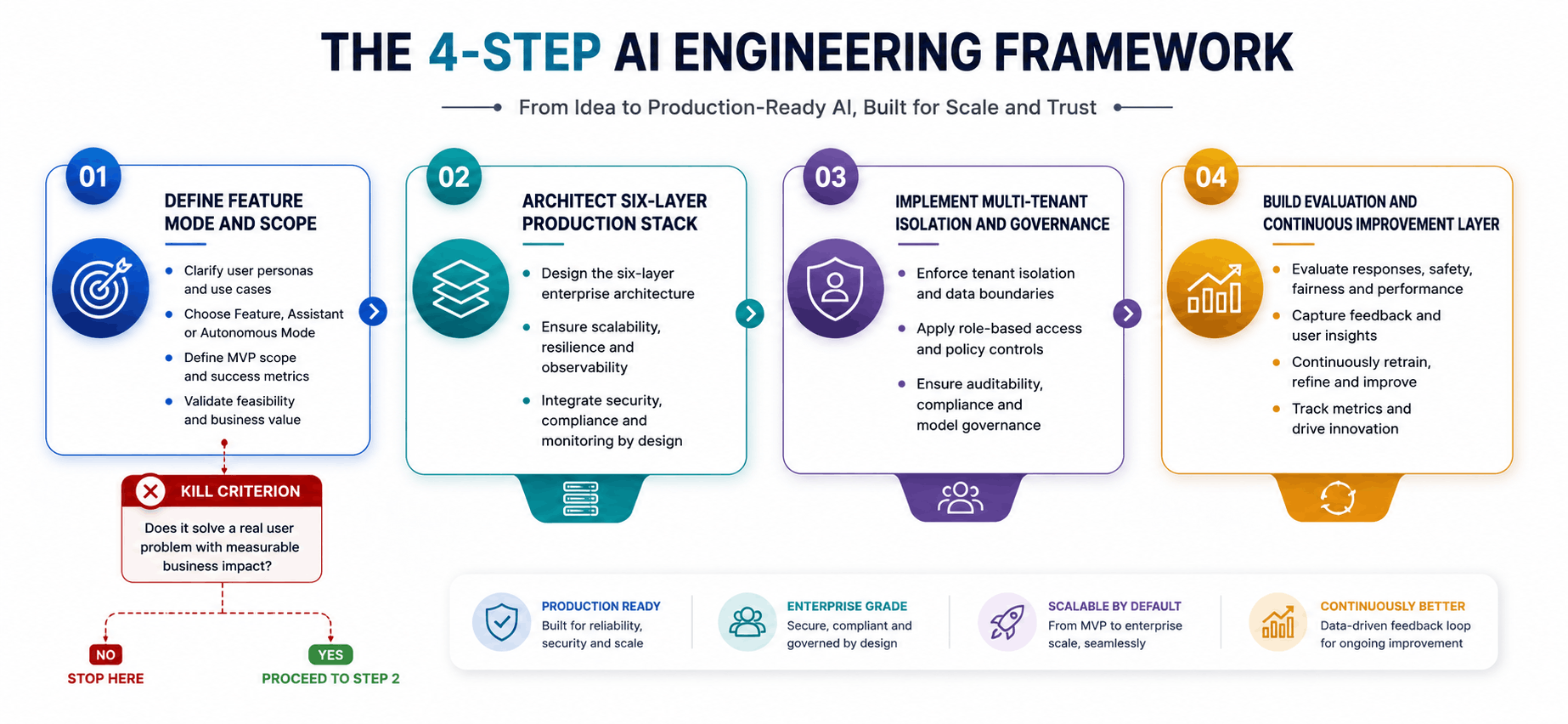
Step 1: Define the Feature Mode and Scope Boundary
Classify the AI feature by action type: does it generate content, analyze data, make a recommendation, or execute an autonomous action? The governance requirement differs materially across these four modes. Content generation requires hallucination and IP controls. Autonomous action requires permission boundaries, human approval checkpoints, and audit trails.
Start narrow with a single, measurable use case: initial development only accounts for 25 to 35 percent of your three-year AI feature spend; ongoing operations add another 20 to 40 percent annually on top of build cost. A narrowly scoped first feature with a clear success metric is the fastest path to production and the most defensible route to an upsell tier.
Define the kill criterion before building: a pre-committed accuracy floor or adoption threshold that triggers a model change or feature pause prevents continued investment in underperforming AI features.
Step 2: Architect the Six-Layer Production Stack
Production-grade AI engineering for SaaS requires all six layers to be designed before engineering begins, not retrofitted after a demo impresses the first customer:
Compute and sandboxing: isolated execution environments per tenant, preventing data cross-contamination across your customer base.
Memory: short-term conversational context and long-term user and account memory, with clear data retention policies per tier.
Tools and actions: whitelisted capability boundaries defining what the AI can and cannot do, with least-privilege access per feature scope.
Model routing: cost and latency routing across foundation models, with fallback logic when primary models are unavailable or exceed cost thresholds.
Multi-step orchestration: the workflow layer connecting sequential agent actions, with retry logic and failure handling built in from day one.
Observability and governance: full logging of agent actions, model decisions, tool calls, and escalation events, plus the compliance guardrails and human approval checkpoints required for enterprise customer trust.
Step 3: Implement Multi-Tenant Isolation and Governance
This is the layer that most SaaS teams underestimate until their first enterprise customer asks for a data isolation certification. Multi-tenant AI requires context isolation at the model input and output layers, not just at the database layer. A shared vector store without tenant-level namespace isolation can allow one customer's AI context to leak into another's query results, an enterprise-level security failure that is invisible until it surfaces in a security review. For SaaS companies serving regulated industries including BFSI, healthcare, or government, governance controls must also include per-decision audit trails exportable on demand. The AI security compliance services provide this governance documentation structure for SaaS companies whose customers operate in regulated contexts. The top 5 product engineering guide covers how the most successful AI product engineering engagements structure governance from day one.
Step 4: Build the Evaluation and Continuous Improvement Layer
Samta.ai's Veda AI data analytics platform supports this step by connecting SaaS AI feature outputs to outcome dashboards on Databricks and Snowflake, so product teams can measure whether the AI feature is actually changing customer behavior or just generating usage metrics that mask poor outcomes. Alongside outcome monitoring, teams can use AI-powered software testing to continuously validate model behavior, accuracy, reliability, performance, and unexpected changes before they affect customers. The Veda AI data analytics platform turns AI feature evaluation from a post-launch exercise into a continuous operational capability. The Veda vs data intelligence platform comparison documents how this evaluation layer compares against general-purpose analytics platforms for AI feature measurement. The AI consulting for SaaS guide covers how specialist engagement accelerates the evaluation layer build alongside the feature itself, and the data integration consulting services support the data pipeline integration that feeds the evaluation layer with reliable customer and product data.
AI Engineering for SaaS: Build vs Embed Comparison
Dimension | Full In-House Build | Embed via AI Infrastructure Platform | Governed Partner Build (Samta.ai Model) | Build for Core Differentiation, Embed for Commodity | Key Risk |
Time to First Production Feature | 12 to 18 months before a single customer benefits | Weeks with embedded infrastructure platform | 8 to 14 weeks with governance built in | Varies by feature mode | In-house: competitive window closes; embed: governance gaps for regulated customers |
Multi-Tenant Isolation | Must be built from scratch; frequent gap in early builds | Provided by platform with API-level tenant separation | Designed in from architecture phase; knowledge transferred to internal team | Embed for standard isolation; build when isolation requirements are non-standard | Missing tenant isolation is an enterprise deal-stopper, surfaced only at security review |
Governance and Audit Trail | Optional without enterprise mandate; frequently missed | Varies by platform; often an add-on | Built into architecture as a first-class requirement; exportable for regulated customer audits | Build governance layer for enterprise tier; embed for SMB tier | Retrofitting governance after launch costs 3 to 5x more than designing it in at Step 2 |
Three-Year Cost | Build cost is 25 to 35 percent of three-year spend; operations add 20 to 40 percent annually | Lower initial; platform fees compound with scale | Most predictable for regulated enterprise programs with defined scope | Model total cost across three years, not initial build estimate | All three models have hidden costs; in-house misses model update cost; embed misses per-unit API cost at scale |
IP and Competitive Moat | Defensible AI features require proprietary data loops and custom micro-agent architectures rather than simple public API integrations | Lower IP ownership; platform lock-in risk | IP owned by customer; architecture knowledge transferred to internal team | Build IP-differentiating layers; embed commodity infrastructure | Embedding core product intelligence creates competitive vulnerability at platform contract renewal |
Know Your AI Risk Score Before Regulators Do
Enterprise Use Cases: AI Engineering for SaaS in Practice
Use Case 1: BFSI SaaS Company Adding Explainable AI to Compliance Workflows
A Singapore-headquartered compliance SaaS company serving BFSI customers needed to add an AI feature that flagged regulatory breaches in uploaded documents. The customer base included MAS-regulated banks, making governance and audit trail documentation a first-order architecture requirement, not a post-launch consideration. The team designed the six-layer stack from Step 2 before writing any feature code: sandboxed execution per bank tenant, document memory isolated by customer, flagging tools whitelisted to read-only operations, and a per-decision audit trail exportable for MAS examiner review. Truly defensible AI features are built on proprietary, domain-specific data loops rather than simple public API integrations, and this company's proprietary regulatory taxonomy, built from three years of customer compliance data, became the competitive moat that generic LLM wrappers could not replicate.
Use Case 2: Manufacturing SaaS Embedding AI Agents for Procurement Automation
A Singapore manufacturing SaaS company serving ai saas products for manufacturing customers deployed an AI agent for automated procurement monitoring. The agent monitored inventory drops, auto-negotiated with vendor APIs based on pre-set historical data thresholds, and drafted purchase contracts for final approval. This was a Tier 2 agentic feature: some irreversible actions (vendor API calls that reserve inventory) requiring named human approval before contract finalization. The company chose the governed partner build model over full in-house build after calculating that the six-layer stack would require four senior engineers for 14 months, versus an 11-week engagement with knowledge transfer gates that left the internal team owning the production system. The how modern enterprises build AI-ready operations guide framed the data infrastructure prerequisites the team completed before the AI feature build began.
Key Risks and Failure Modes
Building an AI wrapper instead of an AI feature: The era of the simple AI wrapper is entirely over. Enterprise buyers demand deep, verticalized, and context-aware business systems that actively execute complex workflows autonomously. A thin layer over a foundation model API will not retain enterprise customers who can access the same foundation model directly.
Missing the multi-tenant isolation requirement until the first enterprise security review: Shared vector stores, shared model context, or shared logging pipelines without tenant-level namespace isolation create enterprise-level security failures that are invisible in development and deal-stopping in customer security reviews.
Underestimating ongoing operations cost: Initial development only accounts for 25 to 35 percent of three-year AI feature spend; ongoing operations add another 20 to 40 percent annually on top of build cost. SaaS product roadmaps that approve AI features based on build cost only will face unbudgeted operational overhead by Year 2.
No evaluation layer at launch: AI features that ship without a measurement framework connecting feature usage to customer outcome metrics cannot demonstrate retention or upsell impact. An AI feature with no outcome measurement is a cost line, not a revenue line, in the next board review.
Decision Framework: Is Your SaaS AI Feature Architecture Production-Ready?
The AI feature's action type is classified and governance requirements are designed for that specific mode
All six infrastructure layers are designed before engineering begins, not retrofitted after demo
Multi-tenant context isolation is implemented at the model input and output layers, not only at the database layer
An audit trail exportable on demand exists for every AI-influenced decision in the feature
A kill criterion (accuracy floor, adoption floor, or cost ceiling) is pre-committed before launch
An evaluation layer connecting feature usage to customer outcome metrics is live from day one
If fewer than four boxes are checked, the feature is likely to stall between demo and trusted production deployment.
Get Clarity on Your AI Strategy and Execution
Conclusion
ai engineering for saas companies in 2026 is the discipline that separates the 12 percent of AI agent projects that actually ship from the 88 percent that stall at proof of concept. The gap is not model quality; it is the six-layer production stack, multi-tenant isolation, governance architecture, and evaluation framework that most SaaS teams design for only three of the six layers before they discover the rest during the first enterprise security review. The SaaS companies that close that gap in the next six months will be the ones whose AI features appear in competitor win-loss analyses, not just roadmap presentations.
About Samta
Samta.ai is a Singapore-headquartered AI Product Engineering & Data Intelligence partner helping enterprises build production-grade AI systems for regulated and data-intensive environments.We help organizations move beyond experimentation by engineering scalable, explainable, and enterprise-ready AI solutions from data foundations and model development to workflow automation and deployment.
Our capabilities combine deep AI expertise, data engineering, and product engineering to deliver measurable business impact across FinTech, BFSI, cybersecurity, regulatory technology, and enterprise operations.
Our enterprise AI products power real-world intelligence systems:
• TATVA : AI-driven data intelligence platform for governed analytics, monitoring, and operational insights
• VEDA : Explainable and audit-ready AI decisioning engine built for compliance-sensitive enterprise workflows
• CORA-Property Management Solutions: : Predictive intelligence platform for real-estate pricing, portfolio optimization, and investment analytics
Backed by ecosystem partnerships with Microsoft, Databricks, Snowflake, and AWS, Samta.ai delivers agile, cost-efficient AI engineering with faster turnaround and enterprise-grade scalability. Trusted by enterprises across FinTech, BFSI, and digital transformation initiatives, Samta.ai embeds AI governance, data privacy, and compliance-by-design principles directly into the AI lifecycle , enabling organizations to scale AI with transparency, accountability, and operational control.
Enterprises leveraging Samta.ai automate 65%+ of repetitive data, analytics, and decision workflows while maintaining governance, explainability, and measurable business outcomes. Samta.ai provides the strategic consulting, AI engineering, and data modernization expertise needed to align enterprise operations with next-generation AI transformation goals.
Frequently Asked Questions
What is AI engineering for SaaS companies and how does it differ from general AI development?
ai engineering for saas companies differs from general AI development in three critical areas: multi-tenancy requires context isolation across thousands of customers simultaneously; SaaS monetization requires usage-metered AI infrastructure that scales per-customer without linear cost increases; and enterprise customer trust requires governance documentation and audit trails that general AI development does not address. The six-layer production stack is specifically the SaaS-context requirement that general AI development frameworks underspecify.
What is the six-layer production stack for AI SaaS features?
Production-grade agentic AI infrastructure means compute and sandboxing, memory, tools and actions, model routing, multi-step orchestration, plus observability and governance. Skip any one of them and the rollout stalls. Most SaaS teams in early AI builds design three of these six layers and discover the missing three during the first enterprise customer security review or the first production incident.
Should SaaS companies build AI features in-house or embed an AI infrastructure platform?
Truly defensible AI features are built on proprietary, domain-specific data loops and custom micro-agent architectures rather than simple public API integrations. The practical answer in 2026 is to build the IP-differentiating intelligence layer internally (your proprietary data models, domain-specific training, and customer outcome logic) and embed commodity infrastructure (compute, sandboxing, model routing, and billing primitives) from a proven platform to compress time to market.
What are ai saas products for security and what governance do they require?
ai saas products for security apply AI to threat detection, anomaly monitoring, and compliance audit workflows. These require the highest governance tier in SaaS AI engineering: per-decision audit trails, access controls restricting the AI to read-only operations unless an explicit write action is approved, and explainability documentation for every alert generated. For regulated enterprise customers, the governance documentation must be exportable on demand for security review, not reconstructed per request.
How do you monetize AI features in a SaaS product in 2026?
Notion's pattern of charging $10 per 1,000 credits as a usage-based add-on for Custom Agents is likely the pattern most SaaS products will follow: agents as premium features with usage-based pricing. The monetization model that converts most reliably is a base subscription for access plus usage-based pricing for AI actions executed, because it ties revenue directly to customer value delivered rather than to platform access.