
Summarize this post with AI
Most Bengaluru businesses already have the data they need to answer a hard question today, and still wait two weeks for a dashboard request to clear the queue. An AI powered insights platform exists specifically to close that gap, letting a CFO or operations lead ask a business question in plain language and get a decision ready answer back, not a chart that still needs interpreting. Gartner defines this category as augmented analytics, using machine learning to automate insight generation and explanation rather than leaving that work entirely to a human analyst. For Bengaluru's fast growing enterprise base, that shift changes how quickly a business can actually act on what its data already knows.
AI Powered Insights Platform:
An AI powered insights platform uses machine learning and natural language processing to let business users ask questions about enterprise data directly and receive an answer, a recommendation, and an explanation, rather than a static dashboard requiring manual interpretation. Gartner's augmented analytics category defines this shift precisely, technologies that automate data preparation, insight generation, and insight explanation to change how people explore data inside analytics and BI platforms. For Bengaluru businesses managing data across multiple systems and teams, the practical difference is time, a decision that once took a dashboard request and a wait now takes a conversation.
What an AI powered insights platform actually is
What is an AI powered insights platform? It is software that combines a company's business data with machine learning and a conversational interface, so a user can ask a question in plain English and receive an answer grounded in the underlying data, not a search result pointing toward a dashboard. This differs from traditional business intelligence, which requires someone to build a specific chart or report before a question tied to that view can be answered.
Decision intelligence extends this a step further. Rather than only answering what happened, a mature platform recommends what to do next, connecting an insight to a suggested action rather than leaving that interpretation entirely to the person reading it. Our guide on artificial intelligence for decision making covers this distinction between reporting and recommending in more depth, and academic research on natural language interfaces for business intelligence confirms this shift is well underway across enterprise analytics broadly, not a Bengaluru specific trend alone.
See Where Your Business Stands on AI Readiness
Why Bengaluru businesses need this now
Ai analytics software bengaluru companies are evaluating has become a genuine competitive question for three reasons.
Enterprise data volume has outpaced manual reporting capacity. As Bengaluru businesses scale across SaaS, online retail, and technology services, the number of systems generating data has grown faster than the analyst headcount available to interpret it.
Conversational analytics has become the expected interface, not a novelty. Every major BI vendor has raced to add natural language querying over the past two years, meaning a platform without it now looks dated rather than differentiated.
Time to insight has become a board level metric. A CFO waiting days for a report that a conversational platform could answer in minutes is now a visible, measurable cost, not an accepted operational norm.
Our overview of real time AI inference covers the technical foundation that makes same day answers possible, rather than the batch reporting cycles most legacy BI tools still rely on.
How to evaluate an AI powered insights platform
What should businesses look for in an AI analytics platform? Five criteria separate a genuinely useful platform from one that adds a chat interface on top of the same static dashboards.
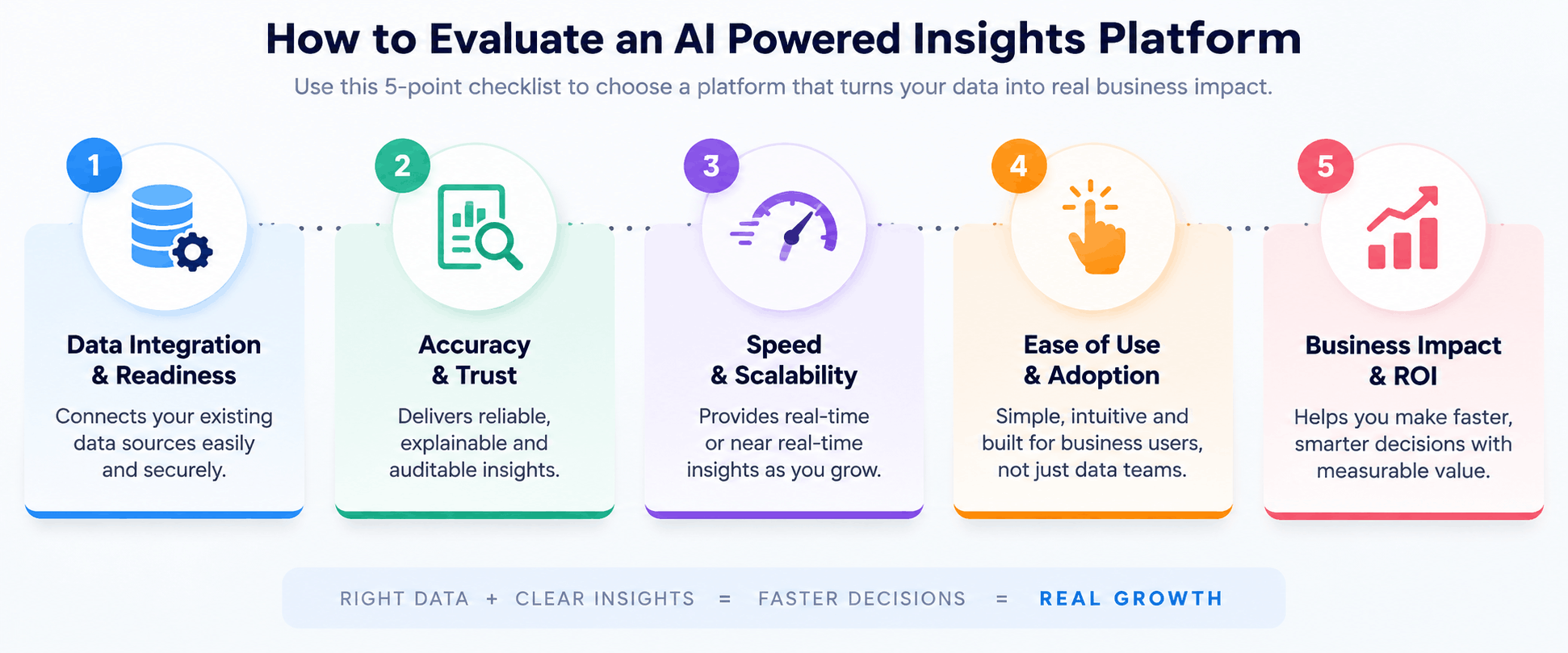
Natural language querying depth. Test whether the platform handles a genuinely complex, multi part business question, not only simple lookups a basic search bar could answer.
Data integration breadth. Confirm the platform connects directly to the data warehouses and systems your business already runs, rather than requiring a separate export step before analysis begins.
Decision intelligence, not just reporting. Check whether the platform recommends an action alongside an insight, or simply presents a number and leaves interpretation to the user.
Explainability of every answer. A platform should show its reasoning alongside a result, so a business user can trust and defend the answer, not just accept it.
Time to first useful answer. Measure how long it actually takes from asking a question to receiving something actionable, not the vendor's marketed capability.
This is where the engineering execution layer matters. Samta.ai built the VEDA AI decision analytics platform around exactly these five criteria, connecting directly with Databricks, Snowflake, and Microsoft data infrastructure through our data integration consulting services so Bengaluru businesses are not left stitching together a separate integration project before analysis can begin. Our AI ready data engineering guide covers what needs to be true about your underlying data before a conversational platform can actually deliver on this promise.
VEDA versus ThoughtSpot versus traditional BI dashboards
Our full VEDA versus ThoughtSpot comparison covers this in more depth, but the summary below gives a fair, side by side view across the capabilities that matter most.
Capability | VEDA | ThoughtSpot | Traditional BI Dashboards | Best For |
Natural Language Querying | Conversational analytics answering business questions directly | Search driven natural language querying, a recognized pioneer of this approach | Limited or absent, relies on pre built filters | Teams wanting to ask questions without building a dashboard first |
Decision Intelligence | Recommends a next action alongside the insight, not just a number | Surfaces automated insights but stops short of recommending action | Requires a human to interpret the number and decide | Teams wanting a recommendation, not only a metric |
Data Integration Approach | Built to integrate directly with Databricks, Snowflake, and Microsoft data stacks | Connects to major cloud data warehouses with a natural language layer on top | Requires separate data preparation tooling before dashboards can be built | Teams wanting integration and insight in one platform |
Time to Insight | Answers available in a live conversation, no dashboard build required | Fast for supported query patterns, still dashboard centric for complex views | Slower, requires a dashboard request and build cycle | Teams needing same day answers to new questions |
Governance and Explainability | Reasoning shown alongside every answer by default | Explanation depth varies by query complexity | Explainability depends entirely on the underlying dashboard design | Teams needing to trust and defend automated answers |
Identify Your AI Model Risk Before It Becomes a Business Issue
Real world enterprise use cases
Regulated industry: a financial services firm reducing reporting delays
A financial services firm with operations spanning Bengaluru and Singapore needed its finance team to answer board level questions without waiting on a weekly reporting cycle. Its previous process required a data analyst to manually pull figures from three separate systems before every board meeting, a cycle that consumed most of a working week each month. Reviewing Samta.ai's broader enterprise AI engineering in Singapore work alongside its Bengaluru deployment helped the firm apply the same conversational analytics approach across both regions consistently, rather than running two separate reporting systems with two different levels of maturity.
General enterprise: a SaaS company automating its weekly ops review
A Bengaluru SaaS company running a weekly operations review previously spent two days each cycle assembling data from separate systems before the meeting could even start, with one team member effectively dedicated to spreadsheet consolidation every week. Pairing a conversational insights platform with workflow automation consulting let the operations team ask questions live during the meeting itself, cutting the preparation cycle entirely rather than just shortening it, and freeing that team member to work on analysis instead of data assembly.
Key risks and failure modes
Choosing a platform for its chat interface alone. A conversational front end sitting on top of the same static, poorly integrated data does not solve the underlying reporting delay problem.
Skipping the data readiness step. A platform cannot answer questions well against data that is incomplete, poorly labeled, or scattered across disconnected systems.
No explainability behind automated answers. A business user who cannot see the reasoning behind an answer will not trust it enough to act on it, undermining the entire point of faster decisions.
Assuming natural language querying handles every question equally well. Complex, multi part business questions still need to be tested directly, not assumed to work based on a vendor demo using simple examples.
Underestimating the change management needed. Teams accustomed to requesting dashboards need onboarding to shift toward asking questions directly, or adoption stalls regardless of the platform's actual capability.
When an AI powered insights platform is worth adopting
Adopt now when:
Your team routinely waits days for answers to questions your existing data could already answer
Multiple disconnected systems make manual reporting increasingly time consuming to assemble
Decision makers need same day answers to support fast moving business decisions
A traditional BI approach may still be enough when:
Your reporting needs are highly standardized with little variation from week to week
Your data volume and system count remain small enough for manual reporting to stay manageable
No immediate business pressure exists to reduce current reporting turnaround time
Reviewing Samta.ai's case studies alongside your own reporting bottlenecks gives a useful benchmark for whether the shift is worth prioritizing now.
Need Help Scaling AI Across Your Enterprise?
Conclusion
An AI powered insights platform changes the actual unit of measurement for a business decision, from days waiting on a report to minutes spent in a conversation with your own data. Bengaluru businesses that adopt this approach are not simply buying a faster dashboard, they are removing the reporting delay that used to separate a question from its answer entirely.
About Samta
Samta.ai is a Singapore-headquartered AI Product Engineering & Data Intelligence partner helping enterprises build production-grade AI systems for regulated and data-intensive environments.We help organizations move beyond experimentation by engineering scalable, explainable, and enterprise-ready AI solutions from data foundations and model development to workflow automation and deployment.
Our capabilities combine deep AI expertise, data engineering, and product engineering to deliver measurable business impact across FinTech, BFSI, cybersecurity, regulatory technology, and enterprise operations.
Our enterprise AI products power real-world intelligence systems:
• TATVA : AI-driven data intelligence platform for governed analytics, monitoring, and operational insights
• VEDA : Explainable and audit-ready AI decisioning engine built for compliance-sensitive enterprise workflows
• CORA-Property Management Solutions: : Predictive intelligence platform for real-estate pricing, portfolio optimization, and investment analytics
Backed by ecosystem partnerships with Microsoft, Databricks, Snowflake, and AWS, Samta.ai delivers agile, cost-efficient AI engineering with faster turnaround and enterprise-grade scalability. Trusted by enterprises across FinTech, BFSI, and digital transformation initiatives, Samta.ai embeds AI governance, data privacy, and compliance-by-design principles directly into the AI lifecycle , enabling organizations to scale AI with transparency, accountability, and operational control.
Enterprises leveraging Samta.ai automate 65%+ of repetitive data, analytics, and decision workflows while maintaining governance, explainability, and measurable business outcomes. Samta.ai provides the strategic consulting, AI engineering, and data modernization expertise needed to align enterprise operations with next-generation AI transformation goals.
Frequently asked questions
What is an AI powered insights platform?
An AI powered insights platform combines enterprise data with machine learning and a conversational interface, letting business users ask questions in plain language and receive a data grounded answer, rather than requiring a pre built dashboard for every possible question.
How can Bengaluru companies use AI analytics?
Bengaluru companies can use AI analytics to reduce reporting delays across finance, operations, and customer facing teams, connecting existing data systems to a conversational platform that answers business questions directly rather than routing every question through a dashboard request queue.
What should businesses look for in an AI analytics platform?
Businesses should test natural language querying depth on genuinely complex questions, confirm data integration breadth against their existing systems, check for decision intelligence rather than only reporting, verify explainability behind every answer, and measure real time to first useful answer.
How can a Bengaluru CFO reduce reporting delays?
A Bengaluru CFO can reduce reporting delays by adopting a conversational analytics platform connected directly to existing financial and operational data systems, removing the dashboard request and build cycle that typically separates a business question from its answer.
What is decision intelligence?
Decision intelligence extends analytics beyond reporting what happened to recommending what to do next, connecting an insight directly to a suggested action rather than leaving interpretation entirely to the person reviewing the data.