
Summarize this post with AI
Most enterprises don't fail at analytics. They fail at the decision that comes after the dashboard. A 2026 ai decision intelligence platform comparison matters because dashboards answer "what happened," while decision intelligence platforms are built to answer "what should we do next" with governance attached. VEDA, ThoughtSpot, and Domo all sit in this space, but they solve different problems. This guide breaks down where each one wins, where each one struggles in regulated markets like Singapore and India, and how to pick without a six-month pilot.
Ai decision intelligence platform comparison:
VEDA is built for regulated, decision-centric AI workflows with embedded governance and BFSI-specific data models. ThoughtSpot leads on natural-language search and self-service BI speed. Domo leads on low-code app-building and cross-functional dashboarding. For enterprises that need auditable, decision-grade AI recommendations rather than just faster dashboards, VEDA and other decision intelligence platforms are the closer fit; ThoughtSpot and Domo remain strong enterprise reporting and analytics tools rather than full decision-intelligence layers.
What Is an AI Decision Intelligence Platform
A decision intelligence platform is not a rebranded BI tool. Per Gartner, decision intelligence platforms combine explicit decision modeling, AI, and analytics capabilities to support, augment, or automate decision-making not just visualize data.Decision intelligence platforms combine explicit decision modeling, AI, analytics and related capabilities to support, augment or automate decision making, driving business outcomes (Gartner Market Guide for Decision Intelligence Platforms).
That distinction matters for decision intelligence tools comparison work. A dashboard tells a credit risk team default rates rose 4%. A decision intelligence platform recommends which accounts to flag, models the downstream impact, and logs the reasoning for audit. This is the difference covered in more depth in what is data science and how it feeds decisioning layers. Business intelligence tools like ThoughtSpot and Domo were built in an earlier era, when the goal was faster access to data. Decision intelligence platforms assume you already have data access solved the harder problem now is what happens between the insight and the action.
Why the Distinction Gets Blurred
Vendors in both categories now use "AI" in their marketing, which makes the line harder to see from a features page alone. The clearest test is whether the platform recommends an action and tracks the reasoning behind it, or simply renders the data faster.
Benchmark Your AI Readiness Against Industry Standards
What Is VEDA?
VEDA is Samta.ai's AI decision analytics platform, built specifically to close the insight-to-action gap for enterprises operating under regulatory scrutiny starting with BFSI, fintech, and proptech in Singapore and India. Unlike a standalone BI tool, VEDA is designed as an execution layer that sits on top of existing infrastructure Databricks, Snowflake, or Microsoft environments rather than replacing it. That matters because most enterprises don't need another dashboard; they need the layer that turns dashboard data into a governed, explainable recommendation.
What Makes VEDA Different
Three things distinguish the VEDA AI decision analytics platform from a conventional BI or visualization tool:
Decision modeling, not just reporting: VEDA recommends actions and simulates likely outcomes before a human commits to a decision, rather than stopping at a chart.
Built-in governance: Every AI-driven recommendation carries an audit trail mapped to frameworks regulators already expect, including MAS-style fairness and transparency principles.
Minimal-rebuild integration: VEDA connects into existing data warehouses and lakes rather than requiring a parallel data architecture, which shortens the path to what does a production-grade deployment.
Where VEDA Fits as an Alternative
For teams evaluating a thoughtspot alternative or domo alternative, VEDA's starting assumption is different: the bottleneck isn't finding the insight, it's what happens to it once found.
Why This Comparison Matters Now (2026, APAC Context)
Three forces are converging in 2026:
Regulatory pressure: MAS's FEAT Principles already require Singapore financial institutions to justify AI-driven decisions with fairness, ethics, accountability, and transparency documentation, providing guidance to firms offering financial products and services on the responsible use of AI and data analytics, to strengthen internal governance around data management and use (MAS FEAT Principles).
Adoption is accelerating fast: Roughly a third of organizations surveyed for Gartner's 2024 CDAO Agenda Survey had already deployed decision intelligence, with most of the remainder piloting within the following two years.
Data volume without decisioning is now a liability: not an asset, in BFSI and proptech environments running on fragmented data lake vs data warehouse architectures.
This is where thoughtspot alternative and domo alternative searches are trending teams already running BI want to know if they need a decisioning layer on top, or whether their existing stack can be extended instead of replaced.
Core Framework: How to Evaluate These Platforms
Use a four-step evaluation, not a feature checklist:
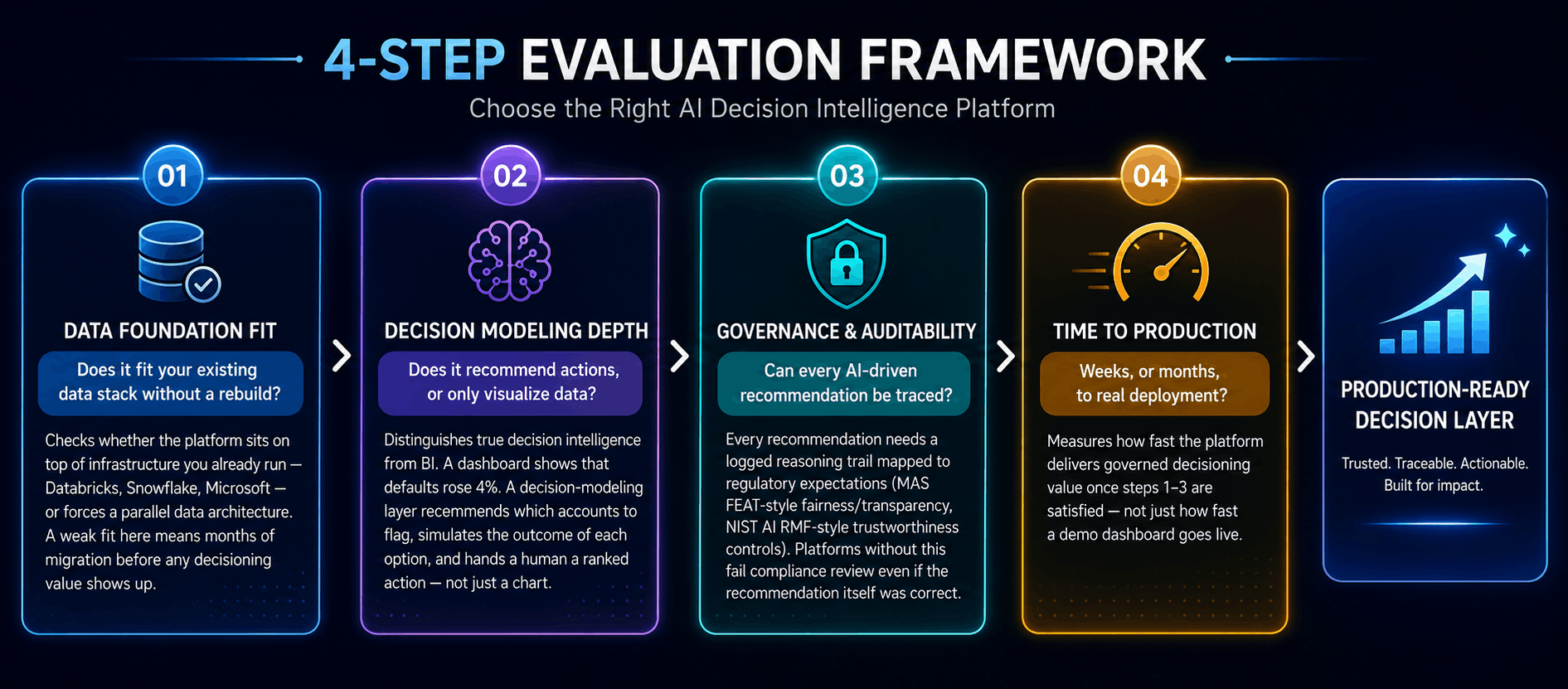
Data foundation fit: can it sit on your existing Databricks, Snowflake, or Microsoft stack without a rebuild, per data integration consulting services best practice?
Decision modeling depth: does it recommend actions and simulate outcomes, or only visualize them?
Governance and auditability: can every AI-driven recommendation be traced, per NIST's AI Risk Management Framework, which is designed to build trustworthiness into AI design, development, and evaluationReleased on January 26, 2023, the Framework was developed through a consensus-driven, open, transparent, and collaborative process (NIST AI RMF)?
Time to production: referenced in what does a production-grade deployment actually require.
Where the Three Platforms Diverge
Applying this framework is where the gap between the three platforms becomes clearest. ThoughtSpot and Domo score well on steps 1 and 4 for pure reporting use cases. VEDA is built around steps 2 and 3 first, which is why it's positioned less as a thoughtspot alternative in the narrow BI sense and more as the layer that sits above BI to turn predictive business insights into governed action.
Measure Your AI Model Risk in Minutes
Comparison Table
Dimension | VEDA | ThoughtSpot | Domo | Best For |
Core architecture | Decision-modeling layer on existing data stack | Search-driven BI, in-memory engine | Low-code app + dashboard builder | Regulated enterprises need VEDA; fast BI needs ThoughtSpot |
Decision intelligence depth | Native — recommends, simulates, logs decisions | Limited — surfaces insights, not actions | Limited — workflow automation, not decision modeling | VEDA for predictive business insights at decision level |
BFSI/regulatory fit | Built-in governance mapped to FEAT/NIST-style controls | Requires custom governance layer | Requires custom governance layer | VEDA for MAS/regulated environments |
Data integration effort | Sits on Databricks/Snowflake/Microsoft with minimal rebuild | Moderate — connector-dependent | Moderate — connector-dependent | Depends on existing stack maturity |
Time to production value | Weeks, via managed onboarding | Fast for self-service BI, slower for governed use | Fast for dashboards, slower for governed use | ThoughtSpot/Domo for pure reporting speed |
(Figures on deployment timelines are directional based on typical enterprise rollouts request platform-specific benchmarks during evaluation. Source required for vendor-published timelines.)
Real-World Enterprise Use Cases
BFSI: Credit Risk Decisioning
A regulated lender consolidating fragmented BI reporting into a single decisioning layer needs both the audit trail MAS expects and the model transparency NIST's framework recommends. Instead of a dashboard flagging that defaults rose, a decision intelligence layer recommends which accounts to review first, models the impact of each option, and logs why. This is the exact pattern documented in Samta.ai's case studies.
General Enterprise: Proptech Operations
A property management firm using CORA-style AI can combine occupancy analytics with a decisioning layer to flag lease renewals worth prioritizing, rather than just reporting occupancy trends after the fact. The same logic extends to talent assessment workflows, where a hiring platform surfaces a ranked shortlist instead of a raw scorecard. Both cases share a pattern: the BI layer already existed. What was missing was the decisioning layer on top of it the specific gap VEDA is built to close.
Key Risks and Failure Modes
Treating BI as decisioning: ThoughtSpot and Domo are excellent at enterprise reporting and analytics, but bolting a "decision" label onto a dashboard doesn't create auditability.
Under-governing AI recommendations: Skipping documentation invites regulatory friction in MAS-supervised environments, and complicates audits under NIST-aligned frameworks even outside the US.
Over-customizing without a framework: Teams that skip the digital transformation managed services step often rebuild the same integration twice, once for reporting and again for decisioning.
Underestimating change management: A decisioning layer changes how teams work, not just what they see rollout plans need owner sign-off before go-live, not after.
Decision Framework: When to Use Which
Use VEDA When
You're in BFSI, fintech, or another regulated sector; you need decisions, not just dashboards; auditability is non-negotiable. See the full VEDA vs traditional BI breakdown.
Use ThoughtSpot When
Your priority is fast, natural-language self-service search across large datasets and governance needs are lighter.
Use Domo When
You need low-code app-building and cross-functional dashboards more than decision-grade AI recommendations.
Explore the deeper comparison: VEDA vs data intelligence platform for a category-level breakdown, or the VEDA AI decision analytics platform product page for capability specifics.
Accelerate Your AI Strategy with Expert Insights

Conclusion
Choosing between VEDA, ThoughtSpot, and Domo isn't about which dashboard looks best it's about whether your organization needs faster reporting or governed, decision-grade AI. In regulated markets, that distinction carries real compliance weight. Start with an honest audit of what your current stack decides versus what it only displays, then map the gap.
About Samta
Samta.ai is a Singapore-headquartered AI Product Engineering & Data Intelligence partner helping enterprises build production-grade AI systems for regulated and data-intensive environments.We help organizations move beyond experimentation by engineering scalable, explainable, and enterprise-ready AI solutions from data foundations and model development to workflow automation and deployment.
Our capabilities combine deep AI expertise, data engineering, and product engineering to deliver measurable business impact across FinTech, BFSI, cybersecurity, regulatory technology, and enterprise operations.
Our enterprise AI products power real-world intelligence systems:
• TATVA : AI-driven data intelligence platform for governed analytics, monitoring, and operational insights
• VEDA : Explainable and audit-ready AI decisioning engine built for compliance-sensitive enterprise workflows
• CORA-Property Management Solutions: : Predictive intelligence platform for real-estate pricing, portfolio optimization, and investment analytics
Backed by ecosystem partnerships with Microsoft, Databricks, Snowflake, and AWS, Samta.ai delivers agile, cost-efficient AI engineering with faster turnaround and enterprise-grade scalability. Trusted by enterprises across FinTech, BFSI, and digital transformation initiatives, Samta.ai embeds AI governance, data privacy, and compliance-by-design principles directly into the AI lifecycle , enabling organizations to scale AI with transparency, accountability, and operational control.
Enterprises leveraging Samta.ai automate 65%+ of repetitive data, analytics, and decision workflows while maintaining governance, explainability, and measurable business outcomes. Samta.ai provides the strategic consulting, AI engineering, and data modernization expertise needed to align enterprise operations with next-generation AI transformation goals.
FAQs
Is VEDA a ThoughtSpot alternative?
Yes, for teams needing decisioning depth rather than search-driven BI. VEDA is positioned as a thoughtspot alternative for regulated industries where recommendations need audit trails, not just fast dashboards.
Is VEDA a Domo alternative?
As a domo alternative, VEDA focuses less on low-code app-building and more on embedded decision modeling with governance mapped to frameworks like MAS FEAT and NIST AI RMF.
What's the real difference in a veda vs thoughtspot decision?
ThoughtSpot excels at self-service search speed; VEDA excels at turning that insight into a governed, auditable recommendation the core of any veda vs thoughtspot evaluation for regulated sectors.
How long does a VEDA deployment take?
Deployment length depends on existing data architecture maturity. Source required for exact benchmarks request a scoped estimate during an AI Readiness Briefing.
What data stack does VEDA require?
VEDA is designed to sit on existing Databricks, Snowflake, or Microsoft environments rather than requiring a rebuild see data integration consulting services for scoping.