

Summarize this post with AI
Most boards approve AI deployments based on a one page summary. Few ever see the actual risk matrix behind that summary, because most enterprises never built one. An ai risk assessment framework that a C-suite can actually use needs to score every AI system on probability and severity, map a specific mitigation to each risk, and track what remains after that mitigation is applied. This guide gives you that structure directly.
AI risk assessment framework:
An AI risk assessment framework scores each identified risk on probability and severity, maps a specific mitigation to it, and records the residual risk remaining after that mitigation, typically organised in a risk matrix a C-suite can review at a glance. This structure aligns with the NIST AI Risk Management Framework's govern, map, measure and manage functions, and with ISO/IEC 42001, the first certifiable AI management system standard. For enterprise and BFSI leadership in Singapore and the wider APAC region, the framework also needs to flag high risk AI use cases explicitly, since regulators increasingly expect differentiated oversight by risk level, not uniform treatment across every system.
What is an AI risk assessment framework?
An ai risk assessment framework is the structured method an organisation uses to identify, score and mitigate the risks introduced by its AI systems, producing a consistent, comparable output across every model in use.
This differs from ai model risk management, which focuses specifically on the technical governance of individual models, validation, monitoring, documentation. A risk assessment framework sits above that, giving the C-suite a portfolio level view across all AI risk, not just model specific detail.
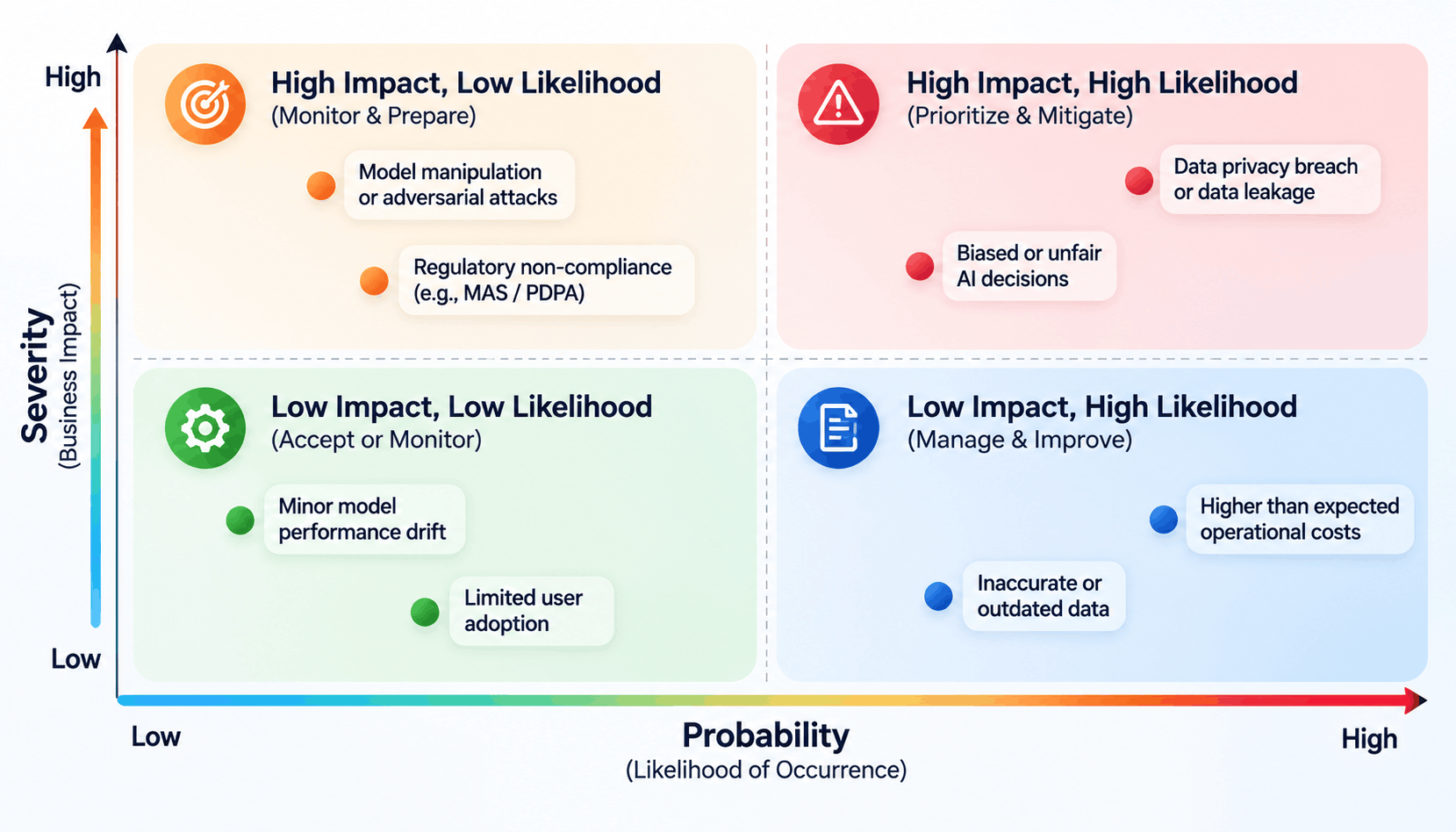
A risk matrix is the core tool this framework produces, plotting each risk by probability and severity to prioritise where mitigation effort should go first. For a deeper breakdown of ready to use structures, see AI risk assessment templates and AI risk management as a model.
Ready to Make Better Decisions with AI?
Why this matters now for enterprise C-suites
Three developments make a structured framework essential in 2026, not a nice to have.
Global technical standards now expect this structure explicitly. The NIST AI Risk Management Framework, organised around govern, map, measure and manage functions, requires organisations to document risks with the kind of probability and severity scoring a proper risk matrix provides.
A certifiable global standard now exists specifically for AI. ISO/IEC 42001:2023, the world's first international AI management system standard, requires organisations pursuing certification to identify, assess and treat AI specific risks with documented rigor, not informal judgment.
APAC regulators are converging on risk tiered oversight. MAS's proposed AI Risk Management Guidelines for Singapore financial institutions expect materiality based risk tiering, meaning high risk AI use cases require more oversight than low risk ones, a principle this framework builds in directly.
See how this connects to the broader governance picture in AI risk management framework fundamentals and AI governance framework versus a standalone risk assessment.
A five step framework for conducting an AI risk assessment
Here is the sequence a C-suite can actually follow, rather than delegating the whole exercise and seeing only a summary.
Inventory every AI system in scope. Include internally built, vendor supplied and embedded AI, since a risk assessment that excludes third party systems misses a major source of exposure.
Score each risk on probability and severity. Probability asks how likely the risk is to occur. Severity asks how damaging it would be if it did. Score both independently before combining them, since a low probability, high severity risk, like a regulatory breach, needs different attention than a high probability, low severity one.
Identify where bias and fairness risks specifically apply. Bias deserves its own explicit check, not a general catch all category, since it requires testing against training data and outputs directly rather than inferring from policy documents alone.
Map a specific mitigation to each scored risk. A listed risk with no mapped mitigation is a description, not a managed risk. AI security and compliance services support organisations building this mitigation mapping directly.
Record residual risk and review on a fixed cycle. Residual risk, what remains after mitigation, is what a board actually needs to see. Samta.ai's Veda platform and the Veda AI decision analytics product support this step directly, keeping risk and mitigation data traceable across connected systems as the engineering execution layer once the framework itself is defined.
Sample AI risk matrix for C-suite review
Risk category | Probability | Severity | Mitigation | Residual risk |
Training data bias affecting a customer facing decision | Medium | High | Documented bias testing before deployment, ongoing monitoring | Low |
Model drift degrading accuracy in production | High | Medium | Scheduled drift monitoring with defined thresholds | Low |
Vendor supplied model missing from inventory | Medium | High | Third party AI added to inventory with same oversight as internal models | Medium |
Hallucinated or factually incorrect output reaching a customer | High | Medium | Human review for high stakes outputs, disclosure that content is AI generated | Low |
No board level accountability for AI decisions | Low | High | Named executive sponsor per material AI system, reviewed quarterly | Low |
This five row structure extends the same pattern across your full AI inventory. For a platform level comparison relevant to the automation layer behind this, see Veda versus a general Data Intelligence Platform.
Ready to Scale AI? Start with a Free Assessment
Real world use cases
Regulated bank: credit model risk matrix surfacing a vendor gap
A bank's AI risk matrix covered every internally built credit model but excluded a vendor supplied fraud detection tool. Running the full inventory step against this framework surfaced the gap directly, since the vendor model had never been scored for probability or severity at all.
Adding the vendor model to the matrix, with the same mitigation mapping applied to internal models, closed the gap before an external review could raise it independently. See related delivery patterns in Samta.ai's case studies.
General enterprise: manufacturer discovering an unscored high severity risk
A manufacturer's AI risk assessment initially scored every risk on probability alone, without a separate severity score. This meant a low probability but potentially severe risk, an AI driven quality control system that could approve defective output, sat buried under more frequent but lower stakes risks.
Separating probability and severity explicitly surfaced this risk as a priority, leading to additional human review steps before the system's output reached production decisions.
Key risks and failure modes
Scoring only probability, not severity separately. A frequent but low impact risk can crowd out attention from a rare but catastrophic one if the two scores are blended together too early.
Excluding third party and vendor supplied AI from the inventory. This is consistently the most common gap in enterprise risk assessments, and regulators increasingly expect the same oversight regardless of who built the system.
Treating bias as a general category rather than a specific test. Bias requires direct testing against training data and model outputs, not inference from a written policy alone.
Listing risks without a mapped mitigation. A risk entry with no specific control attached is documentation, not risk management.
Reviewing the matrix once and shelving it. New AI systems enter production continuously, and a risk matrix built once goes stale within months.
Presenting only a summary to the board, never the underlying matrix. A C-suite that never sees the actual probability and severity scoring cannot meaningfully challenge or prioritise the organisation's AI risk posture.
What are high risk AI use cases, and when to escalate oversight
Escalate to high risk, intensive oversight if the AI system:
Makes or materially influences decisions affecting credit, employment, insurance or legal outcomes
Processes sensitive personal data at scale
Operates with limited human review in a customer facing capacity
Has no clear explainability path for individual decisions
Standard oversight is typically sufficient if the AI system:
Supports internal, low stakes drafting or summarisation tasks
Operates with a human fully in the loop for every output
Has no access to sensitive data and no regulated decision impact
Assess Your AI Model Risk with Confidence
Conclusion
A risk summary without the underlying matrix behind it tells a board very little. The structure above turns abstract AI risk into something scored, mapped and reviewable at a glance. Score every system on probability and severity, map a mitigation to each one, and track what remains. The next step is building this matrix against your own actual AI portfolio.
About Samta
Samta.ai is a Singapore-headquartered AI Product Engineering & Data Intelligence partner helping enterprises build production-grade AI systems for regulated and data-intensive environments.We help organizations move beyond experimentation by engineering scalable, explainable, and enterprise-ready AI solutions from data foundations and model development to workflow automation and deployment.
Our capabilities combine deep AI expertise, data engineering, and product engineering to deliver measurable business impact across FinTech, BFSI, cybersecurity, regulatory technology, and enterprise operations.
Our enterprise AI products power real-world intelligence systems:
• TATVA : AI-driven data intelligence platform for governed analytics, monitoring, and operational insights
• VEDA : Explainable and audit-ready AI decisioning engine built for compliance-sensitive enterprise workflows
• CORA-Property Management Solutions: : Predictive intelligence platform for real-estate pricing, portfolio optimization, and investment analytics
Backed by ecosystem partnerships with Microsoft, Databricks, Snowflake, and AWS, Samta.ai delivers agile, cost-efficient AI engineering with faster turnaround and enterprise-grade scalability. Trusted by enterprises across FinTech, BFSI, and digital transformation initiatives, Samta.ai embeds AI governance, data privacy, and compliance-by-design principles directly into the AI lifecycle , enabling organizations to scale AI with transparency, accountability, and operational control.
Enterprises leveraging Samta.ai automate 65%+ of repetitive data, analytics, and decision workflows while maintaining governance, explainability, and measurable business outcomes. Samta.ai provides the strategic consulting, AI engineering, and data modernization expertise needed to align enterprise operations with next-generation AI transformation goals.
Frequently asked questions
How do you conduct an AI risk assessment?
Start with a complete inventory of every AI system in use, including vendor supplied and embedded tools, then score each identified risk on probability and severity independently. Map a specific mitigation to each risk, and record the residual risk that remains after that mitigation is applied. Review the full matrix on a fixed cycle, since new AI systems enter production continuously and a static assessment goes stale.
What are high risk AI use cases?
High risk AI use cases typically include systems that make or materially influence decisions affecting credit, employment, insurance or legal outcomes, process sensitive personal data at scale, or operate with limited human review in customer facing roles. These require more intensive oversight, more frequent validation and clearer explainability than low stakes, internal only AI tools.
What framework should a Chief Risk Officer use to assess enterprise AI deployment risks?
A Chief Risk Officer should use a framework that scores probability and severity independently, maps a specific mitigation to each identified risk, and tracks residual risk after mitigation, rather than a framework that produces only a single blended risk score. Aligning this structure to the NIST AI Risk Management Framework or ISO/IEC 42001 gives the assessment credibility against both global technical standards and APAC regulatory expectations.
What is the difference between probability and severity in an AI risk matrix?
Probability measures how likely a given risk is to actually occur, while severity measures how damaging the outcome would be if it did. Scoring these independently matters because a rare but catastrophic risk, such as a major compliance breach, needs different prioritisation than a frequent but low impact one, such as a minor formatting error in generated content.
How often should an AI risk assessment framework be reviewed?
An AI risk assessment should be reviewed at minimum annually, and immediately whenever a new AI system enters production or an existing one changes materially. Risk profiles shift as data, usage patterns and regulatory expectations evolve, so a matrix built even a year ago may no longer accurately reflect an organisation's actual AI risk exposure.