
Summarize this post with AI
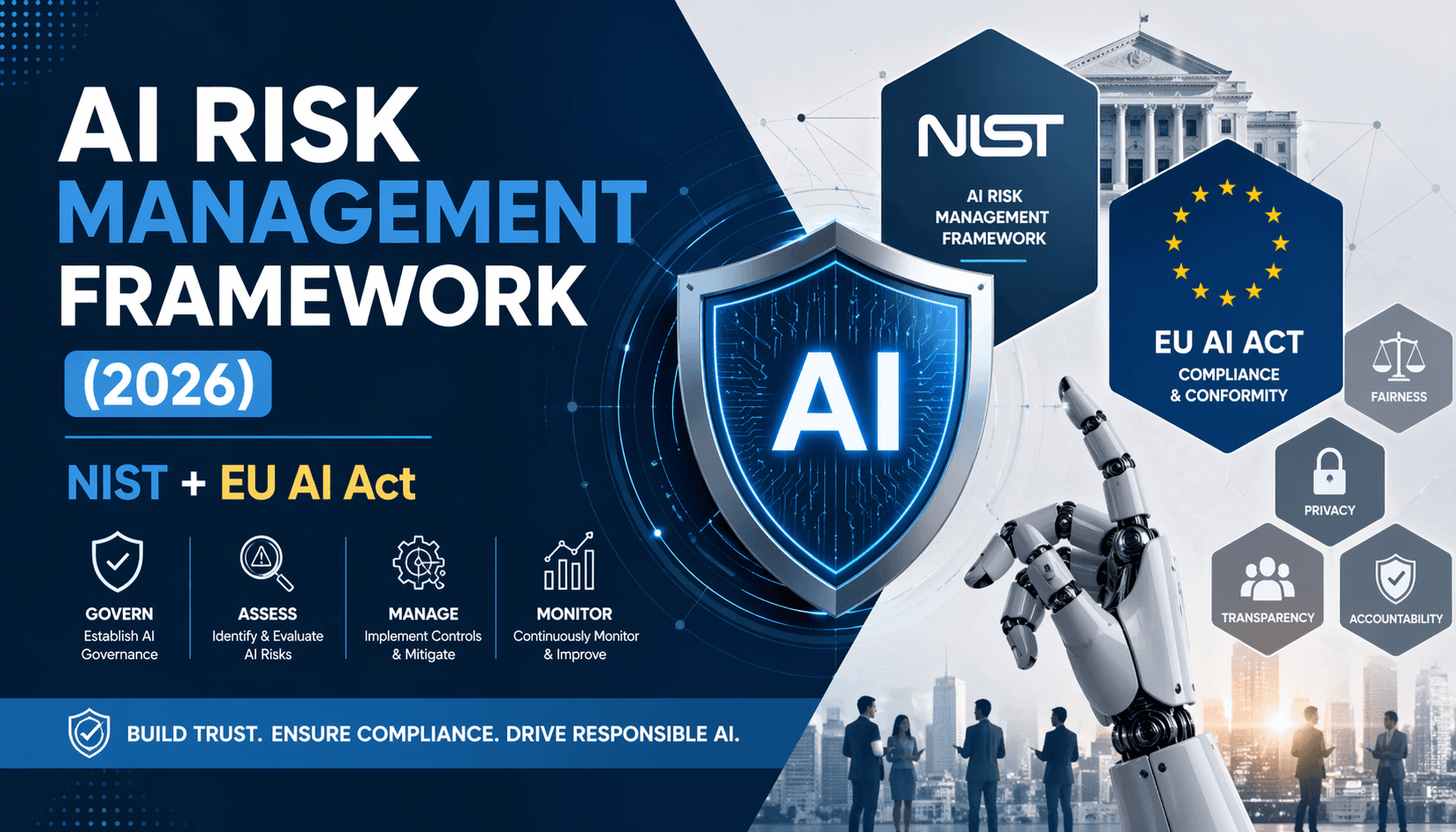
In 2026, an ai risk management framework is no longer optional it is the foundation for building compliant, scalable, and trustworthy AI systems. The convergence of global standards like the National Institute of Standards and Technology (NIST) and the EU AI Act means enterprises must align both technical and legal risk strategies. Staying updated with nist ai risk management framework update news today ensures your organization remains compliant while maintaining innovation velocity. At its core, what is the NIST AI risk Management Framework? It is a structured methodology to identify, assess, and mitigate AI risks across the lifecycle covering governance, mapping, measurement, and management. For enterprises, this translates into proactive risk mitigation, reduced compliance exposure, and stronger stakeholder trust all powered by a mature ai risk management framework ai rmf approach.
Key Takeaways
Regulatory Convergence: NIST RMF and EU AI Act now function as complementary frameworks
Mandatory Compliance: High-risk AI systems require documented risk controls
Continuous Governance: Shift toward real-time monitoring using an ai risk management framework ai rmf
Global Influence: Standards like ai risk management framework mas are shaping international compliance expectations
Operational Maturity: AI is now treated as a governed enterprise asset
What This Means in 2026
The modern enterprise must go beyond fragmented compliance efforts and adopt a unified governance strategy. A strong starting point is implementing a structured AI governance framework for enterprises. This ensures AI systems are not treated as black boxes but as auditable, controllable assets.
Additionally, global financial regulators such as the Monetary Authority of Singapore are influencing governance standards. The rise of ai risk management framework mas highlights how BFSI organizations must align with multi-region compliance requirements. To prepare, leaders should evaluate readiness using AI readiness strategies for CTOs in 2026
Benchmark Your Organization's AI Readiness Today
Core Comparison of Frameworks
Aspect | Samta.ai Approach | NIST AI RMF | EU AI Act | MAS / BFSI Standard |
Primary Goal | Automated Governance & Compliance | Technical Trustworthiness | Legal & Safety Regulation | Financial Risk & Stability |
Nature | Real-time, software-driven | Voluntary, guidance-based | Mandatory regulation | Regulatory + Supervisory |
Target | Enterprise AI/ML Pipelines | Developers & Users | Providers & Deployers | Banks & Financial Institutions |
Enforcement | Proactive Guardrails | Non-binding | Heavy Fines/Bans | Audits & Regulatory Oversight |
Global Relevance | Enterprise-wide scalability | US-led global influence | EU jurisdiction with global impact | Strong influence via ai risk management framework mas |
Practical Use Cases
Financial Services
Organizations use governance dashboards aligned with AI governance KPIs for performance tracking to detect bias and ensure fair lending practices.
Healthcare AI
Agent-based systems require strict oversight through Agentic AI governance framework to maintain clinical safety and accountability.
Enterprise Marketing
Using AI governance for GenAI systems ensures LLM-generated content complies with brand and legal standards.
Supply Chain & HR
From predictive maintenance to hiring algorithms, organizations embed risk controls aligned with an ai risk management framework to prevent operational and ethical failures.
AI Risk Assessment Templates
Access standardized documentation and checklists to accelerate your path to NIST and EU AI Act alignment.
Limitations & Risks
No framework guarantees zero risk. Instead, an ai risk management framework ensures risks are continuously monitored and reduced to acceptable levels.
Over-reliance on static checklists like a basic Ai risk management framework template can create blind spots, especially as AI models evolve.
According to a , continuous monitoring is critical because AI systems degrade over time due to data drift and changing environments.
At the same time, excessive compliance rigidity can slow innovation. The goal is balance structured governance without operational friction.
Benchmark Your AI Models Against Risk Best Practices
Decision Framework
To choose the right approach:
Operating in the EU? EU AI Act compliance is mandatory
Building internal AI systems? NIST RMF ensures technical robustness
Scaling globally? Combine both for full-spectrum coverage
For implementation, enterprises increasingly rely on AI security and compliance services. This hybrid strategy ensures both regulatory alignment and operational efficiency.
Conclusion
The evolution of the ai risk management framework signifies a maturing industry that prioritizes safety alongside performance. As we move through 2026, the convergence of NIST and EU standards will provide the roadmap for sustainable AI adoption. Samta.ai stands at the forefront of this transition, offering deep expertise in AI and ML to help enterprises navigate these complex regulatory waters with confidence and technical precision.
About Samta
Samta.ai is a Singapore-headquartered AI Product Engineering & Data Intelligence partner helping enterprises build production-grade AI systems for regulated and data-intensive environments.We help organizations move beyond experimentation by engineering scalable, explainable, and enterprise-ready AI solutions from data foundations and model development to workflow automation and deployment.
Our capabilities combine deep AI expertise, data engineering, and product engineering to deliver measurable business impact across FinTech, BFSI, cybersecurity, regulatory technology, and enterprise operations.
Our enterprise AI products power real-world intelligence systems:
• TATVA : AI-driven data intelligence platform for governed analytics, monitoring, and operational insights
• VEDA : Explainable and audit-ready AI decisioning engine built for compliance-sensitive enterprise workflows
• CORA-Property Management Solutions: : Predictive intelligence platform for real-estate pricing, portfolio optimization, and investment analytics
Backed by ecosystem partnerships with Microsoft, Databricks, Snowflake, and AWS, Samta.ai delivers agile, cost-efficient AI engineering with faster turnaround and enterprise-grade scalability. Trusted by enterprises across FinTech, BFSI, and digital transformation initiatives, Samta.ai embeds AI governance, data privacy, and compliance-by-design principles directly into the AI lifecycle , enabling organizations to scale AI with transparency, accountability, and operational control.
Enterprises leveraging Samta.ai automate 65%+ of repetitive data, analytics, and decision workflows while maintaining governance, explainability, and measurable business outcomes. Samta.ai provides the strategic consulting, AI engineering, and data modernization expertise needed to align enterprise operations with next-generation AI transformation goals.
Move from AI Ideas to Business Impact
FAQs
How do I start a NIST AI RMF implementation?
Begin by mapping your AI systems to understand their impact. Utilizing an Ai risk management framework template can help document the "Map, Measure, and Manage" phases. This ensures every model is accounted for before moving to the 2026 guide to AI implementation.
Is the EU AI Act mandatory for US companies?
Yes, if the AI system is used within the EU or its output affects individuals in the EU. Companies must align their internal Veda platform or similar governance tools with EU standards to maintain market access and avoid extraterritorial legal action.
What is the difference between AI Governance and AI Risk Management?
Governance is the overarching strategy and policy setting for AI within an organization. Risk management is the specific set of tactical actions and frameworks, like the NIST AI RMF, used to identify and mitigate specific hazards associated with those AI systems.
Can small startups skip these frameworks?
While some exemptions exist for research, most commercial AI applications must adhere to basic safety standards. Implementing a lightweight version of a framework early on prevents massive technical debt and future legal hurdles as the company scales.