
Summarize this post with AI
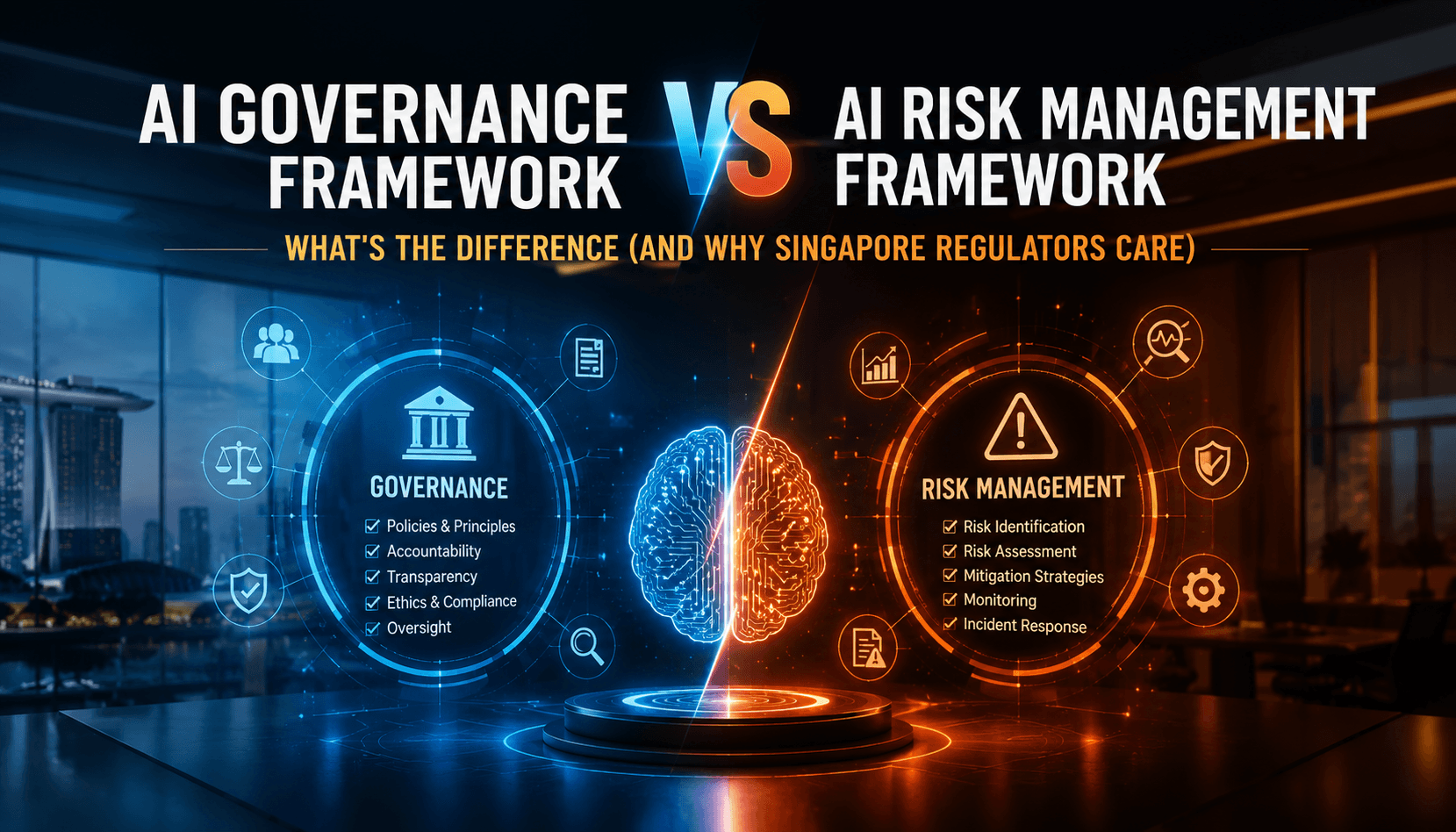
Most institutions building an ai governance framework assume it is the same document as their AI risk management framework, just under a different name. It is not, and MAS treats them as distinct disciplines for a reason. A governance framework sets policy, accountability, and decision rights for AI use across the organization. A risk management framework identifies and mitigates the specific risks a given AI system creates. Confusing the two leaves institutions with a governance charter nobody can act on, or a risk register with no accountable owner sitting above it. Here is where each one actually starts and ends.
AI Governance Framework:
An ai governance framework establishes organization wide policy, accountability structures, and decision rights for how AI is used, while an ai risk management framework identifies, assesses, and mitigates the specific risks individual AI systems create. ISO/IEC 42001 is the international standard for AI governance, an AI management system covering policy and accountability, while ISO/IEC 23894 and the NIST AI RMF address AI risk management specifically. In Singapore, MAS's FEAT principles anchor the governance side, and the proposed AI Risk Management Guidelines anchor the risk side, with both frameworks expected to operate together, not as substitutes for each other.
What is AI governance, and how it differs from AI risk management
What is ai governance? It is the policy layer, who is accountable for AI outcomes, what principles guide AI use, and how decisions about deploying AI get made and escalated. This is closer to IT governance vs AI governance in structure than to a technical risk discipline, it defines roles, committees, and objectives rather than assessing a specific system's failure modes.
AI risk management, by contrast, operates underneath that policy layer. It is the practical work of identifying what could go wrong with a specific model or agent, how severe that risk is, and what controls reduce it. The distinction mirrors model risk vs data governance in traditional banking risk functions, model risk teams assess individual models, while data governance sets the policy those assessments operate within.
ISO/IEC 42001 makes this split explicit at a standards level. It specifies requirements for an AI management system, the governance layer, while a separate standard, ISO/IEC 23894, provides guidance specifically on AI risk management. Two standards exist because these are genuinely two different bodies of work, not one document split in half for convenience.
See Where Your Business Stands with AI
Why Singapore regulators care about this distinction now
Ai risk management framework mas expectations have made this distinction matter operationally, not just academically, for three reasons.
MAS FEAT sets the governance principles, not the risk controls. Fairness, Ethics, Accountability, and Transparency describe what good AI governance looks like, but they do not themselves specify how to assess a given model's fairness testing results.
The proposed AI Risk Management Guidelines fill the risk side MAS FEAT left open. AIRG adds AI inventory requirements, risk materiality assessment, and lifecycle controls, the practical risk management layer that sits underneath FEAT's governance principles.
Institutions without both layers fail examinations differently. A firm with governance but no risk management has policy nobody can evidence against a specific model. A firm with risk management but no governance has scattered model reviews with no board level accountability tying them together.
Our guide on AI governance for MAS supervised institutions and our companion piece on MAS AI risk management both cover their respective half of this split in more depth than one article can hold together.
It is worth naming a third category that does not fit neatly into either box. Our SAFR vs AIRG comparison covers a runtime standard for agentic AI that is neither a governance framework nor a risk management framework in the sense described here, it is a technical execution layer that sits underneath both, verifying an agent's action in real time rather than setting policy or assessing risk on a periodic cycle.
How the two frameworks fit together in practice
Building both frameworks correctly means treating them as connected layers, not competing documents.
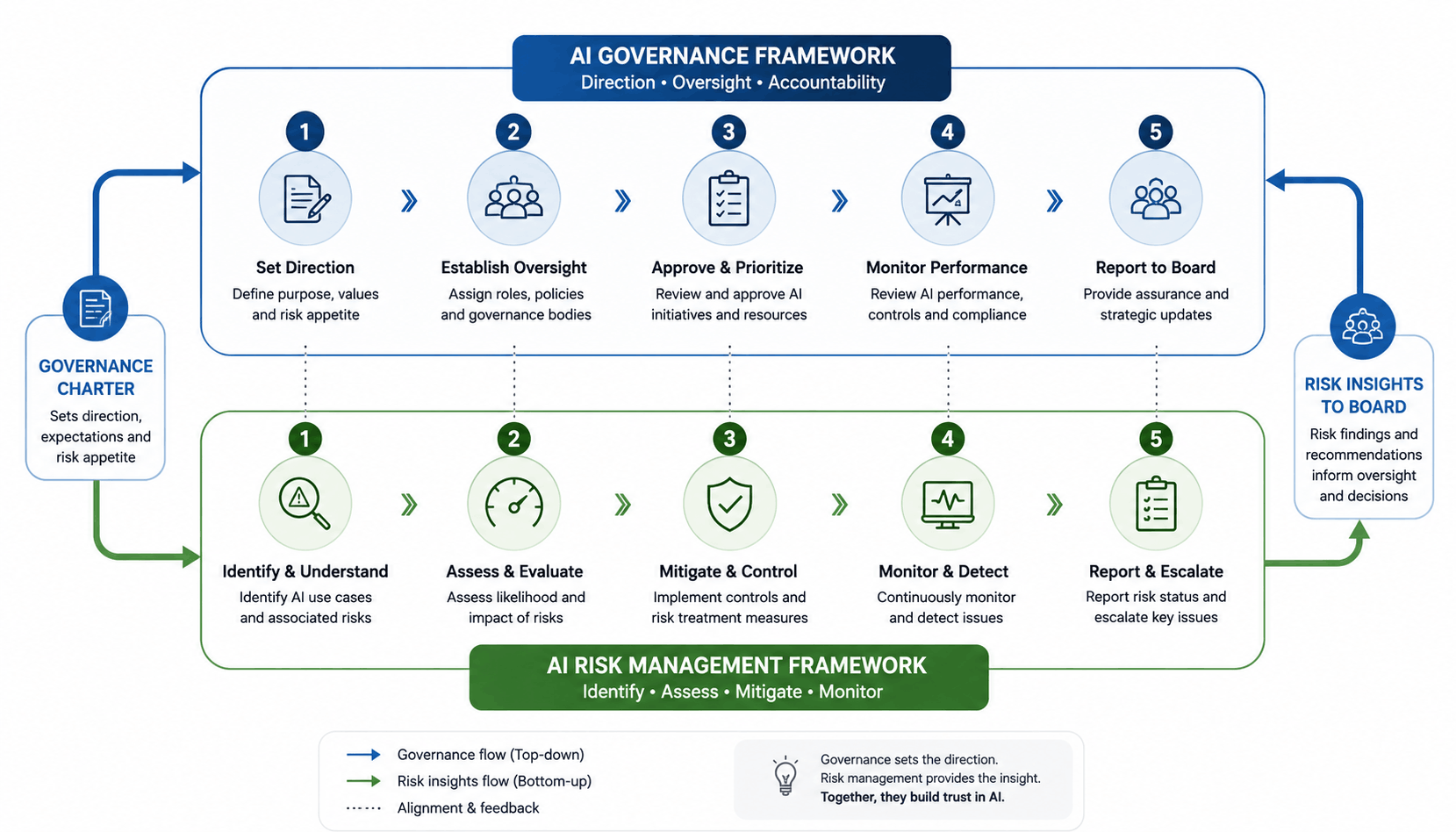
Governance sets the charter. A board approved AI policy names who is accountable for AI outcomes and what principles, drawn from FEAT or an internal ethics standard, guide every AI decision.
Governance defines the committee structure. A model risk governance committee, reporting to the CRO or a dedicated AI governance lead, becomes the body both frameworks report through.
Risk management builds the inventory. Every model and agent gets logged, classified by risk materiality, impact, complexity, and reliance, which the governance charter above already authorized the committee to require.
Risk management runs the technical assessment. Fairness testing, explainability checks, and lifecycle controls happen here, against the specific standards, NIST AI RMF or ISO/IEC 23894, an institution has chosen to follow.
Governance receives the risk findings. Board risk reporting closes the loop, translating individual risk assessments back into the accountability structure governance established in step one.
This is where the engineering execution layer matters. Samta.ai builds the VEDA AI decision analytics platform to hold both layers in one system, the governance charter, committee structure, and accountable owners on one side, and the AI inventory, risk materiality scores, and lifecycle evidence on the other, rather than maintaining them as two disconnected documents. Institutions building out the risk specific half of this structure should also see our dedicated AI risk management framework guide, and our broader AI governance framework for 2026 roadmap covers how both sides typically get sequenced across a full year program.
Institutions weighing whether a general analytics tool can hold both layers should see how VEDA compares to other data intelligence platforms, since most were not built to separate governance evidence from risk evidence while still connecting the two. The VEDA platform keeps the governance charter and the risk inventory as linked records rather than two systems a team has to reconcile manually before every board report.
AI governance framework vs AI risk management framework at a glance
Dimension | AI Governance Framework | AI Risk Management Framework | Reference Standard | Primary Owner |
Purpose | Sets policy, accountability, and decision rights for AI use | Identifies and mitigates the specific risks an AI system creates | ISO/IEC 42001 | Board and senior management |
Scope | Organization wide, spans culture, roles, and oversight structure | System or model specific, scoped to a defined risk surface | ISO/IEC 23894 | CRO or model risk function |
Time Horizon | Ongoing, revisited as strategy and regulation evolve | Reassessed at each lifecycle stage or material model change | NIST AI RMF | Model owners |
Primary Artifact | A governance charter, AI policy, and committee structure | A risk register, materiality assessment, and control set | MAS FEAT principles | Model risk governance committee |
Singapore Regulatory Anchor | MAS FEAT's accountability and transparency principles | MAS AIRG's lifecycle controls and materiality assessment | Both build on FEAT | CRO reporting to the board |
Understand Your AI Model Risk Exposure
Real world enterprise use cases
BFSI: a bank with strong risk management but no governance charter
A bank had a mature model risk function running fairness testing and lifecycle reviews on every model, but no board approved AI governance charter naming who was ultimately accountable for AI outcomes. During a review, the bank could evidence individual model risk assessments but not who owned the decision to approve a new AI use case in the first place. Building a governance charter, supported by AI security and compliance services, closed that accountability gap without requiring the bank to rebuild its already solid risk management work.
General enterprise: a proptech firm with governance but no risk assessment discipline
A proptech firm had written a clear AI ethics policy and named an accountable executive, satisfying the governance side, but had never run a structured risk materiality assessment on any of its models. Reviewing enterprise AI engineering in Singapore helped the firm add the missing risk assessment layer underneath its existing governance charter, rather than treating the two as separate projects on separate timelines.
Key risks and failure modes
Writing a governance policy with no risk assessment behind it. A charter naming accountability without a risk inventory to apply it to is a document, not a working framework.
Running risk assessments with no governance structure above them. Model risk teams doing good technical work with no board level accountability structure leave institutions unable to answer who ultimately approved a given AI use case.
Treating one standard as covering both disciplines. ISO/IEC 42001 and ISO/IEC 23894 exist as separate standards because governance and risk management are genuinely separate bodies of work, not one document under two names.
Assuming MAS FEAT alone satisfies AIRG's expectations. FEAT sets governance principles; AIRG's risk materiality assessment and lifecycle controls are a distinct, additional requirement.
No connection between the two layers over time. A governance charter and a risk register that never reference each other in reporting drift apart, leaving neither current by the time an examiner asks for both.
When to build governance first versus risk management first
Build the governance framework first when:
No named accountable owner exists for AI decisions at board or senior management level
Multiple business units are making independent AI decisions with no shared policy
You need board level buy in before a risk management function can get the resourcing it needs
Build the risk management framework first when:
Governance and accountability already exist, but no AI inventory or risk materiality process has been run
You have specific models or agents in production with no documented risk assessment
An examination or audit has already flagged a lack of technical risk evidence
Reviewing Samta.ai's case studies alongside your own documentation gives a useful benchmark for how other institutions have sequenced this work depending on which gap was larger.
Start Your AI Transformation Journey

Conclusion
An ai governance framework and an AI risk management framework are not the same document under two names, they are two connected layers, policy and accountability on one side, technical risk assessment on the other. Institutions that build and connect both, rather than treating one as a substitute for the other, are the ones that can answer an examiner's questions about either.
About Samta
Samta.ai is a Singapore headquartered AI product engineering and data intelligence partner helping enterprises build production grade AI systems for regulated and data intensive environments. We help organizations move beyond experimentation by engineering scalable, explainable, and enterprise ready AI solutions, from data foundations and model development to workflow automation and deployment.
Our capabilities combine deep AI expertise, data engineering, and product engineering to deliver measurable business impact across FinTech, BFSI, cybersecurity, regulatory technology, and enterprise operations.
Our enterprise AI products power real world intelligence systems:
TATVA: AI driven data intelligence platform for governed analytics, monitoring, and operational insights
VEDA: Explainable and audit ready AI decisioning engine built for compliance sensitive enterprise workflows
CORA Property Management Solutions: Predictive intelligence platform for real estate pricing, portfolio optimization, and investment analytics
Backed by ecosystem partnerships with Microsoft, Databricks, and Snowflake, Samta.ai delivers agile, cost efficient AI engineering with faster turnaround and enterprise grade scalability. Samta.ai embeds AI governance, data privacy, and compliance by design principles directly into the AI lifecycle, enabling organizations to scale AI with transparency, accountability, and operational control.
Frequently asked questions
What is the difference between an AI governance framework and an AI risk management framework?
An AI governance framework sets organization wide policy, accountability, and decision rights for AI use. An AI risk management framework identifies, assesses, and mitigates the specific risks individual AI systems create. Governance is the policy layer, risk management is the technical assessment layer underneath it.
What is AI governance?
AI governance is the set of policies, accountability structures, and decision rights an organization establishes for how AI is used, including who approves new AI use cases and what principles guide those decisions, distinct from the technical work of assessing a specific model's risk.
Does ISO/IEC 42001 cover AI risk management as well as governance?
ISO/IEC 42001 focuses on AI governance, specifying requirements for an AI management system covering policy and accountability. AI risk management specifically is addressed in a separate standard, ISO/IEC 23894, reflecting that the two disciplines are treated as distinct even at the standards level.
How does MAS FEAT relate to AI risk management?
MAS FEAT sets governance principles, fairness, ethics, accountability, and transparency, that describe what responsible AI governance looks like. The proposed AI Risk Management Guidelines build the practical risk assessment and lifecycle control layer underneath those principles.
Can an institution have good AI risk management without AI governance?
Yes, and it is a common gap. A model risk function can run strong technical assessments with no board approved governance charter above it, leaving the institution unable to show who is ultimately accountable for approving AI use cases in the first place.