
Summarize this post with AI
Most Singapore enterprises underestimate their ai transformation cost singapore by 30 to 50 percent before a single line of code is written. The problem is rarely the build cost; it is everything surrounding it: data preparation, compliance overhead, change management, and ongoing inference fees that compound over the first two years of operation. Enterprise AI implementation cost in Singapore in 2026 ranges from S$8,000 for a basic chatbot to over S$600,000 for a full enterprise AI platform, but what sits between those numbers determines whether your program delivers ROI or becomes expensive technical debt. This guide covers verified 2026 cost benchmarks, the hidden cost layers most enterprises miss, and how Singapore's Budget 2026 grant stack materially changes the net investment figure.
AI Transformation Cost Singapore
ai transformation cost singapore for enterprise programs in 2026 ranges from S$250,000 for a focused single-department deployment to S$2,000,000 or more for organization-wide ai transformation for business with compliance infrastructure. Data engineering consistently accounts for 30 to 40 percent of total project budget, and hidden costs including inference fees, model retraining, compliance updates, and change management add 30 to 50 percent on top of the build cost over the first two years. Singapore's Budget 2026 grant stack, including the Enterprise Development Grant at 50 percent co-funding and the Enterprise Innovation Scheme 400 percent tax deduction on qualifying AI expenditure, can materially reduce the net investment for eligible enterprises.
What AI Transformation Cost Singapore Actually Covers
What is enterprise AI in this context is the first question worth answering clearly. Enterprise AI transformation is not purchasing a SaaS tool or enabling a copilot feature. It is a structured program covering strategy, data infrastructure, model development or integration, deployment, governance, and ongoing monitoring, all of which carry distinct cost lines.
The six phases of an enterprise AI implementation are strategy and use case selection (4 to 8 weeks, S$20,000 to S$80,000), pilot (8 to 12 weeks, S$50,000 to S$150,000), infrastructure buildout, deployment, governance, and ongoing operations. Each phase has a separate cost driver, and enterprises that compress timelines without adequate change management consistently fail in the deployment phase.
For enterprises beginning this journey, the AI maturity models guide helps identify which phase your organization is actually at before committing budget to the wrong stage.
Get Your Personalized AI Assessment Report
Why 2026 Is a Turning Point for AI Transformation Investment in Singapore
Three forces are reshaping the ai transformation cost singapore calculation this year specifically.
1. Singapore Budget 2026 created the most aggressive AI incentive stack the government has ever deployed: The National AI Impact Programme announced by IMDA targets 10,000 enterprises and 100,000 workers over three years. The Champions of AI programme provides tailored transformation support for selected enterprises making AI a core driver of productivity and growth.
2. The Enterprise Innovation Scheme now covers AI expenditure: Singapore's EIS provides a 400 percent tax deduction on qualifying AI expenditure, capped at S$50,000 per year for assessment years 2027 and 2028, announced by Prime Minister Lawrence Wong in Budget 2026. The Enterprise Development Grant covers up to 50 percent of qualifying project costs for eligible SMEs, and the WDG JR+ grant covers up to 70 percent for qualifying workforce transformation components.
3. Compliance costs are rising, not falling: For regulated industries such as finance and healthcare, compliance requirements increase project costs by 15 to 30 percent above general enterprise benchmarks. With MAS's AI Risk Management Toolkit and the proposed AI Guidelines both active in 2026, BFSI enterprises face a compliance layer that is not optional. The why AI transformation governance matters guide covers this compliance cost driver in depth.
The AI Transformation Cost Framework: Phase by Phase
Use this breakdown to build or validate your enterprise ai implementation cost estimate for a Singapore program.
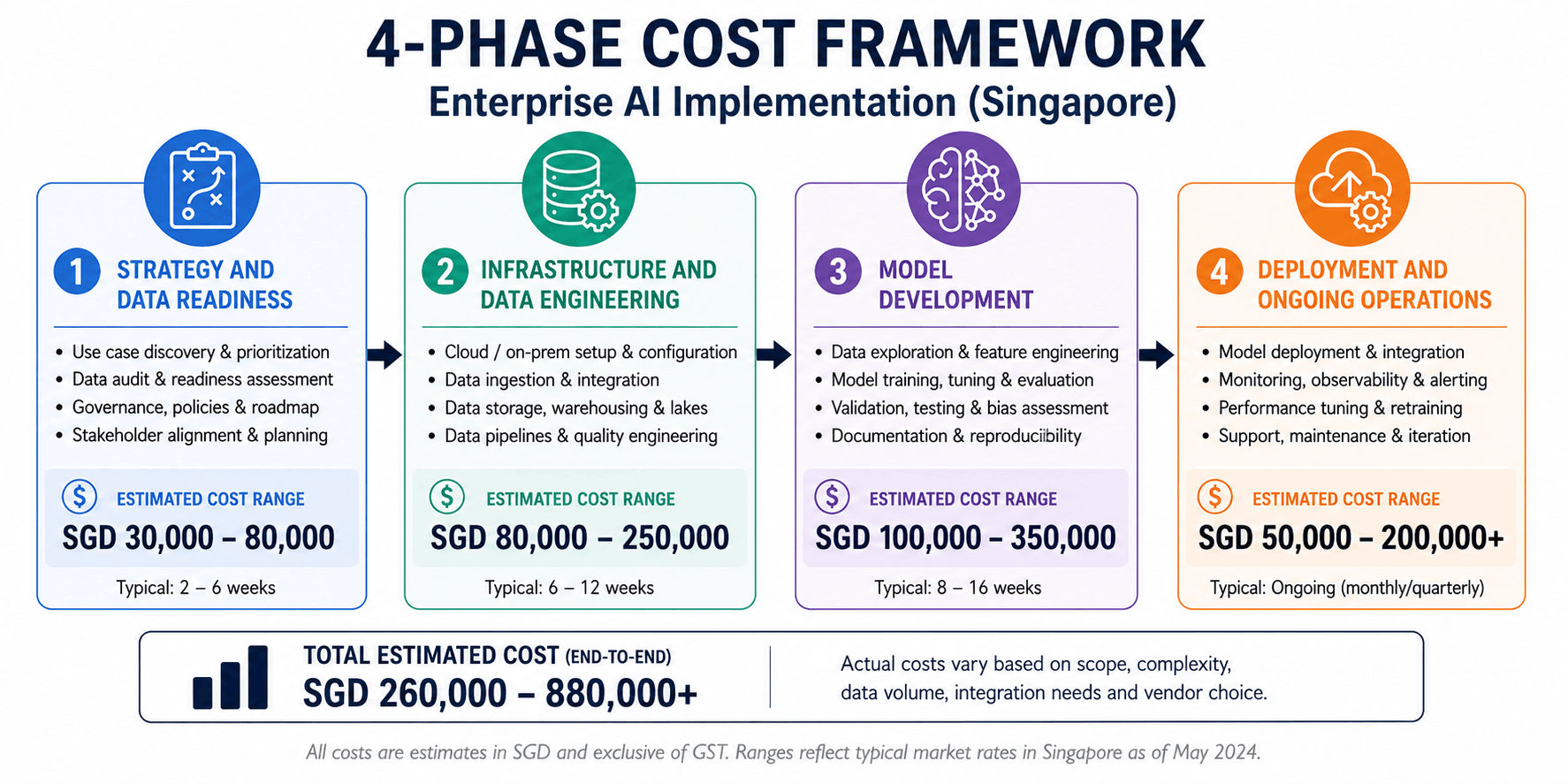
Phase 1: Strategy and Data Readiness (S$20,000 to S$80,000)
AI readiness assessment: audit current data estate, technology stack, and use case fit before any build decision.
Use case prioritization: identify the two to three highest-ROI AI use cases to sequence first, rather than attempting organization-wide transformation simultaneously.
Data readiness gap analysis: data preparation accounts for 30 to 40 percent of total project budget; knowing the gap before the build begins prevents the cost doubling that occurs when data problems surface mid-project.
Phase 2: Infrastructure and Data Engineering (S$80,000 to S$300,000)
Cloud platform buildout: production AI systems require computing infrastructure for training and deployment; cloud compute alone runs S$1,000 to S$20,000 per month depending on scale.
Data pipeline construction: integration costs range from S$5,000 for simple API connections to over S$150,000 for complex enterprise integrations across legacy systems.
Data governance layer: establishing lineage, quality scoring, and access controls before model development, not after, prevents the compliance retrofit costs that inflate BFSI program budgets.
Phase 3: Model Development or Integration (S$50,000 to S$200,000)
Build vs. integrate decision: most enterprises use pre-built foundation models with fine-tuning rather than training from scratch; fine-tuning on proprietary data is significantly cheaper than full model training.
Vendor model integration: integrating an existing AI vendor's model with your enterprise systems is typically the fastest path to a production-ready system, but integration costs at the enterprise level are rarely trivial.
Bias testing and explainability documentation: for BFSI and regulated sectors, these are not optional additions; they are part of the build cost for any model touching regulated decisions.
Phase 4: Deployment, Governance, and Ongoing Operations
This is where most enterprises underestimate their true ai transformation pricing exposure. Maintenance and optimization alone typically run 15 to 25 percent of the initial development cost annually. Inference fees compound as usage scales. Model retraining when drift occurs is a recurring cost, not a one-time investment.
Samta.ai's Veda AI decision analytics platform reduces this phase's cost by unifying model monitoring, drift detection, and governance documentation into a single operational layer, rather than requiring separate tooling for each function. The Veda AI decision analytics platform connects to cloud data platforms including Databricks and Snowflake, and pairs with Samta.ai's data integration consulting services for enterprises that need the data infrastructure layer built before model deployment can proceed.
AI Transformation Cost Singapore: Tier Comparison
Tier | Scope | Typical Investment (SGD) | Timeline | Compliance Cost Premium | Samta.ai Engagement Type |
Pilot or proof of concept | Single use case, limited data scope | S$20,000 to S$150,000 | 8 to 16 weeks | Low, general controls only | AI readiness assessment |
Focused deployment | Single department, production-ready | S$250,000 to S$600,000 | 12 to 18 months | Moderate, standard governance | Data integration plus model deployment |
Enterprise platform | Multi-department, integrated AI stack | S$600,000 to S$2,000,000 | 18 to 36 months | High, full lifecycle controls required | Full AI transformation program |
BFSI or regulated enterprise | Any scope with MAS or sector compliance | Add 15 to 30 percent above base | Plus 3 to 6 months | Very high, compliance embedded in build | AI governance plus security compliance |
Organisation-wide transformation | Full AI-native enterprise program | S$2,000,000 to S$15,000,000 | 36 to 60 months | Highest, board-level governance required | Champions of AI programme aligned |
Evaluate Your AI Model Risk Posture
Enterprise Use Cases: What Singapore Enterprises Actually Spend
Use Case 1: Singapore Bank Deploying AI Credit Decisioning
A mid-size Singapore bank scoped an AI credit decisioning deployment at S$800,000. After accounting for the 20 percent compliance overhead required by MAS governance expectations, data pipeline work to unify four legacy data sources, and independent model validation, the actual spend landed at just over S$1,000,000 over 18 months. The bank accessed the Enterprise Development Grant to offset 30 percent of qualifying costs, reducing net investment to approximately S$700,000. Detailed governance documentation from the outset, following the approach in the enterprise AI governance guide, meant no compliance retrofit was required when MAS supervisory review was conducted.
Use Case 2: Logistics Enterprise Deploying Demand Forecasting AI
A Singapore logistics company deployed demand forecasting AI at the focused deployment tier, with a total spend of S$420,000 over 14 months. Data engineering accounted for S$160,000 of this, the largest single cost line, consistent with the 30 to 40 percent rule. Cloud infrastructure runs at S$8,000 per month in ongoing costs. The company qualified for a 400 percent EIS tax deduction on S$50,000 of qualifying AI expenditure, and used a hybrid delivery model, Singapore-side oversight with offshore engineering execution, which reduced total engineering cost by approximately 40 percent against an equivalent Singapore-only team structure.
Key Risks and Failure Modes
Underestimating data readiness cost: The most accurate predictor of AI cost overrun is data readiness: when data pipelines, quality controls, or integrations must be rebuilt mid-project, cost doubles or sometimes triples. This is the single most consistent budget failure across Singapore AI programs in 2026.
Treating 80 percent of budget as technology spend: BCG's 2026 AI Readiness Report documents that organizations following the 10-20-70 rule, 10 percent technology, 20 percent data and analytics, and 70 percent people and process, outperform those treating AI as a technology project by 3x on ROI. Singapore enterprise budgets consistently over-index on technology and under-index on change management.
Ignoring inference cost at scale: 80 percent of enterprises miss their AI infrastructure forecasts by more than 25 percent, and 84 percent report significant gross margin erosion tied to AI workloads. Inference fees at production scale are rarely modeled accurately in initial business cases.
Not stacking available grants: Most enterprises access only one grant programme rather than stacking EDG, WDG JR+, and EIS together, leaving significant government co-funding unclaimed. For an S$800,000 program, grant stacking can reduce net investment by S$200,000 to S$300,000 with proper structuring. The intersection of AI investment and governance covers how governance-related costs qualify for specific grant categories.
AI Implementation Playbook Get a phase-by-phase cost breakdown template mapped to your use case and Singapore grant eligibility. Request the AI Implementation Playbook from Samta.ai and build a defensible business case before your next budget cycle.
Decision Framework: Are You Budgeting Correctly?
Data readiness assessment is complete before the build budget is set
Compliance cost premium (15 to 30 percent for regulated industries) is included in total cost of ownership
Hidden costs including inference fees, model retraining, and change management are modeled over 24 months, not just the build phase
Grant eligibility (EDG, WDG JR+, EIS) has been assessed by a qualified advisor before project kick-off
The delivery model (Singapore-only, hybrid, or offshore-led) has been evaluated against total cost impact
Ongoing operations costs at 15 to 25 percent of build cost annually are included in the business case
If fewer than four boxes are checked, your ai transformation pricing estimate is likely to be revised upward during execution rather than at planning stage.
Get Clarity Before You Invest in AI

Conclusion
ai transformation cost singapore in 2026 is not simply a technology budget line. It is a multi-layer investment spanning data infrastructure, model development, compliance, change management, and ongoing operations, with Singapore Budget 2026 grants now creating a meaningful opportunity to reduce net investment for enterprises that structure their programs correctly. Enterprises that plan for hidden costs upfront and access available grant stacking consistently outperform those that discover these factors mid-program.
About Samta
Samta.ai is a Singapore-headquartered AI Product Engineering & Data Intelligence partner helping enterprises build production-grade AI systems for regulated and data-intensive environments.We help organizations move beyond experimentation by engineering scalable, explainable, and enterprise-ready AI solutions from data foundations and model development to workflow automation and deployment.
Our capabilities combine deep AI expertise, data engineering, and product engineering to deliver measurable business impact across FinTech, BFSI, cybersecurity, regulatory technology, and enterprise operations.
Our enterprise AI products power real-world intelligence systems:
• TATVA : AI-driven data intelligence platform for governed analytics, monitoring, and operational insights
• VEDA : Explainable and audit-ready AI decisioning engine built for compliance-sensitive enterprise workflows
• CORA-Property Management Solutions: : Predictive intelligence platform for real-estate pricing, portfolio optimization, and investment analytics
Backed by ecosystem partnerships with Microsoft, Databricks, Snowflake, and AWS, Samta.ai delivers agile, cost-efficient AI engineering with faster turnaround and enterprise-grade scalability. Trusted by enterprises across FinTech, BFSI, and digital transformation initiatives, Samta.ai embeds AI governance, data privacy, and compliance-by-design principles directly into the AI lifecycle , enabling organizations to scale AI with transparency, accountability, and operational control.
Enterprises leveraging Samta.ai automate 65%+ of repetitive data, analytics, and decision workflows while maintaining governance, explainability, and measurable business outcomes. Samta.ai provides the strategic consulting, AI engineering, and data modernization expertise needed to align enterprise operations with next-generation AI transformation goals.
Frequently Asked Questions
What is the typical AI transformation cost in Singapore for an enterprise in 2026?
ai transformation cost singapore for enterprise programs ranges from S$250,000 for a focused single-department deployment to S$2,000,000 or more for organization-wide transformation with compliance infrastructure. Most first implementations land between S$500,000 and S$1,500,000 for a production-ready system with governance infrastructure, based on 2026 market data from Singapore-based vendors.
What are the hidden costs of AI implementation in Singapore?
Hidden costs add 30 to 50 percent to build cost over the first two years of operation and include inference fees at production scale, model retraining when drift occurs, compliance updates as regulations evolve, and change management. Data preparation alone accounts for 30 to 40 percent of total project budget and is consistently the most underestimated cost line.
What Singapore government grants are available to offset AI transformation costs in 2026?
The Enterprise Development Grant covers up to 50 percent of qualifying project costs for eligible SMEs. The WDG JR+ grant covers up to 70 percent of qualifying workforce transformation costs for SMEs. The Enterprise Innovation Scheme provides a 400 percent tax deduction on qualifying AI expenditure, capped at S$50,000 per year for assessment years 2027 and 2028, as announced by PM Lawrence Wong in Budget 2026.
How does compliance affect AI transformation cost for BFSI enterprises in Singapore?
For regulated industries such as finance and healthcare, enterprise ai implementation cost increases by 15 to 30 percent above general enterprise benchmarks. MAS's AI Risk Management Toolkit and proposed AI Guidelines require governance documentation, independent model validation, and continuous monitoring, all of which carry direct cost implications that must be budgeted from program inception rather than added as an afterthought.
What is the ROI timeline for AI transformation investment in Singapore?
Based on 2026 Singapore market benchmarks, strategy and roadmap projects deliver 3 to 5x returns within 12 to 24 months. Implementation projects deliver 5 to 10x returns within 24 to 36 months. Enterprise transformation programs deliver 10 to 20x returns within 36 to 60 months. Financial services typically achieve faster ROI at 18 to 24 months compared to healthcare or public sector at 36 to 48 months.