
Summarize this post with AI
Only one in five AI initiatives achieves ROI, and just one in fifty delivers true transformation, according to Gartner research. The gap is almost never the AI model. It is the absence of a structured ai transformation roadmap template that sequences strategy, data infrastructure, governance, and organizational change in the right order. A CIO without a roadmap is managing a portfolio of expensive pilots, not a transformation program. This guide provides a reusable ai transformation roadmap template built on verified 2026 frameworks, covering the full arc from readiness assessment to continuous 90-day execution cycles.
AI Transformation Roadmap Template
An ai transformation roadmap template is a phased, sequenced plan that takes an enterprise from AI readiness assessment through pilot validation, infrastructure build, governance implementation, and scaled deployment, organized around 90-day execution cycles rather than static multi-year plans. Only 34 percent of enterprises say their AI programs produce a measurable financial impact, and less than 20 percent have mature governance frameworks in place, making structured sequencing across strategy, data, governance, and operating model the primary differentiator between enterprises that scale AI and those that stay stuck in pilot mode. For CIOs in Singapore BFSI and regulated industries, the roadmap must embed MAS compliance checkpoints alongside technical milestones from the first 90-day cycle onward.
What an AI Transformation Roadmap Template Actually Is
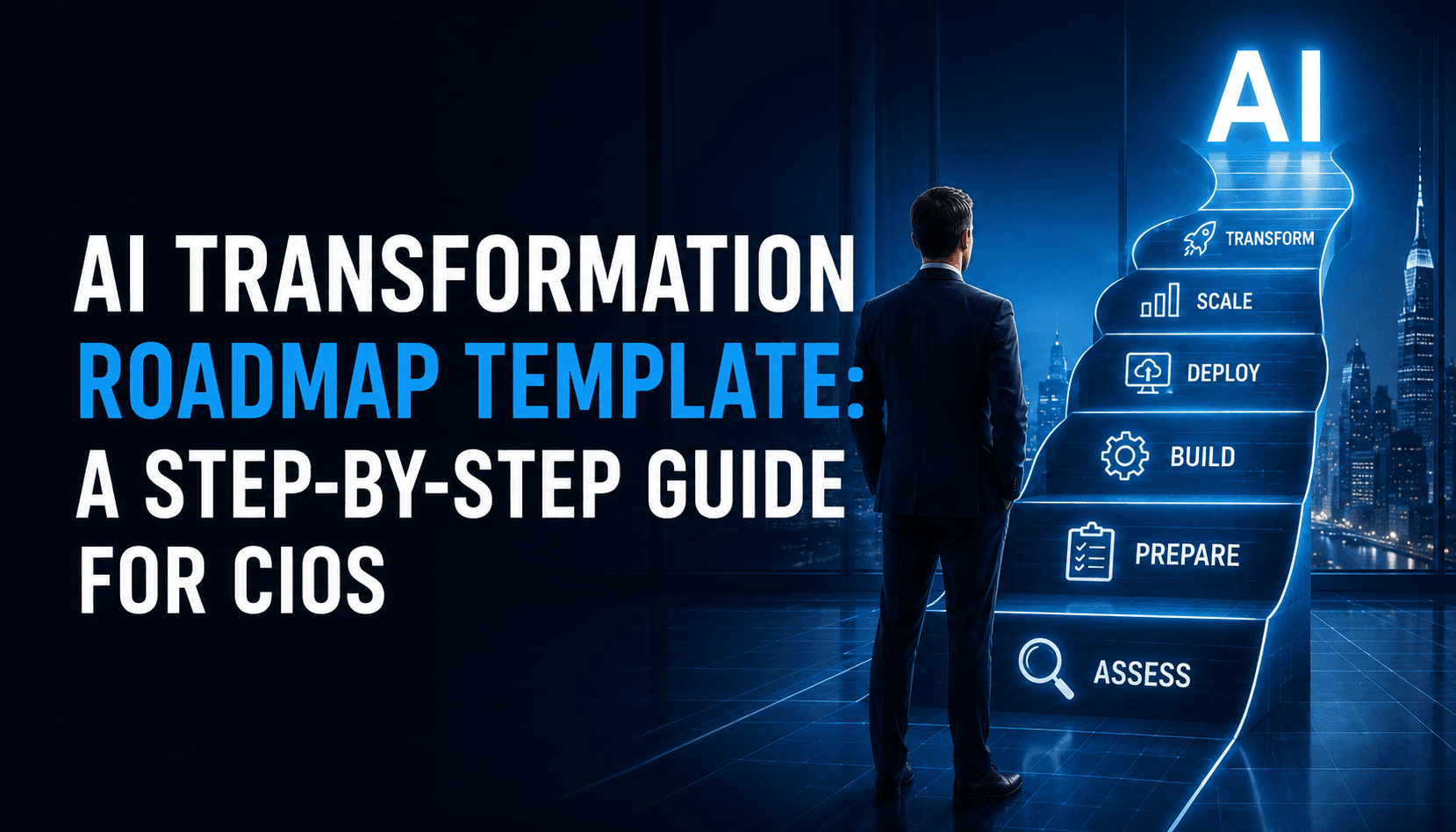
what is transformation roadmap in enterprise AI terms is a structured plan that sequences every AI-related activity, from data readiness and use case selection through model deployment, monitoring, and organizational capability building, across defined phases with measurable milestones. The key distinction from a traditional IT project plan is that an ai business transformation roadmap addresses data maturity, model governance, regulatory exposure, and cultural change alongside the technical build. Without clear prioritization, teams spread thin across too many use cases and deliver none of them well; sequencing is everything in a scalable AI transformation roadmap. Gartner's AI Roadmap organizes critical activities into seven workstreams: AI strategy, AI value, AI organization, AI people and culture, AI governance, AI engineering, and AI data. This guide structures those workstreams into a practical, phased template CIOs can apply regardless of their current AI maturity level. For enterprises starting from the beginning, the building an AI-ready organisation guide is the prerequisite read before any roadmap work begins.
Assess Your AI Transformation Readiness
Why the Roadmap Structure Matters More in 2026
Three forces make structured sequencing more consequential this year than in any prior period.
1. Agentic AI is collapsing the governance timeline: Gartner predicts that 60 percent of agentic AI projects will fail in 2026 due to a lack of AI-ready data. CIOs who have not completed data readiness work before deploying agentic systems will discover that dependency at the worst possible moment: during a production failure or regulatory examination.
2. Static three-year roadmaps are obsolete: The AI landscape shifts every few months; static three-year roadmaps are obsolete before they are executed. The 90-day cycle model replaces them with a repeating assess, prioritize, execute, measure, and adapt rhythm that stays current without requiring a full strategy reset.
3. Shadow AI is expanding faster than governance can track: Most CIOs estimate their organization uses 60 to 70 AI tools; actual monitoring typically reveals 200 to 300 tools in use, and organizations spend 3 to 5 times what they think on AI with unknown exposures to unsanctioned shadow AI.
For BFSI enterprises, the roadmap must also account for MAS supervisory expectations now active in Singapore. The AI implementation roadmap for enterprise covers the BFSI-specific sequencing considerations in depth, and top AI transformation readiness indicators provides the maturity scoring framework that determines where on the roadmap your organization actually sits.
Get the full phase-by-phase execution template. Request Samta.ai's AI Implementation Playbook and map your roadmap against your current data maturity, governance baseline, and 90-day sprint structure.
The AI Transformation Roadmap Template: Phase by Phase
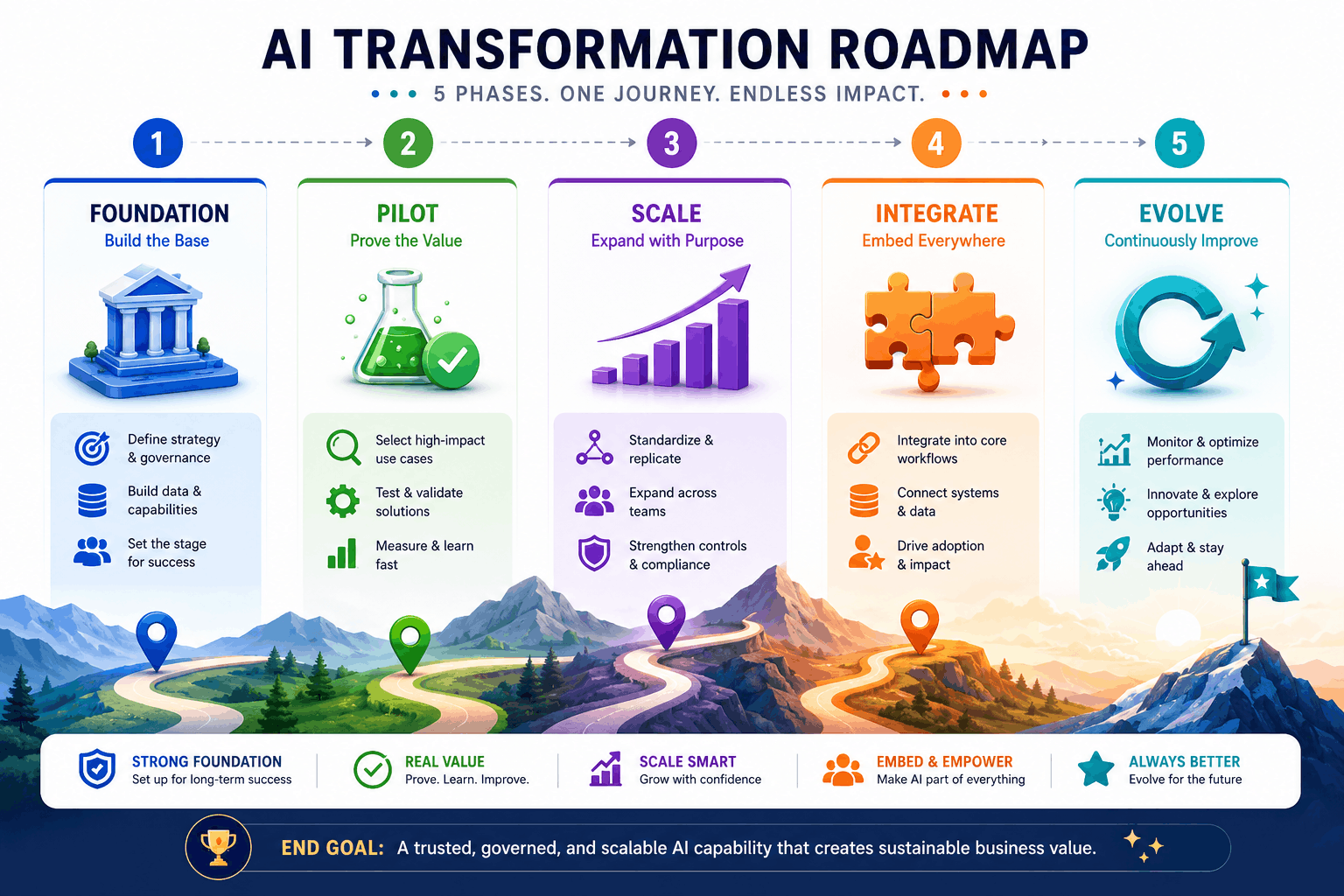
Use this sequence as your reusable ai roadmap for enterprises across any industry or organizational maturity level.
Phase 1: AI Readiness Assessment (Weeks 1 to 6)
Audit data maturity across four dimensions: availability, lineage, integration, accuracy, and governance. Data quality, completeness, and accessibility determine AI performance entirely, and a realistic audit prevents budget overruns from data problems discovered mid-build.
Assess technical infrastructure: cloud platform readiness, MLOps pipeline availability, and legacy system integration complexity.
Score use case candidates: rank candidates by business impact, data readiness, implementation complexity, and regulatory risk. Limit initial scope to three to five focused use cases; attempting too many simultaneous initiatives dilutes resources and reduces success probability.
Document governance baseline: identify what AI risk controls, bias testing processes, and audit trail capabilities currently exist before any build begins.
Phase 2: Strategy and Governance Foundation (Weeks 6 to 16)
Define a specific AI vision statement: not "become an AI-driven organization" but a measurable outcome such as "reduce credit review time by 40 percent by Q3 2026 through AI-assisted decisioning."
Build the AI governance layer first: governance frameworks including data privacy protocols, bias detection, and compliance with evolving regulations must be built into the architecture from day one, not as an afterthought.
Establish the operating model: define who owns the models, who manages pipelines, how teams collaborate, and which roles must evolve.
Assign board-level AI risk accountability: for regulated enterprises, this is a prerequisite for the compliance documentation that MAS and equivalent regulators now actively review.
Phase 3: Pilot Validation (Weeks 8 to 20, overlapping with Phase 2)
Run a controlled proof of concept on the highest-scored use case from Phase 1, in a sandboxed environment before any production data or live workflows are involved.
Measure against pre-defined success criteria: not vague efficiency gains but specific, quantifiable outcomes with baseline comparisons.
Document bias testing results and explainability outputs: before any decision to scale, not as a retrospective exercise.
Phase 4: Infrastructure Build and Scaled Deployment (Months 4 to 18)
Build scalable data pipelines on cloud data platforms such as Databricks or Snowflake, with automated quality checks via dbt before any model consumes the data.
Integrate into existing systems: connect AI outputs to ERP, CRM, and core banking systems via API-first architecture. Integration is the step where embedding AI into the daily tools teams already use determines whether adoption follows.
Deploy MLOps infrastructure: model monitoring, drift detection, and retraining pipelines must be live before the model scales, not added reactively.
This is where Samta.ai's execution model accelerates delivery. Rather than hand-off after strategy, the digital transformation managed services model maintains engineering and governance continuity from pilot through scaled deployment. The Veda AI decision analytics platform connects model monitoring, bias detection, and compliance audit trails into a single operational layer across Databricks and Snowflake infrastructure, turning roadmap Phase 4 from a multi-vendor coordination challenge into a unified delivery.
Phase 5: Continuous 90-Day Execution Cycles (Month 6 onward)
The 90 day ai transformation plan replaces static annual roadmaps with a repeating five-step cycle: Assess where your most valuable knowledge sits and what has changed; Prioritize which domains AI should amplify this cycle; Execute by encoding organizational intelligence into AI workflows; Measure impact across defined dimensions; Adapt by feeding lessons into the next cycle. The rhythm stays constant; the depth increases each cycle.
AI Transformation Roadmap Template: Phase Comparison
Phase | Timeline | Primary Owner | Key Deliverable | Governance Checkpoint | Samta.ai Touchpoint |
1. AI Readiness Assessment | Weeks 1 to 6 | CIO plus Data team | Readiness report with gap analysis matrix | Compliance baseline documented | AI readiness assessment |
2. Strategy and Governance Foundation | Weeks 6 to 16 | CIO plus Risk and Compliance | AI vision statement, governance framework, operating model | Board level AI risk owner assigned | Governance design and assurance |
3. Pilot Validation | Weeks 8 to 20 | Engineering plus Business unit | Validated PoC with bias testing results | Explainability documentation complete | Pilot build and validation |
4. Infrastructure Build and Deployment | Months 4 to 18 | Engineering plus MLOps | Production system with MLOps and monitoring live | Full audit trail operational | Veda AI plus data integration |
5. Continuous 90-day Cycles | Month 6 onward | Cross-functional AI team | Quarterly outcome measurement and roadmap refresh | Ongoing drift monitoring and governance review | Digital transformation managed services |
Strengthen AI Governance with Actionable Insights
Enterprise Use Cases: How CIOs Apply This Template in Practice
Use Case 1: Singapore Bank Running a 90-Day BFSI Roadmap Sprint
A Singapore bank's CIO used a 90-day cycle to scope and validate an AI credit triage system. Phase 1 and 2 ran concurrently across the first six weeks, with data readiness revealing a key gap: three legacy systems feeding the credit model had no automated quality scoring. Rather than proceeding and discovering the problem in production, the bank built a data quality layer first. The pilot validated a 38 percent reduction in manual review time before any capital was committed to full deployment. Governance documentation was structured from the first sprint consistent with the approach outlined in the AI implementation alternatives consulting guide, giving the compliance team an audit trail ready for MAS review before the model reached production.
Use Case 2: Technology Enterprise Escaping Pilot Purgatory
A Singapore technology company had seven AI pilots running simultaneously with no shared infrastructure, no cross-functional governance, and no measurable production outcomes after 14 months. The CIO reset using the Phase 1 readiness scoring matrix, identifying two of the seven pilots as high-impact and data-ready, and consolidating investment into those two. Most efforts are still limited to pilots or fragmented deployments; what separates organizations that experiment with AI from those that scale it is a structured, intentional roadmap. The CIO's consolidation decision, driven by readiness scoring rather than stakeholder politics, reduced total AI spend by 40 percent while doubling the number of production-ready models within 12 months.
Key Risks and Failure Modes
Starting without clean data: Companies that start model development without data readiness end up spending 80 percent of their AI budget on data cleaning after the fact. The readiness assessment in Phase 1 exists specifically to prevent this.
Treating governance as Phase 4 work: Governance retrofitted after deployment costs significantly more than governance embedded from Phase 2. For regulated industries, the compliance exposure of an ungoverned production model exceeds the governance build cost by a significant margin. The enterprise AI governance guide documents this failure mode in detail.
Static roadmaps in a dynamic landscape: Organizations that run the same tool strategy they had a year ago are not being adaptive, they are being complacent. The 90-day cycle model is specifically designed to prevent roadmap staleness.
Scoping too broadly in Phase 1: 88 percent of organizations use AI in at least one business function, yet nearly two-thirds have failed to scale beyond pilot stage. Over-scoping the initial use case list is the most common reason enterprises stay in that two-thirds.
Get your Phase 1 readiness baseline completed before building your roadmap. Request a Free AI Assessment Report from Samta.ai and enter your roadmap sprint knowing your data maturity, use case scores, and governance gaps clearly.
Decision Framework: Is Your Roadmap Ready to Execute?
Phase 1 data readiness assessment is complete with a documented gap analysis matrix
Use cases are scored by impact, data readiness, complexity, and regulatory risk, not by stakeholder enthusiasm
AI governance framework is designed in Phase 2 before any model reaches production
Board-level AI risk accountability is assigned and documented
90-day execution cycles are scheduled with defined measurement criteria per cycle
MLOps and drift monitoring infrastructure is planned before the first scaled deployment
If fewer than four boxes are checked, the roadmap is not yet execution-ready regardless of how detailed the strategy document is.
Turn Your AI Vision into Business Value
Conclusion
An ai transformation roadmap template is not a document CIOs produce once and archive. It is a living execution structure that sequences data readiness, governance, and deployment in the right order, then refreshes every 90 days as the AI landscape evolves. Less than 20 percent of enterprises have mature governance frameworks in place, which means the CIOs who build governance into Phase 2 rather than retrofitting it in Phase 4 will face significantly less friction at every subsequent stage of their transformation.
About Samta
Samta.ai is a Singapore-headquartered AI Product Engineering & Data Intelligence partner helping enterprises build production-grade AI systems for regulated and data-intensive environments.We help organizations move beyond experimentation by engineering scalable, explainable, and enterprise-ready AI solutions from data foundations and model development to workflow automation and deployment.
Our capabilities combine deep AI expertise, data engineering, and product engineering to deliver measurable business impact across FinTech, BFSI, cybersecurity, regulatory technology, and enterprise operations.
Our enterprise AI products power real-world intelligence systems:
• TATVA : AI-driven data intelligence platform for governed analytics, monitoring, and operational insights
• VEDA : Explainable and audit-ready AI decisioning engine built for compliance-sensitive enterprise workflows
• CORA-Property Management Solutions: : Predictive intelligence platform for real-estate pricing, portfolio optimization, and investment analytics
Backed by ecosystem partnerships with Microsoft, Databricks, Snowflake, and AWS, Samta.ai delivers agile, cost-efficient AI engineering with faster turnaround and enterprise-grade scalability. Trusted by enterprises across FinTech, BFSI, and digital transformation initiatives, Samta.ai embeds AI governance, data privacy, and compliance-by-design principles directly into the AI lifecycle , enabling organizations to scale AI with transparency, accountability, and operational control.
Enterprises leveraging Samta.ai automate 65%+ of repetitive data, analytics, and decision workflows while maintaining governance, explainability, and measurable business outcomes. Samta.ai provides the strategic consulting, AI engineering, and data modernization expertise needed to align enterprise operations with next-generation AI transformation goals.
Frequently Asked Questions
What is an AI transformation roadmap template and why do CIOs need one?
An ai transformation roadmap template is a reusable phased plan that sequences AI readiness assessment, governance design, pilot validation, infrastructure build, and scaled deployment with measurable milestones at each stage. Gartner research shows only one in five AI initiatives achieves ROI, and a structured template is the primary tool CIOs use to avoid being in the four-out-of-five that do not.
What is a 90-day AI transformation plan and how does it work?
A 90-day ai transformation plan replaces static multi-year roadmaps with a repeating five-step cycle: assess, prioritize, execute, measure, and adapt. Early cycles establish visibility and map where organizational intelligence lives; mid cycles move from mapping to encoding AI into workflows. The 90-day rhythm keeps the roadmap current without requiring a full strategy reset every time the AI landscape shifts.
How do you prioritize AI use cases in a transformation roadmap?
Score each use case candidate against four dimensions: business impact, data readiness, implementation complexity, and regulatory risk. High-impact use cases on high-quality data with manageable complexity and low regulatory exposure go first. Limit initial objectives to three to five focused goals; attempting too many simultaneous initiatives dilutes resources and reduces success probability.
What is the difference between an AI roadmap and an AI strategy?
An AI Playbook template or strategy defines what your organization wants to achieve with AI and which principles will guide it. An ai transformation roadmap template defines how, when, and in what sequence each activity will be executed, with measurable milestones and governance checkpoints. Strategy without a roadmap produces vision documents; a roadmap without strategy produces technically functional systems that do not support business priorities.
How long does building an AI transformation roadmap take for an enterprise?
Phase 1 readiness assessment takes four to six weeks for an enterprise. Phase 2 strategy and governance foundation runs concurrently with Phase 3 pilot validation from weeks six to twenty. Phase 4 infrastructure build and deployment runs from months four to eighteen. The first measurable production outcome is typically achievable within six to nine months for a well-scoped, data-ready use case.