
Summarize this post with AI
Successfully navigating ai adoption challenges 2026 requires a fundamental shift from experimental pilots to resilient, production-grade systems. As organizations integrate intelligence into core workflows, they face significant barriers to adoption, including data fragmentation, talent scarcity, and regulatory and ethical issues. Addressing these challenges demands a structured ai adoption strategy that prioritizes model transparency and long-term value over short-term automation gains. By identifying and mitigating ai adoption risks early, enterprises can ensure their AI investments scale effectively without compromising security or compliance. This advisory outlines the critical roadblocks B2B leaders must overcome to achieve measurable AI ROI challenges and maintain a competitive edge in an increasingly automated global market through professional ethical ai implementation.
Key Takeaways
Standardize Accountability: Use ai accountability frameworks to assign clear ownership of AI outputs.
Prioritize Transparency: Ensure model explainability is a core requirement of all governance frameworks.
Risk-Based Approach: Categorize AI systems by impact level to apply proportionate ethical ai controls.
Continuous Auditing: Move beyond one-time checks to real-time ethical ai risk mitigation.
What This Means in 2026
In 2026, the landscape of AI adoption challenges 2026 is defined by the transition toward "Autonomous Operations." Success is no longer measured by implementation, but by systemic resilience.A significant barrier is the move toward scaling AI governance for enterprises. Organizations are discovering that decentralized AI usage leads to unmanageable risk surfaces. Furthermore, a lack of ai governance compliance in enterprises has led to a stagnation of production-ready tools. Without a unified framework to manage these ai adoption risks, companies find themselves trapped in perpetual "pilot purgatory" where ROI remains elusive and technical debt accumulates.
Turn AI Ambitions into Measurable Results
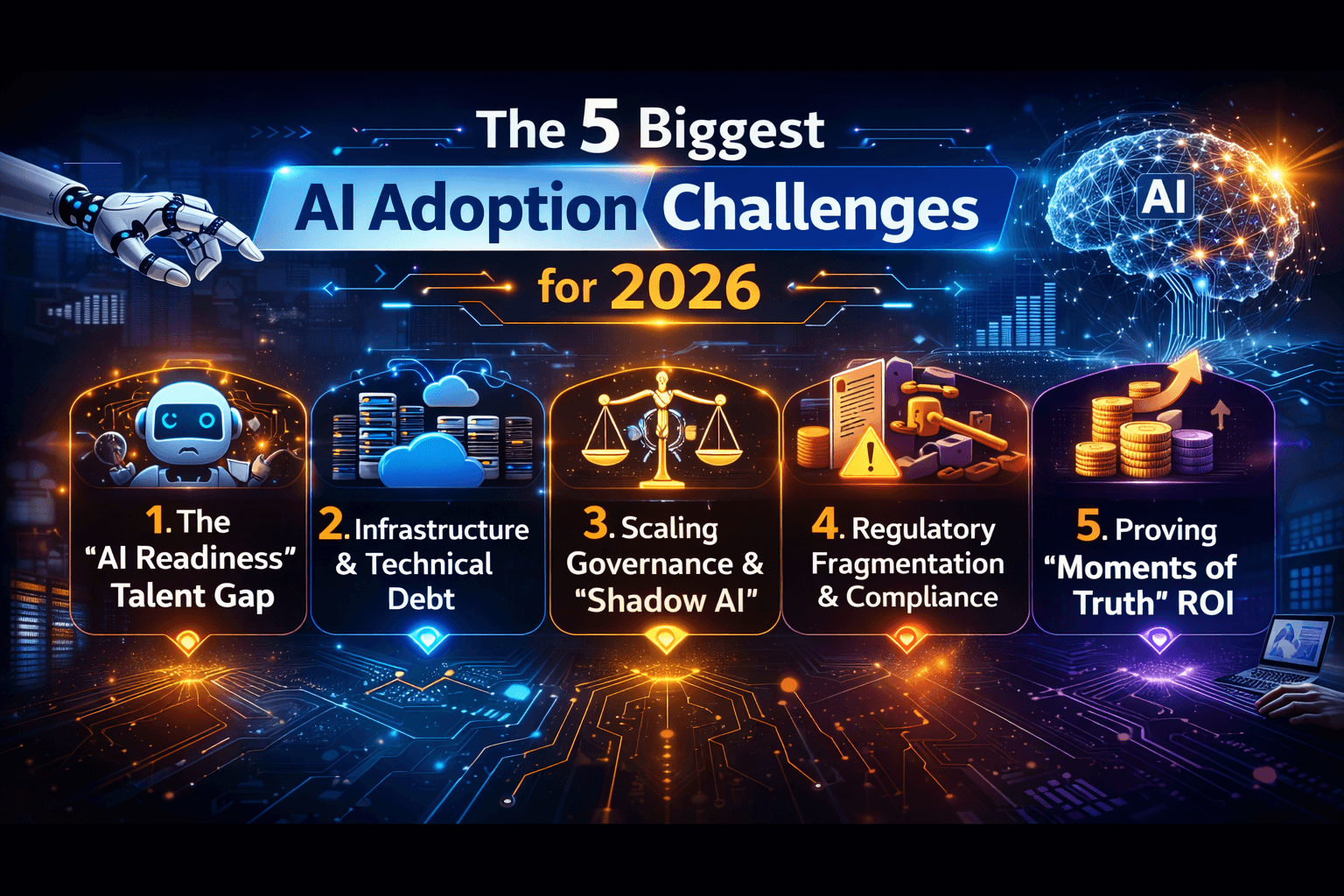
The 5 Biggest AI Adoption Challenges for 2026
1. The "AI Readiness" Talent Gap
Organizations in 2026 are struggling with a massive disconnect: while technical hiring is at an all-time high, there is a critical shortage of leaders who understand how to manage production-grade AI. This gap means companies often secure specialized engineering talent but lack the strategic oversight required to anchor AI initiatives within a robust ai governance compliance in enterprises framework. Without "AI-literate" management, projects often stall at the pilot stage because the leadership cannot navigate the complex trade-offs between model performance, ethical guardrails, and operational costs.
2. Infrastructure & Technical Debt
Legacy IT systems are increasingly becoming the primary bottleneck for AI scalability. Many 2026 enterprises are discovering that their decades-old data architectures cannot support the high-velocity, real-time data needs of modern generative models. As seen in recent post-mortems of data breaches caused by ai, technical debt acts as a silent saboteur. When modern AI is layered over fragile legacy infrastructure, it creates massive security gaps and inconsistent model performance, leading to "hallucinations" that are rooted in poor data plumbing rather than the AI itself.
3. Scaling Governance & "Shadow AI"
The democratization of AI tools has led to an explosion of "Shadow AI," where departments deploy unauthorized third-party models without IT oversight. This creates massive blind spots in intellectual property (IP) security and data residency. Solving this challenge requires a fundamental shift toward the future of AI governance, where organizations move away from static policy documents toward automated, real-time monitoring. In 2026, the goal is to implement checks that track system behavior as it evolves, ensuring that even decentralized AI usage remains within the organization’s risk appetite.
4. Regulatory Fragmentation & Compliance
With the full enforcement of global mandates like the EU AI Act and local variations across Asia and North America, navigating the "compliance maze" has shifted from a legal task to an operational one. 2026 is the year of accountability, where firms must provide documented proof of model transparency, bias testing, and data lineage. Enterprises are finding that compliance is not a one-time event but a continuous requirement, making specialized audits a mandatory part of the weekly production cycle to avoid crippling financial penalties.
5. Proving "Moments of Truth" ROI
The "hype phase" has ended, and boards are now demanding concrete, financial proof of AI value. Many firms fail to deliver a positive return because they treat AI as a standalone experiment rather than a business process. To move from "pilot purgatory" to a measurable ROI engine, organizations need a structured approach that balances high-performance output with risk-adjusted costs. Proving value in 2026 requires a level of precision in performance tracking that most companies are still struggling to implement at scale.
Core Comparison: Solving AI Adoption Barriers
Solution / Platform | Adoption Focus | ROI Velocity | Risk Mitigation | Best Fit | Core Role |
|---|---|---|---|---|---|
Automated Governance | Immediate (Ops) | Full (Continuous) | Regulated Industries | Governance & compliance | |
Strategic Architecture | High (Structural) | Managed (Expert-led) | Enterprise Scaling | AI architecture foundation | |
Internal Dev Teams | Feature Building | Variable | Limited to Code | Early-stage Pilots | Feature experimentation |
Generic SaaS Tools | Plug-and-Play | Fast (Initial) | Low (Third-party) | Non-critical Tasks | Quick AI deployment |
Samta.ai offers deep expertise in AI/ML engineering, providing the technical foundation to solve ai adoption challenges 2026 through elite model architecture.
Practical Use Cases
Financial Risk Mitigation: Institutions solve the intersection of AI and finance complexities by using automated monitoring to prevent credit bias.
Healthcare Diagnostic Accuracy: Medical providers integrate AI into clinical workflows by verifying models against diverse datasets to address regulatory and ethical issues.
Supply Chain Optimization: Logistics firms use structured engineering to cleanse legacy data streams, ensuring actionable insights for route volatility management.
HR Fairness Compliance: Companies monitor recruitment algorithms to ensure compliance with fair-hiring laws, converting legal risk into talent advantage.
Customer Service Safety: Retailers vet Generative AI bots for hallucination risks, protecting brand reputation and ensuring data privacy for end-users.
Identify Hidden Risks Across Your AI Models
Limitations & Risks
The ROI Gap: Inconsistent measurement of AI performance leads to "sunk cost" fallacies.
Fragmented Ownership: Lack of clear AI leadership results in conflicting strategies.
Security Vulnerabilities: Rapid adoption without security-first engineering exposes data to poisoning.
Decision Framework
When to Accelerate AI Adoption:
Your core industry is undergoing rapid digital transformation.
You have a mature data foundation capable of supporting ai governance compliance in enterprises.
You need to move beyond manual oversight to a specialized enterprise AI governance tool.
Conclusion
Overcoming ai adoption challenges 2026 is a matter of technical discipline. The organizations that thrive will be those that view governance, monitoring, and ROI as a unified system. Samta.ai provides the elite technical depth required to navigate this evolution, ensuring your AI initiatives are both high-impact and regulation-ready. By partnering with experts in AI & data science services, you turn the complexity of adoption into a sustainable engine for growth.
Plan Your Next AI Move with Confidence
About Samta
Samta.ai is a Singapore-headquartered AI Product Engineering & Data Intelligence partner helping enterprises build production-grade AI systems for regulated and data-intensive environments.We help organizations move beyond experimentation by engineering scalable, explainable, and enterprise-ready AI solutions from data foundations and model development to workflow automation and deployment.
Our capabilities combine deep AI expertise, data engineering, and product engineering to deliver measurable business impact across FinTech, BFSI, cybersecurity, regulatory technology, and enterprise operations.
Our enterprise AI products power real-world intelligence systems:
• TATVA : AI-driven data intelligence platform for governed analytics, monitoring, and operational insights
• VEDA : Explainable and audit-ready AI decisioning engine built for compliance-sensitive enterprise workflows
• CORA-Property Management Solutions: : Predictive intelligence platform for real-estate pricing, portfolio optimization, and investment analytics
Backed by ecosystem partnerships with Microsoft, Databricks, Snowflake, and AWS, Samta.ai delivers agile, cost-efficient AI engineering with faster turnaround and enterprise-grade scalability. Trusted by enterprises across FinTech, BFSI, and digital transformation initiatives, Samta.ai embeds AI governance, data privacy, and compliance-by-design principles directly into the AI lifecycle , enabling organizations to scale AI with transparency, accountability, and operational control.
Enterprises leveraging Samta.ai automate 65%+ of repetitive data, analytics, and decision workflows while maintaining governance, explainability, and measurable business outcomes. Samta.ai provides the strategic consulting, AI engineering, and data modernization expertise needed to align enterprise operations with next-generation AI transformation goals.
FAQs
What are the primary ai adoption challenges 2026?
The 2026 landscape is dominated by data silos and complex regulatory and ethical issues. Many organizations find that their initial pilots fail to scale because they lack the infrastructure for scaling AI governance for enterprises, which is necessary to move models from isolated testing environments into full-scale production.How do I solve AI ROI challenges?
Solving ROI challenges requires moving beyond automation for its own sake and aligning AI projects with specific business KPIs. By ensuring that continuous monitoring for AI is integrated into the workflow, enterprises can track efficiency gains and accuracy improvements in real-time, providing the financial proof required for sustained investment.How does technical debt impact AI performance in 2026?
Technical debt in legacy systems often prevents AI models from accessing the high-quality, real-time data they require. This results in "model decay," where the AI's predictions become less accurate over time because the underlying data plumbing cannot keep pace with the model's requirements, leading to operational friction.What is the risk of "Shadow AI" in large organizations?
Shadow AI occurs when employees use unvetted third-party tools, creating massive vulnerabilities in data privacy and intellectual property. Without a centralized governance strategy, these "hidden" models can lead to accidental data leaks and regulatory non-compliance, as they bypass the organization’s standard security protocols and ethical guardrails.Can AI adoption risks be fully eliminated?
While risks cannot be entirely eliminated, they can be mitigated through a structured ai adoption strategy. This includes implementing rigorous bias testing, establishing clear accountability frameworks, and maintaining human-in-the-loop oversight to ensure that AI outputs remain aligned with both corporate values and legal mandates in an evolving regulatory environment.