
Summarize this post with AI
Most technical assessment purchases are made on demo polish, not on proof that a test predicts job performance. That is how teams end up with a platform that candidates can game and recruiters cannot interpret.
Best technical assessment tools:
The right pick depends on who runs the test. Engineering led teams favour CodeSignal, Codility or HackerRank for coding depth, while recruiter led teams in APAC get faster results from iMocha, Vervoe or TATVA, which score skills without engineers writing each test. Whichever you shortlist, require a role mapped rubric, configurable proctoring and native ATS integration. Confirm candidate data handling against Singapore’s PDPA.
What are technical assessment tools?
Technical assessment tools are platforms that measure a candidate’s job skills through coding challenges, simulations and structured scoring. They return a ranked result to the recruiter. Technical assessment software replaces the unstructured phone screen with a repeatable test.
Most platforms share five building blocks:
A coding environment with an in browser editor, multiple languages and test cases
A question library and a custom test builder
A rubric or automated scoring engine
Proctoring and plagiarism detection
ATS integration and reporting
Technical skills assessment tools also cover roles beyond coding, such as data analysts, cloud engineers and QA testers. For suites that mix cognitive, behavioural and technical tests, read our guide to the 8 best talent assessment tools.
Ready to Make Hiring Faster and More Effective?
Why technical assessment matters in 2026
Three pressures make tool selection harder this year.
AI assistants change what a test proves. Generative AI can answer many standard algorithm questions, so tests that reward memorised answers no longer separate candidates. Tests must probe reasoning, debugging and trade offs.
Regulators expect careful candidate data handling. The PDPC applies the PDPA to recruitment agencies and expects data from unsuccessful applicants to be kept only as long as needed for business or legal purposes. Read the PDPC Advisory Guidelines on the PDPA for Selected Topics before configuring retention.
Speed decides who wins talent. Cloud, data and AI engineers receive multiple offers, so slow screening loses them. The shift to AI hiring tools is already compressing shortlist time for teams that adopt it.
Each of these makes a vague “we use an online test” process a liability.
The 5 step framework for choosing and running technical assessments
Use this sequence whether you buy a platform or build a shortlist. Each step produces an artifact you can audit.
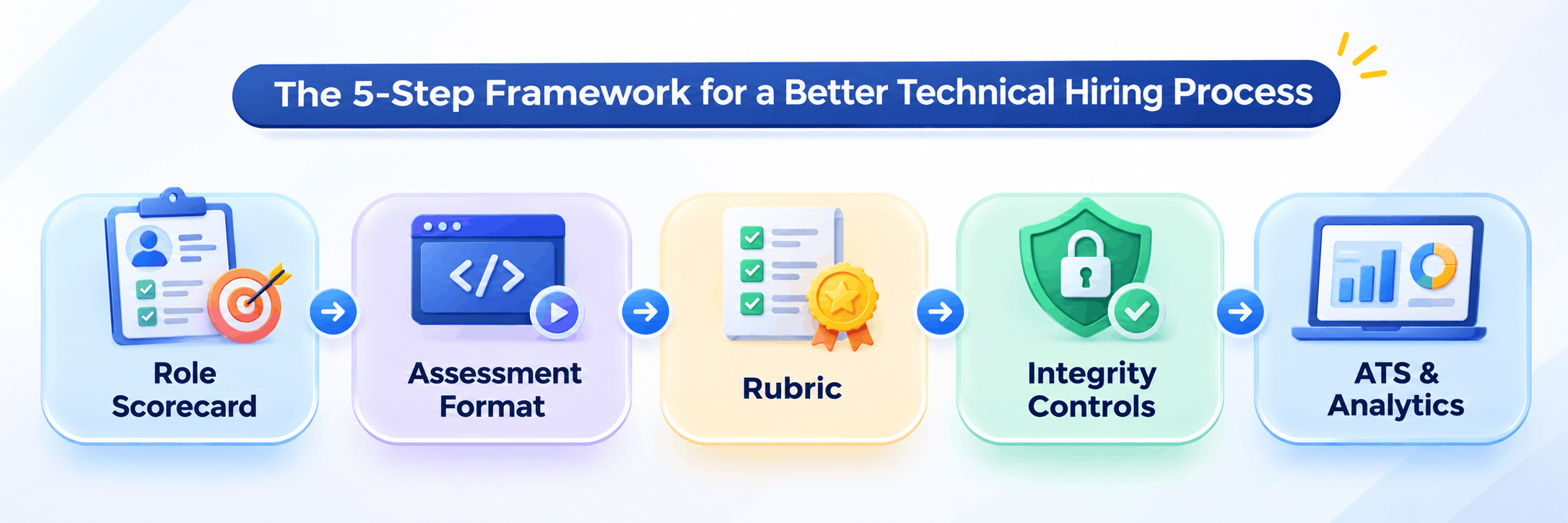
Write a role scorecard. List the five to eight skills the job needs and the evidence that proves each one. Without it, any tool scores the wrong thing.
Choose the assessment format. Use coding tasks for developers, simulations for analysts and multiple choice for high volume screening. An AI driven assessment platform can generate role specific questions from a job description, which removes the engineer bottleneck. Samta.ai delivers this through the TATVA hiring assessment platform.
Define the rubric. Score on weighted criteria such as correctness, code quality and problem approach. Share the rubric with your hiring panel so two reviewers reach the same score.
Set integrity controls. Configure proctoring features such as tab switch detection, identity checks and plagiarism comparison. Match strictness to seniority, because heavy controls hurt senior candidate experience.
Connect results to your ATS and data stack. Push scores into the ATS and your analytics layer so decisions leave an audit trail.
Step 5 is where Samta.ai acts as the engineering execution layer. Where reporting runs on Snowflake, Databricks or Microsoft Azure, workflow automation consulting can route scores, trigger recruiter alerts and keep logs. Nothing is copied by hand.
Technical assessment software comparison: top platforms side by side
A technical assessment software comparison is only useful if every row is judged on the same five attributes. This table summarises the best technical assessment platform options by fit, depth, integrity and setup.
Platform | Best fit | Assessment style | Integrity and proctoring | ATS and setup |
CodeSignal | Engineering teams hiring developers at volume | Coding tasks in a full coding environment with standardised scoring | Identity and plagiarism controls available | Major ATS connections; engineers help configure |
Codility | Engineering teams wanting structured coding screens | Timed coding tasks with automated correctness checks | Plagiarism checks and session monitoring | ATS connections; moderate setup |
HackerRank | Large engineering teams needing language breadth | Large coding question library plus project style tasks | Plagiarism detection and proctor settings | Common ATS connections; engineers often build tests |
iMocha | Recruiters testing many skills across technical and other roles | Broad skills library with coding and role tests | Proctoring options by plan | ATS connections; recruiter friendly |
Vervoe | Recruiters wanting job simulations without engineers | Job style tasks scored by AI | Basic integrity controls | ATS connections; fast setup |
TATVA | APAC enterprises and agencies in regulated sectors | AI generated role tests with rubric based scoring | Configurable proctoring | Workflow support from Samta.ai |
Treat this table as a starting shortlist and verify each cell in a trial.
For a direct head to head, read TATVA vs HackerRank. For a wider scan of the category, see these 7 AI tools recruiters are testing now.
Need Help Scaling AI Across Your Enterprise?
Real world use cases
BFSI: a Singapore bank hiring data engineers (illustrative scenario). Hiring decisions in banking face audit, so scoring must be consistent and explainable. If an assessment uses AI scoring, align it with the MAS FEAT Principles on fairness, ethics, accountability and transparency.
In practice that means versioned rubrics, human review of borderline scores and a log of every scoring decision.
General enterprise: a recruitment agency placing contract developers. An agency cannot keep an engineer on call for every client brief. A library with automated scoring lets recruiters screen quickly and send clients readable reports.
Agencies that pair assessment with tech staffing and augmentation can shortlist faster and defend each placement with evidence. The TATVA platform is built for this recruiter led workflow.
Compare this model with traditional hiring platforms to see where manual screening still creates delay.
Key risks and failure modes
Trivia tests. A test that measures puzzle recall instead of job tasks produces confident but wrong shortlists.
Undetected AI assistance. Weak proctoring lets candidates outsource answers, so scores stop reflecting skill.
Opaque AI scoring. If a vendor cannot explain a score, you cannot defend a rejection. The NIST AI Risk Management Framework gives a useful structure: govern, map, measure and manage the risk.
Over retained candidate data. Keeping unsuccessful applicants’ results indefinitely breaches the retention principle in the PDPA.
Long tests. Assessments that run past ninety minutes raise drop off, especially among passive candidates.
Manual score handling. Copying results into the ATS breaks the audit trail and invites errors.
When to use technical assessment tools and when not to
Use them when:
Applicant volume exceeds what interviewers can screen consistently
The role has measurable skills, such as coding, SQL or cloud configuration
You need an audit trail for regulated hiring
Recruiters, not engineers, own the first screen
Avoid or limit them when:
The role is senior architecture, where a portfolio review and live discussion reveal more
Hiring volume is so low that a structured interview is enough
You cannot explain the scoring method to a candidate who asks
Benchmark Your AI Model Risk Exposure
Conclusion
A weak assessment process fails in three ways: it tests the wrong skill, it can be gamed, and it mishandles candidate data. The best technical assessment tools reduce all three through a clear rubric, credible proctoring and tight ATS integration. Choose the platform that your recruiters can run and your compliance team can defend.
About Samta
Samta.ai is a Singapore-headquartered AI Product Engineering & Data Intelligence partner helping enterprises build production-grade AI systems for regulated and data-intensive environments.We help organizations move beyond experimentation by engineering scalable, explainable, and enterprise-ready AI solutions from data foundations and model development to workflow automation and deployment.
Our capabilities combine deep AI expertise, data engineering, and product engineering to deliver measurable business impact across FinTech, BFSI, cybersecurity, regulatory technology, and enterprise operations.
Our enterprise AI products power real-world intelligence systems:
• TATVA : AI-driven data intelligence platform for governed analytics, monitoring, and operational insights
• VEDA : Explainable and audit-ready AI decisioning engine built for compliance-sensitive enterprise workflows
• CORA-Property Management Solutions: : Predictive intelligence platform for real-estate pricing, portfolio optimization, and investment analytics
Backed by ecosystem partnerships with Microsoft, Databricks, Snowflake, and AWS, Samta.ai delivers agile, cost-efficient AI engineering with faster turnaround and enterprise-grade scalability. Trusted by enterprises across FinTech, BFSI, and digital transformation initiatives, Samta.ai embeds AI governance, data privacy, and compliance-by-design principles directly into the AI lifecycle , enabling organizations to scale AI with transparency, accountability, and operational control.
Enterprises leveraging Samta.ai automate 65%+ of repetitive data, analytics, and decision workflows while maintaining governance, explainability, and measurable business outcomes. Samta.ai provides the strategic consulting, AI engineering, and data modernization expertise needed to align enterprise operations with next-generation AI transformation goals.
FAQ
What is the best technical assessment tool for recruiters?
There is no single winner. Engineering led teams often prefer CodeSignal, Codility or HackerRank for coding depth, while recruiter led teams prefer iMocha, Vervoe or TATVA for faster setup. Judge each platform on rubric quality, proctoring, ATS integration and candidate experience, then run a trial on one live role before committing to an annual contract.
What features matter in a technical assessment platform?
Prioritise five features: a realistic coding environment, a transparent rubric, configurable proctoring, native ATS integration and clear candidate reporting. Add data controls for personal data, including retention settings and export on request. Features that look impressive but do not change a hiring decision, such as flashy dashboards, should rank lower than scoring accuracy and integrity.
How much do technical assessment tools cost?
Pricing varies by vendor, seat count, test volume and contract length, and most vendors quote on request. Source Required: each vendor’s current pricing page. Ask for the cost per candidate assessed, overage fees, proctoring add ons and ATS integration charges, then compare total annual cost against the hiring volume you actually expect.
Which technical assessment tool can recruiters use without engineers?
Recruiters can use platforms that generate and score tests without engineers writing each question. Look for libraries mapped to job roles, AI scoring with a visible rubric and reports a hiring manager can read quickly. Vervoe, iMocha and TATVA position themselves in this space, but confirm with a trial that scoring matches your hiring managers’ judgment.
How do you compare technical assessment platforms for a small recruitment agency in Singapore?
Start with three questions: which roles you place most, who reviews results, and where candidate data is stored. Shortlist two or three platforms, run the same sample test on each, and compare scoring consistency, setup time and PDPA controls. A small agency should favour fast setup and clear reports over the deepest coding library.