
Summarize this post with AI
Organisations that use a developer coding assessment platform for all their hiring are solving a technical screening problem with a tool that was not designed for non technical roles, regulated sector hiring, or PDPA explainability requirements. Tatva vs HackerRank is a comparison enterprise talent leaders need to make with full clarity on what each platform was built to do, and what it was not built to do. This guide gives CHROs, talent acquisition heads, and HR technology leaders a structured, honest evaluation of both platforms across the criteria that matter in 2026, with the goal of helping enterprise buyers match the right tool to the right hiring context rather than over or underscoping their assessment investment.
Tatva vs HackerRank:
HackerRank is a technical assessment platform built primarily for developer, data science, and engineering role screening using coding challenges, algorithm tests, and technical skill measurement. TATVA (Talent Aptitude Testing and Verification via Algorithms) is an AI powered assessment platform designed for both technical and non technical role assessment across enterprise and BFSI hiring contexts, with adaptive scoring, PDPA explainability output, and native ATS workflow integration. For Singapore and APAC enterprise buyers hiring across a mixed role portfolio including credit analysts, compliance officers, operations leads, and technology engineers, TATVA covers the full spectrum; HackerRank covers the technical developer subset. The right choice depends on your role mix, your regulatory explainability obligations, and whether your hiring program extends beyond software engineering.
What Each Platform Was Built to Do
What Is HackerRank
HackerRank is a widely used technical assessment platform that allows employers to evaluate software developers, data scientists, and engineering candidates through coding challenges, algorithm problems, take home projects, and technical interview simulations. It has a large library of pre built coding problems across programming languages and technical domains.
HackerRank is primarily used for:
Software engineering candidate screening through coding challenges
Developer skill benchmarking against defined technical standards
Technical interview preparation and structured coding interview administration
Data science and ML engineering assessment through algorithm and data manipulation problems
HackerRank's core design assumption is that the candidate being assessed is a technical professional whose primary evaluation criterion is coding proficiency. This makes it a strong fit for developer hiring programs and a limited fit for hiring programs that include non technical functions such as credit risk, compliance, operations, finance, or customer service. For current feature specifications, pricing tiers, and APAC specific product offerings, verify directly with HackerRank's published documentation, as third party comparison data in this category becomes outdated quickly as platforms update their offerings.
What Is TATVA
TATVA stands for Talent Aptitude Testing and Verification via Algorithms. It is Samta.ai's AI hiring software designed for enterprise and BFSI organisations that hire across both technical and non technical role types within a single hiring program.
TATVA's core design principle is adaptive assessment: the evaluation criteria, question selection, and scoring methodology adjust based on role function, seniority level, and regional hiring context rather than applying a single test format to all candidates. A credit analyst candidate and a software engineer candidate receive different assessments configured for their specific role requirements, not variations of the same coding or aptitude test.
TATVA's primary capabilities include:
Adaptive assessment models configured per role, seniority, and function
PDPA compliant explainability output at the criterion level for every assessed candidate
Native ATS integration with workflow automation for automated candidate progression
Assessment coverage across technical and non technical role types including BFSI analyst tracks, operations functions, compliance roles, and technology engineering
Review how TATVA compares to traditional hiring platforms for a detailed breakdown of where adaptive AI assessment outperforms static test batteries in enterprise hiring programs.
Identify AI Opportunities and Gaps
Why This Comparison Matters in 2026
Three market conditions make platform selection more consequential than it was two years ago:
1. PDPA and fair employment obligations require explainability
Singapore's PDPA and Tripartite Guidelines on Fair Employment Practices require that candidates can request the basis of automated employment decisions. AI hiring tools that produce only a score or a ranking without criterion level rationale create regulatory exposure for every hiring decision they process (Source Required: Singapore Tripartite Guidelines on Fair Employment Practices). This obligation applies equally to technical and non technical hiring programs.
2. Mixed role hiring programs require platform coverage across function types
Enterprise hiring programs in BFSI and regulated sectors rarely hire only engineers. A bank hiring 300 people annually across credit, risk, technology, operations, and compliance needs a platform that covers all five function types with role specific assessment, not one that excels at technology assessment and applies a generic aptitude test to the other four.
3. ATS integration gaps are the most common cause of time to hire regression
AI hiring software that does not integrate natively with the organisation's ATS requires manual data transfer that adds 2 to 5 days per hiring cycle (Source Required: LinkedIn Talent Solutions Report). In high volume hiring programs, this manual overhead offsets the automation gain at the assessment stage entirely.
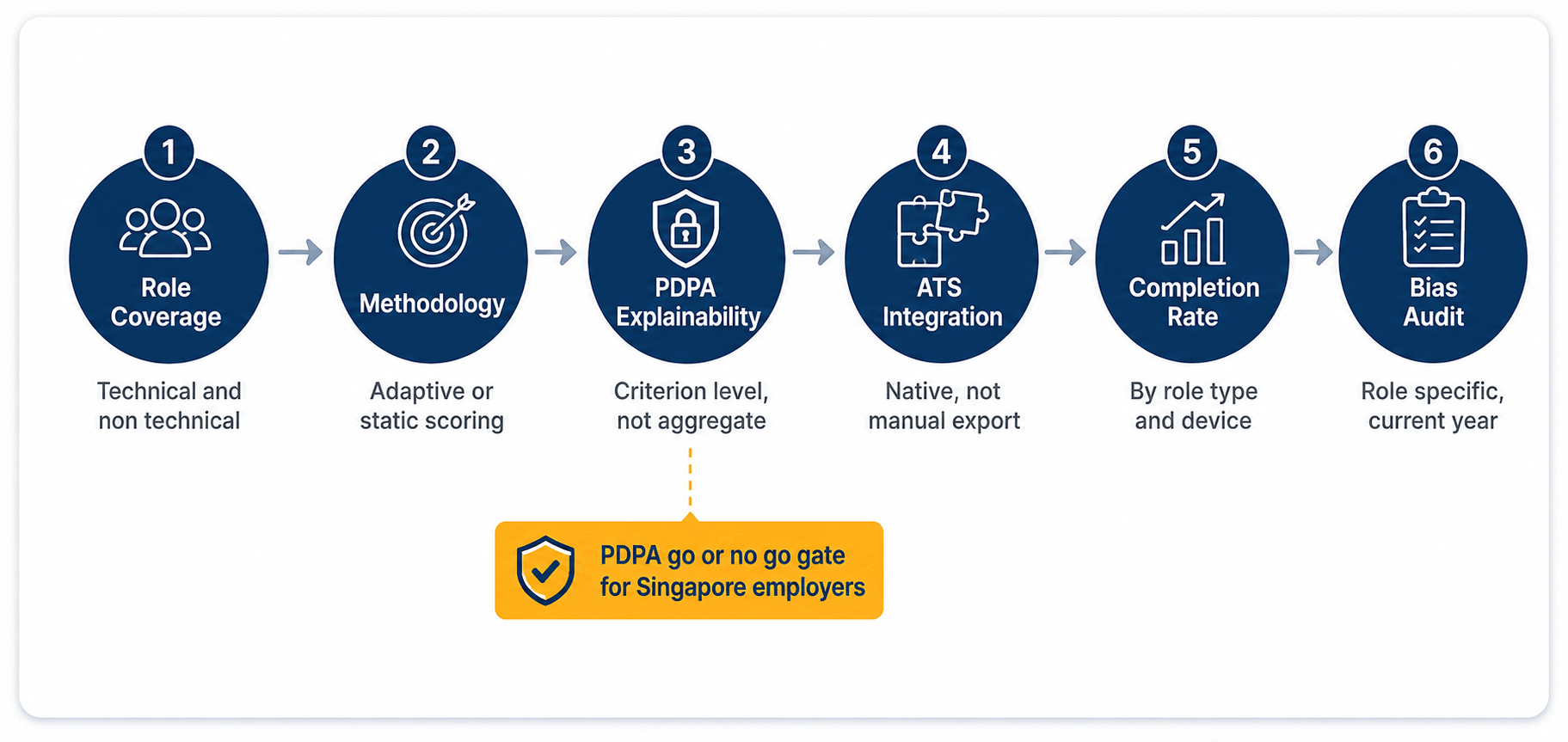
The 6 Criteria Framework for Evaluating AI Hiring Platforms
Use this as your ai recruiting platform comparison framework when shortlisting any assessment platform:
Criterion 1: Role Coverage Breadth
Does the platform assess technical and non technical roles with equal depth, or does it excel at one category and apply a generic fallback to the other? For enterprise programs with mixed role portfolios, role coverage breadth is the primary selection criterion before any other evaluation begins.
Criterion 2: Assessment Methodology
Is the assessment adaptive (content and scoring adjusts per role and seniority) or static (fixed test battery applied uniformly with adjusted scoring thresholds)? Adaptive methodology produces higher hiring manager shortlist acceptance rates because the scoring reflects actual role requirements rather than generic aptitude norms.
Criterion 3: PDPA and Regulatory Explainability
Can the platform produce criterion level scoring rationale for individual candidates on demand? Aggregate score reports and percentile rankings are not sufficient for PDPA compliance. Individual criterion level rationale is the legal standard for automated employment decisions in Singapore.
Criterion 4: ATS Integration Depth
Does the platform integrate natively with your specific ATS, or does it require manual export and import steps? Require a live demonstration of the candidate data journey from assessment completion to hiring manager shortlist in your actual ATS environment, not a generic integration diagram. Samta.ai's workflow automation consulting practice implements the ATS integration layer as part of every TATVA deployment, ensuring candidate progression is automated end to end rather than requiring manual data transfer at any stage.
Criterion 5: Candidate Experience and Completion Rate
What is the platform's candidate completion rate for your role types segmented by assessment length and device type? Completion rates below 70% for professional roles indicate a candidate experience problem that will extend time to fill. Require benchmark data from comparable clients in your industry and geography.
Criterion 6: Bias Audit Documentation
Can the platform provide a current bias audit report covering disparate impact analysis for the specific assessment content you will deploy? Platform level aggregate audits are not sufficient for enterprise regulated employer procurement requirements. Role specific bias audit documentation within the last 12 months is the standard.
Tatva vs HackerRank:
Evaluation Criterion | TATVA (Samta.ai) | What to Verify | Why It Matters | |
Role Coverage | Technical and non technical: BFSI analyst, operations, compliance, technology engineering | Primarily technical: software engineering, data science, algorithm assessment | Verify HackerRank's current non technical assessment capability directly with vendor | Determines whether one platform can serve your full hiring program |
Assessment Methodology | Adaptive ML model per role and seniority level | Structured coding challenges and technical problem library | Request methodology documentation from both vendors | Adaptive methodology produces higher hiring manager shortlist acceptance rates |
PDPA Explainability | Native criterion level explainability for every candidate, standard output | Verify current explainability output format with HackerRank documentation | Request a live demonstration of individual candidate explainability output | Legal requirement for automated employment decisions in Singapore |
ATS Integration | Native integration with workflow automation layer | Verify current ATS partner directory with HackerRank directly | Confirm integration with your specific ATS in a live demo | Manual integration adds 2 to 5 days per hiring cycle |
Bias Audit Documentation | Role specific PDPA aligned bias documentation | Verify current bias audit scope and currency with HackerRank directly | Request role specific bias audit reports from both vendors | Fair employment compliance obligation for Singapore regulated employers |
Assess Your AI Models for Hidden Risks
Real World Use Cases
Use Case 1: Mixed Role Graduate Program, Singapore Bank (BFSI)
A Singapore licensed bank ran an annual graduate hiring program across five tracks: credit analyst, risk analyst, technology, operations, and compliance. The technology track previously used a coding assessment platform. The other four tracks used a generic aptitude test that hiring managers described as providing no meaningful differentiation between candidates. Consolidating all five tracks onto TATVA's adaptive platform allowed track specific assessment models to be configured independently. The credit analyst track assessed financial reasoning and regulatory knowledge. The technology track assessed algorithmic problem solving and technical aptitude. The operations and compliance tracks assessed process reasoning and regulatory awareness. Hiring manager shortlist acceptance rate across all five tracks increased from 58% (generic aptitude) and 71% (coding platform for technology) to 83% across all tracks with role specific adaptive assessment. Total time to shortlist across all five tracks reduced by 38%. Review how TATVA compares to traditional online assessments for the methodology that produced these outcomes.
Use Case 2: Technology and Operations Hiring, Regional Logistics Company (General Enterprise)
A regional logistics technology company needed to hire 60 software engineers and 40 operations analysts within a 12 week window. They had used a technical coding platform for engineer screening and a generic aptitude test for operations analyst screening, managed as two separate hiring programs with two separate assessment tools. Consolidating both functions onto a single adaptive assessment platform reduced administrative overhead, eliminated the dual vendor management cost, and produced a unified candidate experience across both function types. Time to shortlist for software engineers: 11 days. Time to shortlist for operations analysts: 9 days. Both improved relative to the previous separate platform approach. This reflects the practical benefit of the Tatva vs HackerRank evaluation for organisations with mixed hiring portfolios: reducing to a single platform that covers both technical and non technical roles reduces administrative overhead, vendor management cost, and candidate experience inconsistency across function types. Explore similar program outcomes in Samta.ai case studies.
Key Risks When Choosing the Wrong Platform for Your Role Mix
Applying a technical coding platform to non technical roles: produces assessments that have no face validity for the candidate or the hiring manager. A credit analyst presented with algorithm coding challenges will correctly question whether the assessment is relevant to the role, increasing candidate drop off and reducing hiring manager trust in the shortlist.
Applying a generic aptitude test to technical roles: produces shortlists that technical hiring managers reject at high rates because generic aptitude scores do not differentiate the specific technical skills required for the role function.
Using two separate platforms for technical and non technical hiring: creates administrative overhead, inconsistent candidate experience, dual vendor management cost, and fragmented assessment data that cannot be compared across function types in a unified talent analytics view.
Deploying any platform without verifying PDPA explainability output: creates regulatory exposure for every hiring decision processed. This risk applies equally to technical and non technical hiring programs. The PDPA obligation is triggered by the automated decision, not by the role type being assessed. Review the 8 best talent assessment platforms evaluation to understand how the broader market handles the technical versus non technical coverage gap before finalising your shortlist.
Decision Framework: Tatva vs HackerRank for Your Organisation
Consider TATVA when:
Your hiring program spans both technical and non technical role types
Your organisation is a Singapore regulated employer with PDPA explainability obligations for automated employment decisions
Native ATS integration with automated candidate progression is a procurement requirement
You want a single platform that covers your full role portfolio with role specific adaptive assessment
Consider HackerRank when:
Your hiring program is primarily or exclusively focused on software engineering and developer role assessment
Coding challenge depth and technical problem library breadth are the primary assessment requirements
Your non technical hiring is managed separately and does not require platform consolidation
Evaluate both in parallel when:
You are running a formal procurement process and need comparative demonstration data across your actual role profiles before committing
Your technology hiring volume is high enough to warrant a dedicated technical assessment tool alongside a broader enterprise platform
Explore the AI driven assessment platform technical guide and the top 10 AI hiring platforms evaluation for broader market context before finalising your shortlist, and review the TATVA platform documentation to understand the adaptive methodology before requesting a demonstration.
Accelerate Your AI Journey with a Free Consultation

Conclusion
Tatva vs HackerRank is not a competition between two equivalent platforms. They were built for different primary use cases: HackerRank for technical developer assessment at depth, TATVA for enterprise and BFSI hiring programs that span both technical and non technical role types with PDPA compliant, adaptive, and ATS integrated assessment. If your hiring is exclusively focused on software engineering and developer roles, HackerRank's technical depth is a genuine strength. If your hiring spans credit, risk, compliance, operations, and technology functions within a single program, a platform designed for the full role spectrum with regulatory explainability built in is the more appropriate choice. Evaluate based on your actual role mix, your regulatory obligations, and your ATS environment, not on brand recognition or a vendor demo designed around the platform's strongest use case.
About Samta
Samta.ai is a Singapore-headquartered AI Product Engineering & Data Intelligence partner helping enterprises build production-grade AI systems for regulated and data-intensive environments.We help organizations move beyond experimentation by engineering scalable, explainable, and enterprise-ready AI solutions from data foundations and model development to workflow automation and deployment.
Our capabilities combine deep AI expertise, data engineering, and product engineering to deliver measurable business impact across FinTech, BFSI, cybersecurity, regulatory technology, and enterprise operations.
Our enterprise AI products power real-world intelligence systems:
• TATVA : AI-driven data intelligence platform for governed analytics, monitoring, and operational insights
• VEDA : Explainable and audit-ready AI decisioning engine built for compliance-sensitive enterprise workflows
• CORA-Property Management Solutions: : Predictive intelligence platform for real-estate pricing, portfolio optimization, and investment analytics
Backed by ecosystem partnerships with Microsoft, Databricks, Snowflake, and AWS, Samta.ai delivers agile, cost-efficient AI engineering with faster turnaround and enterprise-grade scalability. Trusted by enterprises across FinTech, BFSI, and digital transformation initiatives, Samta.ai embeds AI governance, data privacy, and compliance-by-design principles directly into the AI lifecycle , enabling organizations to scale AI with transparency, accountability, and operational control.
Enterprises leveraging Samta.ai automate 65%+ of repetitive data, analytics, and decision workflows while maintaining governance, explainability, and measurable business outcomes. Samta.ai provides the strategic consulting, AI engineering, and data modernization expertise needed to align enterprise operations with next-generation AI transformation goals.
Frequently Asked Questions
What is the main difference between Tatva and HackerRank?
HackerRank is a technical assessment platform built primarily for software developer and engineering role screening through coding challenges and algorithm tests. TATVA (Talent Aptitude Testing and Verification via Algorithms) is an AI powered assessment platform designed for both technical and non technical role assessment with adaptive scoring, PDPA explainability, and ATS integration. The core difference is role coverage breadth: HackerRank excels at technical developer assessment; TATVA covers the full enterprise role spectrum.
Is HackerRank suitable for non technical hiring in Singapore enterprises?
HackerRank's core design and test library are optimised for technical developer and engineering assessment. For non technical role types including BFSI analyst tracks, operations, compliance, and customer service functions, verify directly with HackerRank whether their current product satisfies your specific assessment requirements. Best AI recruiting platforms for mixed role portfolios are designed from the ground up to cover both technical and non technical functions with equal assessment depth.
What does TATVA stand for and what makes it an AI powered assessment platform?
TATVA stands for Talent Aptitude Testing and Verification via Algorithms. It is AI hiring software that uses adaptive machine learning models to adjust assessment content and scoring criteria based on role, seniority, and regional hiring context. Unlike static test libraries, TATVA's models are trained on enterprise hiring data to produce role specific evaluation rather than generic aptitude scoring, which produces higher hiring manager shortlist acceptance rates across both technical and non technical role types.
How do AI hiring tools handle PDPA compliance for automated employment decisions in Singapore?
Singapore's PDPA requires that candidates can request the basis of automated employment decisions. AI hiring tools that produce only aggregate score reports or percentile rankings do not satisfy this requirement. Platforms must produce criterion level scoring rationale explaining which specific assessment criteria were applied and how the candidate performed against each. This requirement applies to all automated employment decisions regardless of role type, so both technical and non technical assessment platforms used in Singapore must satisfy it.
What is the best AI recruiting platform for enterprise BFSI hiring in Singapore?
The best AI recruiting platform for Singapore BFSI enterprise hiring must satisfy three requirements simultaneously: PDPA criterion level explainability for every assessed candidate, role specific adaptive assessment covering both technology and regulated function role types (credit, risk, compliance, operations), and native ATS integration with automated candidate progression. Platforms that satisfy all three for both technical and non technical roles simultaneously are best positioned for BFSI hiring programs where role mix is broad and regulatory obligations are non negotiable.