
Summarize this post with AI
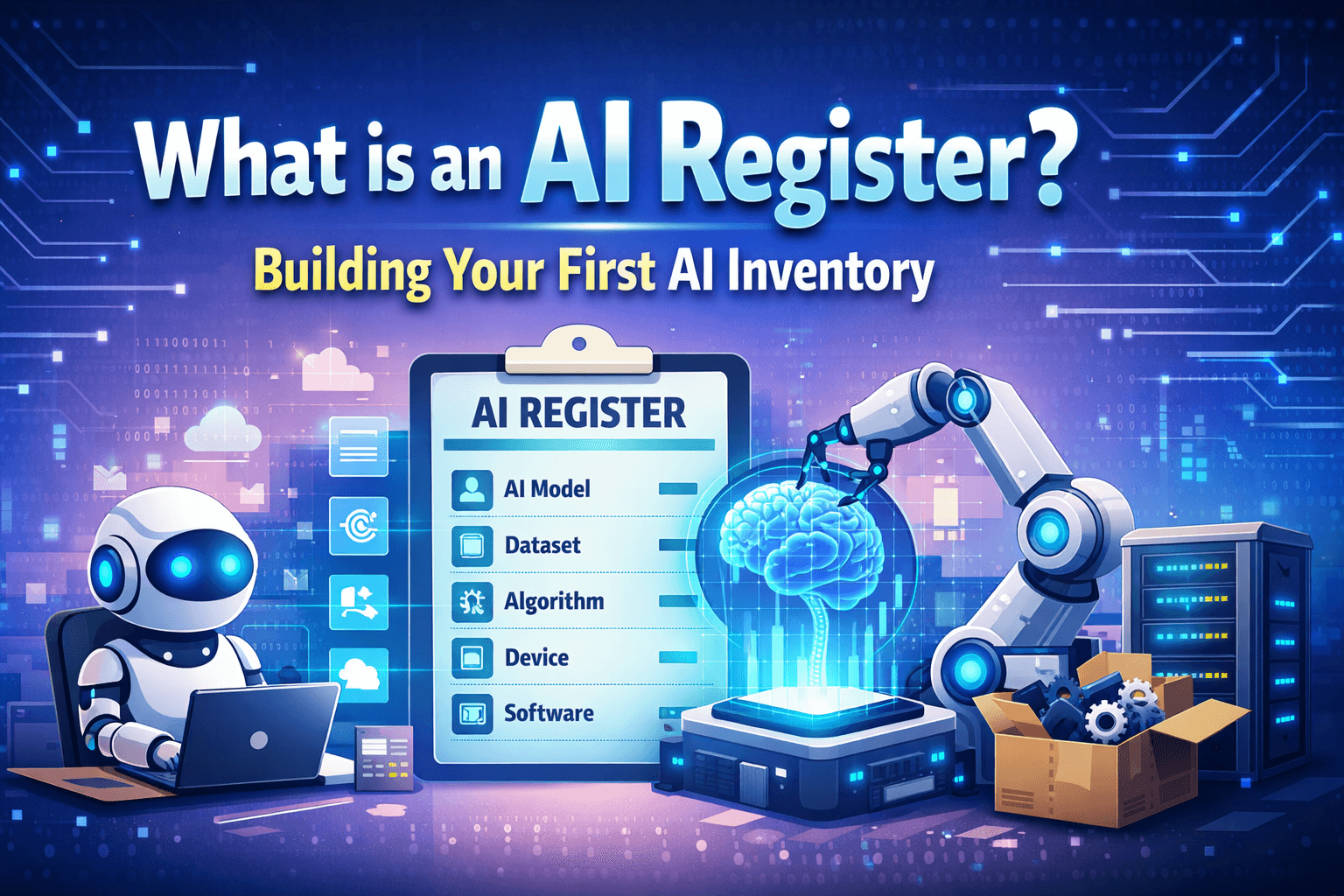
An ai register template is a critical governance tool used by enterprises to catalog, track, and manage all artificial intelligence systems deployed across an organization. It functions as a centralized ai inventory, documenting model types, data sources, risk levels, and ownership details. For B2B leaders and IT teams, maintaining an accurate machine learning inventory is no longer optional; it is the baseline for AI assurance framework implementation. By utilizing a standardized ai register template, firms can identify "shadow AI," ensure regulatory alignment, and streamline the auditing process. This foundational document serves as the single source of truth for an organization's enterprise AI governance tool ecosystem, enabling data-driven oversight of the entire AI lifecycle.
Key Takeaways
Centralize Oversight: Consolidate all AI assets into a single ai inventory to eliminate departmental silos.
Risk Categorization: Use the register to assign risk levels (Low, Medium, High) based on ai policy standards.
Ensure Accountability: Define clear ownership and maintenance schedules for every model in the machine learning inventory.
Simplify Compliance: Prepare for global regulations by maintaining audit-ready documentation for every AI use case.
What This Means in 2026
In 2026, the AI inventory has evolved from a static spreadsheet into a dynamic component of the enterprise AI governance tool suite. As regulations like the EU AI Act reach full enforcement, organizations are legally required to maintain transparency regarding their AI deployments. An ai register template provides the structured data needed to demonstrate compliance with evolving EU AI Act readiness standards.
Furthermore, as AI systems become more integrated into core business logic, the register serves as a protective layer against data breaches caused by ai. By knowing exactly where AI is processing data, IT teams can apply specific security guardrails. This visibility is essential for maintaining a responsible artificial intelligence policy in a landscape where unvetted AI tools create significant liability.
Core Comparison: Inventory Management Approaches
Solution / Platform | Inventory Capability | Automation Level | Compliance Support | Best Fit | Key Advantage |
|---|---|---|---|---|---|
Real-time AI Asset Tracking | Full (Automated) | Audit-Ready Logs | Regulated Industries | End-to-end automated governance with real-time visibility and compliance readiness | |
Samta.ai Strategy | Custom Register Frameworks | High (Managed) | Policy Alignment | Enterprise Scaling | Flexible and scalable framework tailored to enterprise governance needs |
Manual Spreadsheet | Static Data Entry | Zero | Low | Early-stage Startups | Simple and low-cost starting point for basic AI tracking |
Generic GRC Tools | Broad Asset Management | Moderate | Limited to IT | General IT Departments | Integrates AI tracking within broader IT governance systems |
Samta.ai leverages deep-tech expertise in AI and ML to help organizations build robust, scalable inventories that transition from simple templates to automated governance engines.
Practical Use Cases
1. Eliminating Shadow AI
Large enterprises often discover that departments are using unvetted third-party APIs. A structured ai register template allows procurement teams to conduct a thorough third party ai risk assessment, ensuring every external tool is accounted for in the master inventory.
2. Scaling Governance Across Business Units
As companies grow, maintaining a consistent AI assurance framework becomes difficult. By utilizing centralized tools, as discussed in scaling AI governance for enterprises, organizations can ensure that the same AI policy standards are applied to the marketing team's chatbot and the finance team's fraud detection model alike.
Access Your Free AI Assessment Report
Discover where AI can improve efficiency, reduce costs, and scale operations across your enterprise.
Limitations & Risks
Data Staleness: A manual ai inventory becomes obsolete the moment a model is updated or a new API is integrated.
Incomplete Scope: Failing to include "embedded AI" (AI features inside standard SaaS tools) creates a massive governance gap.
Lack of Context: A register that only lists model names without assessing their impact level fails as an AI assurance framework.
Resource Intensive: Maintaining a comprehensive machine learning inventory requires dedicated hours from IT and compliance teams.
Decision Framework
When to Use a Standard AI Register Template:
You are preparing for your first external AI audit or regulatory filing.
Your organization is scaling beyond 5 active AI use cases.
You need to standardize your approach to ethical AI governance frameworks across multiple departments.
When to Transition to Automated Tools (e.g., VEDA):
You deploy high-frequency, high-risk models (e.g., automated credit scoring).
You require real-time explainability and drift monitoring.
The administrative cost of manual inventory management exceeds the cost of a specialized governance tool.
As organizations move from foundational tracking to mature governance, adopting a structured ai risk register template becomes essential for identifying, assessing, and mitigating potential risks across AI systems. While basic inventories provide visibility, combining them with modern ai inventory tools enables real-time monitoring, automated risk classification, and continuous compliance alignment. This shift not only reduces operational overhead but also strengthens enterprise resilience by ensuring that every AI deployment is accountable, auditable, and aligned with evolving regulatory standards.
Section A: How US Enterprises Approach Artificial Intelligence and Applications
US enterprises approach artificial intelligence and applications with a strong focus on scalability, ROI, and integration into existing systems. AI use cases such as AI inventory tracking, predictive analytics, and customer intelligence are often led by CTOs, CIOs, and data teams working collaboratively. Organizations increasingly rely on standardized AI templates to accelerate deployment and reduce development time. Governance, explainability, and performance monitoring are key priorities, particularly in industries like retail, healthcare, and finance. The goal is to move from isolated AI experiments to enterprise-wide adoption that delivers measurable operational and financial outcomes.
Section B: How Singapore Companies Handle Artificial Intelligence and Applications
Singapore-based enterprises take a structured and compliance-driven approach to artificial intelligence and applications, guided by frameworks from MAS and PDPC. AI use cases such as AI inventory tracking and automation templates are implemented with strong emphasis on data privacy, transparency, and auditability. Decision-making involves senior leadership, including Heads of Compliance and Digital Transformation. Unlike purely efficiency-driven models, Singapore organizations prioritize trust and governance in AI adoption. This ensures that AI systems are scalable, compliant, and aligned with both business goals and regulatory expectations.
Conclusion
Building an ai inventory is the first definitive step toward organizational maturity in the age of automation. Whether you start with a simple ai register template or implement a sophisticated governance tool, the goal remains the same: total visibility and control over your AI assets. As the complexity of these systems grows, the enterprises that thrive will be those that prioritize structured oversight and accountability. For organizations looking to transform their governance from a manual burden into a strategic advantage, Samta.ai provides the ML engineering expertise and consulting strategy needed to build a secure, future-proof AI ecosystem.
Take Control of Your AI.
Book a Demo with Samta.ai to automate your AI inventory and simplify compliance today.
About Samta
Samta.ai is an AI Product Engineering & Governance partner for enterprises building production-grade AI in regulated environments.
We help organizations move beyond PoCs by engineering explainable, audit-ready, and compliance-by-design AI systems from data to deployment.
Our enterprise AI products power real-world decision systems:
Tatva : AI-driven data intelligence for governed analytics and insights
VEDA : Explainable, audit-ready AI decisioning built for regulated use cases
Property Management AI : Predictive intelligence for real-estate pricing and portfolio decisions
Trusted across FinTech, BFSI, and enterprise AI, Samta.ai embeds AI governance, data privacy, and automated-decision compliance directly into the AI lifecycle, so teams scale AI without regulatory friction.
Enterprises using Samta.ai automate 65%+ of repetitive data and decision workflows while retaining full transparency and control.
FAQs
What should be included in an ai register template?
At a minimum, your ai register template should include the model name, owner, purpose, data sources, risk classification, and a log of last-known performance audits. This structure ensures alignment with the principles outlined in our future of AI governance guide.
Is an AI inventory a legal requirement?
Yes, under frameworks like the EU AI Act, maintaining a register of "High-Risk" AI systems is mandatory. Failure to do so can lead to significant penalties, as seen in cases involving data breaches caused by ai where lack of oversight was a primary factor.
How does a machine learning inventory help with security?
A machine learning inventory identifies the data pipelines feeding your AI. By knowing which models access sensitive PII (Personally Identifiable Information), security teams can apply specific encryption and access controls, reducing the overall attack surface.
How often should the AI register be updated?
The register should be updated in real-time or, at minimum, quarterly. Any significant change in a model's training data or intended use case triggers a mandatory review within your AI assurance framework.