
Summarize this post with AI
Hiring a data analyst when you need a data engineer is one of the most expensive sequencing mistakes a Singapore enterprise can make and it happens constantly. Data engineering vs data analytics in Singapore is not a technical distinction that only data teams need to understand. It is a strategic investment decision that determines whether your AI and analytics programs have the foundation to deliver value or whether they stall waiting for data that was never properly built. This guide gives Singapore CTOs and technology leaders a clear framework for understanding both disciplines, when to invest in each, and how to sequence them correctly for BFSI and enterprise AI programs in 2026.
Data Engineering vs Data Analytics Singapore:
Data engineering Singapore covers the design, build, and operation of data pipelines, data platforms, and data infrastructure the systems that move, clean, govern, and store data so that downstream consumers can use it reliably. Data analytics Singapore covers the analysis, visualisation, and interpretation of data to produce business insights and decision support. In practice, data engineering must precede data analytics at scale: analytics built on ungoverned, ungoverned pipelines produces unreliable insights that erode business trust faster than no analytics at all. For Singapore BFSI and enterprise organisations, both disciplines must satisfy MAS TRM data lineage and PDPA consent requirements which means governance is a shared obligation, not an engineering-only concern.
What Data Engineering and Data Analytics Actually Cover
What Is Data Engineering?
Data engineering is the discipline of building and maintaining the systems that make data available, reliable, and governed for downstream consumption. A data engineer's core responsibilities include:
Designing and building ingestion pipelines from source systems ERP, CRM, core banking, IoT, third-party APIs
Implementing data quality controls completeness, accuracy, consistency, and timeliness scoring with automated alerting
Building and maintaining data warehouses and lakehouses on platforms such as Snowflake, Databricks, or Microsoft Azure
Documenting data lineage from source to consumption layer
Managing data access controls and audit trail infrastructure
Versioning training datasets for AI and ML model governance
A data engineering roadmap for a Singapore enterprise typically sequences infrastructure before analytics: clean, governed data pipelines must exist before analysts can produce reliable insights from them.
What Is Data Analytics?
Data analytics Singapore covers the consumption layer taking governed, available data and producing business value from it through analysis, modelling, and visualisation:
Descriptive analytics: what happened (dashboards, reports, KPI tracking)
Diagnostic analytics: why it happened (root cause analysis, cohort analysis)
Predictive analytics: what will happen (forecasting models, churn prediction, risk scoring)
Prescriptive analytics: what to do (optimisation models, recommendation engines, decision automation)
Data engineer vs data analytics in role terms: data engineers build the roads; data analysts and analytics engineers drive on them. A brilliant analyst operating on a poorly engineered data foundation produces unreliable insights at high maintenance cost.
The Dependency That Most Singapore Enterprises Underestimate
Analytics quality is bounded by data engineering quality. An organisation with excellent analysts and poor data pipelines will spend 60–70% of analyst time on data cleaning and reconciliation not on analysis (Source Required: Gartner Data Quality Research). The investment sequence matters: data engineering investment consistently produces higher analytics ROI than analytics investment alone because it multiplies the productivity of every analyst in the organisation. Review data engineering ROI to understand how to quantify and present this investment sequence to a board that may be inclined to fund the visible analytics layer without funding the invisible engineering foundation it depends on.
Download Your Free Enterprise AI Assessment Report
Why This Distinction Matters More for Singapore CTOs in 2026
Three developments have raised the stakes for getting the engineering vs analytics investment sequence right:
1. MAS TRM and PDPA obligations extend to both disciplines
MAS Technology Risk Management guidelines require data lineage documentation and engineering obligations. PDPA requires consent tracking and deletion capability, an engineering obligation. But both also affect analytics: analysts using data without documented lineage cannot produce regulatory reports that satisfy MAS examination standards, and analytics models trained on data without consent documentation create PDPA exposure (Source Required: MAS Technology Risk Management Guidelines).
2. AI programs require both disciplines working together
Every AI model in production depends on data engineering for its training data pipeline and inference data feed, and on data analytics for its performance monitoring, business impact measurement, and board reporting. Data engineering services in Singapore that are scoped without analytics integration planning produce models that cannot be measured or defended to stakeholders — which is as bad as models that cannot be deployed.
3. The talent market treats them as separate career tracks
Singapore's data talent market has bifurcated: data engineers command SGD 80,000–160,000 base salaries and data analysts command SGD 60,000–120,000, with almost no overlap in skills or tooling (Source Required: LinkedIn Singapore Talent Insights). CTOs who conflate the two roles in job descriptions end up with neither capability or with one capability masquerading as the other.
The 5-Layer Framework: How Data Engineering and Analytics Work Together
Understanding data engineering vs data analytics Singapore as a layered architecture not as competing disciplines is the most useful frame for CTO-level investment decisions:
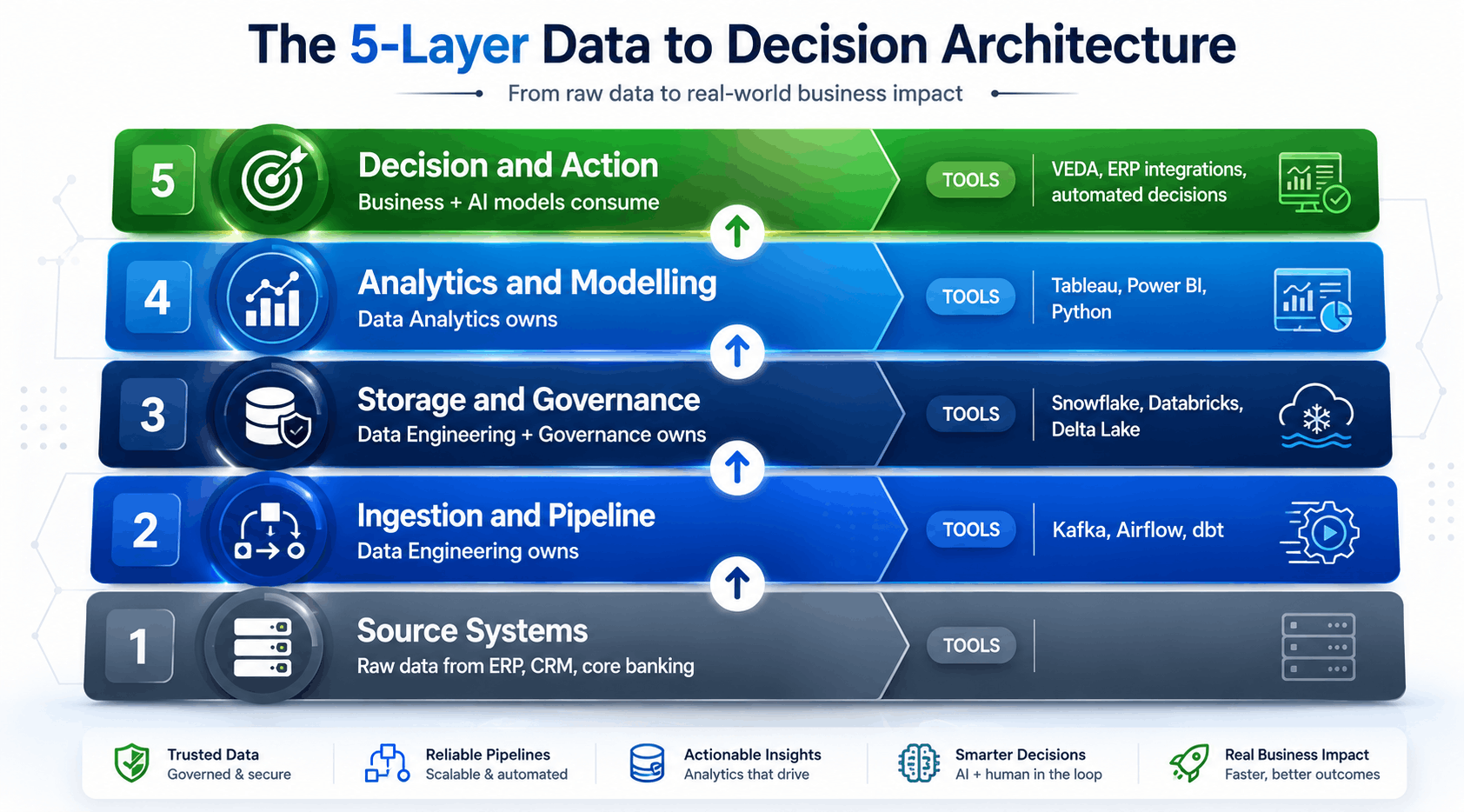
Layer 1: Source Systems
Raw data from ERP, CRM, core banking, transaction systems, and third-party APIs. Neither engineering nor analytics can operate without clean source system access. Data engineering owns the connection and extraction layer; analytics owns the business context for what data matters.
Layer 2: Ingestion and Pipeline
Data engineers build the pipelines that move raw data from source systems into a centralised platform. Data engineering tools at this layer include Apache Kafka for streaming, Apache Airflow or Databricks Workflows for batch orchestration, and dbt for transformation. This layer is invisible to analysts but determines the freshness, completeness, and reliability of everything they see.
Layer 3: Storage and Governance
Data is stored in a governed warehouse (Snowflake, BigQuery) or lakehouse (Databricks Delta Lake, Azure Data Lake). Data engineers own quality scoring, lineage tracking, access controls, and PDPA consent metadata at this layer. Samta.ai's data integration consulting services implement this layer on Databricks and Snowflake as the foundational investment that multiplies analytics ROI across every subsequent use case.
Layer 4: Analytics and Modelling
Data analysts, analytics engineers, and data scientists consume governed data from Layer 3 to produce dashboards, forecasting models, and AI training datasets. Data analytics Singapore tools at this layer include Tableau, Power BI, Looker, and Python/R for statistical modelling. The quality of output at this layer is entirely determined by the quality of Layers 2 and 3.
Layer 5: Decision and Action
Analytics outputs are consumed by business decision-makers, automated decision systems, and AI models in production. The VEDA AI Data Analytics Platform sits at this layer — connecting governed data from Layers 2–3 to production AI decision models and business intelligence dashboards with embedded explainability and audit trail infrastructure.
Data Engineering vs Data Analytics Singapore: 5-Column Comparison
Dimension | Data Engineering | Data Analytics | Where They Overlap | Samta.ai Capability |
Primary Output | Governed data pipelines and platforms | Insights, reports, forecasting models | Analytics engineering (dbt, data modelling) | Full stack — engineering through to analytics |
Core Tools | Databricks, Snowflake, Kafka, Airflow, dbt | Tableau, Power BI, Python, SQL, Looker | dbt, SQL, Python | Databricks + Snowflake + VEDA analytics layer |
Governance Obligation | Lineage, quality, access controls, PDPA consent | Model documentation, insight auditability | Shared — both must satisfy MAS TRM data standards | MAS TRM-aligned across both layers |
Investment Sequence | Must precede analytics at scale | Multiplied by engineering quality | Analytics engineering bridges both | Sequenced correctly in every engagement |
Singapore Salary Range | SGD 80K–160K (data engineer) | SGD 60K–120K (data analyst) | Analytics engineer: SGD 90K–140K | Covered by engagement model — no single hire risk |
Evaluate Your AI Risk Posture in Minutes
Real-World Use Cases: Data Engineering and Analytics in Singapore
Use Case 1: Treasury Risk Analytics, Singapore Bank (BFSI)
A Singapore-licensed bank's treasury analytics team was producing daily risk reports that took 6 hours to generate and were frequently flagged by the model risk team for data quality inconsistencies. The analysts were spending 65% of their time reconciling data from four source systems manually before any analysis could begin. The root cause was not the analysts it was the absence of a governed data engineering layer beneath them. Samta.ai's data integration consulting services built a unified Snowflake data foundation with automated quality scoring and lineage tracking. Report generation time dropped from 6 hours to 35 minutes. Analyst time on data reconciliation dropped from 65% to 12%. The analytics capability did not change the engineering foundation underneath it did. This is the core lesson of data engineering vs data analytics Singapore for BFSI: analytics productivity is an engineering investment, not an analyst headcount question. Compare how data platform decisions affect analytics ROI in the VEDA vs data intelligence platform comparison.
Use Case 2: Demand Analytics Platform, Regional Retailer (General Enterprise)
A regional retailer operating across Singapore, Malaysia, and Thailand had a business intelligence team of 8 analysts producing weekly demand reports. When the business requested daily reports to support a new just-in-time inventory program, the analytics team reported that daily reporting was not possible the data pipelines ran weekly batch jobs and could not support higher frequency. The constraint was engineering, not analytics. A Databricks pipeline rebuild with daily orchestration and a Delta Lake storage layer enabled daily reporting within 8 weeks. The analytics team's output frequency increased 7x without any additional analyst headcount. Understanding enterprise AI engineering in Singapore makes clear that analytics frequency and quality are engineering constraints before they are analytical ones.
Key Risks When Data Engineering and Analytics Are Misaligned
Analytics investment without engineering foundation: funding dashboards and BI tools before governed pipelines exist produces reports that analysts cannot defend and business users stop trusting within 3–6 months
Engineering investment without analytics consumption planning: building a data platform without defining the analytics use cases it must serve produces technically excellent infrastructure that nobody uses
Role conflation in hiring: advertising for a "data analyst" when the role requires pipeline engineering, or a "data engineer" when the role requires business insight generation, produces mismatched hires that frustrate both the individual and the organisation
Governance treated as engineering-only: data analysts building reports on ungoverned data create MAS examination risk and PDPA exposure that the engineering team did not create and cannot remediate alone
Platform sprawl: separate engineering and analytics teams selecting different tools without a shared platform strategy creates integration overhead that compounds quarterly; align on Snowflake, Databricks, or Azure as the shared foundation before either team builds independently
Review data governance tools comparison to understand how platform selection decisions affect both engineering and analytics capability over a 3-year investment horizon.
Decision Framework: When to Invest in Data Engineering vs Data Analytics
Invest in data engineering first when:
Data exists in more than two unintegrated source systems with no shared quality standard
Analytics teams spend more than 30% of their time on data preparation rather than analysis
AI or ML use cases are in the roadmap and require governed training data pipelines
MAS examination or PDPA audit has identified data lineage or quality gaps
Report generation requires manual reconciliation steps that cannot be automated in the current state
Invest in data analytics capability when:
A governed, unified data platform already exists with automated quality scoring
Business stakeholders are making decisions without data visibility — not because data is unavailable but because it is not presented in actionable form
Competitive intelligence, customer behaviour analysis, or forecasting use cases have been validated and prioritised
Invest in both simultaneously when:
You are building a net-new data capability from scratch with a defined 12-month use case roadmap
An analytics engineering function (dbt, modelling layer) can bridge the two disciplines in a single team
Your data engineering roadmap and analytics roadmap share a common platform (Snowflake or Databricks) that both teams will build on
Review enterprise data integration services for a structured approach to sequencing both investments within a single program rather than running them as separate workstreams.
Discover Your Best AI Growth Opportunities
Conclusion
Data engineering vs data analytics Singapore is not a competition between two disciplines — it is a dependency relationship that CTOs must sequence correctly to deliver AI and analytics value at enterprise scale. Engineering enables analytics. Analytics justifies engineering investment. Governance connects both to regulatory compliance. The organisations that get this sequence right build compounding data advantage. Those that fund analytics without engineering foundations consistently rebuild their data stack every 18–24 months as trust in data quality collapses. Invest in the foundation first then build the insights layer on top of it.
About Samta
Samta.ai is a Singapore-headquartered AI Product Engineering & Data Intelligence partner helping enterprises build production-grade AI systems for regulated and data-intensive environments.We help organizations move beyond experimentation by engineering scalable, explainable, and enterprise-ready AI solutions from data foundations and model development to workflow automation and deployment.
Our capabilities combine deep AI expertise, data engineering, and product engineering to deliver measurable business impact across FinTech, BFSI, cybersecurity, regulatory technology, and enterprise operations.
Our enterprise AI products power real-world intelligence systems:
• TATVA : AI-driven data intelligence platform for governed analytics, monitoring, and operational insights
• VEDA : Explainable and audit-ready AI decisioning engine built for compliance-sensitive enterprise workflows
• CORA-Property Management Solutions: : Predictive intelligence platform for real-estate pricing, portfolio optimization, and investment analytics
Backed by ecosystem partnerships with Microsoft, Databricks, Snowflake, and AWS, Samta.ai delivers agile, cost-efficient AI engineering with faster turnaround and enterprise-grade scalability. Trusted by enterprises across FinTech, BFSI, and digital transformation initiatives, Samta.ai embeds AI governance, data privacy, and compliance-by-design principles directly into the AI lifecycle , enabling organizations to scale AI with transparency, accountability, and operational control.
Enterprises leveraging Samta.ai automate 65%+ of repetitive data, analytics, and decision workflows while maintaining governance, explainability, and measurable business outcomes. Samta.ai provides the strategic consulting, AI engineering, and data modernization expertise needed to align enterprise operations with next-generation AI transformation goals.
Frequently Asked Questions
What is the difference between data engineering and data analytics in Singapore?
Data engineering Singapore covers the infrastructure and pipeline layer moving, cleaning, governing, and storing data reliably. Data analytics Singapore covers the consumption and insight layer analysing, visualising, and interpreting governed data to produce business decisions. The critical dependency: analytics quality is bounded by engineering quality. Organisations that invest in analytics without a governed engineering foundation consistently experience data trust failures within 6–12 months of launching their analytics programs.
Which should a Singapore CTO invest in first data engineering or data analytics?
For most Singapore enterprises, data engineering investment must precede analytics investment at scale. The sequence is: govern the data first (engineering), then analyse it reliably (analytics). Exceptions apply when a single, well-scoped analytics use case can be built directly from a clean source system without a centralised platform but these are narrow cases that do not scale. The data engineering roadmap should be defined before analytics tool selection begins.
What data engineering tools are most commonly used in Singapore enterprises?
Common data engineering tools in Singapore enterprise environments include: Databricks (lakehouse architecture, Delta Lake, MLflow for AI model training), Snowflake (governed data warehousing, time-travel, access history), Apache Airflow (pipeline orchestration), dbt (data transformation and analytics engineering), Apache Kafka (real-time streaming), and Microsoft Azure Data Factory (ETL for Azure-native environments). Tool selection should be driven by existing infrastructure, latency requirements, and the analytics and AI use cases the platform must support.
What is a data engineering roadmap and what should it cover?
A data engineering roadmap for Singapore enterprise covers four phases: platform assessment and source system audit (what data exists, where, and in what quality state); architecture design and tool selection; pipeline build, quality remediation, and governance embedding (lineage, PDPA consent, access controls); and handover to analytics and AI consumers with monitoring and operations in place. The roadmap should be scoped to deliver the first governed, analytics-ready data domain within 12 weeks not as a multi-year infrastructure project.
How does the VEDA platform connect data engineering and analytics for Singapore enterprises?
The VEDA AI Data Analytics Platform sits at the intersection of data engineering and analytics consuming governed data from Snowflake and Databricks pipelines and producing production AI decisions and business intelligence dashboards with embedded explainability and audit trail infrastructure. It eliminates the manual handoff between the engineering layer and the analytics consumption layer that most enterprises manage through separate BI tools and separate data science notebooks collapsing both into a single governed analytics and AI decision platform.