

Summarize this post with AI
Boards approve AI budgets and question data engineering budgets even though no AI initiative delivers value without a governed data platform underneath it. Data engineering ROI is one of the hardest business cases to make precisely because the value is foundational: it enables every downstream initiative without appearing on any single revenue line itself. This guide gives CIOs, CTOs, and data leaders in BFSI and enterprise sectors a structured framework to calculate, present, and defend data engineering ROI to a board that wants outcomes, not infrastructure arguments.
Data Engineering ROI:
Data engineering ROI is calculated by measuring the combined value of outcomes enabled by a governed data platform including AI model accuracy improvements, operational cost reductions from automated pipelines, regulatory compliance cost avoidance, and revenue uplift from faster, more reliable analytics against the total cost of platform build and operations. For BFSI and regulated enterprise in APAC, the roi of data engineering investment also includes avoided regulatory remediation cost, which routinely exceeds the platform build cost when data lineage and governance infrastructure is absent. A structured data platform business case presents ROI across three horizons: immediate cost reduction, medium-term AI enablement value, and long-term competitive data advantage.
What Data Engineering ROI Actually Measures
What is ROI in technology investments is straightforward in theory return divided by cost but data engineering roles and responsibilities produce value across multiple dimensions that are rarely captured in a single metric.
A complete data engineering ROI calculation includes:
Direct cost savings: replacing manual data preparation, reducing ETL failures, eliminating duplicate data storage costs, and automating reporting that previously required analyst hours
AI enablement value: the revenue and risk outcomes delivered by AI models that could not have been built without a governed data foundation
Compliance cost avoidance: the cost of regulatory remediation avoided by having documented data lineage, consent management, and audit trail infrastructure in place
Decision velocity value: the commercial value of faster, more reliable data access for business decisions: faster credit approvals, more accurate demand forecasting, earlier fraud detection
The most common error in data platform business cases is presenting only the first category direct cost savings which consistently underrepresents total ROI by 60–70%. Boards that see only infrastructure cost savings reject data platform investments. Boards that see AI enablement value and compliance cost avoidance approve them. Understanding AI ROI measurement frameworks is directly relevant here because data engineering ROI and AI ROI are not separate calculations for most enterprises. They share the same value chain.
Get a complimentary assessment of your data platform's AI-readiness and ROI potential from Samta.ai
\Why Data Engineering ROI Is Harder to Ignore in 2026
Three forces have made data engineering roadmap investment a board-level priority rather than a technology team decision:
1. AI programs are stalling on data, not models
Gartner estimates that through 2025, poor data quality costs organisations an average of USD 12.9M per year (Source Required: Gartner Data Quality Research). More specifically, AI programs that begin model development before data infrastructure is governed consistently take 2–3x longer to reach production and deliver 40–60% lower model accuracy than projected. The data platform is not upstream of the AI business case it is inside it.
2. Regulatory data obligations are expanding
MAS Technology Risk Management guidelines, RBI data governance frameworks, and PDPA obligations in Singapore all require documented data lineage, quality controls, and audit trail infrastructure. The cost of retrofitting these controls after a model is in production or after a regulatory examination routinely exceeds the cost of the original platform build (Source Required: Deloitte Data Risk Report).
3. The data talent market is clarifying what good looks like
Data engineering roles and responsibilities have matured significantly since 2022. Boards now have access to benchmarks cost per pipeline, data quality scores, time-to-insight metrics that allow them to evaluate data platform performance rather than just approve infrastructure spend. This creates both pressure and opportunity: pressure to justify existing platform investment, and opportunity to make a credible ROI case for new investment. Review AI engineering services cost benchmarks to understand how data infrastructure cost sits within the broader AI program investment picture.
The 5-Step Framework to Calculate and Present Data Engineering ROI
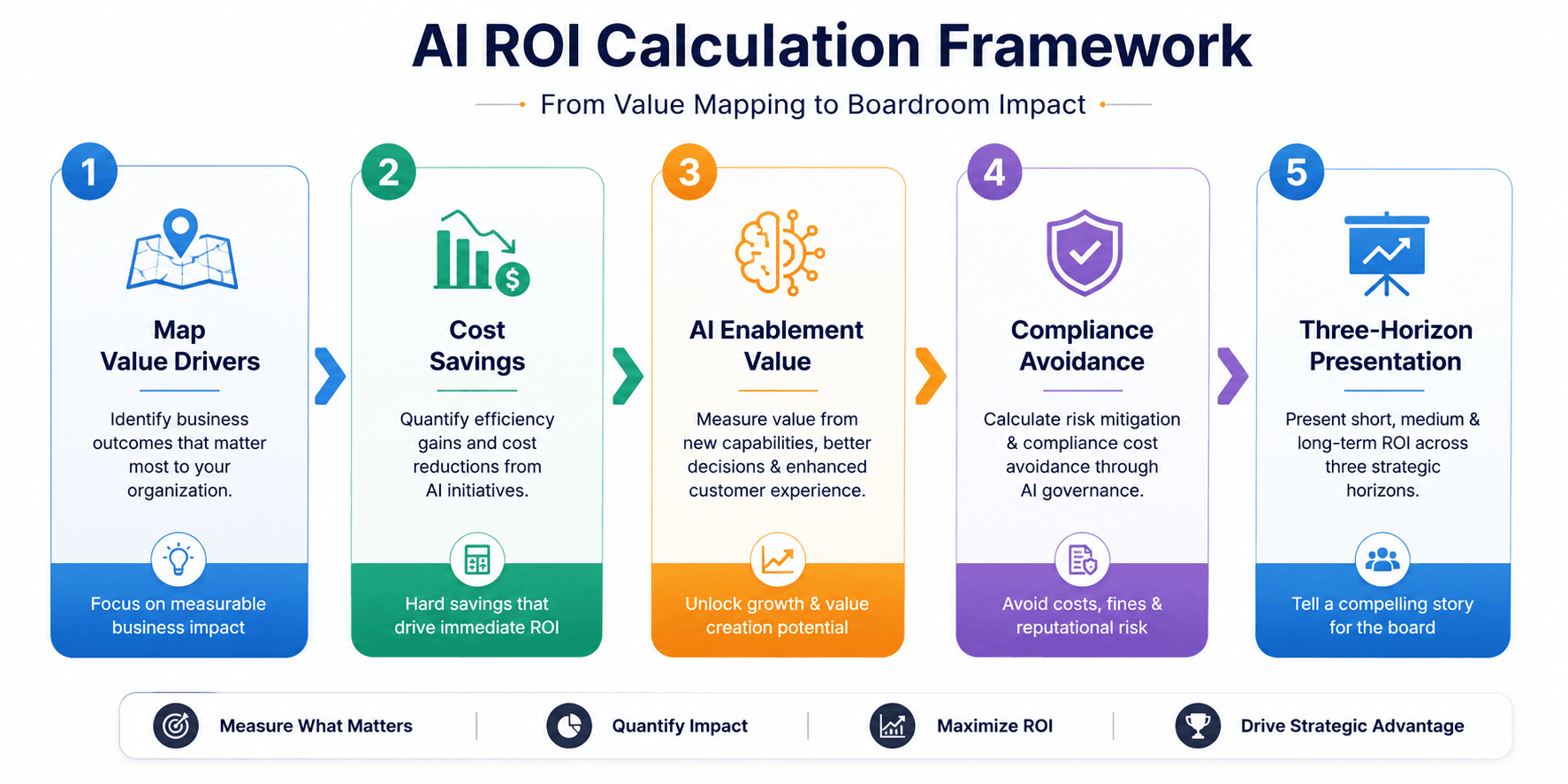
Step 1: Map Every Downstream Value Driver
Before calculating any number, list every business outcome your data platform enables or will enable: AI models in production, automated reporting replacing analyst hours, compliance documentation generated automatically, real-time fraud alerts, customer segmentation models. Each of these is a ROI contributor that belongs in the calculation.
Step 2: Quantify Direct Cost Savings
Calculate the annual cost of what your data platform replaces or automates: manual data preparation hours, ETL failure remediation, duplicate data storage, ad hoc reporting requests. These are the most visible and easiest to defend in a board presentation. For most mid-to-large enterprises, this layer alone delivers SGD 400,000–1.2M in annual cost savings (Source Required: McKinsey Data Infrastructure Value Report).
Step 3: Assign AI Enablement Value
For every AI model in production or in the roadmap estimate the annual business value it delivers: credit loss reduction, fraud savings, demand forecasting accuracy improvement, customer retention uplift. Then assign the data platform a proportional credit for enabling that value. A conservative attribution is 30–40% of AI model value to the underlying data infrastructure. Samta.ai's data integration consulting services use Databricks and Snowflake to build the pipeline infrastructure that AI models depend on and the engagement always includes a value attribution model that connects platform investment to downstream AI outcomes for board reporting purposes.
Step 4: Calculate Compliance Cost Avoidance
For regulated enterprises, document the cost of regulatory remediation avoided by having governed data lineage, consent management, and audit trail infrastructure in place. Benchmark against actual remediation costs at peer institutions. In BFSI, retroactive data governance remediation routinely costs SGD 500,000–2M per examination cycle (Source Required: industry disclosure). Samta.ai's digital transformation managed services include compliance infrastructure as a standard component of every data platform engagement ensuring this cost avoidance is built in, not bolted on.
Step 5: Structure the Three-Horizon ROI Presentation
Present data engineering ROI across three time horizons:
Horizon 1 (0–12 months): Direct cost savings, pipeline automation, reporting efficiency
Horizon 2 (12–24 months): AI model enablement value, faster time-to-insight for business decisions
Horizon 3 (24–36 months): Competitive data advantage, compounding model improvement, regulatory examination readiness
This structure gives the board a payback timeline and a compounding value story — not a one-time infrastructure justification.
Data Engineering ROI: Investment Comparison
ROI Dimension | Without Data Platform | Basic Data Platform | Governed Data Platform | Samta.ai Benchmark |
AI Model Time to Production | 18–24 months | 12–18 months | 6–9 months | 6–8 months (BFSI) |
Data Quality Score | < 60% completeness | 65–75% completeness | 85–95% completeness | 90%+ with automated monitoring |
Regulatory Remediation Risk | High — no lineage documentation | Moderate — partial lineage | Low — full lineage and audit trail | Near-zero — embedded compliance controls |
Annual Cost Savings (Mid-Enterprise) | Baseline | SGD 200K–500K | SGD 600K–1.5M | SGD 800K–1.8M |
AI Enablement Value (Year 2) | None — models cannot be deployed | Partial — limited use cases | Full — multiple use cases in production | Compounding — platform improves with each model |
Know Your AI Risk Before It Costs You →
Real-World Use Cases: What Data Engineering ROI Looks Like in Practice
Use Case 1: Regional Bank, Singapore (BFSI)
A Singapore-licensed bank had three AI use cases approved and budgeted credit scoring, fraud detection, and customer churn prediction but all three were blocked at the data layer. Data existed across seven unintegrated systems with no lineage tracking, inconsistent quality standards, and no consent documentation for PDPA compliance. Rather than building three separate data pipelines for three separate models, the bank invested SGD 780,000 in a unified Snowflake data platform with Databricks orchestration, governed lineage, and automated quality scoring. All three AI models were deployed within 11 months of platform completion. Combined annual AI model value: SGD 4.2M. Platform ROI in Year 1: 5.4x. The VEDA AI Decision Analytics Platform was deployed on top of this foundation to provide continuous model monitoring and board-level performance reporting ensuring the platform's ROI remained visible and measurable after deployment, not just at launch.
Use Case 2: Regional Retailer, Southeast Asia (General Enterprise)
A retail conglomerate operating across five APAC markets had fragmented data environments in each market different ERP systems, different customer data platforms, no unified product master. Demand forecasting, inventory optimisation, and customer analytics were all blocked. A unified data platform investment of SGD 1.1M including Databricks pipeline engineering and Microsoft Azure data warehouse consolidation enabled demand forecasting AI deployment in Month 9. Year 1 inventory cost reduction: SGD 3.8M. The roi of data engineering investment in this case was 3.5x in Year 1, compounding in Year 2 as the platform was extended to customer analytics and supplier optimisation use cases. This outcome mirrors patterns documented in what is data science value frameworks where the data layer consistently accounts for 40–60% of total AI program value when correctly attributed.
AI Implementation Playbook Get the complete data platform ROI calculation framework including board presentation templates and three-horizon value models. Download free →
Key Risks That Undermine Data Engineering ROI
Single-use pipeline architecture: building data pipelines for one AI use case rather than a reusable platform foundation; each subsequent use case requires a separate build, destroying the compounding ROI that shared platforms deliver
Governance deferred to Phase 2: data lineage, quality monitoring, and consent management treated as future-state additions rather than Phase 1 requirements; regulatory remediation cost eliminates platform ROI when governance is retrofitted
ROI attribution failure: presenting platform investment without connecting it to specific downstream AI and analytics outcomes; boards reject infrastructure spend they cannot trace to business value
Vendor lock-in on proprietary pipelines: data platforms built on single-vendor proprietary tooling create migration costs that destroy long-term ROI; open standards on Databricks, Snowflake, and Azure provide portability
Data quality threshold set too low: platforms that go live at 65% data quality and never improve create AI models with degrading accuracy, which inverts the ROI case over time
Compare how platform architecture decisions affect long-term ROI in the VEDA vs data intelligence platform comparison where platform design choices made at build time consistently determine ROI trajectory in Year 2 and beyond.
Decision Framework: When to Invest in a Data Platform vs When to Wait
Invest in a governed data platform now when:
Two or more AI use cases are approved or in pipeline and all are blocked at the data layer
Data exists across more than three unintegrated systems with no shared quality standards
Regulatory examination in the next 12 months requires documented data lineage or consent management
The board has approved AI investment but no data infrastructure investment to support it
Wait or scope a smaller initial investment when:
Only one AI use case is approved and the required data is already in a single, reasonably clean system
A major M&A or restructuring event will change the data architecture within 12 months
No AI or analytics use cases have been validated and prioritised yet
Use the AI engineering team structure framework to confirm whether the data engineering roles required to build and operate the platform are in place before committing to platform investment.
Data engineering specialist to build a board-ready ROI model for your specific data platform investment
Conclusion
Data engineering ROI is not invisible it is simply presented incorrectly. Boards that see only infrastructure cost reject data platform investment. Boards that see AI enablement value, compliance cost avoidance, and a three-horizon compounding return consistently approve it. The data platform is not upstream of your AI business case. It is inside it. Build the ROI case that reflects that reality and present it that way from the first board conversation. Explore how Samta.ai's digital transformation managed services structure data platform investment for maximum ROI visibility.
About Samta
Samta.ai is a Singapore-headquartered AI Product Engineering & Data Intelligence partner helping enterprises build production-grade AI systems for regulated and data-intensive environments.We help organizations move beyond experimentation by engineering scalable, explainable, and enterprise-ready AI solutions from data foundations and model development to workflow automation and deployment.
Our capabilities combine deep AI expertise, data engineering, and product engineering to deliver measurable business impact across FinTech, BFSI, cybersecurity, regulatory technology, and enterprise operations.
Our enterprise AI products power real-world intelligence systems:
• TATVA : AI-driven data intelligence platform for governed analytics, monitoring, and operational insights
• VEDA : Explainable and audit-ready AI decisioning engine built for compliance-sensitive enterprise workflows
• CORA-Property Management Solutions: : Predictive intelligence platform for real-estate pricing, portfolio optimization, and investment analytics
Backed by ecosystem partnerships with Microsoft, Databricks, Snowflake, and AWS, Samta.ai delivers agile, cost-efficient AI engineering with faster turnaround and enterprise-grade scalability. Trusted by enterprises across FinTech, BFSI, and digital transformation initiatives, Samta.ai embeds AI governance, data privacy, and compliance-by-design principles directly into the AI lifecycle , enabling organizations to scale AI with transparency, accountability, and operational control.
Enterprises leveraging Samta.ai automate 65%+ of repetitive data, analytics, and decision workflows while maintaining governance, explainability, and measurable business outcomes. Samta.ai provides the strategic consulting, AI engineering, and data modernization expertise needed to align enterprise operations with next-generation AI transformation goals.
Frequently Asked Questions
What is data engineering ROI and how is it calculated?
Data engineering ROI measures the financial return generated by a governed data platform relative to its total build and operational cost. Calculation includes: direct cost savings from automation, AI model value enabled by the platform, compliance cost avoidance from governance infrastructure, and decision velocity value from faster analytics. The most accurate calculation attributes 30–40% of every downstream AI model's value to the data platform that enabled it.
What is ROI in technology investments like data platforms?
What is ROI in technology for data platforms differs from application software ROI because the value is foundational rather than direct. A CRM delivers value directly; a data platform delivers value by enabling every other system to deliver more value. This means data platform business case presentations must trace value through the downstream systems the platform enables AI models, analytics, compliance infrastructure — rather than attributing value to the platform itself in isolation.
How long does it take to achieve positive data engineering ROI?
Well-scoped data platform investments with governed architecture typically achieve positive ROI within 12–18 months when two or more AI or analytics use cases are deployed on the foundation. The ROI timeline compresses significantly when the platform is built to serve multiple use cases simultaneously rather than scoped for a single pipeline. Platforms with embedded compliance infrastructure achieve positive ROI faster in regulated sectors because they avoid the remediation costs that ungoverned platforms incur.
What is included in a data engineering roadmap for enterprise?
A data engineering roadmap for enterprise covers four phases: data infrastructure assessment and gap analysis; platform architecture design and vendor selection (Snowflake, Databricks, Azure); pipeline build, data quality remediation, and governance embedding; and AI model deployment and ongoing platform operations. Each phase has defined deliverables and success metrics that feed the ROI calculation making the roadmap itself a board presentation tool, not just a technical plan.
What are the data engineering roles and responsibilities in a platform build?
Data engineering roles and responsibilities in a platform build include: data engineers who design and build ingestion pipelines and quality controls; data architects who design the overall platform structure and integration patterns; DataOps or MLOps engineers who automate pipeline monitoring and retraining; and a data governance lead who owns lineage documentation, consent management, and audit trail infrastructure. For regulated enterprises, the governance lead role is as critical as the engineering roles for achieving regulatory compliance alongside technical delivery.