
Summarize this post with AI
Most digital transformation consultancy engagements in Singapore fail not because the technology is wrong, but because the scope was sold before the risk was understood. A digital transformation consultancy helps an enterprise redesign processes, data, and systems around AI and cloud capability, then owns delivery against a measurable outcome. Cost, governance fit, and delivery accountability decide whether that engagement survives past the pilot stage, and this guide walks through all three in detail.
Digital Transformation Consultancy: The Direct Answer
A digital transformation consultancy in Singapore typically charges between SGD 40,000 and SGD 500,000 per engagement depending on scope, ranging from a focused AI readiness assessment to a full enterprise rebuild spanning data, workflow, and governance. The right partner combines business transformation consulting expertise with hands on engineering delivery, not just slide based strategy. For regulated sectors such as BFSI, the partner must also design against MAS supervisory expectations from day one, not retrofit compliance after launch.
What is a digital transformation consultancy
A digital transformation consultancy is a firm that redesigns how an enterprise operates using digital and AI capability, covering strategy, data architecture, workflow automation, and change management as one connected program rather than four separate projects. The category sits distinct from a pure strategy house on one side and a pure systems integrator on the other.
Digital transformation consulting work usually spans four layers, each of which needs its own specialist skill set even when a single vendor delivers all four.
Strategy and operating model design, which sets the target state before any build begins
Data and platform architecture, which decides whether the AI layer will actually work at production scale
AI and automation build, where models and workflows are engineered and tested
Governance, risk, and change adoption, which determines whether the system survives contact with real users and real regulators
In Singapore specifically, digital transformation consultancy Singapore engagements increasingly start with a regulatory question rather than a technology question, because MAS, PDPC, and IMDA expectations shape what can actually be deployed in production. A useful starting reference here is this deeper look at AI transformation consulting in Singapore, which breaks down how local regulatory context changes the shape of a typical scope of work. Enterprises comparing vendors at this stage often benefit from a structured view on identifying the best AI consulting companies before they issue a request for proposal, since the shortlist criteria differ meaningfully between a strategy shop and an engineering led partner.
Why it matters now
2026 has pushed enterprise transformation from a competitive advantage to a supervisory expectation, particularly across BFSI and fintech. MAS finalised its Guidelines on Artificial Intelligence Risk Management for financial institutions, building directly on the earlier Principles to Promote Fairness, Ethics, Accountability and Transparency. Boards are now expected to demonstrate AI oversight, not just describe it in a policy document. Globally, the NIST AI Risk Management Framework has become a reference point that Singapore based enterprise transformation teams increasingly map their own controls against, even outside the United States, because regulators and auditors now expect a named framework behind any AI governance claim.
Three forces are converging at once, and any one of them alone would justify a transformation program.
Regulatory scrutiny on AI in financial services and healthcare, where explainability is no longer optional
Legacy core systems reaching end of vendor support, forcing a rebuild whether or not the business wanted one this year
Rising customer expectation for real time, personalised digital service, which older batch based systems simply cannot deliver
An enterprise that treats these as separate work streams usually ends up paying three vendors to solve one problem. This is the gap that enterprise AI consulting engagements are designed to close, by putting one accountable team across strategy, build, and governance at once.
Measure Your Organization's AI Maturity
What a full scope of work typically includes
Before comparing partners on price, it helps to know what should actually be inside the scope. A properly priced digital transformation consulting engagement usually bundles several distinct services rather than selling them separately. Ongoing operational support after go live is often the piece enterprises forget to budget for, which is why many partners now offer it as a named line item under digital transformation managed services rather than an afterthought. Process heavy functions such as claims handling, lease renewals, or compliance checks usually sit under a dedicated workflow automation consulting work stream, since automating a broken process just makes the mess move faster. Underneath all of it sits the data layer, and a credible scope will always include data integration consulting services as a named deliverable, because no AI model performs better than the data feeding it.
The core framework: how a transformation program actually runs
Every credible transformation consulting engagement follows a version of this sequence, even when the vendor names it differently.
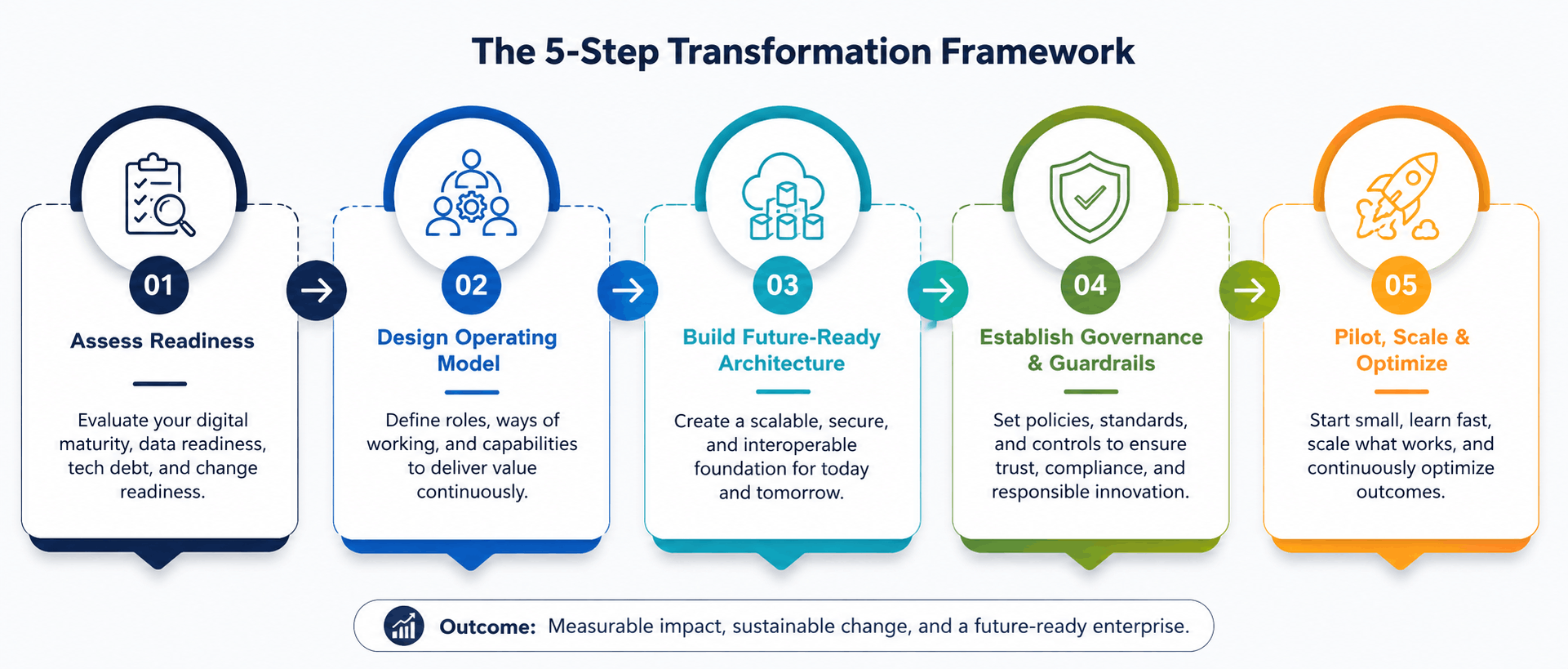
Readiness assessment. Data quality, system inventory, regulatory exposure, and team capability are scored against a baseline, usually over two to four weeks, producing a gap report the board can actually read.
Target operating model. The future state process, org design, and platform stack are defined, referencing a proven AI implementation playbook rather than a generic template built for a different industry.
Architecture and build. Data pipelines, integration layers, and AI models are engineered on platforms such as Databricks, Snowflake, or Microsoft Azure, depending on the existing estate, with a data analytics layer such as the VEDA AI data analytics platform doing the heavy lifting on ingestion, cleaning, and modelling at production scale.
Governance layer. Model risk controls, audit trails, and human oversight checkpoints are built in, not bolted on, echoing the argument made in why AI transformation needs governance from day one rather than at the audit stage.
Rollout and adoption. Change management, training, and phased go live replace a single big bang launch, since even a technically flawless system fails if the people using it were never brought along.
This is where enterprise digital transformation consulting services earn or lose their fee. Strategy decks are cheap to produce. The engineering layer is where most consultancies quietly fall short, which is exactly the gap a platform like VEDA is built to close inside the architecture step rather than as a bolted on purchase later.
Comparing consultancy partner types
Partner Type | Typical Engagement Cost (SGD) | Delivery Model | Regulatory Depth (BFSI) | Best Fit For |
Big four advisory arm | 200,000 to 1,000,000+ | Strategy heavy, subcontracted build | Strong on paper, slower to execute | Board level narrative and audit defensibility |
Global systems integrator | 150,000 to 800,000 | Engineering heavy, rigid process | Moderate, varies by team | Large legacy core replacement |
Boutique AI consultancy | 40,000 to 250,000 | Lean team, fast iteration | Varies widely by firm | Focused pilots and proof of concept |
Independent contractor network | 20,000 to 120,000 | Highly variable, low continuity | Usually limited | Narrow, well defined technical tasks |
Enterprise AI engineering partner (e.g. Samta.ai) | 60,000 to 500,000 | Strategy plus in house build | Purpose built for MAS, PDPC context | Enterprises needing strategy and delivery under one accountable team |
A comparison of AI consultancies against traditional development companies shows the same pattern across most engagements, where firms that separate strategy from build tend to lose weeks in handoff. The same gap shows up one layer down at the platform level, which is worth checking directly through this comparison of VEDA against other data intelligence platforms before locking in a data architecture decision that is expensive to reverse later.
Real world enterprise use cases
BFSI example: A Singapore based regional bank needed to modernise fraud detection while satisfying MAS supervisory expectations on model explainability. The engagement combined a data integration layer pulling from six legacy systems, an explainable AI model for transaction scoring, and a documented governance framework mapped to FEAT. The result was a production model with an audit trail a supervisor could actually review, not a black box score, delivered by a team working under the same standards described in enterprise AI engineering in Singapore.
General enterprise example: A regional proptech operator running manual lease management across multiple markets needed workflow automation without replacing its core property system. The build layered workflow automation on top of the existing stack, automating renewal notices, compliance checks, and reporting, cutting manual processing time without a disruptive rip and replace.
Third example, cross sector: A healthcare operator consolidating patient intake data across three clinics needed a single data layer before any AI model could be trusted. Full detail on outcomes like these, including timelines and measurable results, sits in the Samta.ai case studies archive, which is worth reviewing before shortlisting any partner so expectations on both cost and timeline are grounded in real delivery history rather than a sales projection.
Understand Your AI Risk Profile
Key risks and failure modes
Most failed business transformation consulting programs fail for identifiable, repeatable reasons, and most of them are visible before the contract is even signed if someone knows what to look for.
Scope creep without a governance owner. No single accountable executive means the project drifts until budget runs out.
Data quality assumed, not tested. Models trained on unvalidated data produce confident, wrong outputs that look correct until they are audited.
Compliance treated as a final checklist. Retrofitting MAS or PDPC alignment after build is far more expensive than designing for it upfront.
Vendor lock without an exit plan. Proprietary platforms with no data portability leave the enterprise stuck at renewal time, paying whatever the vendor asks.
Change management underfunded. Even a technically sound system fails if frontline teams are not trained and incentivised to use it.
No clear line between strategy fee and build fee. Some contracts bill heavily for workshops and light for actual delivery, which is worth checking before signing.
A data integration foundation, done properly, removes the single biggest risk on this list because most downstream failures trace back to unreliable source data rather than a flawed model.
When to use a digital transformation consultancy, and when not to
Use one when:
Multiple legacy systems need to be unified into one data and workflow layer
Regulatory exposure (MAS, PDPC, or equivalent) requires documented AI governance
Internal teams lack bandwidth or specialised AI engineering skill
The enterprise needs both strategy and hands on build under one accountable team
Skip or delay when:
The organisation has not yet run a basic data quality audit internally
Budget only covers a strategy deck, with no funding for actual build
A single, well scoped internal project would solve the immediate problem without a full program
Digital transformation consultants who push a full program regardless of readiness are optimising for their own fee, not the client's outcome. A credible partner will sometimes recommend a smaller first step, and a clear framework on how to choose the right transformation partner is worth reading in full before any vendor conversation starts, since the criteria that matter rarely match the ones featured in a glossy pitch deck.
Conclusion
A digital transformation consultancy is only worth its fee when strategy, engineering, and governance sit inside one accountable team rather than three disconnected vendors. Cost is a smaller risk than misalignment on delivery ownership. For a Singapore enterprise operating under MAS or PDPC scrutiny, that alignment has to be designed in from the first workshop.
Discuss Your AI Goals with Our Experts
About Samta
Samta.ai is a Singapore-headquartered AI Product Engineering & Data Intelligence partner helping enterprises build production-grade AI systems for regulated and data-intensive environments.We help organizations move beyond experimentation by engineering scalable, explainable, and enterprise-ready AI solutions from data foundations and model development to workflow automation and deployment.
Our capabilities combine deep AI expertise, data engineering, and product engineering to deliver measurable business impact across FinTech, BFSI, cybersecurity, regulatory technology, and enterprise operations.
Our enterprise AI products power real-world intelligence systems:
• TATVA : AI-driven data intelligence platform for governed analytics, monitoring, and operational insights
• VEDA : Explainable and audit-ready AI decisioning engine built for compliance-sensitive enterprise workflows
• CORA-Property Management Solutions: : Predictive intelligence platform for real-estate pricing, portfolio optimization, and investment analytics
Backed by ecosystem partnerships with Microsoft, Databricks, Snowflake, and AWS, Samta.ai delivers agile, cost-efficient AI engineering with faster turnaround and enterprise-grade scalability. Trusted by enterprises across FinTech, BFSI, and digital transformation initiatives, Samta.ai embeds AI governance, data privacy, and compliance-by-design principles directly into the AI lifecycle , enabling organizations to scale AI with transparency, accountability, and operational control.
Enterprises leveraging Samta.ai automate 65%+ of repetitive data, analytics, and decision workflows while maintaining governance, explainability, and measurable business outcomes. Samta.ai provides the strategic consulting, AI engineering, and data modernization expertise needed to align enterprise operations with next-generation AI transformation goals.
Frequently asked questions
What does a digital transformation consultancy actually deliver?
A digital transformation consultancy delivers a redesigned operating model, the data and AI architecture to support it, and a governance layer for ongoing compliance. Deliverables typically include a target state blueprint, working software or models, and documented controls rather than a strategy document alone.
How much does digital transformation consulting cost in Singapore?
Costs range from roughly SGD 40,000 for a focused readiness assessment to SGD 500,000 or more for a full enterprise program spanning data, AI, and governance. Regulated sectors such as banking typically sit at the higher end due to added compliance and audit work.
What is the difference between digital transformation consulting and IT outsourcing?
Digital transformation consulting redesigns the operating model and strategy alongside the build, while IT outsourcing typically executes a predefined technical task without changing how the business runs. The two are often confused, but only the former changes the underlying process end to end.
What is business transformation consulting, in simple terms?
What is business transformation consulting in practice is the redesign of how an organisation creates value, covering people, process, and technology together, rather than a single system upgrade in isolation. It usually starts with a diagnosis, not a technology recommendation.
How long does an enterprise transformation program take?
A focused readiness assessment can complete in four to six weeks. A full enterprise transformation program spanning data, AI build, and governance typically runs six to eighteen months depending on the number of systems involved and how much legacy debt exists underneath.