
Summarize this post with AI
Most enterprise AI engagements do not fail because the model underperformed. They fail because the statement of work never defined what success actually looked like. Enterprise ai consulting contracts are where most of the real risk in an AI project actually sits, not in the model architecture. This guide gives you the 12 questions to ask before signing, organised around the parts of a statement of work most enterprises skip past too quickly.
Enterprise AI consulting:
An enterprise AI consulting SOW should define acceptance criteria, IP ownership, milestones, change request handling, and pricing structure explicitly, since Gartner's Hype Cycle for Generative AI 2026 found at least half of generative AI projects overrun their budgeted costs due to poor architectural choices and a lack of operational know-how. Enterprises in Singapore and the wider APAC region should treat the SOW itself as a risk management document, not boilerplate, since the questions asked before signing determine whether a cost overrun becomes a contractual dispute or a manageable change request.
What is enterprise AI consulting?
Enterprise ai consulting is advisory and delivery work that helps large organisations define, build and deploy AI systems, covering strategy, architecture, data engineering and model implementation together. This differs from a narrower ai consultant engagement, which may focus on a single phase, strategy advice alone, or model building alone, without covering the full path from problem definition to production deployment.
Enterprise ai consulting services typically bundle strategy, data engineering, model development and governance into one accountable engagement, which is exactly why the SOW defining that engagement matters so much. For a broader breakdown of what a complete engagement includes, see enterprise AI consulting fundamentals and enterprise AI consulting services specifically.
Turn AI Ambition Into an Actionable Roadmap
Why this matters now for enterprises in Singapore and India
Three developments make scrutinising the SOW itself an urgent priority in 2026.
Cost overruns are now the dominant failure mode Gartner tracks. Gartner's Hype Cycle for Generative AI 2026, reported by The Register on 28 May 2026, found that at least half of generative AI projects will overrun their budgeted costs due to poor architectural choices and a lack of operational know-how, with most organisations attempting custom, domain specific models abandoning the effort due to cost and complexity.
Gartner has published specific guidance on managing this risk at the contracting stage. Gartner's March 2026 research, Don't Let AI Agents Burn Your Budget, identifies development and post development operational cost as the key risk drivers leaders need to manage before an engagement begins, not after.
Governance expectations now extend into how acceptance criteria are defined. The NIST AI Risk Management Framework expects documented evidence of how an AI system was measured and validated, which means acceptance criteria in an SOW need to be specific and testable, not vague.
See how this connects to the broader ROI picture in AI transformation ROI and compliance specifically in AI consulting and compliance.
The 12 questions to ask before you sign
Here are the 12 questions organised around the parts of an SOW most enterprises underspecify.
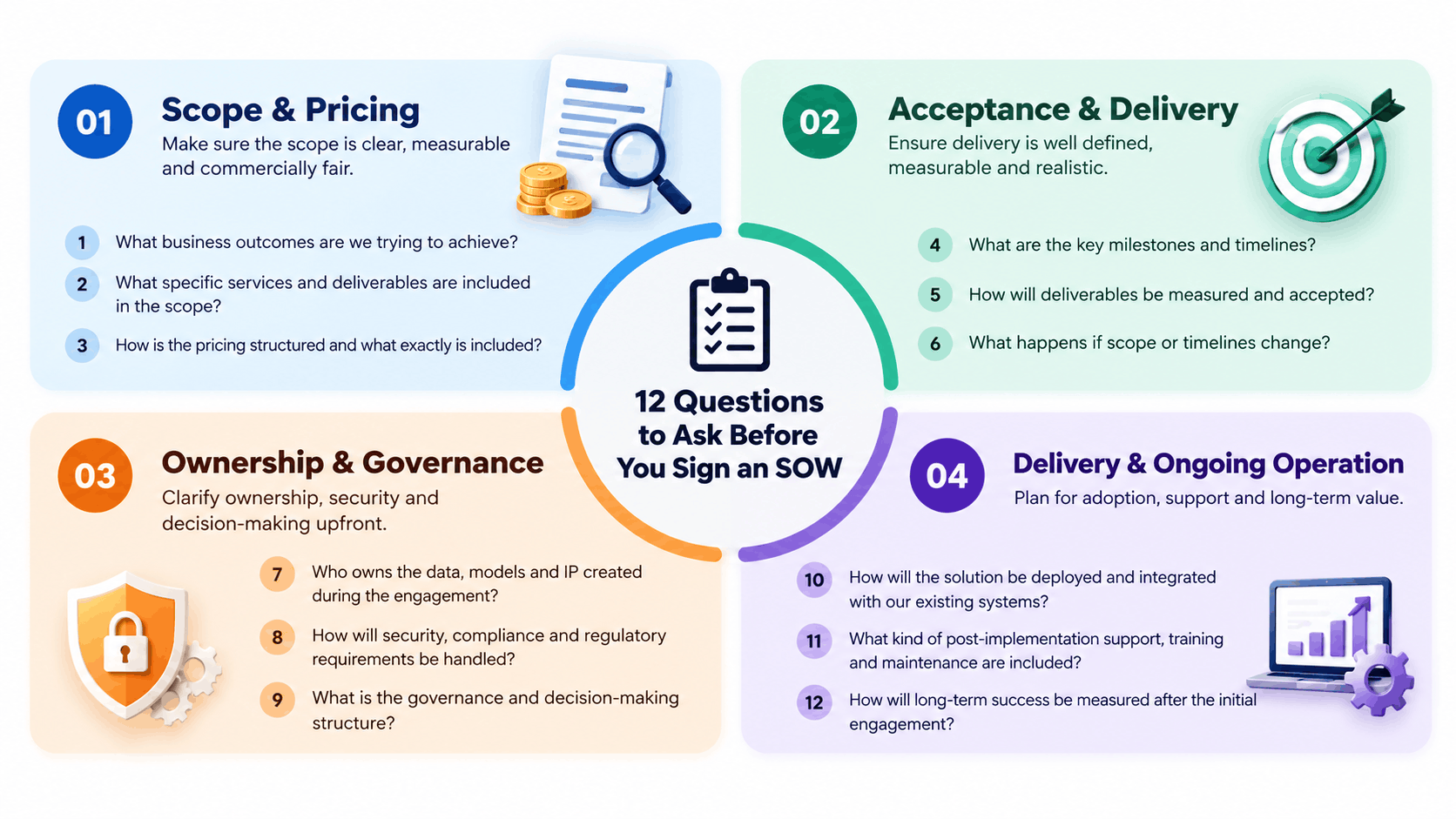
Scope and pricing
Is this engagement priced fixed price or time and materials, and why does that fit this specific scope?
What specifically is out of scope, not just what is in scope?
How are change requests priced and approved once the engagement is underway?
Acceptance and delivery
What are the specific, testable acceptance criteria for each deliverable, not just a general description of success?
What milestones exist, and what happens contractually if one is missed?
Who signs off on acceptance, and what is the dispute process if we disagree?
Ownership and governance
What IP clauses govern the code, models and data pipelines built during this engagement?
Who owns pre existing tools or frameworks the consultant brings into the engagement, versus what is built specifically for us?
What happens to our data and any trained models if we terminate the engagement early?
Delivery and ongoing operation
Who is the actual delivery team, named individuals, not just company credentials?
What ongoing maintenance, monitoring and retraining is included after initial delivery, and what is billed separately?
What is the documented security review and compliance process for this specific engagement?
Digital transformation managed services and AI security and compliance services are the two areas most commonly underspecified in a first draft SOW, worth double checking specifically. Samta.ai's Veda platform and the Veda AI decision analytics product are delivered under SOWs that answer all 12 of these questions explicitly before work begins, which is worth asking any vendor to confirm about their own standard contracting approach.
Comparing five SOW pricing structures
Structure | Payment trigger | Risk allocation | Change request handling | Best fit |
Fixed price | Delivery of defined scope | Vendor bears cost overrun risk | Formal change order, often slow | Well defined, stable scope |
Time and materials | Hours actually worked | Client bears cost overrun risk | Flexible, built into ongoing billing | Exploratory, evolving scope |
Milestone based | Each milestone's acceptance | Shared, tied to milestone definition quality | Requires milestone renegotiation | Multi phase engagements with clear checkpoints |
Outcome based | A defined business outcome or metric | Vendor bears most delivery risk | Rare, since pricing ties to outcome not activity | High confidence, well measured use cases |
Retainer with scoped sprints | Recurring period, scope agreed per sprint | Shared, renegotiated each cycle | Built into sprint planning | Ongoing engagements with evolving priorities |
Milestone based and outcome based structures generally force the clearest acceptance criteria conversations upfront, which is exactly where most weak SOWs fail. For a platform level comparison relevant to ongoing delivery, see Veda versus a general Data Intelligence Platform.
Understand Your AI Model Risk Exposure
Real world use cases
Regulated bank: SOW dispute over undefined acceptance criteria
A bank engaged a consultant to build a fraud detection model under an SOW that described success only as "improved fraud detection accuracy," with no specific threshold defined. When the delivered model showed modest improvement, the bank and vendor disagreed sharply over whether the deliverable met acceptance. Renegotiating the SOW mid engagement to add specific, testable acceptance criteria resolved the dispute, but cost weeks of delay that a clearer original SOW would have avoided. See related delivery patterns in Samta.ai's case studies.
General enterprise: IP ownership gap surfacing after project completion
A manufacturer completed an AI forecasting engagement under an SOW that never explicitly addressed IP ownership of custom components built during the work. When the manufacturer later wanted to extend the system internally, the vendor claimed partial ownership over reusable framework code built during the engagement. A specific IP clause distinguishing pre-existing vendor tools from client specific deliverables, agreed before the SOW was signed, would have prevented this entirely.
Key risks and failure modes
Vague acceptance criteria. "Improved accuracy" or "better insights" without a specific, measurable threshold is the single most common source of SOW disputes.
No defined change request process. Scope naturally evolves on AI projects, and an SOW without a clear change process turns every adjustment into a negotiation.
IP ownership left ambiguous. This surfaces specifically when a client wants to bring work in house or switch vendors, exactly when it is most expensive to resolve.
Pricing model mismatched to scope certainty. Fixed pricing on genuinely exploratory work, or time and materials on well defined work, creates misaligned incentives for both sides.
Meeting only the sales team, not the actual delivery team named in the SOW. The individuals who actually do the work matter more than the company's broader credentials.
No post delivery maintenance terms specified. A model that degrades after launch with no defined retraining or monitoring terms becomes an unplanned cost nobody budgeted for.
When to hire an enterprise AI consultant, and what to check first
Hire an enterprise AI consultant if:
You lack in house capability for a specific, well scoped AI use case
The engagement touches regulated data or decisions requiring documented governance
You need to move from pilot to production faster than internal hiring allows
Multiple stakeholders need a defensible, externally validated approach
Before signing, confirm:
All 12 questions above have specific, written answers, not verbal assurances
The pricing structure matches your actual scope certainty
The named delivery team, not just the sales team, has relevant experience
IP ownership and post delivery maintenance terms are explicit
Talk to an AI Expert About Your Business Needs
Conclusion
The model is rarely what breaks an enterprise AI engagement. The SOW that never defined acceptance criteria, IP ownership or change request handling usually is. Ask all 12 questions before signing, get the answers in writing, and match the pricing structure to how certain your scope actually is. The next step is applying this framework to your own next engagement.
About Samta
Samta.ai is a Singapore-headquartered AI Product Engineering & Data Intelligence partner helping enterprises build production-grade AI systems for regulated and data-intensive environments.We help organizations move beyond experimentation by engineering scalable, explainable, and enterprise-ready AI solutions from data foundations and model development to workflow automation and deployment.
Our capabilities combine deep AI expertise, data engineering, and product engineering to deliver measurable business impact across FinTech, BFSI, cybersecurity, regulatory technology, and enterprise operations.
Our enterprise AI products power real-world intelligence systems:
• TATVA : AI-driven data intelligence platform for governed analytics, monitoring, and operational insights
• VEDA : Explainable and audit-ready AI decisioning engine built for compliance-sensitive enterprise workflows
• CORA-Property Management Solutions: : Predictive intelligence platform for real-estate pricing, portfolio optimization, and investment analytics
Backed by ecosystem partnerships with Microsoft, Databricks, Snowflake, and AWS, Samta.ai delivers agile, cost-efficient AI engineering with faster turnaround and enterprise-grade scalability. Trusted by enterprises across FinTech, BFSI, and digital transformation initiatives, Samta.ai embeds AI governance, data privacy, and compliance-by-design principles directly into the AI lifecycle , enabling organizations to scale AI with transparency, accountability, and operational control.
Enterprises leveraging Samta.ai automate 65%+ of repetitive data, analytics, and decision workflows while maintaining governance, explainability, and measurable business outcomes. Samta.ai provides the strategic consulting, AI engineering, and data modernization expertise needed to align enterprise operations with next-generation AI transformation goals.
Frequently asked questions
What should an AI consulting SOW include?
A strong SOW should define specific, testable acceptance criteria for each deliverable, explicit IP ownership terms for code, models and data pipelines, a clear change request process, named milestones with defined consequences for missed dates, and post delivery maintenance terms. Most generic SOW templates miss several of these, which is exactly where disputes later emerge.
When should an enterprise hire an AI consultant?
Hire an AI consultant when your organisation lacks specific in house capability for a well scoped use case, when the engagement touches regulated data requiring documented governance, or when moving from pilot to production needs to happen faster than internal hiring allows. Enterprises with mature internal AI teams may only need consulting support for specialised, narrow gaps rather than full engagement ownership.
How are AI consulting projects priced?
Pricing typically follows fixed price for well defined, stable scope, time and materials for exploratory or evolving work, milestone based structures tying payment to specific checkpoints, or outcome based pricing tied to a measurable business result. The right structure depends heavily on how confidently the scope is actually defined before work begins, and mismatching structure to scope certainty is a common source of later disputes.
Questions to ask an enterprise AI consulting firm before signing
Ask specifically about acceptance criteria definitions, IP ownership of custom versus pre existing components, the named delivery team rather than company credentials, the change request process, and post delivery maintenance terms. Vendors who answer all of these concretely, in writing, rather than generically, are stronger candidates than those who gesture at experience alone.
Enterprise AI consulting firms in India and Singapore
There is no single verified ranking of enterprise AI consulting firms across both markets, since rankings vary by methodology and update frequently. Evaluate any shortlist against whether their standard SOW explicitly addresses all 12 questions in this guide, acceptance criteria, IP ownership, milestones, change requests and ongoing maintenance, rather than relying on past client logos alone.