
Summarize this post with AI
Most enterprise AI projects fail not because the technology doesn't work but because no one defined what "success" meant before the first dollar was spent. AI transformation ROI is not a post-deployment calculation. It is the strategic foundation your business case must rest on from day one. This guide gives CIOs, CTOs, and transformation leads in BFSI and enterprise sectors a structured approach to quantify, govern, and defend AI ROI before a single model goes into production.
AI Transformation ROI
AI transformation ROI measures the financial and strategic return generated by enterprise AI initiatives relative to total investment including data infrastructure, governance, talent, and licensing. For BFSI and regulated industries in APAC, ROI must account for compliance costs and model risk exposure, not just efficiency gains. The most reliable way to build an AI investment business case is to apply a tri-metric framework: cost reduction, revenue uplift, and risk-adjusted return validated against MAS TRM or RBI guidelines where applicable.
What Is ROI in AI? Definition for Enterprise Leaders
What is ROI in AI goes beyond a simple cost-benefit calculation. For enterprise adoption of AI, ROI must capture three dimensions:
Hard cost savings: automation of manual processes, headcount reallocation, reduced error rates
Revenue uplift: better pricing decisions, faster credit approvals, improved customer retention
Risk-adjusted return: compliance costs avoided, model failure costs prevented, regulatory penalties mitigated
Gartner estimates that through 2025, 85% of AI projects will deliver erroneous outcomes due to bias in data, algorithms, or teams responsible for managing them (Source Required: Gartner). Without a rigorous AI investment business case, organizations expose themselves to that statistic.
Understanding AI governance frameworks is an essential prerequisite before calculating ROI governance gaps are often the largest hidden cost in AI programs.
Know Your AI Maturity Before You Scale
Why AI Transformation ROI Matters More in 2026
Enterprise AI spend in APAC is projected to exceed USD 110 billion by 2027 (Source Required: IDC). Yet fewer than 30% of organizations report they have a standardized process for measuring AI ROI post-deployment (Source Required: McKinsey Global AI Survey).
Three forces are converging to make ROI discipline non-negotiable:
Regulatory escalation: MAS in Singapore, RBI in India, and HKMA in Hong Kong have all issued or are drafting binding guidance on model risk and explainability in 2025–2026.
Board-level scrutiny: CFOs are demanding that AI spend be treated as capital investment with defined payback periods, not R&D exploration.
ROI of generative AI: GenAI use cases (LLM-driven advisory, document automation, fraud detection) require new ROI metrics that legacy frameworks cannot accommodate. See how enterprise AI governance connects directly to ROI accountability in regulated sectors.
The 5-Step Framework to Build an AI Investment Business Case
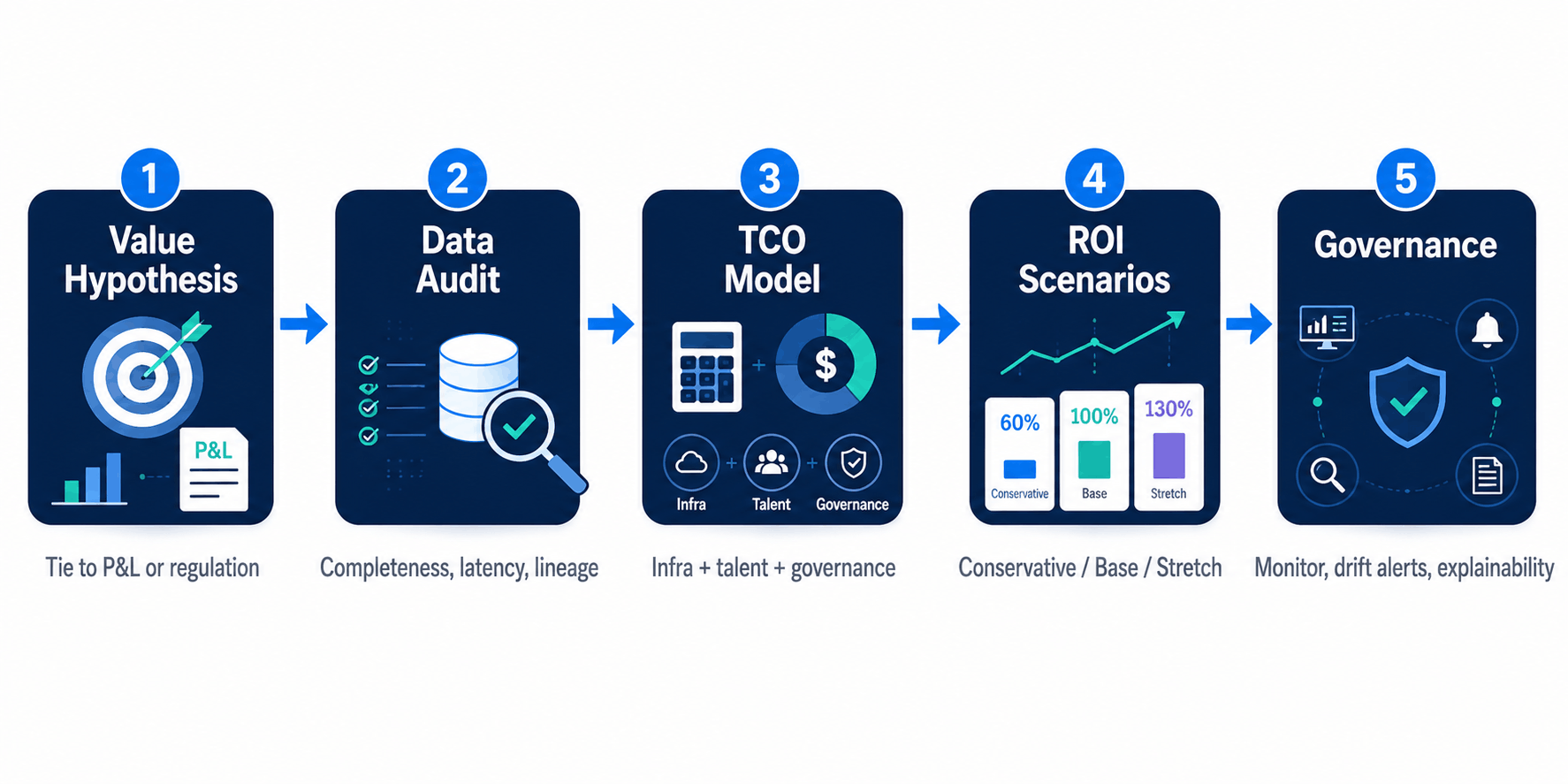
This framework is designed for enterprise transformation leads presenting to boards and investment committees:
Step 1: Define the Value Hypothesis
Before scoping any model, state clearly: what specific business outcome changes if this AI initiative succeeds? Tie it to a line on the P&L or a regulatory metric. AI ROI use cases that cannot be linked to a measurable output are not ready for investment.
Step 2: Audit Data Readiness
Poor data quality is the single largest destroyer of roi of ai for enterprise. Audit data completeness, latency, labeling, and lineage before committing to a model architecture. Samta.ai's data integration consulting practice uses Databricks and Snowflake pipelines to build the data foundation that ROI depends on.
Step 3: Quantify Total Cost of Ownership (TCO)
TCO for an AI initiative includes:
Infrastructure: cloud compute, data warehousing (Snowflake, Azure), API costs
Talent: data scientists, ML engineers, risk officers, change management
Governance: model validation, compliance tooling, audit trails — see AI risk management
Opportunity cost: what does delayed deployment cost per month?
Step 4: Model ROI Scenarios
Build three scenarios — conservative (60% of expected benefit), base (100%), and stretch (130%). Present all three to the board. This demonstrates rigor and pre-empts credibility challenges.
Step 5: Establish Governance Before Go-Live
ROI degrades rapidly when models drift, hallucinate, or produce biased outputs that go undetected. Samta.ai's VEDA AI Decision Analytics Platform embeds continuous monitoring, drift alerts, and explainability reporting directly into the deployment layer protecting realized ROI post-launch. A complete AI governance framework ensures that the value measured at launch is the value sustained at Month 18.
ROI Initiative Benchmarking: 5-Dimension Comparison
Use this table to benchmark your current initiative against recognized patterns of high-ROI AI programs:
Dimension | Low ROI Initiative | Medium ROI Initiative | High ROI Initiative | Samta.ai Benchmark |
Time to Value | > 18 months | 9–18 months | < 9 months | 6–9 months (BFSI) |
Data Readiness | Siloed, unclean | Partially unified | Governed data mesh | Snowflake / Databricks integrated |
Governance Model | None / ad hoc | Policy documented | Automated controls | VEDA AI platform embedded |
Measurable KPIs | Vanity metrics only | Partial cost savings | Revenue + risk + cost | Tri-metric scorecard |
Risk Exposure | High – unmonitored models | Moderate – manual review | Low – automated drift alerts | Continuous model monitoring |
Regulatory Alignment | Not addressed | Partially mapped | MAS / RBI compliant | Built-in compliance workflows |
Benchmark Your AI Risk and Compliance Readines
Real-World AI ROI Use Cases: BFSI and Enterprise
Use Case 1: Credit Risk Decisioning (BFSI, Southeast Asia)
A regional bank in Singapore replaced its rules-based credit scoring engine with an ML model trained on alternative data signals. The AI ROI benefits included a 22% reduction in non-performing loans, 40% faster loan approval cycle, and MAS TRM-aligned model documentation from day one. AI use cases in banking that combine predictive accuracy with regulatory compliance consistently outperform those that optimize for model performance alone.
Explore how similar outcomes have been achieved in Samta.ai case studies across regulated industries.
Use Case 2: Supply Chain Demand Forecasting (General Enterprise)
A manufacturing conglomerate deployed a generative AI-assisted demand forecasting model across 14 markets. The roi of generative ai in this context was measured as a 17% reduction in excess inventory cost and a 9% improvement in service level agreements — translating to USD 4.2M in annualized savings in Year 1 (Source Required: company disclosure).
Key Risks and Failure Modes That Destroy AI ROI
Pilot purgatory: running AI proofs-of-concept indefinitely without defined productionization criteria
Governance debt: deploying models without model cards, audit trails, or drift monitoring; regulatory remediation costs can exceed original build costs
Shadow AI proliferation: business units deploying unapproved GenAI tools that create data liability see why AI transformation governance matters
Misaligned KPIs: measuring model accuracy instead of business outcome change
Change resistance: underinvestment in training and process redesign means adoption rates fall below 50%, collapsing realized ROI
Understanding the future of AI governance will help you anticipate where these failure modes are heading as regulatory requirements tighten through 2027.
Decision Framework: When to Invest vs When to Wait
Invest in AI transformation when all of the following are true:
A clear value hypothesis is tied to a P&L line or regulatory metric
Data readiness score is 70% or above across completeness, accuracy, and latency dimensions
A governance owner has been named and a model risk policy exists
TCO has been modeled across 3 scenarios and approved by finance
Success KPIs are agreed between technology, business, and risk teams
Wait or remediate first when:
Data exists in more than three unintegrated silos with no migration plan
No model risk or AI ethics policy exists at the enterprise level
The only business sponsor is from technology (not business or risk)
Regulatory obligations for the target use case have not been mapped
Speak with an AI Transformation Consultant
Conclusion
AI transformation ROI is not a metric to calculate after deployment it is the strategic discipline that determines whether your AI investment delivers or destroys enterprise value. Organizations that define value hypotheses, audit data quality, govern models proactively, and measure outcomes across cost, revenue, and risk dimensions consistently outperform those that treat ROI as an afterthought. The governance infrastructure you build before go-live is the single strongest predictor of the ROI you realize after it. Start with the right foundation and measure everything from day one. For a deeper look at how to build that foundation, explore Samta.ai's full range of AI solutions.
About Samta
Samta.ai is a Singapore-headquartered AI Product Engineering & Data Intelligence partner helping enterprises build production-grade AI systems for regulated and data-intensive environments.We help organizations move beyond experimentation by engineering scalable, explainable, and enterprise-ready AI solutions from data foundations and model development to workflow automation and deployment.
Our capabilities combine deep AI expertise, data engineering, and product engineering to deliver measurable business impact across FinTech, BFSI, cybersecurity, regulatory technology, and enterprise operations.
Our enterprise AI products power real-world intelligence systems:
• TATVA : AI-driven data intelligence platform for governed analytics, monitoring, and operational insights
• VEDA : Explainable and audit-ready AI decisioning engine built for compliance-sensitive enterprise workflows
• CORA-Property Management Solutions: : Predictive intelligence platform for real-estate pricing, portfolio optimization, and investment analytics
Backed by ecosystem partnerships with Microsoft, Databricks, Snowflake, and AWS, Samta.ai delivers agile, cost-efficient AI engineering with faster turnaround and enterprise-grade scalability. Trusted by enterprises across FinTech, BFSI, and digital transformation initiatives, Samta.ai embeds AI governance, data privacy, and compliance-by-design principles directly into the AI lifecycle , enabling organizations to scale AI with transparency, accountability, and operational control.
Enterprises leveraging Samta.ai automate 65%+ of repetitive data, analytics, and decision workflows while maintaining governance, explainability, and measurable business outcomes. Samta.ai provides the strategic consulting, AI engineering, and data modernization expertise needed to align enterprise operations with next-generation AI transformation goals.
Frequently Asked Questions
What is AI transformation ROI and how is it different from standard IT ROI?
AI transformation ROI differs from standard IT ROI because AI systems produce probabilistic outputs that change over time. Standard IT delivers deterministic value (a CRM processes X records). AI delivers value that depends on model accuracy, data freshness, and governance quality all of which drift. ROI must be measured continuously, not just at project close.
How do I calculate AI ROI for a BFSI use case?
For BFSI, calculate AI ROI using: (Revenue protected or generated + Cost avoided + Regulatory penalties avoided) ÷ Total AI TCO. Include model validation costs, explainability tooling, and ongoing monitoring in TCO. Benchmark against MAS TRM or RBI model risk management guidelines for credibility with regulators and boards.
How does generative AI change the ROI calculation?
The roi of generative ai includes new cost categories absent from traditional ML: prompt engineering maintenance, hallucination risk management, output audit requirements, and LLM API costs that scale with usage. Boards should model GenAI TCO at 2x the initial API cost estimate to account for enterprise-grade safety and governance overhead.
Is an AI governance framework part of the ROI calculation?
Yes. Governance is not an overhead cost it is an ROI enabler. Organizations with mature AI governance frameworks realize 30% higher AI ROI on average because they avoid the cost of model failures, regulatory remediation, and reputational damage (Source Required: Deloitte AI Institute).
What tools help measure and monitor AI ROI over time?
Dedicated AI decision analytics platforms such as Samta.ai's VEDA platform provide continuous model performance monitoring, drift detection, and automated reporting dashboards that allow business leaders to track realized vs projected ROI at every stage of the AI lifecycle. Integration with Microsoft Azure and Snowflake environments ensures enterprise-grade scalability.