
Summarize this post with AI
Most finance teams try to automate everything at once and end up finishing nothing. The teams that actually see payback pick one workflow first, and pick it deliberately. Workflow automation consulting exists to answer exactly that sequencing question, which finance workflow should go first, not just which ones are technically automatable. This guide scores the most common finance ops workflows by actual payback speed.
Workflow automation consulting:
Workflow automation consulting prioritises finance processes by volume, rule complexity and current manual effort, with invoice processing and bank reconciliation typically delivering the fastest payback, while month-end close automation takes longer to implement but compounds value over time. Gartner predicts that 90 percent of finance functions will deploy at least one AI-enabled technology solution by 2026, though less than 10 percent expect headcount reductions, meaning automation is reshaping how finance work gets done rather than simply cutting staff. For enterprises in India and Singapore, the right starting workflow depends on where manual effort and error rates are currently highest, not which process sounds most impressive to automate.
What is workflow automation consulting?
Workflow automation consulting is the practice of identifying, scoring and implementing automation across business processes, matching each process to the right automation approach based on its volume, variability and rule complexity. This differs from general intelligent automation consulting, which covers a broader range of automation types. Workflow automation consulting specifically focuses on sequencing, which processes to automate in what order, based on realistic payback.
Finance process automation sits within this broader category, covering specific workflows like ap automation and reconciliation automation that most enterprises start with, given how repetitive and high volume these processes typically are. For a deeper breakdown of the underlying technology choice, see how RPA and AI work together, and the broader data foundation this depends on in how modern enterprises build automation capability.
Get a Clear View of Your AI Readiness
Why this matters now for finance teams
Three developments make workflow sequencing an active priority in 2026.
Finance AI adoption has become the default, not the exception. Gartner's official prediction from September 2024 states that 90 percent of finance functions will deploy at least one AI-enabled technology solution by 2026, while fewer than 10 percent of functions expect headcount reductions, meaning the shift is primarily about how work gets done, not just cost cutting.
The distinction between RPA and AI agents now actively shapes which workflow to automate first. RPA vs AI agents is not an either or choice, rule based, structured processes with low variability suit traditional RPA, while processes requiring judgment on unstructured inputs, like exception handling in reconciliation, increasingly suit AI agents instead.
Process mining has matured into a standard first step, not an optional extra. Academic process mining research, formalised by Wil van der Aalst's 360 degree overview of the discipline, defines the three core techniques, discovery, conformance checking, and enhancement, that reveal how a process actually runs today before anyone decides what to automate.
See how this plays out in a broader transformation context in agentic AI transformation, and the data foundation this depends on in how enterprise data integration supports it.
A five step framework for scoring and sequencing automation
Here is how to decide which workflow goes first, rather than guessing based on which sounds most impressive.
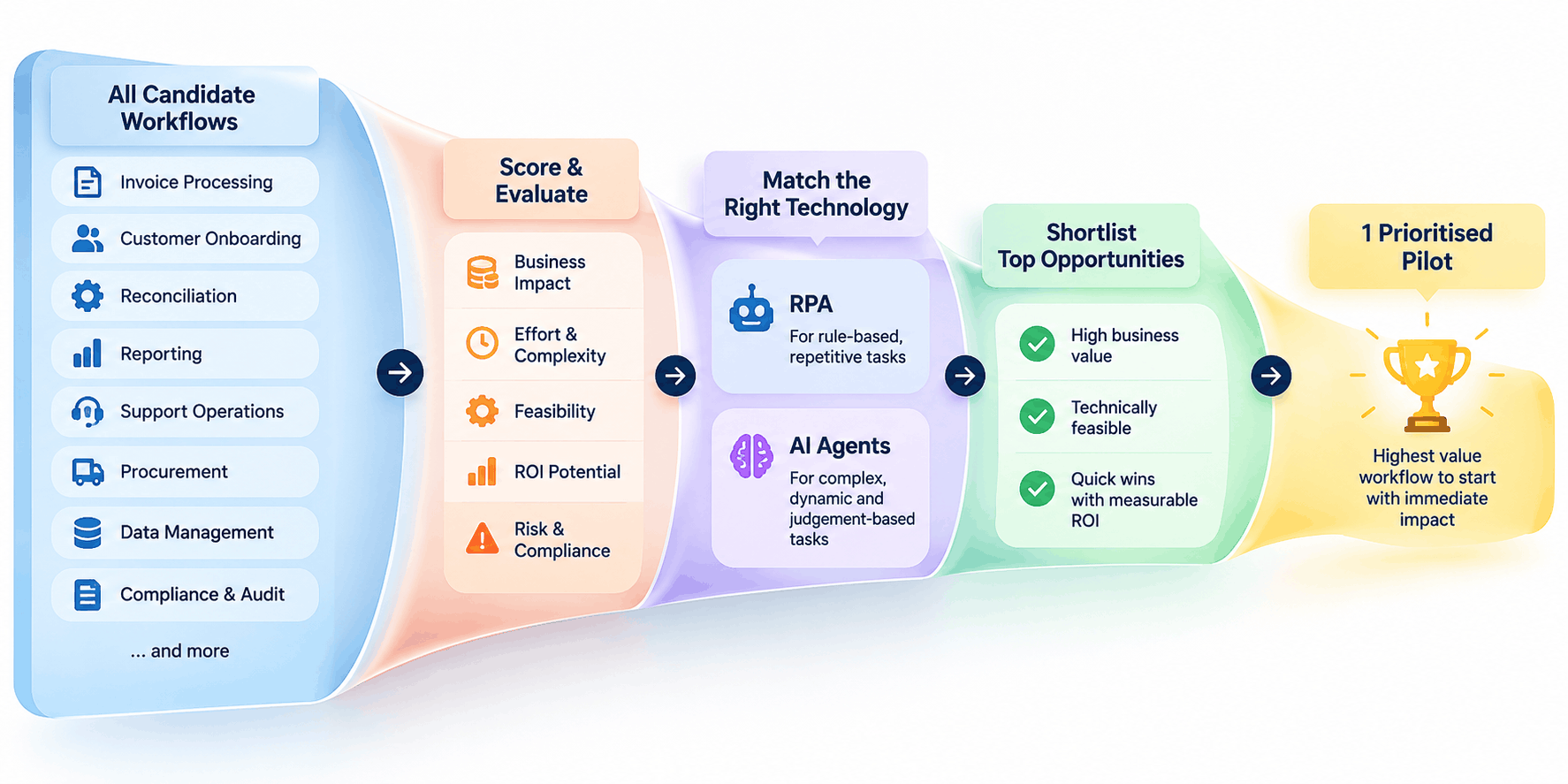
Map the process with process mining before automating anything. Process mining against actual system event logs reveals how a process genuinely runs, not how it is documented to run, which is essential before committing automation effort to the wrong version of a process.
Score each candidate workflow on volume and variability. High volume, low variability processes, like routine invoice processing, typically show the fastest and most predictable payback.
Match RPA or AI agents to the actual rule complexity. Structured, rule based steps suit traditional RPA. Judgment heavy exception handling, like unmatched transactions in bank reconciliation, increasingly suits AI agents instead.
Pilot on one workflow before scaling across finance ops. A single, well scored pilot, properly measured, builds the internal case and operational learning needed before expanding into month-end close automation, which is more complex to implement.
Connect automation into a decision layer, not just a task executor. Digital transformation managed services support this ongoing operational layer once automation is live. Samta.ai's Veda platform and the Veda AI decision analytics product connect automated workflow data into broader decision analytics, acting as the engineering execution layer once the sequencing itself is defined through workflow automation consulting services.
Comparing five finance ops workflows by automation payback
Workflow | Automation potential | RPA vs AI agents fit | Typical payback speed | Best fit for automating first |
Invoice processing and AP | Very high, high volume, repetitive | RPA for capture, AI agents for exception matching | Fastest, often weeks to a few months | Nearly any finance team with meaningful invoice volume |
Bank reconciliation | High, structured matching with exceptions | RPA for routine matches, AI agents for unmatched exceptions | Fast, similar timeline to AP | Teams with high transaction volume and frequent exceptions |
Month-end close orchestration | Medium, complex multi step coordination | AI agents for orchestration and variance commentary | Slower, meaningful setup required first | Teams that have already automated AP and reconciliation |
Expense report processing | High, structured but lower stakes | RPA dominant, limited AI agent need | Fast, but lower overall dollar impact | Teams wanting an easy, low risk starting point |
Financial reporting and variance analysis | Medium to low, requires significant judgment | AI agents for drafting, human review required throughout | Slowest, compounds value over time | Mature automation programs building on earlier wins |
The top two rows are where most enterprises should start, since they combine high volume with manageable complexity. For a platform level comparison relevant to the decision layer connecting these workflows, see Veda versus a general Data Intelligence Platform.
Discover Where Your AI Models Are Most Exposed
Real world use cases
Regulated angle: bank automating reconciliation exception handling
A bank's treasury team manually reviewed thousands of unmatched transactions monthly across multiple reconciliation types, a process that consumed significant analyst time without a clear automation starting point. Process mining against the actual transaction logs revealed that routine matches, not exceptions, made up the bulk of volume. Automating routine matching with RPA first, then layering AI agents specifically for exception handling, delivered measurable time savings within the first automation cycle rather than waiting for a more complex, fully autonomous solution. See related delivery patterns in Samta.ai's case studies.
General enterprise: manufacturer sequencing AP before month-end close
A manufacturer wanted to automate month-end close first, assuming it would deliver the biggest visible win. Scoring the candidate workflows against volume and variability instead pointed to invoice processing as the faster, lower risk starting point. Automating AP first built internal confidence and measurable ROI, which made the subsequent month-end close automation project easier to justify and scope accurately.
Key risks and failure modes
Automating the documented process instead of the actual one. Skipping process mining means automating a version of the workflow that may not reflect how work genuinely happens.
Choosing month-end close as the first automation target. Its complexity and cross functional dependencies make it a poor starting point despite being an attractive headline project.
Applying RPA to processes that actually need judgment. Rule based automation on genuinely variable, exception heavy work produces brittle automation that breaks constantly.
Treating automation as a one time project rather than an ongoing capability. Processes change, and automation that is not maintained degrades as underlying systems and data shift.
Skipping the pilot stage entirely. Scaling automation across multiple workflows simultaneously without a proven pilot first makes failure harder to diagnose and more expensive to fix.
Ignoring the data foundation underneath the automation. Automation built on fragmented or inconsistent source data inherits those problems regardless of how sophisticated the automation layer itself is.
Which finance workflows should be automated first, and which to automate later
Automate first if the workflow has:
High transaction or document volume with predictable structure
Clear, well understood rules governing most of the process
Significant current manual effort or error rate
A measurable baseline you can compare post automation results against
Automate later if the workflow has:
High cross functional complexity with many dependencies, like full month-end close
Significant judgment requirements that resist clean rule definition
Low current volume where manual handling remains genuinely cost effective
No clear baseline measurement to judge improvement against
Talk to an AI Expert About Your Business Needs
Conclusion
The workflow that pays back fastest is rarely the one that sounds most impressive to automate. Invoice processing and reconciliation consistently outperform month-end close as starting points, precisely because they combine volume with manageable complexity. Score your workflows honestly, pilot on the strongest candidate, and build from there. The next step is applying this scoring to your own specific finance operations.
About Samta
Samta.ai is a Singapore-headquartered AI Product Engineering & Data Intelligence partner helping enterprises build production-grade AI systems for regulated and data-intensive environments.We help organizations move beyond experimentation by engineering scalable, explainable, and enterprise-ready AI solutions from data foundations and model development to workflow automation and deployment.
Our capabilities combine deep AI expertise, data engineering, and product engineering to deliver measurable business impact across FinTech, BFSI, cybersecurity, regulatory technology, and enterprise operations.
Our enterprise AI products power real-world intelligence systems:
• TATVA : AI-driven data intelligence platform for governed analytics, monitoring, and operational insights
• VEDA : Explainable and audit-ready AI decisioning engine built for compliance-sensitive enterprise workflows
• CORA-Property Management Solutions: : Predictive intelligence platform for real-estate pricing, portfolio optimization, and investment analytics
Backed by ecosystem partnerships with Microsoft, Databricks, Snowflake, and AWS, Samta.ai delivers agile, cost-efficient AI engineering with faster turnaround and enterprise-grade scalability. Trusted by enterprises across FinTech, BFSI, and digital transformation initiatives, Samta.ai embeds AI governance, data privacy, and compliance-by-design principles directly into the AI lifecycle , enabling organizations to scale AI with transparency, accountability, and operational control.
Enterprises leveraging Samta.ai automate 65%+ of repetitive data, analytics, and decision workflows while maintaining governance, explainability, and measurable business outcomes. Samta.ai provides the strategic consulting, AI engineering, and data modernization expertise needed to align enterprise operations with next-generation AI transformation goals.
Frequently asked questions
Which finance workflows should be automated first?
Invoice processing and bank reconciliation typically deliver the fastest payback, since both combine high transaction volume with largely predictable, rule based structure. Month-end close orchestration and financial reporting carry more complexity and judgment requirements, making them better suited to later automation phases once a team has built capability and confidence on simpler workflows.
RPA or AI agents for finance ops?
The right choice depends on the specific task within a workflow, not the workflow as a whole. Structured, rule based steps like routine transaction matching suit traditional RPA well. Judgment heavy tasks like exception handling in reconciliation or variance commentary in reporting increasingly suit AI agents, which handle unstructured input and ambiguity that RPA cannot.
How do you score processes for automation?
Score each candidate process on volume, variability and current manual effort, using process mining against actual system logs rather than documented procedure to understand how the process genuinely runs. High volume, low variability processes with significant manual effort score highest for early automation, while complex, judgment heavy processes score lower and suit later phases.
Best workflow automation consultants in India
There is no single verified ranking of workflow automation consultants in India, since rankings vary by methodology and update frequently. Evaluate any candidate on whether they start with process mining and workflow scoring, rather than jumping straight to a specific automation tool, since starting point methodology strongly predicts whether the resulting automation actually delivers measurable payback.
Which finance processes give the fastest automation payback?
Invoice processing and bank reconciliation consistently give the fastest payback, since both are high volume, substantially rule based, and typically carry significant existing manual effort that automation directly reduces. Processes requiring cross functional coordination or significant judgment, like full month-end close, take longer to automate and show payback more gradually over multiple cycles.