
Summarize this post with AI
Most CROs do not ask about model accuracy first. They ask what an assessment will cost them in time, exposure and internal effort before they commit. This ai model risk assessment faq answers those questions directly, in the order Singapore risk leaders actually raise them. It covers scope, timeline, confidentiality and what happens once an assessment is done.
AI model risk assessment FAQ:
An AI model risk assessment evaluates an AI system's data inputs, model behaviour, governance controls and outputs against a recognised standard such as the NIST AI Risk Management Framework or the Monetary Authority of Singapore's FEAT principles. Most enterprise assessments take two to six weeks depending on scope, and the exact cost, timeline and methodology vary by system complexity and regulatory context, so these are scoped per engagement rather than fixed upfront. Confidentiality is handled through non disclosure agreements and controlled access, which any credible assessor should confirm before work begins.
What is an AI model risk assessment?
An AI model risk assessment is a structured review of an AI system's inputs, logic, governance and outputs, checked against a recognised risk framework. It answers whether a model behaves as intended, stays within its approved use, and has adequate oversight.
This differs from a general ai and risk assessment, which can cover any operational or financial risk. A model specific assessment focuses on the AI system itself: its training data, decision logic, monitoring and failure modes.
Related terms CROs search for include how to assess ai risk, the general practice, and ai risk assessment tool, referring to software that supports part of the process, such as bias testing or drift monitoring. For deeper background on the category, see what an AI model actually is and the broader practice of AI model risk management.
Ready to Scale AI? Start with a Free Assessment
Why this matters now for Singapore CROs
Three pressures are pushing CROs to formalise ai risk assessment singapore practices in 2026.
A recognised framework now exists to assess against. The NIST AI Risk Management Framework provides a voluntary, widely adopted structure built around four functions: govern, map, measure and manage. It gives assessors a common language even outside the United States.
Financial institutions have a sector specific standard. The Monetary Authority of Singapore's FEAT principles, covering fairness, ethics, accountability and transparency in AI and data analytics, remain the reference point for MAS regulated firms, supported by the open source Veritas toolkit built with industry partners.
Boards are pushing risk teams harder on AI coverage. Gartner's January 2025 research found that while most audit leaders accept AI risk coverage is important for the year ahead, less than a quarter feel confident in their ability to deliver it. That confidence gap is exactly what a structured assessment is meant to close. Teams building this capability internally can see the underlying engineering work in enterprise AI engineering in Singapore.
A four step framework for how an assessment actually runs
Here is what to expect once you agree to start.
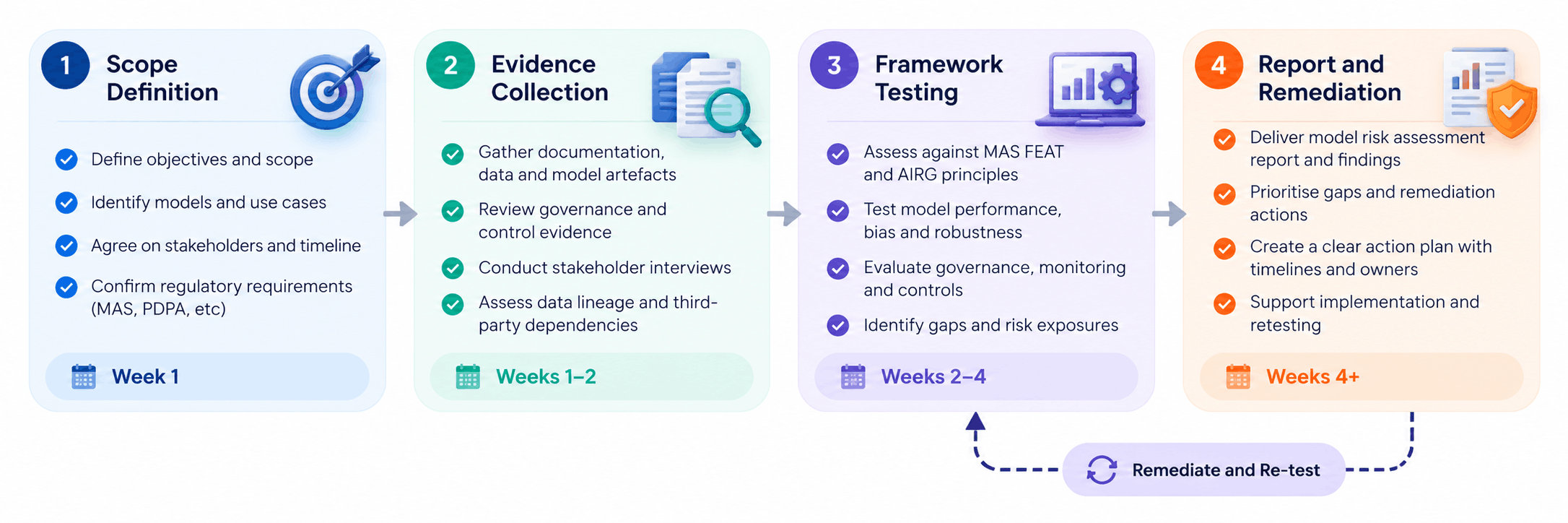
Scope definition. The assessor and your team agree which AI systems are in scope, what data sources feed them, and which framework applies (NIST AI RMF, MAS FEAT, or both). This step directly determines cost and timeline, which is why neither can be quoted before scope is set.
Evidence collection. The assessor reviews model documentation, training data lineage, access controls and monitoring logs. Where AI systems draw on ERP, CRM or operational data that is not yet integrated, this step can surface data quality gaps that need fixing first. Data integration consulting services address that underlying gap when it appears.
Testing against the framework. The assessor checks the model against the chosen standard's specific requirements, such as fairness testing under FEAT or the map and measure functions under NIST AI RMF. This is where scoring methodology is applied, and it varies by framework and by the assessor's own approach, so ask any assessor to walk you through theirs before starting.
Reporting and remediation planning. Findings are documented with a severity rating and a remediation plan. Samta.ai supports this step through its AI security and compliance services, acting as the engineering layer that helps implement fixes once gaps are identified, rather than only producing a report.
For a full methodology walkthrough, see AI audit methodology explained, and for how this fits into ongoing governance, see AI risk management as a model.
Comparing five approaches to AI risk assessment
Approach | Framework alignment | Depth of testing | Typical use | Best fit |
Internal self assessment checklist | Informal or loosely mapped | Shallow, self reported | Early awareness, low risk systems | Small teams starting out |
Vendor supplied risk documentation only | Varies by vendor | Shallow, unverified | Procurement gate check | Low risk, low impact tools |
Framework aligned third party assessment | Explicit, for example NIST AI RMF or MAS FEAT | Moderate to deep, evidence based | Regulatory or board reporting | Regulated firms, high impact models |
Continuous automated monitoring | Ongoing, framework informed | Deep on drift and performance, shallow on governance | Production model oversight | Firms with many live models |
Full assessment plus remediation engagement | Explicit and implemented | Deep, with fixes built in | High stakes or third party AI systems | BFSI and regulated enterprise |
The last two rows work best together rather than as alternatives. For a platform level comparison of how connected data supports ongoing monitoring, see Veda versus a general Data Intelligence Platform.
Know Your AI Model Risk Before You Scale
Real world use cases
Regulated bank: third party credit model
A bank licenses a credit scoring model from a vendor and needs to confirm it meets FEAT expectations before deployment. The bank's own team has limited visibility into the vendor's training data or bias testing process. A third party AI risk assessment reviews the vendor's documentation, runs independent fairness tests where data access allows, and produces a report the bank can present to its board and, if asked, to MAS.
General enterprise: internal forecasting model
A manufacturer built an internal demand forecasting model using its own data science team. Leadership wants assurance the model will not silently degrade as market conditions shift, but has no formal review process in place. An assessment against the NIST AI RMF's measure and manage functions establishes a baseline and a monitoring plan, so drift gets caught before it affects planning decisions. Read more on the platform that can support this kind of ongoing decision analytics in the Veda AI decision analytics product and Veda platform overview.
Key risks and failure modes
Treating the assessment as a one time event. Models drift after deployment. A single assessment without a monitoring plan gives false confidence.
Scoping too narrowly. Reviewing only the model's outputs while ignoring training data lineage misses where most bias and reliability problems actually originate.
No confidentiality agreement in place. Sharing model internals, training data samples or governance documents without a signed non disclosure agreement creates unnecessary exposure.
Choosing an assessor with no framework fluency. An assessment not mapped to a recognised standard such as NIST AI RMF or MAS FEAT has little value in front of a board or regulator.
Assuming vendor documentation is sufficient for third party models. Vendor claims about fairness or accuracy are not independent verification.
Skipping remediation follow up. A report that lists gaps without a path to fix them leaves the organisation exposed exactly where it was before the assessment.
When to start an AI model risk assessment, and when to wait
Start now if:
An AI model informs decisions with financial, legal or customer facing consequences
Your board or regulator has asked for evidence of AI governance
You are deploying a third party or vendor supplied AI model
You cannot currently answer what data trained your production models
You can reasonably wait if:
The AI system is purely internal, low impact and has no regulatory exposure
You are still in early prototyping with no production deployment planned
A recent assessment already covered the same model and no material change has occurred
Talk to an AI Expert About Your Business Needs
Conclusion
The questions CROs ask before starting an assessment are practical, not technical. Cost, timeline and confidentiality decide whether the process gets approved in the first place. Once those are answered clearly, the framework and methodology questions follow naturally. The next step is a scoping conversation, not a lengthy proposal.
About Samta
Samta.ai is a Singapore-headquartered AI Product Engineering & Data Intelligence partner helping enterprises build production-grade AI systems for regulated and data-intensive environments.We help organizations move beyond experimentation by engineering scalable, explainable, and enterprise-ready AI solutions from data foundations and model development to workflow automation and deployment.
Our capabilities combine deep AI expertise, data engineering, and product engineering to deliver measurable business impact across FinTech, BFSI, cybersecurity, regulatory technology, and enterprise operations.
Our enterprise AI products power real-world intelligence systems:
• TATVA : AI-driven data intelligence platform for governed analytics, monitoring, and operational insights
• VEDA : Explainable and audit-ready AI decisioning engine built for compliance-sensitive enterprise workflows
• CORA-Property Management Solutions: : Predictive intelligence platform for real-estate pricing, portfolio optimization, and investment analytics
Backed by ecosystem partnerships with Microsoft, Databricks, Snowflake, and AWS, Samta.ai delivers agile, cost-efficient AI engineering with faster turnaround and enterprise-grade scalability. Trusted by enterprises across FinTech, BFSI, and digital transformation initiatives, Samta.ai embeds AI governance, data privacy, and compliance-by-design principles directly into the AI lifecycle , enabling organizations to scale AI with transparency, accountability, and operational control.
Enterprises leveraging Samta.ai automate 65%+ of repetitive data, analytics, and decision workflows while maintaining governance, explainability, and measurable business outcomes. Samta.ai provides the strategic consulting, AI engineering, and data modernization expertise needed to align enterprise operations with next-generation AI transformation goals.
Frequently asked questions
What does an AI model risk assessment cost?
Cost depends on the number of models in scope, the framework required, and how much remediation work follows the initial review. There is no fixed industry rate, since a single low risk internal model costs far less to assess than a portfolio of customer facing credit models. Ask any assessor for a scoped quote after an initial scope definition call, not before.
How long does an AI risk assessment take?
Most assessments take two to six weeks from scope definition to final report, depending on how many models are involved and how much documentation already exists. Assessments against a sector specific standard such as MAS FEAT can take longer if fairness testing requires new data access. Ongoing monitoring after the assessment is separate and continuous.
Is the AI risk assessment confidential?
It should be. A credible assessor signs a non disclosure agreement before reviewing model internals, training data or governance documents, and limits access to only the people involved in the review. Ask specifically how findings are stored and who can see the final report before you share anything sensitive.
What happens after I complete the assessment?
You receive a report with findings rated by severity and a remediation plan for any gaps. From there, most organisations either fix the gaps internally, engage the assessor for remediation support, or set up ongoing monitoring to catch future drift. The assessment itself is a starting point, not a certificate that closes the topic permanently.
What questions do CROs typically ask before starting an AI model risk assessment?
CROs most often ask about cost, timeline, confidentiality and which framework the assessment maps to, roughly in that order. They also ask what happens if the assessment finds serious gaps, and whether the same team can help fix what it finds. Fewer ask about the underlying scoring methodology upfront, though it becomes important once results are delivered.