
Summarize this post with AI
Most technical tests fail before the first candidate sits them, because they were written from memory instead of from the job. A test that does not mirror the job requirements measures trivia, not performance, and it filters out people who could do the work. This guide shows how to create technical assessment from job description requirements in eight steps: map skills, choose question types, set difficulty levels, and write a rubric before you send a single invite.
Create Technical Assessment from Job Description:
To create a technical assessment from a job description, separate requirements from nice to have ones, map each requirement to a testable skill, choose a question type for each skill, set difficulty to match seniority, and write a scoring rubric with weights before candidates see the test. AI can draft the first version in minutes, but a human must review it for job relevance, fairness, and length. In Singapore, selection criteria should be based on the skills the role needs, in line with the Tripartite Guidelines on Fair Employment Practices.
What does it mean to build an assessment from a job description?
It means treating the job description as the specification for the test. Every question should trace back to a line in the role, and every line that matters should be tested at least once.
The job description is not perfect input. Many are vague, padded with wish lists, or copied from older roles. The first task is to clean it, then translate it into measurable skills.
A good assessment built this way has five parts.
Requirements list: the cleaned set of must have skills and tools
Skills map: each requirement tied to evidence a candidate can show
Question set: a mix of formats matched to each skill
Difficulty plan: how hard each question is for the seniority of the role
Scoring rubric: criteria, weights, and a pass threshold
For a wider view of the tools that support this work, see our guide to the best technical assessment tools.
Why it matters now
Job descriptions are now drafted faster than ever, often with AI, and assessments are following. Speed helps only if the test still measures the job. Evidence supports structured, job related methods. In Sackett and colleagues' revised estimates, work sample tests show validity of 0.33, structured interviews 0.42, and job knowledge tests 0.40. These are moderate figures, so no single test should decide a hire, but all three beat unstructured judgment when they are tied to the role.
Fairness rules point the same way. Singapore's Tripartite Guidelines on Fair Employment Practices expect employers to select on skills and merit, which is easier to show when each question maps to a stated requirement. AI generated content also needs governance. The NIST AI Risk Management Framework is a widely referenced guide for managing AI risks, and its idea of mapping and measuring risk applies directly to a model that drafts test questions.
The market for generators is growing fast. Our overview of the AI driven assessment platform category explains how these products differ from older test libraries.
Know Your AI Readiness Before Your Next Move
The eight step process
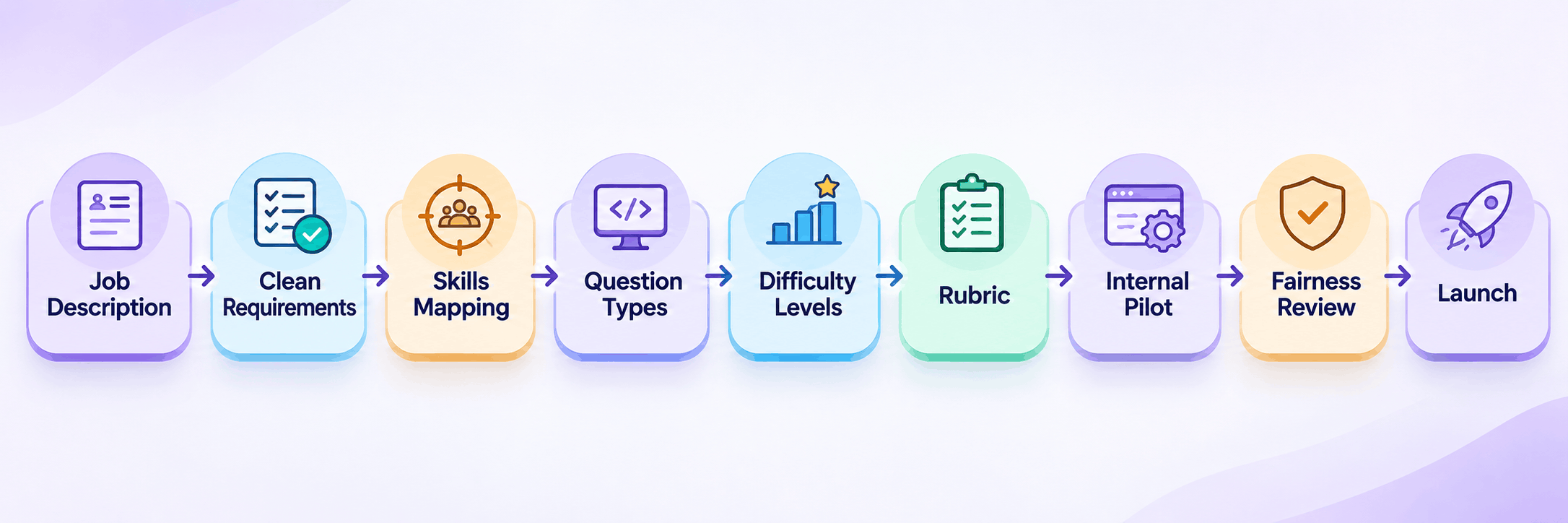
Follow the same eight steps for every role so tests stay consistent.
Clean the job requirements. Split the description into must have and nice to have. Cut anything vague, such as "team player", unless you can test it
Run skills mapping. Turn each requirement into a skill and define what good evidence looks like. "Experience with APIs" becomes "can design a clear, safe endpoint"
Choose question types. Match format to skill: multiple choice for knowledge, short code tasks for applied skill, debugging for troubleshooting, and written answers for judgment
Set difficulty levels. Mix easy, medium, and hard questions to suit seniority. A junior test needs more foundations, while a senior test needs more design and trade offs
Write the rubric. Define criteria, weights, and scoring bands before launch so every reviewer scores the same way
Set the length. A common rule of thumb is 45 to 75 minutes for a full technical assessment and shorter for early screens. This is a judgment call, not a standard, so test it
Pilot internally. Ask three to five people who already do the job to take it, then check timing, difficulty, and ambiguity
Review for fairness and relevance. Remove questions that depend on narrow trivia or cultural knowledge, and keep a record of why each question exists
A worked example: mapping a job description to questions
This is an illustrative mapping for a senior backend engineer role.
Job description line | Skill tested | Question type | Difficulty level | Weight |
Design and build REST APIs | API design | Scenario plus short code task | Hard | 25% |
Work with PostgreSQL | SQL and data modelling | Query writing task | Medium | 20% |
Own service reliability | Debugging and monitoring | Debugging exercise | Medium | 20% |
Review code and mentor | Code review judgment | Review a snippet and write comments | Medium | 15% |
Experience with Python | Language fluency | Multiple choice plus short code | Medium | 20% |
Weights should reflect how much each requirement matters to the role. If you cannot say why a skill carries its weight, the weight is a guess.
What a good rubric looks like
A rubric turns subjective reading into repeatable scoring.
Score each answer from 0 to 4 against named criteria such as correctness, approach, readability, and edge cases
Multiply by the weight from the mapping table
Set a pass band, such as strong, borderline, and not yet
Flag borderline scores for a human review
Where the engineering sits
Assessment data becomes more useful when you keep it. Scores, timings, and question level results can be stored in a governed store such as Snowflake or Databricks and reported through Microsoft Power BI, which lets you see which questions predict success and which confuse candidates. Samta.ai acts as the engineering execution layer for that work, and the TATVA platform is built to produce the structured results that feed it.
TATVA is Samta.ai's AI hiring assessment platform. During a demo, ask how it turns a job description into a draft assessment and how recruiters review and edit it, since that workflow is what matters most.
Can AI generate an assessment from a job description?
Yes. A modern ai assessment generator for hiring can read a job description, extract requirements, and draft questions with a rubric. This is what searchers mean by ai job description to assessment and by phrases such as generate assessment from job description.
The draft is only a starting point. AI tends to produce plausible but generic questions, so a human must check relevance, difficulty, and fairness. Job description AI features work best when the input is clean, which is why step one matters.
Here is a simple prompt you can adapt.
Generate a technical assessment from this job description.
Role: [title]
Seniority: [level]
Must have requirements: [list]
Nice to have: [list]
Create: a skills map, a question set with type and difficulty for each question,
a scoring rubric with weights, and expected time per question.
Do not include anything that is not tied to a listed requirement.
Then review the output against this checklist.
Does every question trace to a requirement?
Is the total time realistic for a candidate?
Are answers clear enough for two reviewers to agree?
Is any question dependent on narrow trivia or a specific culture?
Comparison table: ways to build an assessment
Method | Speed | Quality control | Consistency across roles | Best for |
Dedicated AI assessment platform (for example TATVA) | Fast, draft in minutes | Built in review and scoring workflow | High, reusable structure | Teams hiring across several roles |
General AI chat tool | Fast | Manual, depends on your prompt | Low, varies each time | One off drafts reviewed by an expert |
Template or test library | Fast | Medium, generic content | Medium | Common roles with standard skills |
Hiring manager writes it | Slow | High if the manager is skilled | Low, depends on the person | Niche senior roles |
Consultant or agency built | Slow | High, but costly | Medium to high | Large programs with a budget |
For a deeper view of the wider market, read our list of the 8 best talent assessment platforms. To see how an AI first platform differs from older systems, read TATVA vs traditional hiring platforms.
How long should a technical assessment be?
There is no universal standard, so set length by role and stage. Longer tests lose strong candidates who have other offers.
Early screen: about 20 to 40 minutes, focused on the must have skills
Full assessment: about 45 to 75 minutes for most technical roles
Senior or specialist roles: a longer work sample may be justified, but offer it only after an earlier screen
These are rules of thumb. Test your own assessment with current employees, record how long they take, and add a margin for candidates who are less familiar with the format.
Turn AI Model Risk Into Actionable Insights
Real world use cases
These are illustrative scenarios based on common hiring patterns, not client results.
Regulated industry example. A bank hiring engineers in Singapore wants every assessment tied to the job description and recorded for review. The team keeps the mapping table, rubric, and score records for each role, which shows how decisions were made. Pipelines of the kind described under enterprise AI engineering in Singapore let the bank's teams analyse results centrally.
General enterprise example. A staffing agency receives a new client job description every few days. It uses a generator to draft an assessment, an engineer reviews it once, and the rubric is reused for later roles with similar skills. Agencies building developer supply can also look at tech staffing and augmentation support for the placement side.
For measured outcomes from real deployments, review the Samta.ai case studies before setting targets.
Key risks and failure modes
Assessments built from job descriptions fail in predictable ways.
Copying a weak job description. If the job description is vague, the test will be too
Testing trivia. Narrow facts rarely predict performance on the job
Trusting AI output unchecked. Generated questions can be generic, duplicated, or wrong
No rubric. Without scoring rules, two reviewers will disagree
Too long. Excessive length raises drop off, especially among strong candidates
No pilot. Skipping an internal run hides ambiguity and timing problems
No record. If you cannot show why a question exists, you cannot defend the process
When to build from a job description, and when to rethink
Build from the job description when:
The role has clear, stable requirements
You hire for similar roles often and can reuse the structure
You need a documented, consistent screening process
Recruiters, not engineers, will run the assessment
Rethink or add steps when:
The job description is vague or outdated, so fix it first
The role is highly niche and needs a live conversation or work sample
No one will review the draft before it goes out
Ready to Move Your AI Initiative Forward?
Conclusion
A good assessment is a faithful copy of the job, not a clever puzzle. Clean the requirements, map skills, match question types, set difficulty, and write the rubric before anyone sits the test. Let AI draft the first version, then keep a person in charge of the final one. To see how this fits into a hiring workflow, explore Samta.ai and its TATVA platform.
About Samta
Samta.ai is a Singapore-headquartered AI Product Engineering & Data Intelligence partner helping enterprises build production-grade AI systems for regulated and data-intensive environments.We help organizations move beyond experimentation by engineering scalable, explainable, and enterprise-ready AI solutions from data foundations and model development to workflow automation and deployment.
Our capabilities combine deep AI expertise, data engineering, and product engineering to deliver measurable business impact across FinTech, BFSI, cybersecurity, regulatory technology, and enterprise operations.
Our enterprise AI products power real-world intelligence systems:
• TATVA : AI-driven data intelligence platform for governed analytics, monitoring, and operational insights
• VEDA : Explainable and audit-ready AI decisioning engine built for compliance-sensitive enterprise workflows
• CORA-Property Management Solutions: : Predictive intelligence platform for real-estate pricing, portfolio optimization, and investment analytics
Backed by ecosystem partnerships with Microsoft, Databricks, Snowflake, and AWS, Samta.ai delivers agile, cost-efficient AI engineering with faster turnaround and enterprise-grade scalability. Trusted by enterprises across FinTech, BFSI, and digital transformation initiatives, Samta.ai embeds AI governance, data privacy, and compliance-by-design principles directly into the AI lifecycle , enabling organizations to scale AI with transparency, accountability, and operational control.
Enterprises leveraging Samta.ai automate 65%+ of repetitive data, analytics, and decision workflows while maintaining governance, explainability, and measurable business outcomes. Samta.ai provides the strategic consulting, AI engineering, and data modernization expertise needed to align enterprise operations with next-generation AI transformation goals.
Frequently asked questions
How do you turn a job description into a technical test?
Clean the requirements into must have and nice to have, map each to a testable skill, choose a question type for each skill, set difficulty to match seniority, and write a rubric with weights. Then pilot the test with current employees and review it for fairness before using it with candidates.
Can AI generate an assessment from a job description?
Yes. AI can read a job description and draft a skills map, questions, and a rubric in minutes. The draft still needs human review for relevance, difficulty, and fairness, because generated questions can be generic or wrong. Use AI to speed up the first version, not to replace judgment.
How long should a technical assessment be?
Most full technical assessments run about 45 to 75 minutes, with shorter early screens of 20 to 40 minutes. These are rules of thumb rather than standards. Pilot the test with current employees, record the time they take, and shorten it if strong candidates are likely to drop out.
What is skills mapping in hiring?
Skills mapping links each job requirement to a specific skill and to the evidence that proves it. For example, "build APIs" becomes "can design a clear, safe endpoint". It ensures each question has a reason to exist and shows which requirements remain untested.
Is there a tool that creates hiring tests from a JD?
Yes, several AI assessment platforms draft tests from a job description, including TATVA from Samta.ai. Compare tools on how clean the draft is, how easily a recruiter can edit it, how scoring works, and what data you can export. Ask each vendor to demonstrate a real job description.