
Summarize this post with AI
A Series B fintech founder burned through $2.3 million building a fraud detection model in-house. Eighteen months. A team of six. The model worked in staging and never reached production. That story is not unusual 49 percent of AI projects never move past the pilot stage, and McKinsey puts the average enterprise AI project at 2.7x over initial budget. The choice between outsourced ai engineering services and in-house build is the most consequential technical decision most CTOs will make in 2026, and the way most teams evaluate it misses 60 to 70 percent of the actual cost. This guide gives CTOs a verified, 2026-calibrated framework for making that decision, including when outsourced ai engineering services wins, when in-house wins, and why the answer for roughly 80 percent of organizations is neither.
Outsourced AI Engineering Services:
Outsourced ai engineering services in 2026 typically run 40 to 60 percent of in-house Year 1 costs for a mid-complexity AI system, because they convert capital expenditure to operational expenditure and access a vendor's existing learning curve rather than building one from scratch. However, the decision is not primarily a cost question: it is a risk allocation decision wrapped inside a compliance obligation. Organizations in regulated sectors including BFSI and healthcare should own the control plane internally while outsourcing the acceleration layer, because auditors need to see how the system works, who approved it, and how incidents escalate, and that documentation trail cannot be fully delegated to a vendor. The correct model for most enterprises is a governed hybrid, not a binary choice.
What the Build vs Outsource Decision Actually Covers
build vs outsource ai engineering is not the same decision as build versus buy software. AI engineering introduces cost categories that do not exist in traditional development: prompt engineering overhead, model drift monitoring, LLM inference costs that scale non-linearly with agentic workflows, and talent attrition that runs at 38 percent annually for AI and ML engineers compared to 13 percent for general software engineers. The minimum viable in-house AI team costs between $755,000 and $1.07 million in salaries per year in the US alone, before benefits, recruiting, tooling, and ramp-up time. Senior AI engineers command $180,000 to $250,000 base salary, and engineers with production LLM, multi-agent, and MLOps experience represent less than 3 percent of all software engineers globally.
ai engineering partner vs in-house decisions also differ from standard outsourcing because the right partner transfers architecture knowledge to your team, retains IP ownership with your organization, and delivers a production-grade system rather than a demo. This same principle applies to AI-assisted hiring: organizations that outsourced hiring assessment design without retaining scoring logic ownership discovered the same repatriation problem, which is exactly why platforms like the Tatva hiring assessment platform are built with explainability and audit trail ownership residing with the enterprise, not the vendor. For enterprises building foundational AI readiness before this decision, the AI readiness assessment guide and the how modern enterprises build AI-ready operations guide are the two most useful starting references.
Why This Decision Is More Consequential in 2026
Three shifts make the ai engineering partner vs in-house question a strategic board-level decision rather than a procurement line item.
1. The talent market has created extreme cost volatility: The war for AI talent has pushed base compensation for senior machine learning engineers to $150,000 to $350,000, with top-tier researchers reaching $400,000 to $600,000. In-house AI teams built on 2024 assumptions are overfitted and cannot adapt to the aggressive market shifts of 2026 without massive technical debt. Losing a lead architect can stall projects indefinitely.
2. Regulatory exposure now follows the function, not the vendor: With the EU AI Act, US state-level AI rules, and Singapore's MAS AI Risk Management Toolkit all active in 2026, the compliance controls required around any AI capability are broadly similar whether you built it or bought it. The cost difference between build and outsource narrows when you must build the governance wrap either way.
3. Agentic AI is compressing timelines and raising stakes simultaneously: By end of 2026, Gartner predicts 40 percent of enterprise applications will embed AI agents, up from less than 5 percent just a year ago. Roughly 50 percent of enterprise agentic AI projects are still in proof of concept or pilot stage, and the path to production is where most platforms show their limits. Organizations comparing a purpose-built AI platform against a traditional alternative face the same core question whether to own the intelligence layer internally or delegate it as illustrated clearly in the Veda vs data intelligence platform comparison. For CTOs evaluating this decision in the context of an existing AI program, the bridging the AI pilot to production guide documents why the build versus outsource decision is most consequential at exactly this transition point.
See how enterprises resolved this exact decision in BFSI and regulated contexts. Read Samta.ai's case studies for documented build versus outsource outcomes with real production metrics.
The Decision Framework: Step by Step
Use this sequence to structure the build vs outsource ai engineering decision for any AI system or program.
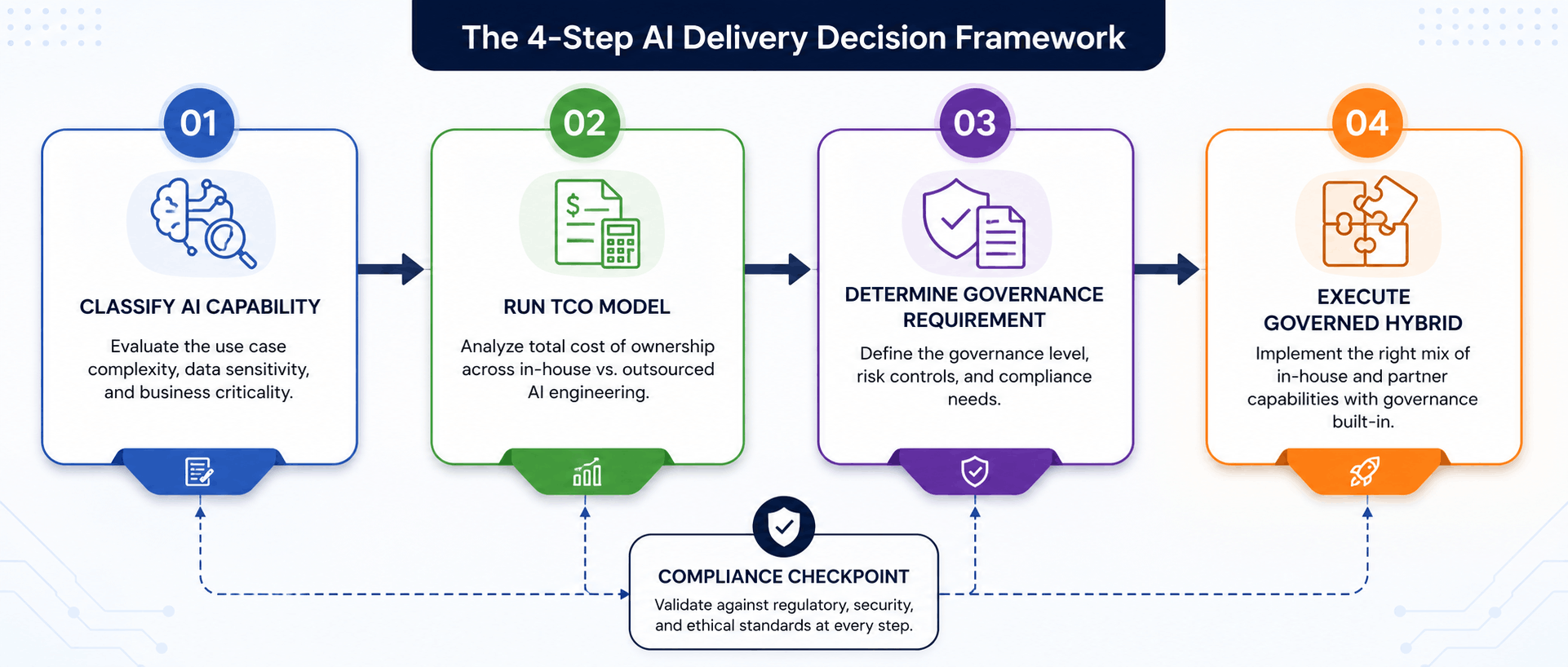
Step 1: Classify the AI Capability by Strategic Position
Core differentiator: AI capability directly encodes competitive advantage through proprietary decision logic, unique data assets, or differentiated customer experience. Own the architecture internally regardless of who builds it.
Operational enabler: AI capability improves efficiency in a function that is not a competitive differentiator. Outsource or integrate a managed service and focus internal effort on governance and integration.
Experimental or commodity: AI capability with low production risk and bounded scope. Use a managed service or pre-built tool and move fast.
A useful parallel: the same classification logic applies when evaluating AI platforms versus traditional alternatives. A property management team choosing between AI-native and legacy tools is making an identical build versus delegate decision the Cora vs traditional property management software comparison illustrates exactly where AI-native platforms create defensible differentiation versus where traditional tools are adequate. And hiring teams evaluating the Tatva vs traditional hiring platforms face the same explainability ownership question as a CTO deciding whether to outsource model scoring logic.
Step 2: Run the True Cost of Ownership Model
Most enterprise AI cost analyses miss 60 to 70 percent of the actual expense. The full cost model for in-house build includes recruiting at $15,000 to $40,000 per hire, 3 to 6 month ramp-up time, 38 percent annual attrition risk, AI-specific tooling, compute infrastructure, and model drift monitoring as a permanent operating cost. For outsource artificial intelligence development, hidden costs include customization premiums, integration charges not in the original scope, usage-based inference costs that spike when agentic workflows run continuous loops, and knowledge concentration in an external team. Budget 15 to 20 percent above quoted project costs for contingencies.
Step 3: Determine the Governance and Compliance Requirement
Regulated industry: choose in-house or heavily internal hybrid. Auditors need to see how the system works, who approved it, and how incidents escalate; this documentation trail cannot be fully delegated to a vendor.
Sensitive data that cannot leave your environment: build internally or use a partner under strict data sovereignty controls.
Standard productivity, summarization, or support use cases: outsource or use a managed AI service; governance overhead is manageable.
Step 4: Execute the Governed Hybrid Model
The principle is straightforward: own the control plane, outsource the acceleration layer. Phase one, outsource the first production model while your internal engineers work alongside the vendor team, learning from ML pipelines, architecture decisions, and model evaluation rather than managing them. Phase two, build internal MLOps capability while the vendor ships version one, so your team owns the deployment pipeline, monitoring, and retraining infrastructure where IP and institutional knowledge accumulate.
This is the model Samta.ai operates within. As a Singapore-headquartered ai engineering partner with Microsoft, Databricks, and Snowflake technology partnerships, Samta.ai builds the acceleration layer while governance, audit trails, and operational monitoring remain under the enterprise's control. The digital transformation managed services model maintains engineering continuity from build through production. For organizations assessing whether they have the data foundation to support either model, the data science and AI readiness guide is the foundational reference.
In-House vs Outsourced AI Engineering: Full Comparison
Dimension | Full In-House Build | Outsourced AI Engineering Services | Governed Hybrid | Best Fit | Key Risk |
Year 1 Cost | $1M to $1.8M for minimum viable team (salaries only, US benchmarks) | 40 to 60 percent of in-house Year 1 cost for equivalent system | Lower than full in-house, higher than pure outsource | Budget under $500K: outsource or hybrid | Hidden costs in all three models; in-house misses talent attrition; outsource misses integration charges |
IP and Data Control | Full control, highest data sovereignty | Vendor risk; data governance requires explicit contractual controls | Shared control; internal team owns architecture, vendor owns build | Regulated industries: in-house or hybrid | Outsourcing core product to agency creates 6 to 12 month repatriation risk |
Time to Production | Slowest; 3 to 6 month hiring ramp before any build begins | Fastest; vendor starts in weeks, not quarters | Moderate; parallel tracks compress timeline | Speed critical: outsource or hybrid | 49 percent of in-house AI projects never exit pilot stage |
Governance and Audit Trail | Strongest internal accountability | Weakest; compliance controls must be built on top of vendor output | Strongest overall; internal team owns governance, vendor owns acceleration | BFSI and regulated: hybrid or in-house | Delegating governance to vendor creates audit exposure |
3-Year Total Cost | Gap versus outsource narrows as cumulative vendor fees converge | Gap closes in Years 2 to 3 as cumulative fees approach in-house costs; most AI systems need re-architecture within 2 to 3 years anyway | Most cost-predictable at 3-year horizon | Long-term program: hybrid or in-house for core; outsource for commodity | Vendor lock-in at the AI layer is the primary 3-year risk for pure outsource |
Enterprise Use Cases: How CTOs Apply This Framework
Use Case 1: Singapore Bank Choosing Governed Hybrid for Credit Decisioning AI
A Singapore bank's CTO needed to deploy AI credit decisioning within 12 months without the 6-month recruiting cycle a full in-house build required. The bank selected the governed hybrid model: Samta.ai built the data pipeline and model layer on Databricks, while the bank's internal risk and compliance team owned the governance documentation, audit trail architecture, and model validation process. This preserved regulatory defensibility under MAS requirements, consistent with the approach outlined in the AI ROI for customer-facing deployment guide, while cutting Year 1 delivery cost by approximately 40 percent versus a full in-house build and compressing time to production from 18 months to 10 months.
Use Case 2: Technology Enterprise Using Pure Outsource for Intelligent Document Processing
A mid-size Singapore technology company needed intelligent document processing deployed within one quarter on a constrained budget, for an internal productivity use case with no regulated decision output. The use case qualified for pure outsource: low strategic differentiation, clean data, manageable governance requirement, and speed as the primary constraint. The outsourced team delivered a working system in eight weeks. Inference costs were modeled at three usage levels before commitment, avoiding the spike risk that catches organizations using agentic workflows. This use case illustrates why a Gen AI development services engagement is the right model specifically when the AI capability is not a competitive differentiator.
Key Risks and Failure Modes
Outsourcing your core product and repatriating later: If the software is your core product, either build it in-house from day one or use a fractional CTO model where the technical leader stays with your company while the build team scales up. The agency team knows the codebase, your team does not, and the transition takes 6 to 12 months and usually involves rewriting significant portions.
Underestimating inference cost at agentic scale: An AI tool priced at $2,000 per month during pilot adoption may require $40,000 per month for full production. Agentic workflows that run continuous loops accelerate this cost trajectory significantly faster than traditional AI inference patterns.
Delegating governance to the vendor: The EU AI Act and US state-level rules enforce strict liability on deployers, meaning the compliance obligations belong to the organization using the AI, not the organization that built it. Governance documentation, audit trails, and incident escalation paths must be owned internally regardless of who built the model.
Building in-house without data maturity: An in-house AI team without clean, lineage-tracked data pipelines will spend 80 percent of its budget on data cleaning rather than model building. Data readiness is the prerequisite to any build decision, not a parallel workstream.
Know your data maturity, governance baseline, and build versus outsource fit before committing budget. Get a Free AI Assessment Report from Samta.ai and enter the decision with verified inputs rather than vendor-supplied assumptions.
Decision Framework: Which Model Is Right for Your Program?
AI capability is a competitive differentiator with proprietary data → in-house or governed hybrid with internal architecture ownership
Use case is commodity: productivity, summarization, standard support → outsource or managed AI service
Regulated industry with MAS, EU AI Act, or equivalent compliance obligation → governed hybrid; internal team owns governance and audit trail
Budget under $500,000 and no regulated decision output → outsource; hire MLOps capacity internally in Phase 2
Speed is the primary constraint and AI is not core to your competitive position → outsource first, internalize later
You need IP ownership and data that cannot leave your environment → in-house or strictly governed partner engagement
If fewer than four boxes are clearly resolved, the build versus outsource decision is not yet ready to take to the board.
Get the phase-by-phase build versus outsource decision template, TCO model, and governed hybrid design framework in one document. Request the AI Implementation Playbook from Samta.ai and structure your engineering sourcing decision before your next board presentation.
Conclusion
The outsourced ai engineering services versus in-house debate has been settled in 2026 for most enterprises: the answer is a governed hybrid that owns the control plane internally and outsources the acceleration layer. Pure in-house build fails under AI talent cost pressure and attrition rates. Pure outsource fails under regulatory compliance obligations and long-term IP risk. The organizations building production AI most effectively are the ones who made this structural decision deliberately before committing budget, not after discovering the failure mode mid-program.
Get a structured session mapping your AI capability portfolio, build versus outsource decision, and hybrid model design against your compliance and budget constraints. Book a Consultation with Samta.ai before your next engineering investment decision.
About Samta
Samta.ai is a Singapore-headquartered AI Product Engineering & Data Intelligence partner helping enterprises build production-grade AI systems for regulated and data-intensive environments.We help organizations move beyond experimentation by engineering scalable, explainable, and enterprise-ready AI solutions from data foundations and model development to workflow automation and deployment.
Our capabilities combine deep AI expertise, data engineering, and product engineering to deliver measurable business impact across FinTech, BFSI, cybersecurity, regulatory technology, and enterprise operations.
Our enterprise AI products power real-world intelligence systems:
• TATVA : AI-driven data intelligence platform for governed analytics, monitoring, and operational insights
• VEDA : Explainable and audit-ready AI decisioning engine built for compliance-sensitive enterprise workflows
• CORA-Property Management Solutions: : Predictive intelligence platform for real-estate pricing, portfolio optimization, and investment analytics
Backed by ecosystem partnerships with Microsoft, Databricks, Snowflake, and AWS, Samta.ai delivers agile, cost-efficient AI engineering with faster turnaround and enterprise-grade scalability. Trusted by enterprises across FinTech, BFSI, and digital transformation initiatives, Samta.ai embeds AI governance, data privacy, and compliance-by-design principles directly into the AI lifecycle , enabling organizations to scale AI with transparency, accountability, and operational control.
Enterprises leveraging Samta.ai automate 65%+ of repetitive data, analytics, and decision workflows while maintaining governance, explainability, and measurable business outcomes. Samta.ai provides the strategic consulting, AI engineering, and data modernization expertise needed to align enterprise operations with next-generation AI transformation goals.
Frequently Asked Questions
What are outsourced AI engineering services and how do they differ from standard software outsourcing?
Outsourced ai engineering services involve contracting an external team to build, deploy, and sometimes maintain AI and ML systems including data pipelines, model development, MLOps infrastructure, and integration. They differ from standard software outsourcing because AI engineering introduces cost categories that do not exist in traditional development: model drift monitoring, LLM inference costs that scale non-linearly, and talent attrition at 38 percent annually for AI engineers compared to 13 percent for general engineers.
What is the ai architect vs ai engineer distinction and does it affect the build vs outsource decision?
An ai architect vs ai engineer distinction matters in governance terms. The architecture layer, which defines how data flows, how models connect to systems, and how governance is enforced, should always be owned internally even if the build is outsourced. The engineering execution layer, which writes the model code and builds the pipelines, is more safely outsourced. Outsourcing architecture as well as engineering is the most common cause of repatriation failure.
When should a CTO choose in-house AI engineering over outsourcing?
Choose in-house when the AI capability directly encodes competitive advantage through proprietary logic or unique data; when you operate in a regulated sector where auditors need full visibility into the system; when you have existing data engineering maturity and executive commitment to a 2 to 4 year capability build; or when the AI system will influence operational continuity or customer-facing decisions that cannot be defended by citing a third-party vendor.
What is ai business process outsourcing and how does it differ from AI engineering outsourcing?
ai business process outsourcing refers to outsourcing an entire business function or workflow to a provider that uses AI to execute it, rather than outsourcing the engineering to build an AI system. The distinction matters because in BPO, the enterprise often relinquishes process control; in engineering outsourcing, the enterprise retains IP and system ownership while the vendor provides build capacity. Regulated enterprises should avoid BPO for AI-influenced regulated decisions.
How do you evaluate an AI engineering partner for a regulated enterprise engagement?
Evaluate on four dimensions: production case studies with measurable outcomes in your industry, not pilot metrics; documented governance framework that maps to your compliance standards; architecture handover process that leaves your team owning the codebase and documentation; and contractual structure that aligns partner incentives to production outcomes, not billable hours. Fixed-fee discovery, then milestone-based delivery with a clear definition of done, is the most defensible contract structure.
Reduce Time-to-Hire by 70% with AI Skill Verification
TATVA helps enterprises screen, assess, and benchmark software engineers and tech talent with audit-ready AI evaluations.
Explore TATVA Platform >