
Summarize this post with AI
87% of Singapore financial institutions now deploy AI in production, but regulatory scrutiny is intensifying under MAS's new AI Risk Management Guidelines. What separates compliant deployments from risky ones? The answer lies in Singapore ai verify the world's first AI governance testing framework and toolkit developed by AI Verify IMDA that enables organizations to demonstrate responsible AI objectively. For CTOs in BFSI Singapore, understanding what is ai verify is no longer optional it's essential for meeting Monetary Authority of Singapore expectations. This guide breaks down the singapore ai verify framework, shows you how to implement it, and compares it against global alternatives like NIST and EU AI Act approaches. For more on emerging trends, read our Future of AI Governance analysis.
Executive Summary
Singapore ai verify
Singapore ai verify is the world's first AI governance testing framework and software toolkit, developed by IMDA and now open-sourced through the ai verify foundation singapore. It enables enterprises to self-assess AI system compliance through standardized testing processes covering transparency, fairness, reliability, and safety.The framework includes 11 core principles aligned with the Model AI Governance Framework for agentic AI Singapore (released February 2026), making it critical for BFSI organizations deploying autonomous AI systems. Implementation requires testing against 27+ metrics with documented evidence for regulatory review.
What Is AI Verify? Definition and Core Components
AI Verify IMDA is a voluntary AI governance testing framework and toolkit that enables organizations to demonstrate responsible AI through standardized, objective verification. Unlike advisory guidelines, Singapore ai verify provides actionable testing processes with measurable metrics. To understand the broader landscape, see our AI Governance Framework 2026 guide.
Discover Your Organization's AI Maturity
Key Components
Component | Description | Purpose / Use |
|---|---|---|
Testing Framework | 11 principles covering transparency, fairness, reliability, safety, accountability | Defines what aspects of AI systems need to be evaluated for responsible AI |
Software Toolkit | Open-source testing tools for automated metric evaluation | Enables automated testing and scoring of AI models using defined metrics |
Documentation Standards | Templates for evidence collection regulatory requirements | Helps organizations prepare audit-ready compliance documentation |
Primer Guide | 40-page implementation guide (June 2023) | Provides step-by-step guidance to implement the AI Verify framework |
The ai model governance framework singapore evolved from IMDA's original 2020 Model AI Governance Framework, now enhanced for agentic AI systems that make autonomous decisions.
Why Singapore AI Verify Matters Now (2026 Context)
Three forces make Singapore ai verify critical in 2026:
1. Regulatory Pressure from MAS
In March 2026, the Monetary Authority of Singapore and Association of Banks in Singapore released the AI Risk Management Toolkit and Handbook, requiring financial firms to implement governance, lifecycle controls, and AI testing. AI Verify IMDA provides the testing methodology MAS expects. For compliance deep dives, check our AI Governance Compliance resource.[rmaindia]
2. Agentic AI Deployment Surge
98% of global financial institutions now deploy AI in operations, with Singapore leading adoption. The new Model AI Governance Framework for agentic AI Singapore (February 2026) specifically governs autonomous AI systems that make decisions without human intervention.[aihaberleri]
3. Accreditation Programme Launch
Singapore's new AI Tester Accreditation Programme (AI TAP), announced May 2026, certifies companies that test and jailbreak AI systems before deployment creating a qualified vendor ecosystem for singapore ai verify implementation.
Core Framework: Step-by-Step Implementation Process
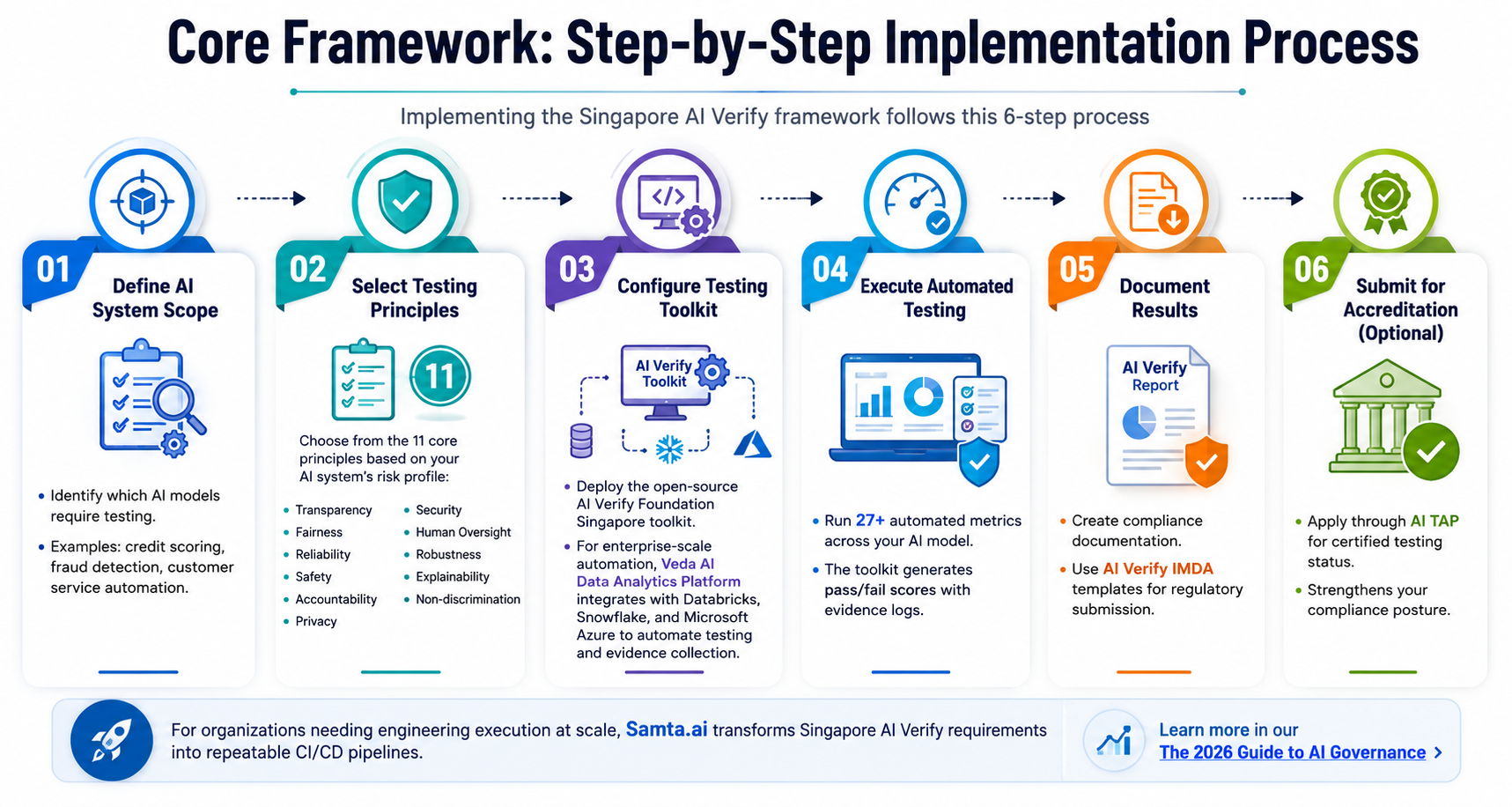
Implementing the singapore ai verify framework follows this 6-step process:
Step 1: Define AI System Scope
Identify which AI models require testing (e.g., credit scoring, fraud detection, customer service automation).
Step 2: Select Testing Principles
Choose from the 11 core principles based on your AI system's risk profile:
Transparency
Fairness
Reliability
Safety
Accountability
Privacy
Security
Human Oversight
Robustness
Explainability
Non-discrimination
Step 3: Configure Testing Toolkit
Deploy the open-source ai verify foundation singapore software toolkit and configure metrics for your use case. For enterprise-scale automation, Veda AI Data Analytics Platform integrates with Databricks, Snowflake, and Microsoft Azure to automate testing toolkit deployment and evidence collection.
Step 4: Execute Automated Testing
Run the 27+ automated metrics across your AI model. The toolkit generates pass/fail scores with evidence logs.
Step 5: Document Results
Create compliance documentation using AI Verify IMDA templates for regulatory submission.
Step 6: Submit for Accreditation (Optional)
Apply through AI TAP for certified testing status, strengthening your compliance posture. For organizations needing engineering execution at scale, Samta.ai transforms Singapore ai verify requirements into repeatable CI/CD pipelines. Learn more in our The 2026 Guide to AI Governance.
Strengthen AI Governance with Actionable Insights
Enterprise Use Cases
Use Case 1: BFSI Credit Scoring Model (Singapore Bank)
A leading Singapore bank implemented Singapore ai verify for its AI-powered credit scoring system serving 2M customers:
Challenge: MAS required documented fairness testing to prevent discriminatory lending practices.
Solution:
Deployed AI Verify IMDA toolkit to test fairness metrics across demographic groups
Ran 15+ fairness tests measuring prediction accuracy variance by age, gender, ethnicity
Documented results showing <2% variance meeting MAS thresholds
Outcome: Passing audit prevented potential regulatory penalties estimated at SGD 15M and enabled model deployment.
Use Case 2: General Enterprise Customer Service AI (Retail Chain)
A Singapore retail chain deployed autonomous customer service AI handling 500K monthly inquiries:
Challenge: The new Model AI Governance Framework for agentic AI Singapore required governance for autonomous decision-making.
Solution:
Applied singapore ai verify principles for safety and human oversight
Tested AI jailbreak scenarios using AI TAP-accredited vendors
Implemented fallback protocols when AI confidence <85%
Outcome: Reduced escalations by 40% while maintaining compliance with February 2026 agentic AI requirements.
Key Risks and Failure Modes
Implementing Singapore ai verify incorrectly creates these critical risks:
Risk | Consequence | Mitigation |
Skipping fairness testing | MAS regulatory penalties up to 2% annual revenue | Run all 15+ fairness metrics per AI Verify IMDA |
Inadequate documentation | Audit rejection, deployment delays | Use singapore ai verify framework templates consistently |
Ignoring agentic AI rules | Violation of February 2026 framework | Apply Model AI Governance Framework for agentic AI Singapore principles |
Using unaccredited testers | AI TAP certification denied | Partner with AI TAP-accredited vendors only |
Manual testing at scale | CI/CD bottleneck, inconsistent results | Automate via Samta.ai integration with Databricks/Snowflake |
For risk management strategies, review our AI Governance Compliance guidelines.
Navigate AI risks with confidence. This playbook provides a step-by-step approach to managing model risks, ensuring alignment with global frameworks and Singapore AI governance best practices.
Decision Framework: When to Use AI Verify
When TO Use Singapore AI Verify
You're a BFSI firm in Singapore under MAS supervision
You deploy agentic AI (autonomous decision-making)
You need documented evidence for regulatory audits
You operate 10+ AI models requiring continuous monitoring
You want open-source, IMDA-aligned testing (not proprietary)
When NOT to Use Singapore AI Verify
You're outside Singapore with no APAC operations (consider NIST AI RMF instead) see The NIST AI Risk Management Framework for details
You're in EU-only markets (EU AI Act requirements differ)
You need quick certification without testing (AI Verify requires actual testing)
Your AI system is low-risk (<100 users, no financial impact)
You lack engineering team for toolkit deployment (consider Samta.ai support)
Comparison: AI Verify vs. Global AI Governance Frameworks
Dimension | Singapore ai verify (IMDA) | NIST AI RMF (US) | EU AI Act | ISO/IEC 42001 | MAS AI Toolkit |
Primary Focus | Testing + Toolkit | Risk management framework | Legal compliance | Management system certification | BFSI risk guidelines |
Mandatory? | Voluntary | Voluntary | Mandatory (2024+) | Voluntary | Mandatory for MAS firms |
Testing Metrics | 27+ automated metrics | Qualitative assessment | Conformity assessment | Audit-based | Risk-based assessment |
Open Source | Yes (Foundation) | Yes | No | No | No |
APAC Alignment | Singapore-specific | US-focused | EU-focused | Global | Singapore BFSI-only |
Key takeaway: Singapore ai verify is the only framework providing open-source automated testing tools, making it fastest to implement for enterprise-scale models. Compare approaches in our The NIST AI Risk Management Framework deep dive.
Start Your AI Transformation Today
Conclusion
Singapore ai verify is no longer experimental it's the operational standard for AI governance in APAC's leading financial hub. With MAS mandating AI testing and the new agentic AI framework requiring autonomous system governance, CTOs in BFSI Singapore must implement AI Verify IMDA to avoid regulatory penalties and deployment delays. The framework's open-source toolkit, 27+ automated metrics, and alignment with the Model AI Governance Framework for agentic AI Singapore make it the fastest path to compliant AI deployment.
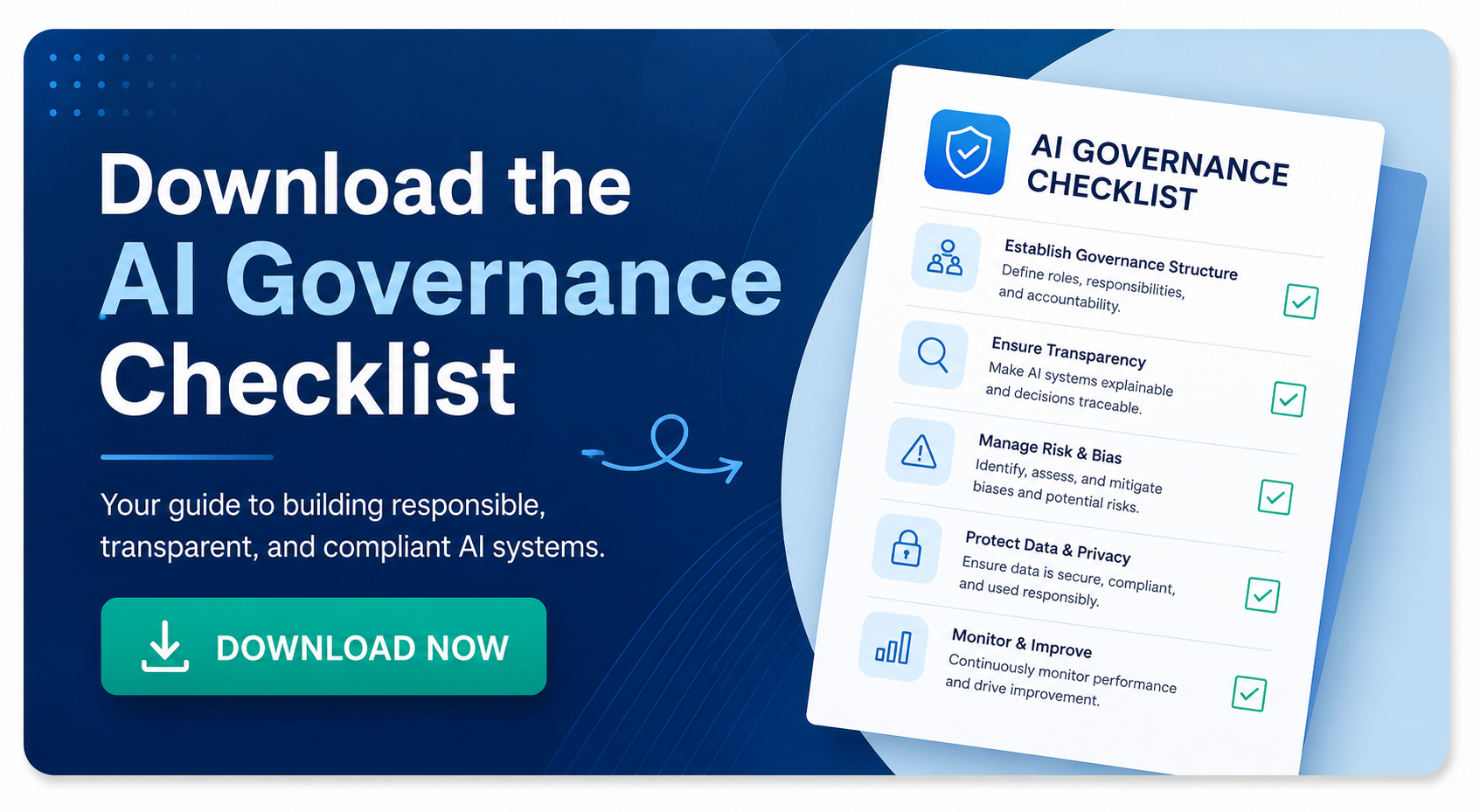
Ensure your AI systems are compliant, accountable, and enterprise-ready. Use this practical checklist to align with Singapore AI Verify principles and implement responsible AI governance.
About Samta
Samta.ai is a Singapore-headquartered AI Product Engineering & Data Intelligence partner helping enterprises build production-grade AI systems for regulated and data-intensive environments.We help organizations move beyond experimentation by engineering scalable, explainable, and enterprise-ready AI solutions from data foundations and model development to workflow automation and deployment.
Our capabilities combine deep AI expertise, data engineering, and product engineering to deliver measurable business impact across FinTech, BFSI, cybersecurity, regulatory technology, and enterprise operations.
Our enterprise AI products power real-world intelligence systems:
• TATVA : AI-driven data intelligence platform for governed analytics, monitoring, and operational insights
• VEDA : Explainable and audit-ready AI decisioning engine built for compliance-sensitive enterprise workflows
• CORA-Property Management Solutions: : Predictive intelligence platform for real-estate pricing, portfolio optimization, and investment analytics
Backed by ecosystem partnerships with Microsoft, Databricks, Snowflake, and AWS, Samta.ai delivers agile, cost-efficient AI engineering with faster turnaround and enterprise-grade scalability. Trusted by enterprises across FinTech, BFSI, and digital transformation initiatives, Samta.ai embeds AI governance, data privacy, and compliance-by-design principles directly into the AI lifecycle , enabling organizations to scale AI with transparency, accountability, and operational control.
Enterprises leveraging Samta.ai automate 65%+ of repetitive data, analytics, and decision workflows while maintaining governance, explainability, and measurable business outcomes. Samta.ai provides the strategic consulting, AI engineering, and data modernization expertise needed to align enterprise operations with next-generation AI transformation goals.
FAQ Section
What is AI Verify in Singapore?
AI Verify is the world's first AI governance testing framework and toolkit developed by IMDA. It enables organizations to demonstrate responsible AI through standardized testing covering 11 principles like transparency, fairness, and safety. The toolkit is now open-source through the ai verify foundation singapore.
How does AI Verify IMDA differ from the Model AI Governance Framework?
AI Verify IMDA is the testing implementation of the broader Model AI Governance Framework for agentic AI Singapore. The Framework provides principles and guidance; AI Verify provides automated testing metrics and software tools to verify compliance objectively.
Is Singapore AI Verify mandatory for BFSI firms?
No, Singapore ai verify is voluntary. However, MAS's AI Risk Management Guidelines (March 2026) require BFSI firms to implement AI testing and documentation. AI Verify IMDA is the IMDA-standard methodology MAS expects, making it effectively mandatory for compliance.
What is the AI Verify Foundation Singapore?
The ai verify foundation singapore is the organization that maintains the open-source version of Singapore ai verify. Launched in 2023, it makes the testing toolkit freely available to enterprises globally while keeping IMDA's original framework intact.
What is the ai model governance framework Singapore?
The ai model governance framework singapore refers to IMDA's evolved governance standards, now including the February 2026 Model AI Governance Framework for agentic AI Singapore. It covers 11 principles for governing AI models across their lifecycle, from development to deployment.