
Summarize this post with AI
Singapore banks and fintechs that have not automated customer onboarding are losing account opening completion rates to competitors by 30 to 50 percentage points, not because their risk controls are stricter but because their processes are slower. KYC automation Singapore is not a technology preference decision in 2026. It is a competitive and regulatory necessity for any institution that wants to onboard customers digitally at the speed MAS MyInfo integration enables and the compliance standard MAS Notice on Prevention of Money Laundering requires simultaneously. This guide gives compliance heads, Chief Risk Officers, and digital banking technology leads a structured evaluation framework for selecting eKYC solutions in Singapore that satisfy both conversion and compliance requirements.
KYC Automation Singapore:
KYC automation Singapore for banks and fintechs requires an integrated eKYC platform that combines: Singpass MyInfo integration for verified personal data retrieval, liveness detection and biometric document verification for identity proofing, PEP and sanctions screening against MAS prescribed lists and global watchlists, AML risk scoring based on customer profile and transaction behaviour signals, and audit trail generation for every onboarding decision that satisfies MAS Notice MAS626 and MAS Notice 314 documentation standards. E KYC regulatory acceptance in Singapore is conditional on the platform meeting MAS Technology Risk Management guidelines for the AI and ML components used in identity verification and risk scoring, requiring explainability output and model governance documentation as standard delivery components.
What KYC Automation Covers and Why Manual KYC Is No Longer Viable
What is AML KYC compliance in operational terms: it is the process of verifying that a new customer is who they claim to be (KYC) and does not present an unacceptable money laundering or terrorist financing risk (AML), documented in a format that satisfies MAS examination standards. Manual KYC processes in Singapore banks and licensed payment service providers require: manual document collection and verification, manual database screening against PEP and sanctions lists, manual risk classification, and manual documentation of the verification steps taken. For a well resourced compliance team, this takes 2 to 5 business days per application. For a digital native customer expecting instant account opening, this is an abandonment event.
Automated onboarding software for customers replaces each manual step with an AI or rule based automated equivalent:
Identity verification: Singpass MyInfo API retrieves verified NRIC, address, and income data directly from government sources. For non Singpass eligible customers, OCR document extraction and biometric document verification authenticate passports, foreign IDs, and work passes. Liveness detection prevents spoofing attacks using photographs or video replays of other individuals.
PEP and sanctions screening: automated screening against MAS prescribed lists, OFAC, UN Security Council lists, and commercial PEP databases produces a screening result within seconds rather than the 24 to 48 hours a manual screening process requires.
AML risk scoring: machine learning models score each applicant against defined risk factors including nationality, occupation, source of funds, politically exposed person status, and geographic risk classification, producing a risk tier assignment that routes high risk applicants to enhanced due diligence without manual review of every application.
Purpose of KYC in banking beyond regulatory compliance: it is also the first data collection opportunity in the customer lifecycle. eKYC platforms that integrate customer profile data from the onboarding process into CRM, credit, and product systems create a data foundation that manual paper based processes cannot produce in usable digital form.
Is Your AI Strategy Ready for Enterprise Scale?
Why eKYC Selection Is More Consequential in Singapore in 2026
Three regulatory and market developments have changed what acceptable eKYC capability means:
1. MAS MyInfo integration is now a table stakes requirement
MAS has promoted Singpass MyInfo as the preferred identity verification mechanism for Singapore residents, and major Singapore digital banks have demonstrated that MyInfo integrated onboarding achieves completion rates of 70 to 85% versus 30 to 50% for non MyInfo flows (Source Required: MAS Digital Finance Report). An eKYC solution Singapore that does not offer native MyInfo integration is structurally disadvantaged for Singapore resident onboarding regardless of its document verification capability.
2. MAS AML KYC examination depth has increased
MAS Notice MAS626 (banks) and MAS Notice 314 (payment service providers) examination standards now include review of the AI and ML model documentation underlying automated AML risk scoring decisions. An AML KYC automation platform that produces risk scores without explainability output or model governance documentation creates regulatory exposure that the compliance team cannot address retrospectively (Source Required: MAS Notice MAS626).
3. Fraud sophistication targeting eKYC flows has increased
Singapore's Cyber Security Agency has reported increasing sophistication in deepfake and synthetic identity attacks targeting digital onboarding flows specifically, requiring liveness detection that goes beyond passive photo matching to active challenge response or 3D depth sensing (Source Required: CSA Singapore Cybersecurity Landscape Report).
The 6 Criteria Evaluation Framework for eKYC Solutions in Singapore
Criterion 1: Singpass MyInfo Integration
Does the platform offer production certified Singpass MyInfo API integration, or does it position MyInfo as a roadmap item? Require a live demonstration of the MyInfo consent flow and a reference from a Singapore licensed institution using it in production. MyInfo API certification requires ACRA and Govtech approval that not all international eKYC vendors have obtained.
Criterion 2: Liveness Detection and Biometric Verification
Does the platform use passive liveness detection (photo analysis) or active liveness detection (challenge response, 3D depth sensing)? For high risk account types and non MyInfo flows, active liveness detection is required to satisfy MAS guidelines on remote customer due diligence for higher risk categories. Require the vendor's iBeta Level 1 and Level 2 PAD (Presentation Attack Detection) certification documentation.
Criterion 3: PEP and Sanctions Screening Coverage
Does the platform screen against MAS prescribed lists, OFAC, UN Security Council lists, FATF high risk jurisdictions, and commercial PEP databases simultaneously, or does it offer selective screening that requires manual supplementation? For Singapore licensed institutions, MAS Notice MAS626 requires screening against all prescribed lists as a minimum. Verify the database refresh frequency: screening databases that update monthly rather than daily create a gap where newly listed individuals pass screening.
Criterion 4: AML KYC Risk Scoring with Explainability
Does the platform produce AML risk scores with explainable factor level output that a compliance officer can review and that satisfies MAS model risk documentation requirements? AML KYC automation platforms that produce black box risk scores without factor level explanation create two problems simultaneously: compliance officers cannot exercise judgment on borderline cases, and MAS examiners cannot assess whether the scoring logic is appropriate. Samta.ai's Onboarding KYC platform produces factor level AML risk score explanations for every applicant as standard output, with model governance documentation satisfying MAS TRM requirements for AI based AML scoring models. The Onboarding KYC platform documentation covers the specific explainability and audit trail architecture.
Criterion 5: Audit Trail and MAS Documentation Standards
Does the platform generate a complete, tamper evident audit trail for every onboarding decision, covering: identity verification steps taken, screening results with database reference, risk score with factor breakdown, and the compliance decision with reviewer identity and timestamp? MAS examination requests for specific customer onboarding records are increasingly common, and institutions that cannot produce complete audit trails for specific accounts face remediation findings. Samta.ai's AI security and compliance services configure the audit trail architecture for Onboarding KYC deployments to satisfy MAS Notice MAS626 and MAS Notice 314 documentation standards as a standard engagement deliverable.
Criterion 6: Integration with Core Banking and CRM Systems
Does the platform offer pre built integrations with your core banking system, CRM, and AML transaction monitoring platform, or does it require custom API development for every downstream system connection? eKYC platforms that operate as data silos require manual data transfer to downstream systems, creating reconciliation overhead and data quality risks that offset the efficiency gains from automated onboarding. Samta.ai's data integration consulting services implement the integration layer between Onboarding KYC and existing core banking, CRM, and AML monitoring platforms for Singapore bank and fintech deployments.
KYC Automation Singapore: 5 Column eKYC Platform Comparison Framework
Evaluation Criterion | Manual KYC Process | Basic Document Verification | Full eKYC without AML | Full eKYC with AML | Samta.ai Onboarding KYC |
MyInfo Integration | None | Varies | Varies | Varies | Production certified Singapore MyInfo API |
Liveness Detection | None | Passive photo only | Active challenge response | Active with iBeta PAD certification | Active liveness with iBeta Level 1 and 2 PAD |
PEP and Sanctions Screening | Manual, 24 to 48 hour turnaround | Not included | Not included | Automated, database dependent | MAS prescribed lists, OFAC, UN, commercial PEP, daily refresh |
AML Risk Scoring with Explainability | Manual, rule based | Not included | Not included | Black box score only | Factor level explainability, MAS TRM model governance documentation |
Audit Trail for MAS Documentation | Manual paper records | Partial digital record | Partial, no AML documentation | Varies by vendor | Tamper evident full audit trail per MAS Notice MAS626 and 314 |
Measure Your AI Model Risk Before Regulators Do
Real World Use Cases
Use Case 1: Digital Bank Account Opening, Singapore Licensed Digital Bank (BFSI)
A Singapore licensed digital bank was achieving a 34% account opening completion rate using a document upload and manual review process. Applicants were abandoning at three points: the document upload step (file size and format issues), the 48 hour manual review waiting period, and the enhanced due diligence request for flagged applicants. Implementing MyInfo integrated eKYC with active liveness detection and automated AML risk scoring reduced the standard applicant journey to under 4 minutes for Singpass eligible Singapore residents. Completion rate for Singapore residents increased from 34% to 76%. Compliance review time per application reduced from 48 hours to under 2 minutes for standard risk applicants. Enhanced due diligence workflow was triggered automatically for elevated risk applicants rather than requiring manual review of every application. Review AI transformation for banks for the broader AI program context in which eKYC automation delivers the highest compounding value within a digital banking transformation program.
Use Case 2: Payment Service Provider Onboarding, Singapore Licensed PSP (Fintech)
A Singapore Major Payment Institution licensee needed to onboard business customers and their beneficial owners under MAS Notice 314 requirements, including beneficial ownership verification, PEP screening for all beneficial owners above 25% threshold, and source of funds documentation for higher risk categories. The manual process took 5 to 8 business days per business customer, creating a sales pipeline bottleneck where qualified merchants were abandoning the onboarding process for competitors. Automating the beneficial owner identification flow, document verification for UEN registered entities via Corppass, and PEP screening for all named beneficial owners reduced time to onboard from 5 to 8 days to under 24 hours for standard risk business customers. Explore AI for Singapore fintech for the regulatory and technology context of eKYC automation within Singapore's licensed payment service provider framework, and review AI KYC vs traditional KYC for a detailed comparison of automated versus manual KYC outcomes across key performance dimensions.
Key Risks in eKYC Platform Selection
MyInfo integration not production certified: is a procurement risk that delays go live by 3 to 6 months when discovered after contract signature. Singpass MyInfo API certification requires Govtech approval that international eKYC vendors without Singapore market presence may not have completed. Require production certification evidence, not a roadmap commitment.
Passive liveness detection against sophisticated deepfake attacks: is a fraud risk that is increasing in the Singapore digital banking market. iBeta Level 2 PAD certification is the current industry standard for liveness detection robustness. Vendors without this certification create fraud exposure that is not visible in a standard demo environment.
Black box AML risk scores without factor level explanation: create two simultaneous risks: compliance officers cannot exercise informed judgment on borderline cases, and MAS examiners inspecting the AML model under TRM guidelines will find the absence of explainability documentation to be a governance finding.
Audit trail gaps between identity verification and AML screening records: occur when identity verification and AML screening are handled by separate platforms that do not share a unified audit log. MAS examination requests for a specific customer's onboarding record expect a single coherent audit trail, not two separate records from two vendors requiring manual correlation.
PEP database refresh frequency below daily: creates a gap where a customer onboarded before a PEP designation is added to a watchlist passes screening without triggering enhanced due diligence. Require daily or real time database refresh as a minimum specification.
Review AI governance compliance in Singapore for the AI model governance requirements that apply to the AML risk scoring components of eKYC platforms under MAS TRM and the 6 components of AI governance that must be present at the engineering layer for MAS examination readiness.
Decision Framework: Which eKYC Approach Fits Your Institution
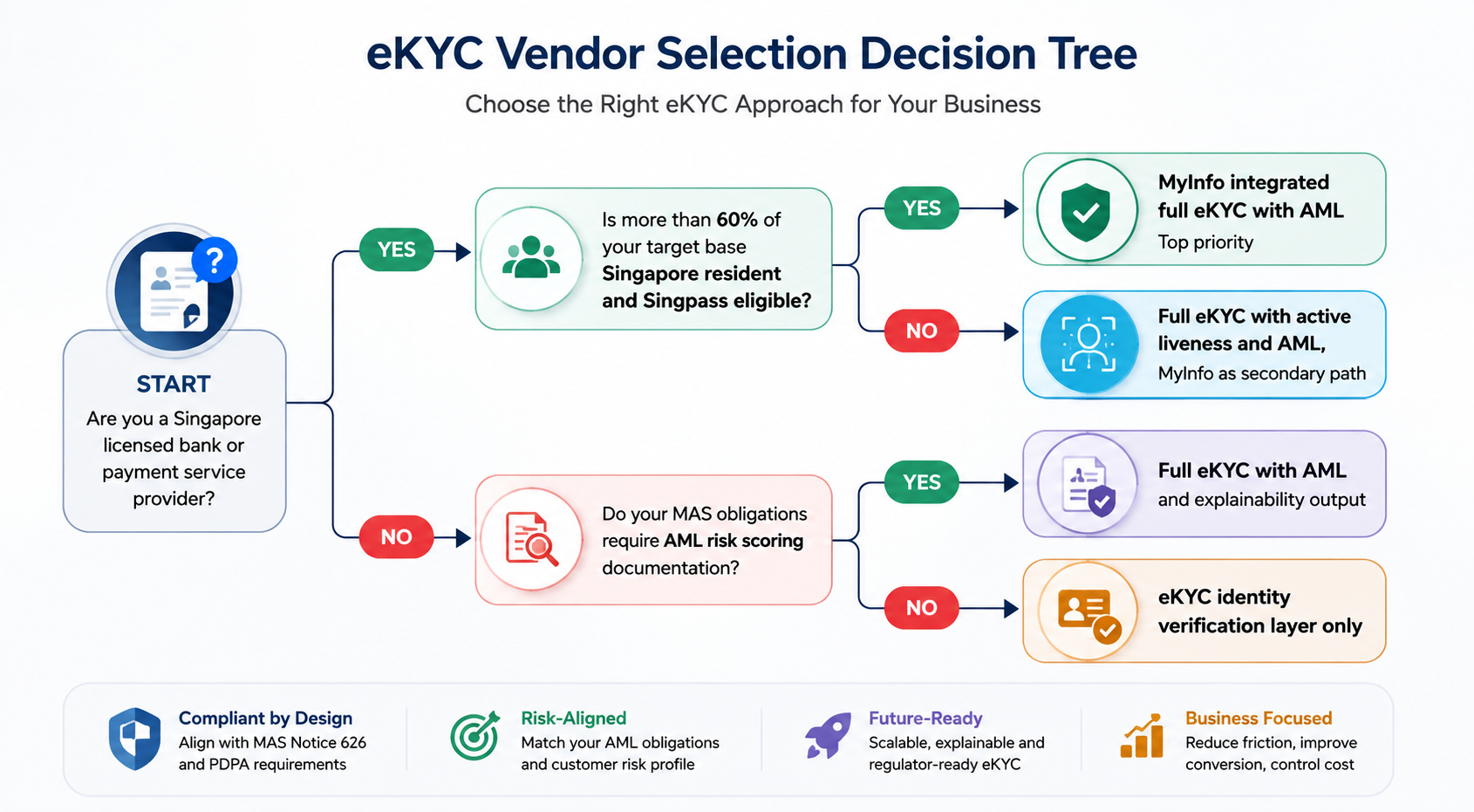
Implement full eKYC with AML integration when:
You are a Singapore licensed bank, digital bank, or major payment institution with MAS Notice MAS626 or Notice 314 obligations
Your current onboarding completion rate is below 60% and the abandonment analysis shows process friction as the primary cause
Your compliance team is spending more than 60% of review time on standard risk applicants who should be processed automatically
Implement eKYC without full AML integration when:
Your customer profile is sufficiently homogeneous that a standard risk classification approach satisfies your MAS obligations without machine learning risk scoring
Your AML transaction monitoring platform already handles risk scoring and you need eKYC only for the identity verification and document authentication layers
Prioritise MyInfo integration above all other eKYC features when:
More than 60% of your target customer base is Singapore resident and Singpass eligible
Competitor digital onboarding journeys in your product category already offer MyInfo integration
Your current document upload process is the primary abandonment point in the onboarding funnel
Accelerate Your AI Journey with Expert Consulting

Conclusion
KYC automation Singapore is simultaneously a compliance requirement and a competitive necessity. Institutions that automate identity verification, PEP and sanctions screening, and AML risk scoring in a unified platform with MAS audit trail documentation achieve completion rates that manual processes cannot match, without compromising the regulatory standard that MAS Notice MAS626 and Notice 314 require. The evaluation framework in this guide ensures that your eKYC platform selection addresses both dimensions: the conversion performance that makes digital onboarding commercially viable, and the governance and documentation standards that make it regulatorily defensible. Build for both from the first procurement decision, not sequentially.
About Samta
Samta.ai is a Singapore-headquartered AI Product Engineering & Data Intelligence partner helping enterprises build production-grade AI systems for regulated and data-intensive environments.We help organizations move beyond experimentation by engineering scalable, explainable, and enterprise-ready AI solutions from data foundations and model development to workflow automation and deployment.
Our capabilities combine deep AI expertise, data engineering, and product engineering to deliver measurable business impact across FinTech, BFSI, cybersecurity, regulatory technology, and enterprise operations.
Our enterprise AI products power real-world intelligence systems:
• TATVA : AI-driven data intelligence platform for governed analytics, monitoring, and operational insights
• VEDA : Explainable and audit-ready AI decisioning engine built for compliance-sensitive enterprise workflows
• CORA-Property Management Solutions: : Predictive intelligence platform for real-estate pricing, portfolio optimization, and investment analytics
Backed by ecosystem partnerships with Microsoft, Databricks, Snowflake, and AWS, Samta.ai delivers agile, cost-efficient AI engineering with faster turnaround and enterprise-grade scalability. Trusted by enterprises across FinTech, BFSI, and digital transformation initiatives, Samta.ai embeds AI governance, data privacy, and compliance-by-design principles directly into the AI lifecycle , enabling organizations to scale AI with transparency, accountability, and operational control.
Enterprises leveraging Samta.ai automate 65%+ of repetitive data, analytics, and decision workflows while maintaining governance, explainability, and measurable business outcomes. Samta.ai provides the strategic consulting, AI engineering, and data modernization expertise needed to align enterprise operations with next-generation AI transformation goals.
Frequently Asked Questions
What is KYC automation in Singapore banking?
KYC automation Singapore is the replacement of manual customer identity verification, document review, PEP and sanctions screening, and AML risk classification with AI and rule based automated systems that complete the same compliance process in minutes rather than days. For Singapore licensed banks and payment service providers, automated eKYC must satisfy MAS Notice MAS626 and Notice 314 documentation standards and MAS TRM guidelines for the AI components used in identity verification and risk scoring.
What is the purpose of KYC in banking and why does it require automation?
The purpose of KYC in banking is to verify that customers are who they claim to be, that they do not appear on PEP or sanctions lists, and that their expected transaction behaviour is consistent with their stated profile, documented in a way that satisfies regulatory examination standards. KYC requires automation in 2026 because manual KYC processes that take 2 to 5 days create abandonment rates that make digital bank account opening commercially unviable against competitors with automated journeys that take under 5 minutes.
What is AML KYC compliance and how does eKYC satisfy it?
What is AML KYC compliance: it is the combined obligation to verify customer identity (KYC) and assess money laundering or terrorist financing risk (AML) before onboarding, documented with audit trail evidence sufficient to satisfy MAS examination. AML KYC automation satisfies this through integrated platforms that automate identity verification, PEP and sanctions screening, and AML risk scoring in a single workflow, producing a unified audit trail per customer that connects identity verification results to AML screening outcomes and risk classification decisions.
What is e KYC regulatory acceptance in Singapore?
E KYC regulatory acceptance in Singapore means MAS has accepted automated identity verification as equivalent to in person verification for specific customer categories and risk levels, subject to conditions including: use of Singpass MyInfo for Singapore residents, active liveness detection for biometric verification, and documentation standards equivalent to manual verification records. MAS Notice MAS626 and Notice 314 specify the conditions under which remote digital onboarding satisfies face to face CDD requirements for different customer risk categories.
What liveness detection standard is required for Singapore eKYC?
Liveness detection for Singapore eKYC should meet iBeta Level 1 Presentation Attack Detection certification for standard risk accounts and iBeta Level 2 for higher risk account categories. Level 1 tests resistance to print attacks and basic video replay. Level 2 tests resistance to sophisticated deepfake and 3D mask attacks that are increasingly used in synthetic identity fraud targeting Singapore digital banking onboarding flows. Vendors without current iBeta PAD certification should not be deployed for customer categories requiring biometric identity proofing.