
Summarize this post with AI
Most institutions doing model risk management agentic ai still assume SR 11-7 is the current standard they are being measured against. It is not, and the framework that replaced it in April 2026 does not fully close the gap agentic AI creates either. SR 11-7 was written in 2011 around a model that produces a single output from a defined input set, validated once before deployment and monitored periodically after. An autonomous agent that executes multi step actions, calls external tools, and modifies real systems does not fit that definition cleanly, and the regulators who replaced SR 11-7 have said so directly.
Model Risk Management Agentic AI:
Model risk management agentic ai requires more than applying SR 11-7's legacy pillars, development, validation, monitoring, and governance, to a new kind of system. SR 11-7 was superseded on 17 April 2026 by SR 26-2, revised interagency guidance from the Federal Reserve, OCC, and FDIC, which keeps the same core lifecycle structure but explicitly leaves generative and agentic AI outside its formal scope, signaling further AI specific guidance is still to come. Institutions cannot wait for that guidance to arrive before building agentic specific controls, since agents are already making autonomous decisions in production today.
What SR 11-7 assumed, and where agentic AI breaks that assumption
Sr 11-7 agentic ai tension starts with a definitional problem. SR 11-7 defined a model as a quantitative method that processes input data to generate output, a framing built for credit scoring, market risk, and similar static models. Our guide to what AI model risk management actually covers walks through how that definition has been stretched, sometimes awkwardly, to cover machine learning and generative AI over the past decade.
Agentic AI does not fit that definition at all. Where a credit model produces one numeric output from a defined feature set, an autonomous agent executes multi step action sequences, calls external tools, writes to databases, and modifies shared state, frequently without a human reviewer in the loop at any point. A generated summary can be reviewed before it influences a decision. A tool call that submits a wire transfer or updates a customer record has already changed external state before any governance layer sees it. That distinction, output versus action, is where most legacy model risk management framework thinking breaks down.
Find Out How AI-Ready Your Business Is
Why this gap matters more in 2026 than it did a year ago
Autonomous decisioning risk has moved from a theoretical governance question to an active supervisory concern for three reasons.
SR 26-2 confirmed the gap rather than closing it. The interagency guidance that replaced SR 11-7 explicitly excludes generative and agentic AI from formal model risk scope, leaving institutions to apply general risk management practices rather than a purpose built framework.
Agentic AI adoption has outpaced governance maturity. Institutions are deploying agents for credit decisioning support, fraud triage, and customer facing tasks faster than model risk functions can extend their existing frameworks to cover action taking systems.
The consequences of an agent's action are often irreversible. Unlike a static model's output, which a human can review before it affects anything, an agent's tool call can alter a customer record or submit a transaction before any governance checkpoint exists to catch it.
Our companion piece on agentic AI governance and our broader AI governance framework for 2026 roadmap both cover how institutions are building the layer SR 26-2 left open.
The agentic model risk framework institutions need instead
Closing this gap means extending, not replacing, the core discipline SR 11-7 and SR 26-2 both preserve, development, validation, monitoring, and governance, to account for action rather than output alone.
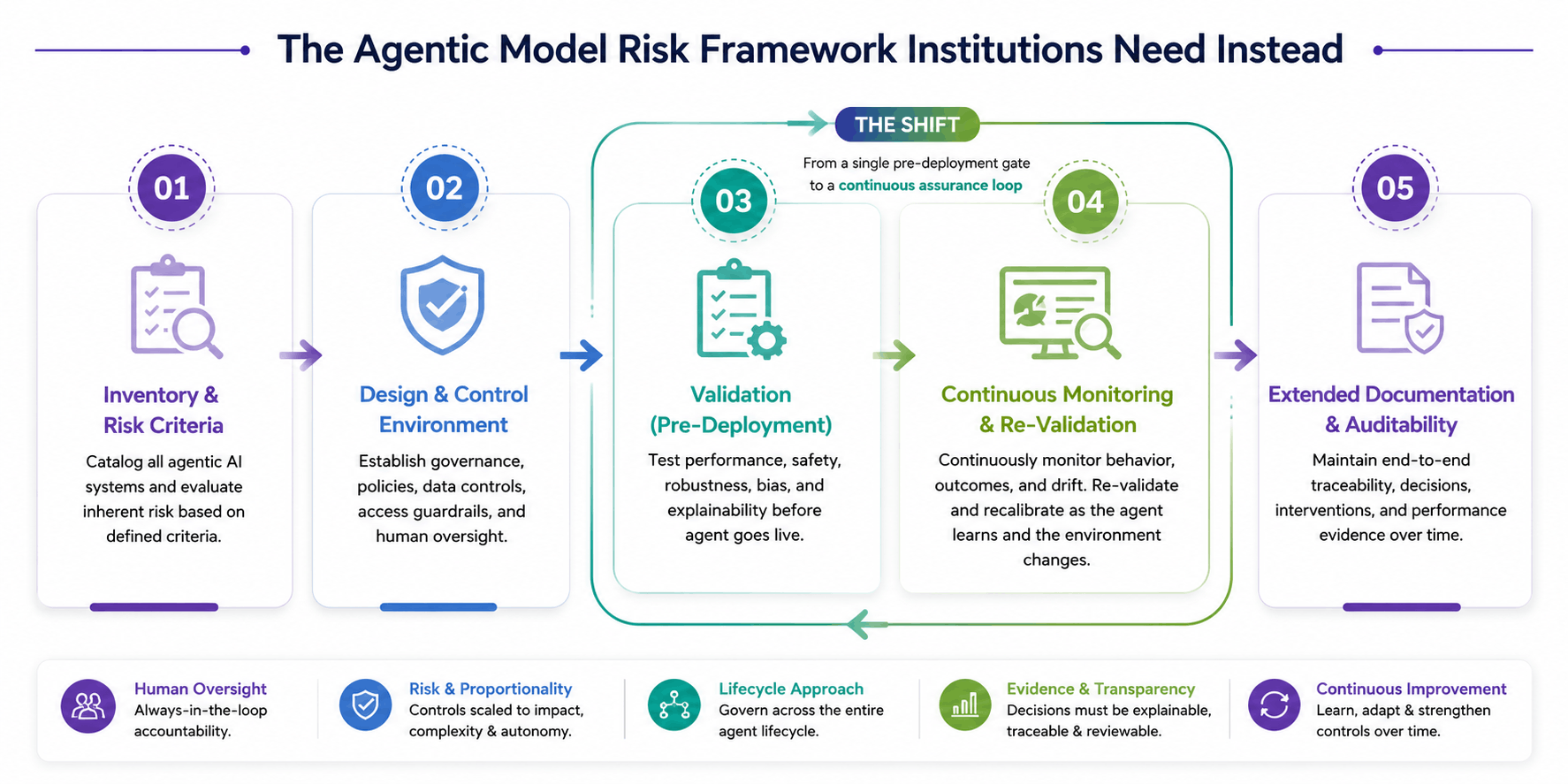
Redefine model inventory criteria to capture action taking systems. An agent that calls tools and modifies state needs to register in the inventory even if it does not resemble a traditional statistical model.
Move from point in time validation to continuous validation. An agent's behavior shifts with prompt context, tool access, and interaction history, which a single pre deployment test cannot capture.
Add runtime checkpoints that verify actions before execution. Governance needs to see a proposed action before it changes external state, not in a monitoring report afterward.
Treat workflow extension as a material change. Extending an existing agent into a new task or data source should trigger revalidation, the same way a material model change would under traditional model risk management.
Extend documentation beyond a model card. Agentic documentation needs to cover tool permissions, escalation paths, and action level audit trails, not only inputs, outputs, and limitations.
This is where the engineering execution layer matters. Samta.ai builds the VEDA AI decision analytics platform to hold agentic systems in the same inventory as traditional models, with ai model risk assessment criteria extended to cover tool access and action logging rather than treating agents as a separate, ungoverned category. Institutions weighing whether a general analytics tool can capture this should see how VEDA compares to other data intelligence platforms, since most were not built to log agent actions at the level SR 26-2's gap requires institutions to cover themselves. The VEDA platform treats action level audit trails as a first class part of the model inventory, not an afterthought bolted onto a system built for static models.
SR 11-7 pillars versus what agentic AI actually needs
MRM Pillar | Traditional Model Assumption | Agentic AI Reality | Gap It Creates | What Institutions Need Instead |
Model Definition and Scope | A model produces one output from a defined input set | An agent executes multi step actions and modifies external state | Agent activity may not register in the inventory at all | Inventory criteria that capture action taking systems specifically |
Validation | Validated once against a static test set before deployment | Behavior shifts with prompt context, tool access, and interaction history | Point in time validation does not reflect ongoing behavior | Continuous validation and runtime testing, not a single gate |
Monitoring | Periodic outcome review against a known benchmark | Actions are often irreversible before any review occurs | Governance sees the action after external state has changed | Runtime checkpoints verifying actions before execution |
Governance and Effective Challenge | A human reviewer signs off on a material model change | Extending an agent into a new workflow may trigger no review | Silent scope creep with no revalidation trigger | Workflow extension itself treated as a material change |
Documentation | A model card describing inputs, outputs, and limitations | Documentation must also cover tool access and escalation paths | Existing templates miss what agents can actually do | Documentation extended to cover permissions and action logs |
Understand Your AI Model Risk Exposure
Real world enterprise use cases
BFSI: a bank extending a credit decisioning agent into collections
A bank had validated an agentic credit decisioning assistant under its existing model risk framework, then extended the same agent into collections outreach without a formal revalidation, since the change looked like a configuration update rather than a new model. An internal review flagged the extension as exactly the kind of silent scope creep SR 26-2's gap allows. Building AI security and compliance services around workflow extension as a trigger for revalidation closed that gap before an examiner raised it.
General enterprise: a proptech firm running an autonomous leasing agent
A proptech firm running an autonomous agent to handle parts of its leasing workflow had validated the agent's initial task scope but had no process for reassessing it as the agent's tool access grew over time. Reviewing enterprise AI engineering in Singapore helped the firm build a lightweight, proportionate version of the same continuous validation discipline banks are adopting under stricter supervision.
Key risks and failure modes
Applying SR 11-7 style point in time validation to a continuously changing agent. A single pre deployment test does not capture behavior that shifts with every new interaction and tool permission.
Treating workflow extension as a configuration change rather than a material change. This is the specific silent scope creep gap institutions are already being caught out by.
Assuming SR 26-2's exclusion means agentic AI needs no governance at all. The guidance leaves agentic AI outside formal model risk scope, it does not exempt institutions from managing the risk through other means.
Monitoring outcomes after actions have already occurred. For an agent whose actions are irreversible, after the fact monitoring catches the failure too late to prevent it.
Documentation that describes outputs but not tool permissions. A model card built for a static model does not capture what an agent is actually authorized to do.
When to build agentic specific model risk controls now
Build agentic specific controls immediately when:
Agents already execute actions affecting customer accounts, payments, or credit decisions without a human in the loop
Your current model risk framework has no revalidation trigger for workflow or tool access extension
No runtime mechanism exists to verify an agent's action before it changes external state
Existing SR 11-7 or SR 26-2 aligned controls may be enough for now when:
Your AI use remains limited to static, single output models with no autonomous action capability
Agentic pilots exist but have no path to production without a formal model risk review first
Tool access and permissions are already tightly scoped and reviewed on every change
Our complete guide to building an agentic model risk program and our dedicated AI risk management model governance committee guide both cover how to sequence this work. Reviewing Samta.ai's case studies alongside your own agent inventory gives a useful benchmark for how other institutions have approached this gap.
Get Personalized AI Consulting for Your Business

Conclusion
Model risk management agentic ai cannot rely on SR 11-7's legacy assumptions, and the 2026 guidance that replaced it, SR 26-2, confirms the gap rather than closing it. Institutions that extend validation, monitoring, and governance to cover action rather than output alone will be ready before formal agentic AI guidance arrives, not scrambling once it does.
About Samta
Samta.ai is a Singapore headquartered AI product engineering and data intelligence partner helping enterprises build production grade AI systems for regulated and data intensive environments. We help organizations move beyond experimentation by engineering scalable, explainable, and enterprise ready AI solutions, from data foundations and model development to workflow automation and deployment.
Our capabilities combine deep AI expertise, data engineering, and product engineering to deliver measurable business impact across FinTech, BFSI, cybersecurity, regulatory technology, and enterprise operations.
Our enterprise AI products power real world intelligence systems:
TATVA: AI driven data intelligence platform for governed analytics, monitoring, and operational insights
VEDA: Explainable and audit ready AI decisioning engine built for compliance sensitive enterprise workflows
CORA Property Management Solutions: Predictive intelligence platform for real estate pricing, portfolio optimization, and investment analytics
Backed by ecosystem partnerships with Microsoft, Databricks, and Snowflake, Samta.ai delivers agile, cost efficient AI engineering with faster turnaround and enterprise grade scalability. Samta.ai embeds AI governance, data privacy, and compliance by design principles directly into the AI lifecycle, enabling organizations to scale AI with transparency, accountability, and operational control.
Frequently asked questions
Is SR 11-7 still the current model risk management standard?
No. SR 11-7 was superseded on 17 April 2026 by SR 26-2, revised interagency guidance from the Federal Reserve, OCC, and FDIC. SR 26-2 preserves the same core lifecycle pillars but takes a more materiality based approach.
Does SR 26-2 cover agentic AI?
SR 26-2 explicitly leaves generative and agentic AI outside its formal scope, according to the guidance and multiple analyses following its release, signaling that further AI specific supervisory guidance is still expected rather than already finalized.
Why does SR 11-7's definition of a model not fit agentic AI well?
SR 11-7 defined a model as a method that produces output from input data, built for static systems like credit scoring. An agentic system executes multi step actions and modifies external state, which is a fundamentally different risk profile than producing a single output.
What is the biggest governance gap agentic AI creates?
The most cited gap is that an agent's actions can be irreversible before any governance checkpoint reviews them, unlike a model's output, which a human can review before it influences a decision.
Should workflow extension count as a material model change?
Yes. Extending an existing agent into a new task or data source changes its risk profile the same way a material model change would, and treating it as a routine configuration update is one of the most common gaps institutions are being caught out by.