
Summarize this post with AI
Most NLP projects fail not because the model is wrong, but because nobody scoped the data needed before the build started. Nlp consulting exists to fix that sequencing problem, matching the right use case to the right data before any model gets built. This piece covers seven enterprise use cases, what each one actually needs, and where it typically goes wrong.
NLP consulting:
NLP consulting is the practice of scoping, building and deploying natural language processing systems for specific enterprise problems, document classification, entity extraction, sentiment analysis, call transcription, RAG based search, fine tuned domain assistants, and process specific automation such as insurance claims triage. Gartner's Hype Cycle for Natural Language and Unstructured Content Technologies confirms that the disruptive shift generative AI brought to this field in 2023 continues to reshape which use cases are now technically and commercially viable. For enterprise and BFSI teams in India and the wider APAC region, the right starting point depends less on which use case sounds most advanced and more on which one already has usable data behind it.
What does an NLP consultant do?
An NLP consultant evaluates which natural language problems an enterprise should solve with AI, scopes the data needed for each one, and builds or oversees the resulting system.
This differs from natural language processing services delivered as a pure technical build, since consulting includes the scoping and prioritisation work that determines whether a use case is even viable before any model gets trained.
Related terms include nlp consulting services, the full engagement covering scoping through deployment, and nlp development company, a vendor focused primarily on the technical build itself. For a deeper breakdown of how this fits into a broader AI engagement, see how NLP consulting helps enterprises and NLP for business intelligence.
Turn AI Ambition Into an Actionable Roadmap
Why this matters now for enterprise and BFSI teams
Three developments make scoped NLP consulting an active priority in 2026.
The underlying technology shift is still working through the market. Gartner's Hype Cycle for Natural Language and Unstructured Content Technologies, 2025 confirms that the disruptive changes generative AI introduced to natural language technology in 2023 continue to shape which capabilities are production ready versus still maturing.
Insurance regulators in India are actively building AI specific oversight. IRDAI constituted a seven member Working Group on Artificial Intelligence on 17 June 2026, tasked with recommending an AI governance framework for ethical, transparent and explainable use of AI tools, explicitly including claims and fraud prevention use cases, with recommendations due within three months of formation.
Governance expectations extend directly to NLP systems. The NIST AI Risk Management Framework, through its govern and map functions, applies as directly to a document classification model as to any other AI system, since explainability and data lineage matter regardless of the underlying technique.
See how this plays out in practice in AI ready data engineering and AI engineering consulting services.
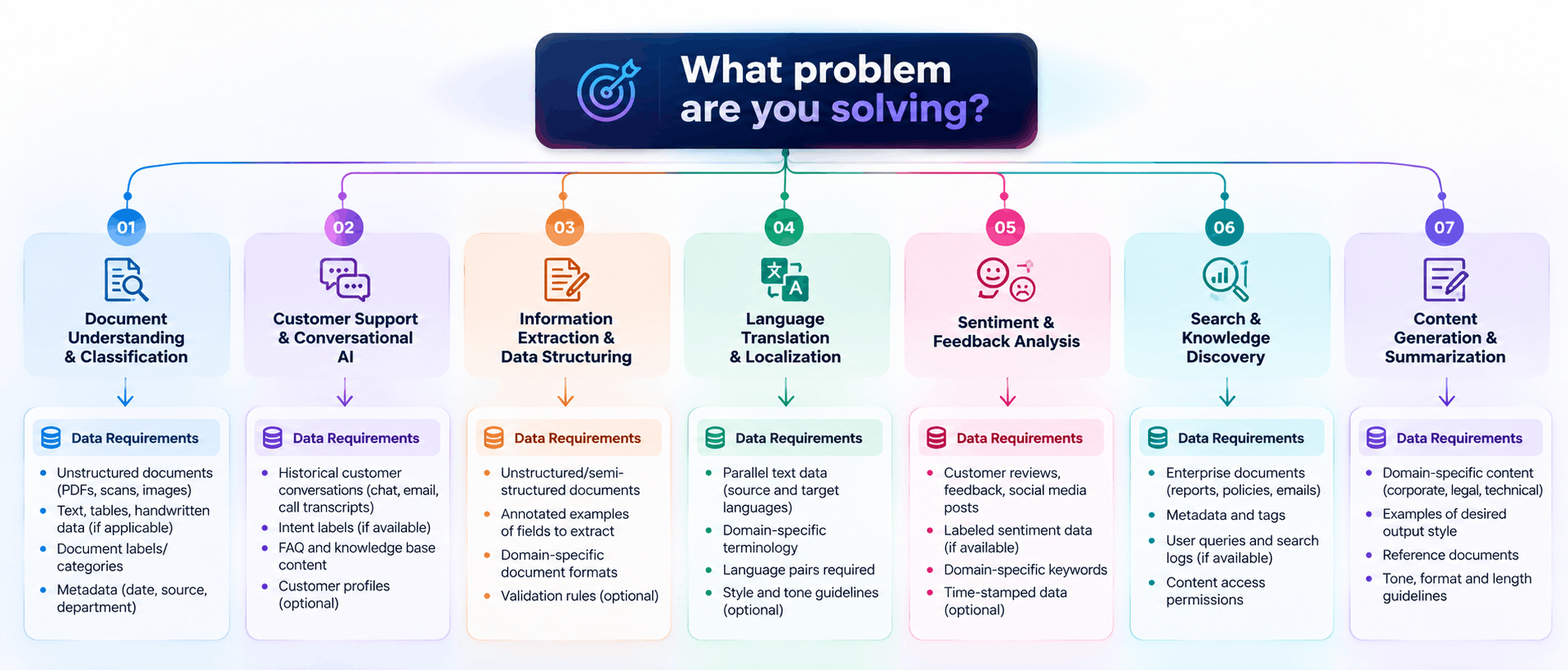
7 enterprise NLP use cases: scope and data needs
Here is the structured breakdown of where NLP consulting typically starts, including nlp use cases in insurance specifically.
Comparing 7 NLP use cases by scope and data needs
Use case | Scope | Data needed | Typical accuracy driver | Best fit |
Document classification | Sort incoming documents into predefined categories | Thousands of labelled examples per category | Label consistency and category clarity | High volume document intake, claims, applications |
Entity extraction | Pull structured fields from unstructured text | Annotated documents with entity boundaries marked | Annotation quality, not just volume | Contract review, invoice processing, KYC documents |
Sentiment analysis | Score customer communication as positive, negative or neutral | Labelled text samples across the sentiment range | Domain specific language, not generic sentiment models | Customer feedback, complaint triage, call centre QA |
Call transcription | Convert voice interactions into searchable text | Audio recordings plus accurate ground truth transcripts | Audio quality and accent or language coverage | Contact centres, compliance recording review |
RAG based search and chatbots | Answer questions by retrieving from an internal knowledge base | A well structured, up to date document corpus | Retrieval quality, not model size alone | Internal knowledge assistants, customer self service |
LLM fine tuning for domain tasks | Adapt a base model to enterprise specific language and tasks | A curated, high quality domain specific dataset | Dataset curation quality over raw volume | Specialised, repeated tasks with consistent patterns |
Insurance claims triage (NLP in insurance) | Classify and route claims based on free text descriptions | Historical claims text with outcome labels | Historical label accuracy and claim type coverage | Insurers and TPAs processing high claim volumes |
A four step framework for scoping an NLP project
Here is the sequence that prevents the most common NLP project failure, building before the data is actually ready.
Define the specific business question, not a general capability. "Classify incoming claims by type" is scopeable. "Use NLP for claims" is not.
Audit whether labelled or structured data already exists. Most enterprises overestimate how much usable training data they actually have, particularly for entity extraction and classification tasks requiring consistent labelling.
Connect and structure the underlying data before model work begins. Data integration consulting services address this foundational step, since NLP models trained on fragmented or inconsistent source data underperform regardless of technique.
Deploy into existing workflows, not a standalone tool. Workflow automation consulting ensures a classification or extraction model actually reaches the point where a claims handler or analyst works, rather than sitting in a separate dashboard. Samta.ai's Veda platform and the Veda AI decision analytics product support this step directly, acting as the engineering execution layer once the data foundation and use case are scoped correctly.
Samta.ai's approach treats this sequencing as the actual differentiator, since the model choice itself is rarely what determines whether an NLP project succeeds.
Understand Your AI Model Risk Exposure
Real world use cases
Regulated industry: insurer automating claims triage
An insurer processed thousands of claims monthly through manual triage, with handlers reading free text descriptions to route each claim to the right team. Volume had grown faster than headcount, creating a backlog. A document classification model trained on historical claims text, with outcomes used as labels, automated first pass routing. This directly maps to the kind of ethical, transparent and explainable adoption IRDAI's working group is examining for claims and fraud prevention use cases specifically. See related delivery patterns in Samta.ai's case studies.
General enterprise: internal knowledge assistant built on fragmented documentation
A mid sized enterprise had years of internal documentation scattered across wikis, shared drives and email threads, with employees routinely unable to find existing answers to common questions. A RAG based internal assistant, built once the document corpus was consolidated and structured, let employees query this knowledge directly in plain language, cutting repeated support requests significantly.
Key risks and failure modes
Starting with the model before the data. Teams that pick an impressive sounding use case, like fine tuning, before checking whether a curated dataset exists waste significant build time.
Treating sentiment analysis as domain agnostic. Generic sentiment models frequently misread industry specific language, insurance and financial complaints read very differently from generic product reviews.
Underestimating annotation quality for entity extraction. Volume alone does not fix inconsistent or low quality labelling, and inconsistent annotations propagate directly into model errors.
Building a RAG system on a poorly structured document corpus. Retrieval quality, not model size, is usually the actual bottleneck in a disappointing RAG deployment.
Deploying NLP outputs with no human review path for high stakes decisions. Claims triage and similar regulated use cases need a review mechanism, not full automation from day one.
Ignoring emerging regulatory expectations. IRDAI's working group is explicitly examining AI audit frameworks covering pre deployment and post deployment requirements for exactly these use cases.
Which enterprise processes suit NLP, and which do not
NLP fits well when:
The task involves classifying, extracting or summarising unstructured text at volume
Historical labelled data exists, or can realistically be created
The process currently relies on manual reading and routing that scales poorly
A clear accuracy or efficiency metric already exists to measure success against
NLP is a poor fit when:
The underlying decision requires judgment beyond what text alone can support
No labelled data exists and creating it is not currently feasible
The use case is low volume, where manual handling remains more cost effective
High stakes decisions would be fully automated with no human review path
Explore What AI Can Do for Your Business
Conclusion
The seven use cases above are not equally easy to build. The ones that succeed are the ones where the data was scoped honestly before the model work started. Start with the business question, check what data actually exists, and deploy into the workflow people already use. The next step is finding out which use case fits your own data right now.
About Samta
Samta.ai is a Singapore-headquartered AI Product Engineering & Data Intelligence partner helping enterprises build production-grade AI systems for regulated and data-intensive environments.We help organizations move beyond experimentation by engineering scalable, explainable, and enterprise-ready AI solutions from data foundations and model development to workflow automation and deployment.
Our capabilities combine deep AI expertise, data engineering, and product engineering to deliver measurable business impact across FinTech, BFSI, cybersecurity, regulatory technology, and enterprise operations.
Our enterprise AI products power real-world intelligence systems:
• TATVA : AI-driven data intelligence platform for governed analytics, monitoring, and operational insights
• VEDA : Explainable and audit-ready AI decisioning engine built for compliance-sensitive enterprise workflows
• CORA-Property Management Solutions: : Predictive intelligence platform for real-estate pricing, portfolio optimization, and investment analytics
Backed by ecosystem partnerships with Microsoft, Databricks, Snowflake, and AWS, Samta.ai delivers agile, cost-efficient AI engineering with faster turnaround and enterprise-grade scalability. Trusted by enterprises across FinTech, BFSI, and digital transformation initiatives, Samta.ai embeds AI governance, data privacy, and compliance-by-design principles directly into the AI lifecycle , enabling organizations to scale AI with transparency, accountability, and operational control.
Enterprises leveraging Samta.ai automate 65%+ of repetitive data, analytics, and decision workflows while maintaining governance, explainability, and measurable business outcomes. Samta.ai provides the strategic consulting, AI engineering, and data modernization expertise needed to align enterprise operations with next-generation AI transformation goals.
Frequently asked questions
What does an NLP consultant do?
An NLP consultant evaluates which natural language problems are worth solving with AI, scopes the data required for each specific use case, and oversees the build and deployment of the resulting system. This includes assessing whether labelled or structured data already exists, since that assessment typically determines whether a use case is viable before any model work begins.
Which enterprise processes suit NLP?
Processes that involve classifying, extracting or summarising unstructured text at volume, document intake, claims routing, contact centre transcripts, internal knowledge search, suit NLP well. Processes requiring judgment beyond what text alone supports, or with too little historical data to train against, are generally poor fits regardless of how advanced the underlying model is.
How much data does an NLP project need?
Data needs vary significantly by use case: document classification typically needs thousands of labelled examples per category, while RAG based search depends more on a well structured document corpus than raw volume. Annotation quality consistently matters more than raw data volume, particularly for entity extraction, where inconsistent labelling propagates directly into model errors.
Top NLP consulting companies in India
There is no single verified ranking of NLP consulting companies in India, since rankings vary by methodology and update frequently. Evaluate any candidate on whether they cover the full path from data scoping through deployment into existing workflows, not model building skill alone, since data readiness is usually the actual bottleneck in NLP project failure.
NLP use cases for insurers and banks
Common use cases include claims triage through document classification, fraud pattern detection through entity extraction across claims documents, contact centre quality review through call transcription and sentiment analysis, and internal policy or compliance search through RAG based assistants. India's insurance regulator IRDAI is actively examining governance expectations for exactly these use case categories through its 2026 AI working group.