
Summarize this post with AI
Most enterprises assume pdpa compliance singapore for AI systems means waiting for new AI specific legislation. It does not. The PDPA applies broadly to personal data processing involving AI systems, and organizations must generally rely on meaningful consent or specific recognized exceptions where statutory criteria are met, and that obligation has applied to every AI deployment touching personal data since before most current AI tools existed. This guide explains exactly how pdpa ai compliance singapore works for enterprises building, training, or deploying AI systems, and what changed when the regulator issued AI specific guidance in 2024.
PDPA AI Compliance Singapore:
pdpa ai compliance singapore requires organizations to obtain consent or rely on a recognized exception, such as the Business Improvement Exception, before using personal data to train or operate AI systems. The PDPC issued Advisory Guidelines on the Use of Personal Data in AI Recommendation and Decision Systems on 1 March 2024, clarifying how existing PDPA obligations apply when personal data is used to train, develop, or operate AI systems. The PDPA itself remains the binding legal framework, while IMDA's governance frameworks provide voluntary implementation guidance layered on top.
What Is PDPA and How It Applies to AI Systems
what is pdpa in singapore is a common starting question, and the answer matters before any AI specific discussion. The PDPA is enforced by the Personal Data Protection Commission, a statutory body under the Infocomm Media Development Authority. It sets out the general data protection framework governing the collection, use, and disclosure of personal data by private sector organisations, with ten main obligations and an eleventh, the Data Portability Obligation, expected to take effect in future.
AI systems do not get a separate legal regime. The PDPA applies broadly to personal data processing involving AI systems, requiring organizations to rely on meaningful consent or specific exceptions such as the Business Improvement Exception and the Research Exception where statutory criteria are met. For background on how this connects to broader AI governance obligations, see the intersection of AI and data protection law, and how those obligations are operationalized in practice in the AI governance compliance guide.
Gain Actionable AI Maturity Insights
Why This Matters Now in 2026
Three developments make pdpa compliance and enforcement a sharper priority for Singapore enterprises this year than in prior years.
1. AI specific guidance is now mature and actively referenced. The PDPA's existing data protection obligations remain the binding legal framework for personal data in AI systems, while IMDA's governance frameworks, including the January 2026 Model AI Governance Framework for Agentic AI, provide practical implementation guidance layered on top.
2. Penalties are real and enforcement decisions are public. The Personal Data Protection Commission can impose penalties up to S$1 million for PDPA violations, and the PDPC publishes enforcement decisions naming the offending enterprises, a sharper consequence than many enterprises assume when treating compliance as a legal checkbox.
3. Breach notification timelines apply directly to AI failures. Organizations must notify the PDPC and affected individuals of data breaches involving AI systems within 3 calendar days of assessment, including breaches caused by AI processing errors or AI system vulnerabilities.
For BFSI specifically, pdpa compliance singapore does not operate alone. The MAS technology risk management notice layers sector specific obligations on top of PDPA's general data protection baseline, and institutions need both addressed simultaneously. Enterprises scaling AI deployments more broadly should also review the principles in scaling AI responsibly, since PDPA exposure tends to grow in step with AI adoption velocity.
AI Risk Assessment Templates Don't guess where your AI data flows create PDPA exposure. Get Samta.ai's AI Risk Assessment Templates, mapped to PDPA consent, exception, and breach notification requirements.
The PDPA AI Compliance Framework: Step by Step
Use this sequence to build or audit pdpa ai compliance singapore for any AI system processing personal data.
Step 1: Determine Your Consent Basis or Exception
Default to consent: organizations must generally rely on meaningful consent before using personal data in AI systems.
Assess the Business Improvement Exception: relevant when the organisation has developed a product or is enhancing an existing one, or when an AI System is intended to improve operational efficiency.
Consider the Research Exception: where the AI development genuinely qualifies as research under PDPC's criteria.
Document your basis: whichever path you choose, the rationale needs to be recorded, not assumed.
Step 2: Prefer Anonymized Data Wherever Feasible
Anonymize before training where possible: anonymised data is no longer personal data and is therefore not governed by the PDPA.
Apply the re-identification test: data is considered anonymised if there is no serious possibility an individual could be re-identified, considering the data itself or combined with other accessible information.
Use pseudonymisation and data minimization: during model development and testing as interim safeguards even when full anonymization is not yet feasible.
Step 3: Build Accountability and Vendor Governance
Maintain accountability even with third party AI vendors: the Accountability Obligation under the PDPA means organizations remain responsible for personal data even when engaging third-party AI developers.
Document data intermediary obligations: service providers acting as data intermediaries are encouraged to adopt good practices such as data mapping, provenance records, and contractual safeguards.
Build proportionate fairness safeguards: accountability obligations require internal fairness safeguards proportionate to the impact of the AI system's decisions on individuals.
Step 4: Operationalize Breach Notification and Continuous Monitoring
This is where most enterprises fall short. Breach notification to the PDPC and affected individuals must occur within 3 calendar days of assessment, including breaches caused by AI processing errors, a timeline that demands automated detection, not manual review cycles. Samta.ai's Veda AI platform supports this step by connecting AI data lineage, consent status, and anomaly detection into a single monitoring layer, so a breach affecting AI training data or inference pipelines is detected and assessed inside the 3 day window rather than discovered after the fact. The Veda AI data analytics platform integrates with cloud data platforms such as Databricks and Snowflake to maintain this continuous visibility, supported by Samta.ai's AI security compliance services for full documentation.
PDPA AI Compliance: Singapore vs Other Jurisdictions
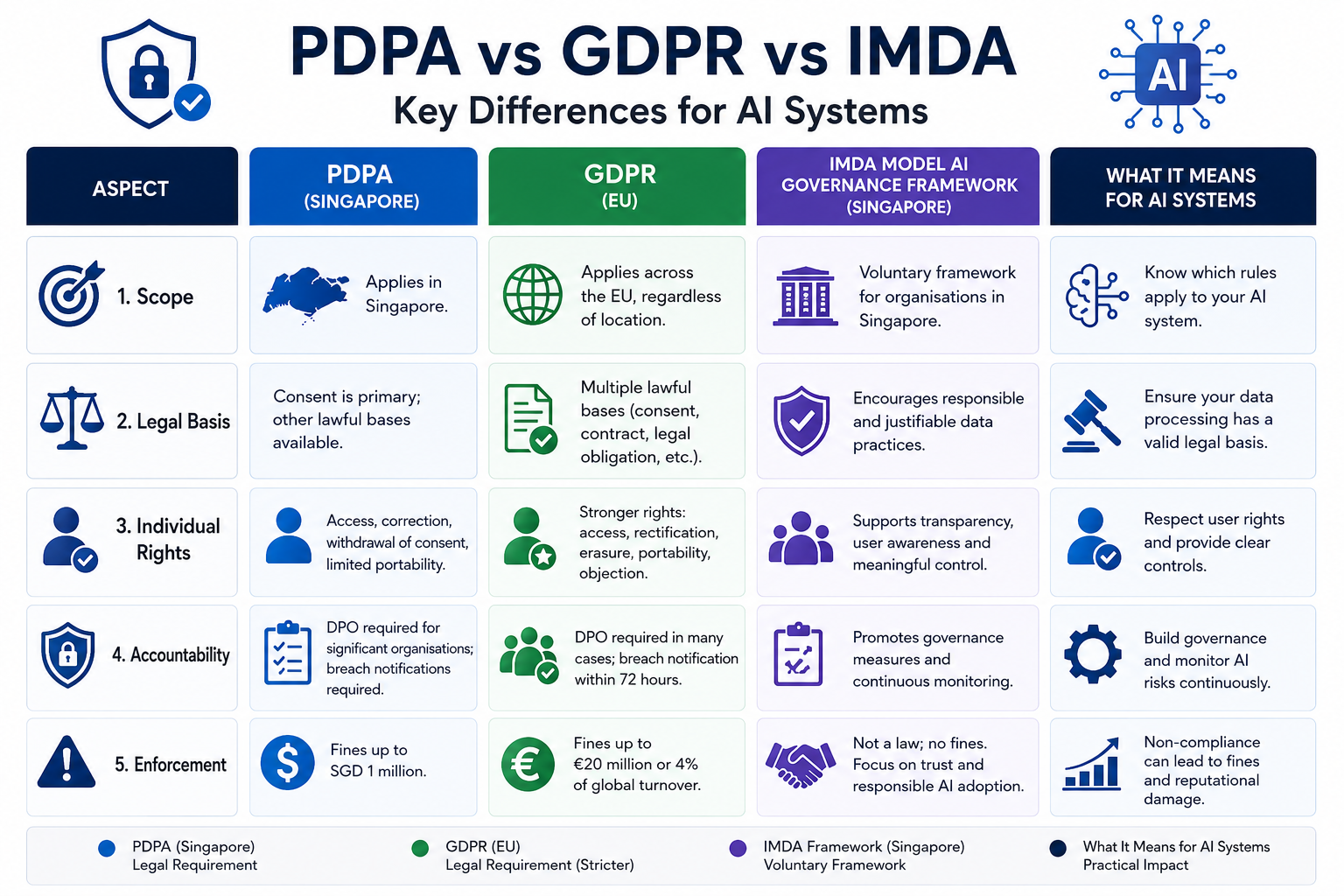
Dimension | PDPA (Singapore) | GDPR (EU) | IMDA Frameworks (Singapore) | Samta.ai Integration Point |
Legal Status | Binding general data protection law | Binding regulation | Voluntary implementation guidance | Maps both binding and voluntary layers |
AI Specific Guidance | Advisory Guidelines on AI Recommendation and Decision Systems, March 2024 | AI Act, risk tiered | Model AI Governance Framework for Agentic AI v1.5, 2026 | Continuous compliance monitoring |
Breach Notification | 3 calendar days from assessment | 72 hours from awareness | Not applicable, governance only | Automated detection and alerting |
Maximum Penalty | Up to S$1 million per violation | Up to 4% of global turnover | Not applicable, non-binding | Risk scoring to avoid exposure |
Anonymization Treatment | Anonymised data falls outside PDPA scope entirely | Similar but stricter re-identification standard | Recommends anonymization as best practice | Built-in anonymization pipeline support |
Get a Clear View of Your AI Risk Exposure
Enterprise Use Cases: How Singapore Organizations Apply This
Use Case 1: Bank Using AI for Credit Decisions
A Singapore bank deploying an AI-driven credit assessment tool needed to satisfy both PDPA and sector specific obligations. The bank's Accountability and Disclosure Obligations were met by providing information on how it used personal data and AI technology to conduct credit assessment, consistent with the PDPC's own enforcement precedent in the HSBC case. This is a direct, real-world example of how pdpa ai compliance singapore checklist items translate into actual regulatory defensibility, not just paperwork. The bank documented its consent basis, its safeguards during model testing, and its accountability disclosures before deployment, not retroactively.
Use Case 2: Employer Using AI for Resume Screening
A Singapore employer deploying AI-powered resume screening and applicant tracking needed careful consent management. AI resume screening and applicant tracking systems require careful consent management and bias testing to avoid discrimination, since these systems process personal data to make decisions that materially affect individuals. The employer's HR team mapped consent collected at application stage against the actual AI processing purpose, closing a common gap where a historical consent scope does not automatically cover newer AI-driven uses of the same data.
Key Risks and Failure Modes
Treating consent as a one-time, static event: Consent state must be a real-time input, not a quarterly export; if a customer withdraws consent, AI systems acting minutes later must respect that withdrawal. Static consent records create real-time compliance gaps.
Assuming anonymization is automatic or absolute: Data is only considered anonymised if there is no serious possibility of re-identification, taking into account the data itself and any other information the organisation has or is likely to have access to. Partial de-identification is not the same as PDPA-exempt anonymization.
Embedding personal data permanently into model weights: Data used to fine-tune or train a model becomes embedded in the model in practice, complicating the Retention Limitation Obligation. The safer architecture uses retrieval-augmented generation rather than fine-tuning for data-specific customisation, so data is retrieved live rather than embedded in weights.
Outsourcing AI development without retaining accountability: Organizations remain responsible for personal data even when engaging third-party AI developers under the Accountability Obligation. A vendor's compliance failure becomes the enterprise's regulatory exposure.
Download the Agentic AI Governance Checklist Map your AI systems against PDPA, the Agentic AI framework, and breach notification timelines in one document. Download the Agentic AI Governance Checklist from Samta.ai.
Decision Framework: Is Your AI System PDPA Compliant?
A documented consent basis or recognized exception exists for every AI system processing personal data
Anonymization or pseudonymisation is applied wherever technically feasible
Accountability obligations extend to third party AI vendors, not just internal systems
Breach detection and assessment can complete within the 3 calendar day notification window
Retention practices account for data embedded in model weights, not just raw stored data
Fairness safeguards are proportionate to the real-world impact of AI driven decisions
If fewer than four boxes are checked, your pdpa ai compliance singapore posture has gaps worth closing before your next data protection impact assessment.
Ready to Scale AI Across Your Enterprise?
Conclusion
pdpa ai compliance singapore is not a future regulatory milestone; it is a present, binding obligation that applies to every AI system processing personal data today. With S$1 million penalties, public enforcement decisions, and a 3 day breach notification clock, the enterprises treating this as a one-time legal review rather than continuous operational discipline carry real, quantifiable exposure.
About Samta
Samta.ai is a Singapore-headquartered AI Product Engineering & Data Intelligence partner helping enterprises build production-grade AI systems for regulated and data-intensive environments.We help organizations move beyond experimentation by engineering scalable, explainable, and enterprise-ready AI solutions from data foundations and model development to workflow automation and deployment.
Our capabilities combine deep AI expertise, data engineering, and product engineering to deliver measurable business impact across FinTech, BFSI, cybersecurity, regulatory technology, and enterprise operations.
Our enterprise AI products power real-world intelligence systems:
• TATVA : AI-driven data intelligence platform for governed analytics, monitoring, and operational insights
• VEDA : Explainable and audit-ready AI decisioning engine built for compliance-sensitive enterprise workflows
• CORA-Property Management Solutions: : Predictive intelligence platform for real-estate pricing, portfolio optimization, and investment analytics
Backed by ecosystem partnerships with Microsoft, Databricks, Snowflake, and AWS, Samta.ai delivers agile, cost-efficient AI engineering with faster turnaround and enterprise-grade scalability. Trusted by enterprises across FinTech, BFSI, and digital transformation initiatives, Samta.ai embeds AI governance, data privacy, and compliance-by-design principles directly into the AI lifecycle , enabling organizations to scale AI with transparency, accountability, and operational control.
Enterprises leveraging Samta.ai automate 65%+ of repetitive data, analytics, and decision workflows while maintaining governance, explainability, and measurable business outcomes. Samta.ai provides the strategic consulting, AI engineering, and data modernization expertise needed to align enterprise operations with next-generation AI transformation goals.
Frequently Asked Questions
What is PDPA and does it apply specifically to AI systems in Singapore?
what is pdpa in singapore refers to the Personal Data Protection Act 2012, which sets out the general data protection framework governing the collection, use, and disclosure of personal data by private sector organisations. It applies broadly to personal data processing involving AI systems, with no separate legal regime carved out for AI specifically.
How does PDPA AI compliance Singapore differ from GDPR?
PDPA breach notification requires reporting within 3 calendar days of assessment, compared to GDPR's 72-hour window from awareness. PDPA penalties reach up to S$1 million per violation, while GDPR penalties scale up to 4% of global annual turnover. Both frameworks share a consent-centric foundation but differ meaningfully in enforcement mechanics, a key distinction for any pdpa ai compliance singapore vs gdpr comparison.
What exceptions allow AI training without explicit consent?
The Business Improvement Exception applies when an organisation has developed or is enhancing a product, or when an AI System is intended to improve operational efficiency. A Research Exception may also apply where statutory criteria are met. Both exceptions require documented justification, not assumption.
Does anonymizing data remove all PDPA obligations?
Largely, yes. Anonymised data is no longer personal data and is therefore not governed by the PDPA. However, data only qualifies as anonymised if there is no serious possibility of re-identification, considering both the data itself and other information the organisation has or is likely to access, which is a higher bar than simple field removal.