
Summarize this post with AI
Outsourcing product engineering services without defining IP assignment terms, tech stack ownership, and knowledge transfer obligations upfront is how enterprises end up with products they cannot maintain, modify, or migrate away from a vendor without a full rebuild. The decision to engage product engineering services is not primarily a cost decision. It is a capability, speed, and ownership structure decision that determines long term product control. This guide gives CTOs, CPOs, and technology transformation leads a structured framework for understanding what product engineering services cover, what they cost in Singapore and APAC, and when outsourcing delivers better outcomes than an in house build in 2026.
Product Engineering Services:
Product engineering services cover the full lifecycle of digital product development: discovery and architecture, MVP development, iterative feature build, testing and quality assurance, deployment and DevOps, and ongoing product operations. For enterprise buyers in Singapore, the decision to engage a product engineering services company rather than build in house depends on four variables: time to market pressure, internal engineering capacity, IP sensitivity of the product domain, and whether the product requires AI or data engineering capabilities that are not readily available as permanent hires. Digital product engineering services that include AI capability require additional evaluation criteria beyond standard software engineering: MLOps, model governance, and regulatory alignment for BFSI and regulated sector products. For organizations evaluating product engineering outsourcing, Samta.ai’s Product Engineering Services page provides further information about its product engineering capabilities.
What Product Engineering Services Actually Cover
Product engineering consulting is a broad category. Understanding what is actually included versus what requires separate scoping is the first evaluation task for any enterprise buyer.
A full scope product engineering services engagement covers seven distinct delivery layers:
Product discovery and architecture: defining user requirements, technology constraints, system architecture, and API design before a line of code is written. Poor discovery is the leading cause of product rebuild programs within 18 months of initial launch.
MVP development: building the minimum viable product that satisfies core user requirements and validates the product hypothesis before full feature investment. MVP scope definition is the highest leverage decision in the engagement and the one most often underinvested.
Iterative feature build: developing and shipping product features in defined sprint cycles with product owner oversight, stakeholder review, and defined acceptance criteria per feature.
Testing and quality assurance: automated unit, integration, and end to end testing with defined coverage thresholds, performance benchmarking, and security vulnerability scanning.
DevOps and deployment infrastructure: CI/CD pipeline build, containerised deployment (Kubernetes, Docker), cloud infrastructure management (Azure, AWS, GCP), and environment management across development, staging, and production.
AI and data engineering integration: for products with AI features, this layer covers model serving integration, data pipeline connection, MLOps tooling, and governance infrastructure. This layer is increasingly standard in enterprise product builds but requires specialist capability that generic software engineering firms do not have internally.
Ongoing product operations: post launch monitoring, incident response, performance optimisation, and product roadmap delivery under a managed services or retainer model.
Product engineering consulting firms that scope only Layers 1 to 4 and treat DevOps, AI integration, and ongoing operations as separate engagement decisions create handover gaps that consistently delay production launch by 6 to 12 weeks. Review top 5 product engineering practices to understand how leading firms structure full scope delivery versus partial scope delivery.
Benchmark Your Organization's AI Readiness Today
Why Product Engineering Outsourcing Decisions Are More Consequential in 2026
Three market conditions have changed the calculus for outsourcing vs in house build:
1. AI capability is now a standard product requirement, not a premium feature
Enterprise products without AI features are increasingly at a competitive disadvantage in 2026. Building AI capable product engineering teams internally requires ML engineers, data engineers, and MLOps specialists that command SGD 120,000 to 220,000 base salaries and take 6 to 18 months to hire and onboard (Source Required: Korn Ferry APAC Talent Report). Engaging a digital product engineering services partner with embedded AI capability is consistently faster and more cost efficient for initial product builds.
2. Regulatory obligations now extend to product architecture decisions
For BFSI and regulated sector products in Singapore, MAS TRM, PDPA, and FEAT requirements impose specific engineering obligations at the product architecture layer: audit trail infrastructure, explainability APIs, consent tracking in data pipelines, and drift monitoring for AI features. A product engineering services company without regulatory alignment capability builds products that fail BFSI client procurement processes regardless of their technical quality (Source Required: MAS Technology Risk Management Guidelines).
3. IP assignment and tech stack ownership disputes are increasing
As outsourced product engineering has scaled, IP assignment disputes over code ownership, model weights, training data, and proprietary algorithm logic have increased. Enterprises that did not specify IP assignment in their original engagement contracts are discovering during product transitions that the vendor retains rights to components the enterprise considers its own product (Source Required: Gartner Outsourcing Risk Research).
The 6 Criteria Framework for Evaluating Product Engineering Services Companies
Criterion 1: Full Scope Delivery Ownership
Does the firm deliver all seven layers of product engineering internally, or does it subcontract DevOps, AI integration, or testing to third parties? Subcontracting creates coordination overhead, accountability gaps at layer handover points, and timeline risk when the subcontractor's delivery schedule conflicts with the primary firm's sprint commitments.
Criterion 2: AI and Data Engineering Depth
For products with AI features, does the firm have production certified ML engineers, data engineers, and MLOps practitioners on staff, or does it position AI capability as a partnership arrangement with a separate AI firm? Integrated AI and product engineering capability is the standard for enterprise AI product builds in 2026. Review AI engineering for SaaS to understand what integrated AI product engineering requires at the technical level.
Criterion 3: IP Assignment and Tech Stack Ownership
Does the standard engagement contract assign all code, models, training data, and product IP to the client on delivery, or does the firm retain rights to components under a proprietary framework or platform licence? Require explicit IP assignment covering: all application code, model weights and architectures, data pipeline code, configuration files, and any third party library licences that the product depends on.
Criterion 4: Engagement Model Flexibility
Can the firm deliver under three engagement structures: project based fixed SOW for MVP or defined feature builds, dedicated team model for ongoing product development with an embedded team under client product ownership, and managed product operations for post launch product maintenance and feature delivery? Firms with only one engagement model create commercial inflexibility as product maturity changes.
Criterion 5: Regulatory Alignment for BFSI Products
For products sold to Singapore financial institutions, does the firm build MAS TRM audit trails, PDPA consent tracking, and FEAT explainability APIs as standard product components, or as post development additions? Samta.ai's digital transformation managed services and data integration consulting services embed regulatory alignment at the product architecture layer, ensuring BFSI client procurement requirements are satisfied from the first product version rather than triggering a governance retrofit before the first enterprise sale.
Criterion 6: Knowledge Transfer and Handover Terms
Does the engagement contract specify: complete code repository transfer with documentation, architecture decision records covering key design decisions and rationale, runbook documentation for all deployed infrastructure, internal team training on product operations, and a defined hypercare period post handover? Outsourcing vs in house build decisions that do not include contractual handover terms create permanent external dependency regardless of the original outsourcing rationale. Compare how Samta.ai compares to traditional development companies on each of these criteria before finalising your shortlist.
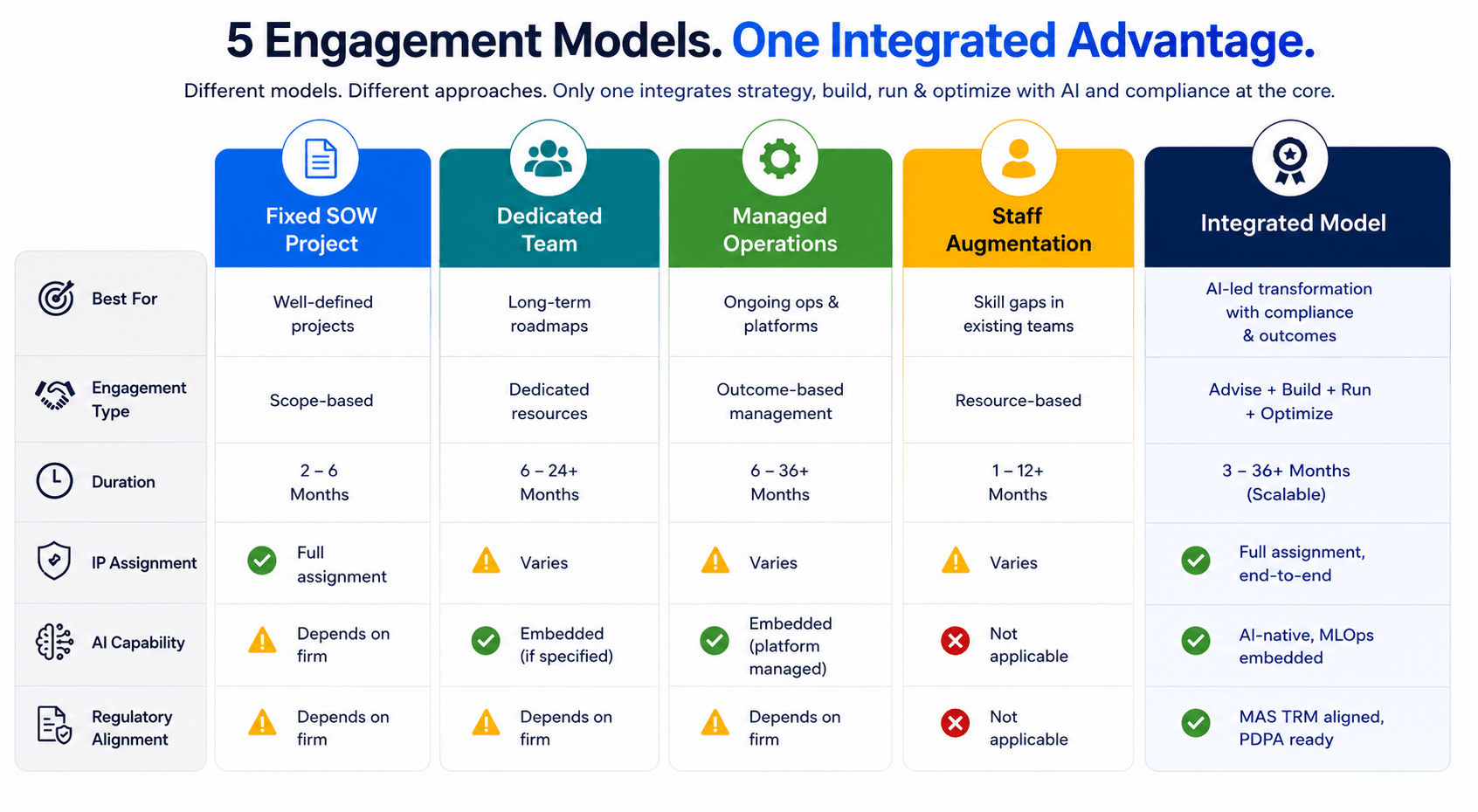
Product Engineering Services: 5 Column Engagement Model Comparison
Dimension | Fixed SOW Project | Dedicated Team Model | Managed Product Operations | Staff Augmentation | Samta.ai Integrated |
Best For | MVP, defined feature build, platform migration | Ongoing product development with client PO oversight | Post launch operations, monitoring, feature maintenance | Internal team skill gap reinforcement | Full lifecycle from discovery to operations with AI integration |
Cost Structure | Fixed price, milestone payment | Monthly team cost, time based | Monthly retainer with defined SLA | Daily or monthly rate, no outcome accountability | Fixed SOW phases with managed operations option |
IP Assignment | Typically full assignment on completion | Typically full assignment ongoing | Typically full assignment | Varies, requires explicit contract terms | Full IP assignment in standard SOW |
AI Capability | Depends on firm | Depends on team composition | Depends on firm | Specialist augmentation only | Embedded ML, MLOps, and data engineering in standard team |
Regulatory Alignment | Varies, rarely standard | Varies, client must specify | Varies, rarely proactive | Not applicable | MAS TRM and PDPA aligned as standard for regulated sector products |
Take the First Step Toward Better AI Risk Management
Real World Use Cases
Use Case 1: AI Product Engineering for RegTech Company, Singapore (BFSI)
A Singapore RegTech firm needed to build an AI powered AML transaction monitoring product for sale to Singapore licensed banks. The product required: ML model serving with individual FEAT explainability for every AML alert, MAS TRM audit trail infrastructure, PDPA consent tracking in the data ingestion pipeline, and a multi tenant architecture supporting deployment within client on premise and private cloud environments. A generic software engineering firm scoped the product without the AI governance or regulatory alignment layers, producing an MVP that failed the first BFSI client procurement review when the risk team requested model card documentation and individual alert explainability output. A full product rebuild with AI governance embedded took 14 weeks and cost SGD 280,000 in addition to the original build cost. Engaging a product engineering services company with embedded AI governance capability from the start would have produced the same compliant product in the original 18 week timeline at approximately SGD 180,000 total. Review AI engineering consulting services to understand how AI governance is scoped as a product engineering requirement, not a compliance addition.
Use Case 2: SaaS Product Build, Regional Enterprise Technology Company
A regional enterprise software company needed to build a B2B SaaS demand forecasting product for the logistics and retail sectors across APAC. The product required: a multi tenant Databricks data processing backend, a React frontend with self service dashboard configuration, a REST API layer for third party ERP integration, and a Kubernetes deployment model supporting deployment in Azure and AWS customer environments. The company engaged a dedicated team model with a 6 person cross functional team (product engineer lead, two full stack engineers, one data engineer, one DevOps engineer, one QA engineer) under the client product owner's direction. The team delivered the MVP in 16 weeks and has operated under a dedicated team engagement for 14 months, shipping quarterly feature releases aligned to the product roadmap. The VEDA AI Decision Analytics Platform was integrated as the AI decision layer for the forecasting product, with the VEDA platform documentation used as the architecture reference for AI serving integration within the product's Databricks backend. Explore Samta.ai case studies for more product engineering outcomes across regulated and general enterprise sectors.
Key Risks in Product Engineering Outsourcing
IP assignment not specified at contract signing: creates disputes at product transition or M and A events where the vendor retains rights to components the enterprise considers core IP. Require explicit IP assignment at component level in the original engagement contract, not as a contract addendum at delivery.
MVP scope creep without defined acceptance criteria: is the most common cause of MVP budget overrun. Every MVP feature must have a written acceptance criterion defined before sprint start. Features without defined criteria are not MVP scope, they are future roadmap.
Tech stack lock in through proprietary frameworks: creates migration costs that exceed the original product build cost when the product needs to evolve beyond what the framework supports. Require open standard architecture decisions with documented rationale for every major tech stack choice.
AI features scoped without MLOps and governance infrastructure: produce AI products that cannot be updated, monitored, or defended to regulators after launch. Every AI feature requires CI/CD pipeline for model retraining, drift monitoring, and audit trail infrastructure as standard build components, not post launch additions.
Dedicated team model without defined output accountability: creates time billed engagements with no milestone accountability, where the team remains productive but product progress is slower than the client's investment implies. Require sprint velocity benchmarks and quarterly product milestone reviews as commercial accountability mechanisms.
Review AI engineering team structure to understand how the five core AI engineering roles must be composed within a product engineering team for AI feature builds, and enterprise AI engineering in Singapore for the engineering standards that BFSI client product procurement processes require.
Decision Framework: Outsource vs In House for Product Engineering
Outsource to a product engineering services company when:
Time to market is the primary constraint and internal hiring would delay MVP by 6 months or more
The product requires AI or data engineering capability not available as permanent hires within your budget
The product domain is not your core IP and the primary risk is execution speed rather than capability ownership
Regulatory alignment for BFSI client sales requires specialist expertise not available internally
Build in house when:
The product is your primary IP and competitive differentiation is embedded in the engineering decisions made at every sprint
You have a defined 3 year engineering investment horizon with board approved permanent headcount
The tech stack and architecture decisions made in Year 1 will define your product for 5 to 7 years and must be owned internally
Your product does not require AI or data engineering specialisation that is difficult to hire permanently
Use a hybrid model when:
You want the speed of outsourced initial build with the long term control of in house ownership
The engagement is structured as a build and transfer program where the external team transitions to an internal team over 12 to 18 months
Core product IP remains in house while scaling engineering capacity is provided externally during peak development periods
See How AI Can Deliver Measurable Business Value

Conclusion
Product engineering services outsourcing decisions that focus only on cost and timeline without addressing IP assignment, tech stack ownership, AI capability depth, and regulatory alignment produce products that are cheaper to build and more expensive to own. The 2026 enterprise product engineering market in Singapore rewards firms that build AI governance, regulatory compliance, and knowledge transfer into their standard delivery model, not those that add it as an option when the client asks. Outsource when speed and capability access are the primary constraints. Build in house when long term IP ownership is the primary requirement. Structure the handover so that the decision can change without a product rebuild. For organizations evaluating product engineering outsourcing, Samta.ai’s Product Engineering Services page provides further information about its product engineering capabilities.
About Samta
Samta.ai is a Singapore-headquartered AI Product Engineering & Data Intelligence partner helping enterprises build production-grade AI systems for regulated and data-intensive environments.We help organizations move beyond experimentation by engineering scalable, explainable, and enterprise-ready AI solutions from data foundations and model development to workflow automation and deployment.
Our capabilities combine deep AI expertise, data engineering, and product engineering to deliver measurable business impact across FinTech, BFSI, cybersecurity, regulatory technology, and enterprise operations.
Our enterprise AI products power real-world intelligence systems:
• TATVA : AI-driven data intelligence platform for governed analytics, monitoring, and operational insights
• VEDA : Explainable and audit-ready AI decisioning engine built for compliance-sensitive enterprise workflows
• CORA-Property Management Solutions: : Predictive intelligence platform for real-estate pricing, portfolio optimization, and investment analytics
Backed by ecosystem partnerships with Microsoft, Databricks, Snowflake, and AWS, Samta.ai delivers agile, cost-efficient AI engineering with faster turnaround and enterprise-grade scalability. Trusted by enterprises across FinTech, BFSI, and digital transformation initiatives, Samta.ai embeds AI governance, data privacy, and compliance-by-design principles directly into the AI lifecycle , enabling organizations to scale AI with transparency, accountability, and operational control.
Enterprises leveraging Samta.ai automate 65%+ of repetitive data, analytics, and decision workflows while maintaining governance, explainability, and measurable business outcomes. Samta.ai provides the strategic consulting, AI engineering, and data modernization expertise needed to align enterprise operations with next-generation AI transformation goals.
Frequently Asked Questions
What are product engineering services and what do they include?
Product engineering services cover the full digital product development lifecycle: discovery and architecture, MVP development, iterative feature build, testing and QA, DevOps and deployment, AI and data integration, and ongoing product operations. A complete engagement covers all seven layers under single vendor accountability. Firms that scope only development and testing and treat DevOps and AI integration as separate decisions consistently create handover gaps that delay production launch by 6 to 12 weeks.
What is the difference between product engineering consulting and software development outsourcing?
Product engineering consulting includes product strategy, architecture design, technology selection, and product roadmap planning alongside engineering execution. Software development outsourcing typically scopes only feature development against a provided specification without contributing to product strategy or architecture decisions. For enterprise products where technology architecture decisions determine long term competitive advantage, product engineering consulting consistently produces better outcomes than pure development outsourcing.
What are MVP development costs for enterprise products in Singapore?
MVP development for an enterprise SaaS product in Singapore typically ranges from SGD 150,000 to 600,000 depending on feature complexity, AI integration requirements, and regulatory compliance infrastructure. Products with AI features, multi tenant architecture, and BFSI regulatory compliance requirements (MAS TRM, PDPA, FEAT) typically run at the higher end of this range. Fixed SOW engagements with milestone based payment provide cost predictability; time and materials engagements routinely overrun by 30 to 60%.
What is the dedicated team model and when is it appropriate?
The dedicated team model embeds a cross functional engineering team under the client's product ownership for ongoing product development. The team is staffed by the vendor but directed by the client product owner with sprint planning, backlog prioritisation, and feature acceptance under client control. It is appropriate for products with ongoing development roadmaps where consistent team composition is more valuable than fixed deliverable accountability. It is not appropriate as a substitute for a fixed SOW when an MVP build with defined scope is the requirement.
How is IP assignment handled in product engineering services engagements?
IP assignment in product engineering services contracts should specify: full assignment of all application code to the client on delivery or on a rolling sprint basis, explicit assignment of model weights and AI architectures for products with AI features, assignment of all data pipeline code and configuration, and documentation of all third party library dependencies including their licence terms. Contracts that assign only application code without specifying model IP create disputes when AI features are the product's primary value driver.