
Summarize this post with AI
Most real estate firms sit on years of transaction data and still price inventory by gut feeling. Proptech consulting exists to close exactly that gap, applying data science to the specific parts of a real estate business where it pays back fastest. This guide covers where that payback actually shows up, and where it does not.
Proptech consulting:
Proptech consulting applies data science to real estate problems such as property valuation, rental yield prediction, lead scoring and occupancy analytics, turning transaction and operational data into pricing and investment decisions. India's proptech sector is expanding fast, with JLL and PropShare projecting the fractional ownership segment alone to grow more than tenfold, surpassing 5 billion dollars in assets under management by 2030. For developers and real estate operators, the highest payback usually comes from pricing and lead prioritisation, not from broad digital transformation efforts.
What does a proptech consultant do?
A proptech consultant evaluates where data science and AI can improve a real estate business, then designs and oversees the models, data pipelines and tools needed to deliver that improvement. This differs from a general proptech strategy consultant, who may focus more on technology selection and digital transformation roadmaps rather than building specific predictive models.
Related terms include data science for real estate, the technical practice of building models like valuation or yield prediction on property data, and real estate ai consulting, a broader category covering AI applications beyond pure data science, such as document automation or virtual tours. For a broader view of where this fits into a developer's technology stack, see proptech AI consulting services and top 10 data science applications across the industry.
Make Property Operations Smarter and More Efficient
Why this matters now for real estate firms in India
Three developments make this a timely investment for Indian real estate businesses in 2026.
The fractional ownership and investment side of the market is accelerating fast. A joint analysis by JLL and PropShare projects India's fractional ownership market will grow more than tenfold, surpassing 5 billion dollars in assets under management by 2030, driven in part by SEBI's Small and Medium REIT regulations.
Regulatory transparency requirements create structural demand for better data. The Real Estate Regulatory Authority, established under India's Real Estate Regulation and Development Act, mandates project registration and transparent disclosure, which pushes developers toward cleaner, more structured data than many currently maintain.
AI governance expectations are rising even outside finance. The NIST AI Risk Management Framework, through its govern and map functions, increasingly shapes how organisations are expected to document and monitor predictive models, including property valuation models used in pricing and lending decisions.
See how this plays out in practice in 7 ways AI predicts real estate outcomes and why SaaS property management platforms are adopting these capabilities directly.
A four step framework for where data science pays back
Here is the sequence that identifies where proptech consulting actually delivers measurable return.
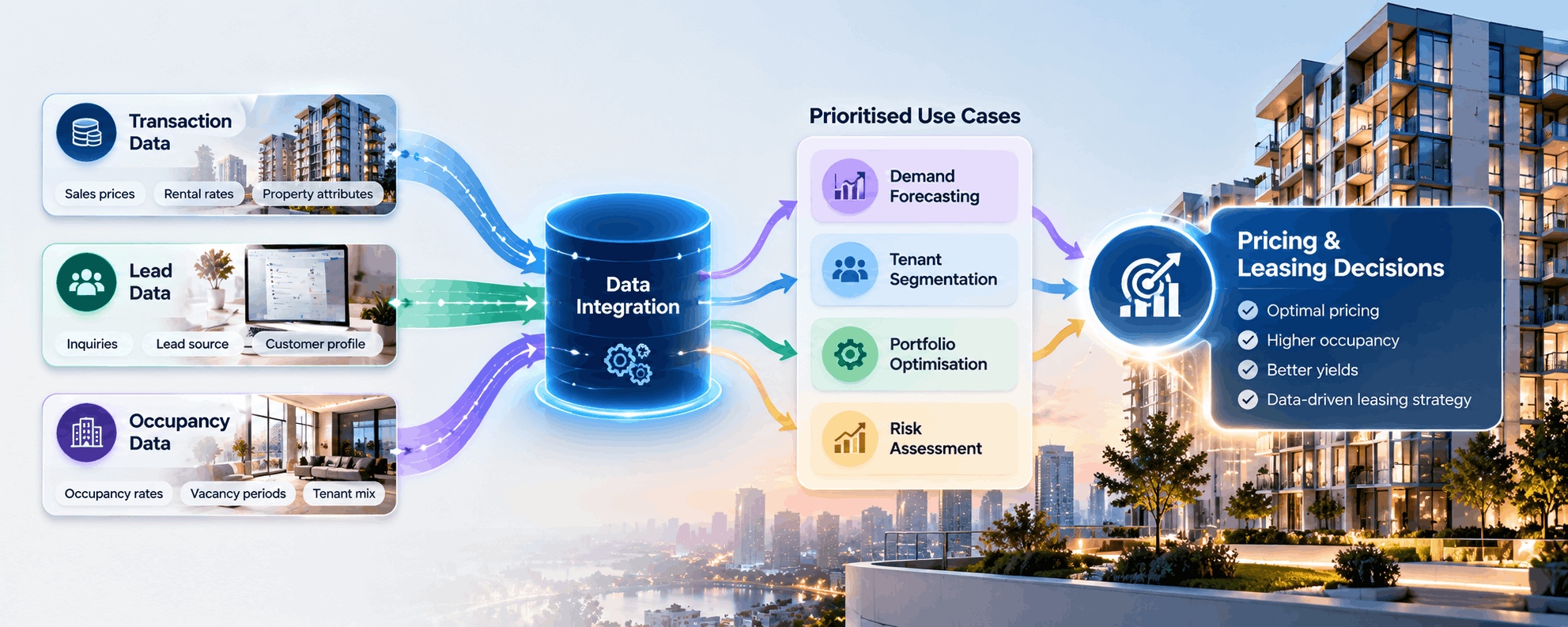
Audit what data you already have. Most developers and brokers sit on transaction history, lead records and occupancy data that is never structured for analysis. This audit usually reveals more usable data than expected, scattered across spreadsheets and disconnected systems.
Prioritise by payback speed, not novelty. Property valuation models and lead scoring for developers typically show return within months, because they improve decisions that already happen daily. Longer term capabilities like full occupancy analytics platforms take longer to pay back.
Connect the underlying data before building models. CRM, ERP and transaction systems need to be integrated before any model can run reliably. Data integration consulting services cover this foundational step, and often reveal the gap that was actually blocking progress.
Deploy models into the workflows people already use. A rental yield prediction model nobody checks before quoting a price delivers no value. Workflow automation consulting ensures predictions reach the point of decision, not a dashboard nobody opens. Samta.ai's Cora AI driven property management platform and the underlying Cora product serve this layer directly, acting as the engineering execution point once the data foundation and prioritisation are in place.
For how this phased build compares against a broader digital transformation engagement, see digital transformation managed services.
Comparing five real estate data science use cases
Use case | What it solves | Data required | Implementation speed | Best fit |
Property valuation models | Pricing accuracy for sale or lease | Historical transaction and comparable sales data | Fast, weeks to a few months | Developers and brokers pricing inventory regularly |
Lead scoring for developers | Prioritising which buyer leads convert | CRM data, enquiry history, site visit records | Fast, weeks | Sales teams managing high lead volume |
Rental yield prediction | Investment return forecasting for income properties | Rental history, occupancy, local market data | Medium, one to two months | Investment platforms and institutional landlords |
Occupancy analytics | Space utilisation and tenant retention insight | IoT sensor data, lease records, usage logs | Slower, requires sensor infrastructure | Commercial landlords with existing IoT capability |
Integrated proptech consulting platform | Pricing, leads, yield and occupancy together | All of the above, integrated | Slowest to full deployment, fastest cumulative return | Larger developers or platforms running multiple use cases at once |
The first two rows typically show the fastest standalone payback. For a platform level view of how these use cases connect, see Cora versus traditional property management software.
Get a Clear View of Your AI Readiness
Real world use cases
Regulated sector angle: institutional investment platform pricing commercial assets
A fractional ownership platform needed to price commercial office assets consistently across multiple cities to meet SEBI's SM REIT disclosure requirements. Manual valuation varied significantly between analysts. A structured valuation model, trained on comparable transaction data and reviewed against RERA registered project disclosures, reduced pricing variance and gave the platform a defensible, documented methodology for regulatory reporting. See related delivery patterns in Samta.ai's case studies.
General enterprise: developer struggling to prioritise leads
A residential developer generated thousands of enquiries monthly across digital channels but had no way to tell which leads were likely to convert. Sales teams called leads in the order they arrived, wasting effort on low intent enquiries. A lead scoring model built on historical conversion data reordered the sales queue by likelihood to close, improving sales team efficiency without adding headcount. See a broader list of consultants working on this kind of problem in 10 leading proptech consultants.
Key risks and failure modes
Building models before fixing the data foundation. A valuation model trained on incomplete or duplicated transaction records produces confident, wrong prices.
Chasing occupancy analytics before simpler wins exist. Sensor heavy use cases take longer to pay back and often get started before faster wins like lead scoring are even in place.
Treating a model as a one time build. Property markets shift, and a valuation model trained on last year's comparables degrades without retraining.
Ignoring regulatory disclosure requirements. Pricing or investment models that cannot explain their logic create exposure under increasingly transparent frameworks like RERA and SEBI's SM REIT rules.
Deploying models outside existing workflows. A prediction tool that requires sales or pricing teams to check a separate system rarely gets used consistently.
Underestimating CRM data quality. CRM for real estate systems are often inconsistently filled in by sales teams, which directly undermines lead scoring accuracy.
When to hire a proptech consultant, and when not to
Hire a proptech consultant now if:
You price inventory or quote rental yields manually, without a consistent model
Your sales team cannot prioritise leads and wastes effort on low intent enquiries
You are preparing documentation for SEBI SM REIT or RERA compliance and need defensible methodology
You already have transaction or CRM data but nobody has structured it for analysis
Hold off, or start smaller, if:
Your transaction volume is too low for a statistical model to be reliable yet
You have no CRM or transaction system in place at all, and need basic digital infrastructure first
A previous data project failed specifically due to data quality, which needs fixing before any new model is built
Discover Where Your AI Models Are Most Exposed
Conclusion
Data science in real estate pays back fastest where it improves decisions a business already makes every day, pricing and lead prioritisation, not where it looks most impressive on a roadmap. Start with the data foundation, prioritise by payback speed, and deploy into existing workflows rather than a separate dashboard. The next step is finding out honestly where your own data stands.
About Samta
Samta.ai is a Singapore-headquartered AI Product Engineering & Data Intelligence partner helping enterprises build production-grade AI systems for regulated and data-intensive environments.We help organizations move beyond experimentation by engineering scalable, explainable, and enterprise-ready AI solutions from data foundations and model development to workflow automation and deployment.
Our capabilities combine deep AI expertise, data engineering, and product engineering to deliver measurable business impact across FinTech, BFSI, cybersecurity, regulatory technology, and enterprise operations.
Our enterprise AI products power real-world intelligence systems:
• TATVA : AI-driven data intelligence platform for governed analytics, monitoring, and operational insights
• VEDA : Explainable and audit-ready AI decisioning engine built for compliance-sensitive enterprise workflows
• CORA-Property Management Solutions: : Predictive intelligence platform for real-estate pricing, portfolio optimization, and investment analytics
Backed by ecosystem partnerships with Microsoft, Databricks, Snowflake, and AWS, Samta.ai delivers agile, cost-efficient AI engineering with faster turnaround and enterprise-grade scalability. Trusted by enterprises across FinTech, BFSI, and digital transformation initiatives, Samta.ai embeds AI governance, data privacy, and compliance-by-design principles directly into the AI lifecycle , enabling organizations to scale AI with transparency, accountability, and operational control.
Enterprises leveraging Samta.ai automate 65%+ of repetitive data, analytics, and decision workflows while maintaining governance, explainability, and measurable business outcomes. Samta.ai provides the strategic consulting, AI engineering, and data modernization expertise needed to align enterprise operations with next-generation AI transformation goals.
Frequently asked questions
What does a proptech consultant do?
A proptech consultant evaluates where data science and AI can improve a real estate business, then designs and oversees the models, data pipelines and tools that deliver that improvement. This typically starts with an audit of existing data, followed by prioritising use cases such as valuation, lead scoring or yield prediction based on how quickly each can pay back.
How is data science used in real estate?
Data science is used to build property valuation models, predict rental yield, score leads by conversion likelihood, and analyse occupancy patterns in commercial space. Each use case depends on different underlying data, transaction history for valuation, CRM data for lead scoring, and sensor or lease data for occupancy analytics, so the right starting point depends on what data a firm already has.
Which real estate processes benefit most from AI?
Pricing and lead prioritisation typically show the fastest return, since they improve decisions that already happen daily and rely on data most firms already collect. Occupancy analytics and more complex investment forecasting take longer to pay back, usually because they require additional sensor infrastructure or longer data history before a model becomes reliable.
Best proptech consulting companies in India
There is no single verified ranking of proptech consulting companies in India, since rankings vary by methodology and update frequently. Evaluate based on whether a firm covers the full path from data integration through model deployment into existing workflows, not just model building in isolation. See a working list of consultants active in this space in 10 leading proptech consultants.
How can a real estate developer use AI to price inventory?
A developer can build a valuation model trained on historical transaction and comparable sales data, which scores new inventory against similar recently sold or leased units. The model needs clean, structured transaction data as a starting point, and should be retrained periodically as market conditions shift, since a static model trained on outdated comparables will misprice new inventory.
Scale Property Operations Without Growing Headcount
Discover how CORA delivers 3x faster issue resolution, automated lease workflows, and real-time portfolio intelligence.
Explore CORA Platform >