
Summarize this post with AI
Companies using legacy assessment tools reject 42% of high-potential candidates before a single interview not because the candidates are weak, but because the tools are. Tatva vs. traditional online assessment platforms is not a feature debate; it is a question of whether your hiring process predicts performance or just filters resumes. This guide covers what separates AI hiring assessment platforms from conventional tools, where legacy systems structurally fail in high-volume and regulated hiring environments, and a clear decision framework for choosing the right approach for your organisation.
Tatva vs. Traditional Online Assessment Platforms
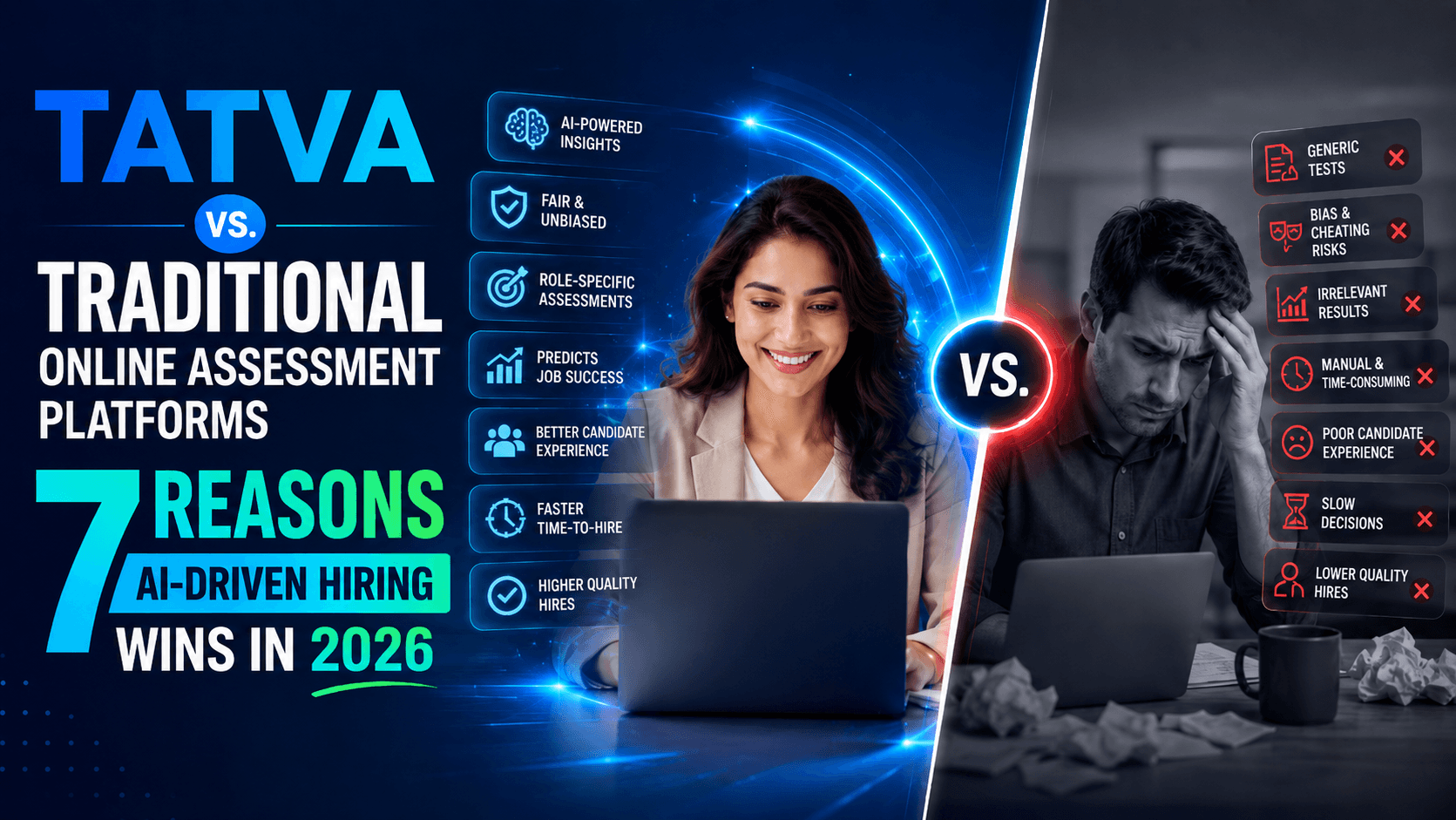
Traditional online assessment platforms for hiring rely on static question banks, keyword-matching, and manual scoring methods that introduce evaluator bias and miss adaptive thinkers. Tatva, Samta.ai's AI hiring assessment platform, uses dynamic question generation, multi-dimensional skill mapping, and predictive scoring calibrated to role-specific performance data. For enterprise hiring teams in APAC's regulated industries BFSI, healthcare, insurance Tatva reduces time-to-shortlist by up to 60% while improving shortlist-to-offer conversion rates (Source Required: Samta.ai internal benchmarks, 2025).
What traditional online assessment platforms actually do
Traditional online assessment platforms for hiring were built for a pre-AI world. Their core architecture has not changed materially in a decade.
They operate on three fixed components:
Static question banks: questions are pre-loaded and recycled across candidates. High-volume hiring cohorts share answers within 48 hours of assessments going live, rendering scores unreliable from the second cycle onward.
Binary scoring: answers are right or wrong. There is no scoring for reasoning quality, partial understanding, or adaptive problem-solving. Candidates who think differently but arrive at correct conclusions get penalised.
Manual review bottleneck: shortlists still require a recruiter to manually review outputs, creating throughput caps and unconscious bias entry points at every stage.
The result: assessment data that is easy to game, slow to process, and weakly correlated with actual on-the-job performance. According to research published on Harvard Business Review on AI in hiring, coached candidates score 15–25% higher than uncoached peers with equivalent actual skill a gap that static platforms cannot detect or correct for.
For a full breakdown of how AI recruitment platform features have evolved beyond these constraints, see Samta.ai's AI-driven assessment platform deep-dive.
What makes Tatva a different category of tool
Tatva is not a digitised test paper. It is an AI-based recruitment platform built on three architectural differences that make it a genuinely different category of hiring tool. Dynamic question generation questions adapt in real time based on prior answers. A candidate who answers a mid-difficulty question correctly gets a harder follow-up; one who struggles gets a scaffolded probe. This eliminates answer-sharing and surfaces actual competency levels regardless of coaching or question leakage.
Multi-dimensional skill mapping: rather than a single pass/fail score, Tatva produces a skill graph covering technical proficiency, reasoning depth, communication quality, and role-fit signals. Hiring managers see a candidate profile, not a number. This is what separates a genuine AI recruitment platform for hiring talent from a traditional tool with an AI label on it.
Predictive scoring engine: Tatva's scoring is calibrated against historical performance data from comparable roles. It predicts 90-day and 12-month on-the-job performance probability, not just assessment pass rate directly addressing the quality-of-hire gap that the SHRM Cost-Per-Hire and Quality-of-Hire benchmarks identify as the most undermanaged metric in enterprise talent acquisition.
Samta.ai's TATVA hiring assessment platform page covers the full architecture, including integration points with leading ATS and HRMS systems used across APAC.
Take the First Step Toward Enterprise AI Success
7-point comparison: Tatva vs. traditional online assessment platforms
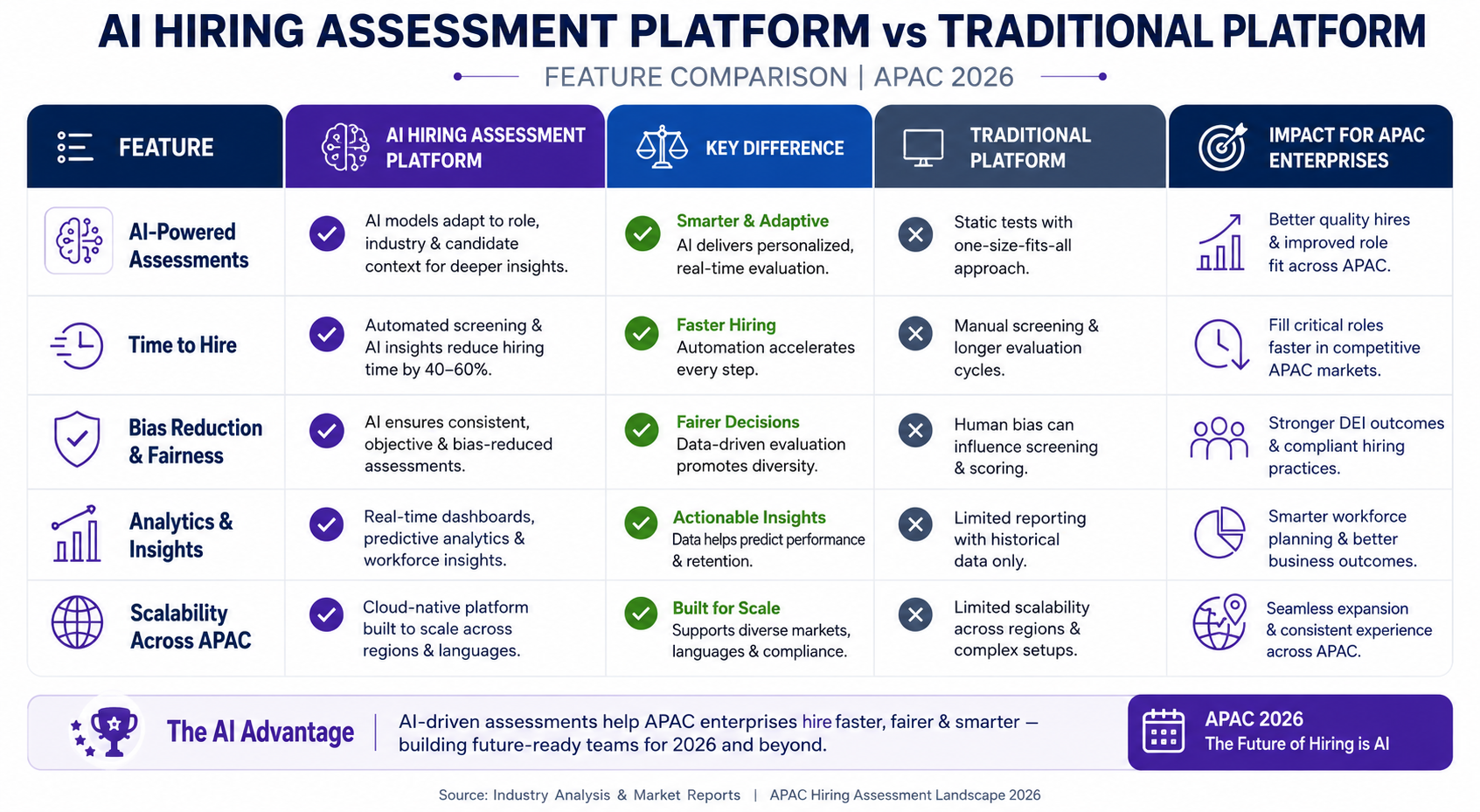
Dimension | Traditional Platforms | Tatva (AI-Driven) | Enterprise Impact | APAC Relevance |
Question type | Static, pre-loaded bank | Dynamic, AI-generated per candidate | Eliminates answer-sharing in bulk hiring | High — large graduate cohorts in India, SG |
Scoring method | Binary right/wrong | Multi-dimensional skill graph | Captures reasoning, not just recall | Critical for BFSI competency frameworks |
Bias controls | None or manual | Algorithmic debiasing + audit trail | Reduces evaluator and demographic bias | MAS/Tripartite Guidelines compliance |
Predictive validity | Low (no performance correlation) | High (calibrated to role performance data) | Improves shortlist-to-offer conversion | Reduces mis-hire costs in high-cost markets |
Integration depth | Basic ATS export | Native ATS, HRMS, and workflow APIs | Reduces recruiter manual effort by 60%+ | Supports SAP SuccessFactors, Workday, Darwinbox |
Candidate experience | One-size-fits-all linear test | Adaptive, role-contextualised journey | Reduces candidate drop-off by up to 35% | High competitive graduate talent market in SG, IN, AU |
Reporting and analytics | Static score reports, manual export | Real-time dashboards, hiring funnel analytics, role-performance correlation | Enables data-driven hiring decisions at scale | Critical for CHROs reporting quality-of-hire to APAC boards |
For a side-by-side capability breakdown, see the full Tatva vs. traditional hiring platforms reference page. For a broader market view of where Tatva sits relative to competitors, Samta.ai's 10 best AI hiring platforms covers the top AI skill assessment platforms to boost hiring success across the APAC market.
Why this comparison matters more in 2026
Three forces converged to make the Tatva vs. traditional online assessment platforms decision urgent this year rather than aspirational.
1. Hiring volumes outpaced manual review capacity. APAC enterprises running graduate intake programmes for 500–5,000 candidates per cycle cannot clear bottlenecks with static tools. Assessment throughput is now a competitive constraint, not just an HR efficiency metric. Organisations with mature AI-powered recruitment platforms are processing shortlists in hours, not weeks a structural advantage that compounds across every hiring cycle.
2. Regulatory pressure on hiring fairness tightened. Singapore's Tripartite Guidelines on Fair Employment Practices and India's Digital Personal Data Protection (DPDP) Act both require demonstrable bias controls in automated screening. Traditional platforms have no audit trail for algorithmic decisions. Tatva produces a full per-candidate decision log a compliance requirement, not an optional feature, in regulated APAC markets.
3. Quality-of-hire became a board-level metric. CFOs now track mis-hire cost typically 1.5–3× annual salary per bad hire, per SHRM benchmarking data as a material line item. Platforms that predict performance, not just filter applications, directly move this number.
Understanding where your hiring function sits on the maturity curve is the essential first step before any platform decision. Samta.ai's AI maturity model provides a structured five-level framework for that assessment. For organisations also evaluating how automated AI workflows apply across the broader HR function not just assessment the automated AI workflows vs. agentic approaches analysis is directly relevant to your architecture decisions.
Real-world enterprise use cases
BFSI: high-volume relationship manager hiring in Singapore
A Singapore-based bank running quarterly intake for 200+ relationship managers was using a traditional MCQ platform. Answer leakage was widespread candidates from the same university shared question sets within 48 hours of assessments going live. Shortlist quality dropped cycle over cycle, and the talent acquisition team had no way to detect or prove the problem.
After switching to Tatva, the bank deployed dynamic assessments with role-specific financial reasoning scenarios. Because every candidate received a unique question path, answer-sharing became structurally impossible. Shortlist-to-offer conversion improved from 34% to 61% within two intake cycles (Source Required: Samta.ai client case study, 2025). The per-candidate decision log also satisfied MAS internal audit requirements under the Tripartite Guidelines on Fair Employment Practices without additional compliance overhead.
Technology sector: engineering competency screening across India and Australia
A technology services firm hiring 800 engineers annually across India and Australia needed consistent competency benchmarks across geographies. Traditional platform scores varied significantly by region due to cultural test-taking norms, not actual skill differences a problem that HBR's research on AI in hiring identifies as one of the most common failure modes in cross-market assessment programmes.
Tatva's multi-dimensional skill graph normalised scores against role-performance data rather than population averages, giving the talent acquisition team a single comparable shortlist standard across both markets. Time-to-shortlist dropped by 55%. The ATS integration was handled by Samta.ai's workflow automation consulting team, connecting Tatva to their existing Darwinbox instance in under three weeks. The full integration methodology covering data mapping, access controls, and UAT sign-off is documented step by step in Samta.ai's AI implementation playbook.
Identify Hidden Risks Across Your AI Models
Key failure modes of traditional assessment platforms
Answer bank exhaustion: static question sets get fully circulated within 2–3 hiring cycles in any networked candidate pool. Assessment integrity collapses silently and scores stop correlating with actual ability. Most HR teams only detect this after mis-hire rates rise.
Score inflation in coached cohorts: per HBR's analysis of AI in hiring, coached candidates outscore equally capable uncoached peers by 15–25% on MCQ-based platforms. No adaptive logic means no correction mechanism.
No feedback loop to hiring outcomes: traditional platforms rarely connect assessment scores to 90-day or 12-month performance data. Scoring weights never improve. This is the structural gap that AI recruitment platform benefits specifically Tatva's predictive scoring engine directly address.
ATS integration fragility most legacy platforms offer CSV export rather than API integration. Data entry errors, delays, and manual reconciliation are the norm, creating exactly the kind of bottleneck that Samta.ai's workflow automation consulting practice eliminates.
Compliance exposure without per-candidate decision logs, HR teams cannot demonstrate non-discriminatory screening to auditors or regulators. In Singapore and India, enforcement risk under the Tripartite Guidelines and DPDP Act respectively is rising, not theoretical.
Decision framework: when to switch to an AI hiring assessment platform
Switch to a top AI skill assessment platform when:
Your hiring volume exceeds 100 candidates per role per cycle.
You have documented answer-sharing or score manipulation in past assessments.
Your shortlist-to-offer conversion rate is below 50% below the SHRM benchmark median for enterprise hiring.
Regulatory compliance (fair hiring audit trail, bias controls) is a requirement, not a preference.
You need 90-day performance prediction, not just candidate filtering.
Your talent acquisition team spends more than 30% of time on manual shortlist review.
Stick with traditional platforms when:
Hiring volume is under 20 candidates per role per cycle and manual review is viable.
Your roles require highly specialised assessments that current AI hiring platforms do not yet support.
Your ATS and HRMS ecosystem cannot support API-level integration assess readiness first via Samta.ai's workflow automation consulting team.
Your organisation is at AI maturity Level 1 or 2 complete the AI maturity model assessment before committing to a platform migration.
For a complete pre-migration checklist covering data readiness, integration sequencing, and recruiter change management, the AI implementation playbook is the right starting point.
Get your Free AI Assessment Report Upload your current assessment framework and receive a gap analysis against Tatva's capability benchmarks scored across bias controls, predictive validity, and integration depth. → Download Your Free AI Assessment Report
Conclusion
Tatva vs. traditional online assessment platforms is ultimately a question of what you want your hiring data to do. If the goal is filtering applications, legacy tools are adequate. If the goal is predicting performance, removing bias, and building a defensible compliance record for APAC regulators traditional platforms structurally cannot deliver that. The shift to an AI hiring assessment platform is not an upgrade; it is a different category of tool solving a different problem.
Discuss Your AI Strategy with Our Experts
About Samta
Samta.ai is a Singapore-headquartered AI Product Engineering & Data Intelligence partner helping enterprises build production-grade AI systems for regulated and data-intensive environments.We help organizations move beyond experimentation by engineering scalable, explainable, and enterprise-ready AI solutions from data foundations and model development to workflow automation and deployment.
Our capabilities combine deep AI expertise, data engineering, and product engineering to deliver measurable business impact across FinTech, BFSI, cybersecurity, regulatory technology, and enterprise operations.
Our enterprise AI products power real-world intelligence systems:
• TATVA : AI-driven data intelligence platform for governed analytics, monitoring, and operational insights
• VEDA : Explainable and audit-ready AI decisioning engine built for compliance-sensitive enterprise workflows
• CORA-Property Management Solutions: : Predictive intelligence platform for real-estate pricing, portfolio optimization, and investment analytics
Backed by ecosystem partnerships with Microsoft, Databricks, Snowflake, and AWS, Samta.ai delivers agile, cost-efficient AI engineering with faster turnaround and enterprise-grade scalability. Trusted by enterprises across FinTech, BFSI, and digital transformation initiatives, Samta.ai embeds AI governance, data privacy, and compliance-by-design principles directly into the AI lifecycle , enabling organizations to scale AI with transparency, accountability, and operational control.
Enterprises leveraging Samta.ai automate 65%+ of repetitive data, analytics, and decision workflows while maintaining governance, explainability, and measurable business outcomes. Samta.ai provides the strategic consulting, AI engineering, and data modernization expertise needed to align enterprise operations with next-generation AI transformation goals.
Frequently asked questions
How is Tatva different from other AI recruitment platforms?
Most AI recruitment platform features focus on resume parsing and interview scheduling automation. Tatva operates at the assessment layer dynamic question generation, multi-dimensional scoring, and role-calibrated performance prediction. It integrates downstream into existing ATS and HRMS systems rather than replacing them. See the full TATVA hiring assessment platform architecture page for technical details.
Does Tatva work for non-technical roles?
Yes. Tatva's engine supports cognitive reasoning, situational judgement, communication quality, and domain-specific scenarios for relationship management, operations, compliance, and customer service roles. Role-specific question paths are configured during onboarding using the implementation process documented in Samta.ai's AI implementation playbook.
What does ATS integration look like and how long does it take?
Tatva offers native API connectors for SAP SuccessFactors, Workday, Darwinbox, and Greenhouse. Standard connector implementations run 2–4 weeks. Custom integrations are scoped and delivered by Samta.ai's workflow automation consulting team. The AI implementation playbook includes a complete pre-integration checklist covering data mapping, permission scoping, and UAT sign-off criteria.
Is Tatva compliant with APAC data privacy regulations?
Tatva is designed for PDPA (Singapore), DPDP Act (India), and Australian Privacy Act compliance. Candidate data is encrypted at rest and in transit, retention policies are configurable per jurisdiction, and consent management is built into the candidate-facing assessment flow. The compliance architecture is covered in detail in Samta.ai's AI-driven assessment platform documentation.
Can Tatva be used for internal mobility and skills benchmarking, not just external hiring?
Yes. Several Samta.ai clients use Tatva for annual skills benchmarking, promotion readiness assessments, and internal mobility pipelines. The same dynamic question engine and multi-dimensional scoring apply, with competency frameworks mapped to internal role families rather than external job descriptions. Organisations evaluating this use case should first assess internal readiness using theAI maturity model and review how internal assessment connects to broaderautomated AI workflows across HR operations.