
Summarize this post with AI
Governance is usually blamed for slowing AI down. In practice, the models that fail audit are almost always the ones that skipped governance early. An AI governance framework Singapore institutions can actually defend in front of a regulator needs three things working together: oversight, lifecycle control, and capability. This piece breaks those into a practical three pillar model and shows where it maps to MAS's current expectations.
AI governance framework Singapore:
An effective AI governance framework rests on three pillars: board level oversight and AI inventory, lifecycle controls that produce an audit trail from data to decision, and organisational capability to sustain compliance as models scale. This structure lines up with the Monetary Authority of Singapore's proposed Guidelines on Artificial Intelligence Risk Management, published for consultation in November 2025, which set out oversight, lifecycle controls, and capability as core supervisory expectations for financial institutions. Done well, this kind of governance as enabler approach speeds up deployment, because approved models move faster once their audit trail already exists.
What is an AI governance framework?
An AI governance framework is the set of policies, controls and oversight structures that determine how an organisation identifies, approves, monitors and retires its AI systems. It is not a single document. It is a working system that produces evidence. This differs from model governance in scope. Model governance typically covers a single model's lifecycle, from development to validation to retirement. AI governance sits above that, covering the inventory of all models, board oversight, and organisation wide policy.
Related terms include AI compliance, the practice of meeting external regulatory expectations, and model governance process, the specific procedures a single model moves through before deployment. For a broader breakdown of what a mature framework includes, see the 6 components of AI governance and AI risk management as a model.
Identify AI Opportunities, Risks, and Gaps
Why this matters now for Singapore financial institutions
Three developments make this an active priority in 2026, not a future concern.
MAS has moved from principles to specific supervisory expectations. On 13 November 2025, MAS published a consultation paper proposing Guidelines on Artificial Intelligence Risk Management, referred to as the MAS AIRG. The proposed guidelines cover four areas: board oversight, risk management systems and policies, AI lifecycle controls, and organisational capability, with a 12 month transition period once finalised.
This builds directly on existing principles, not a replacement for them. The AIRG is intended to complement MAS's earlier FEAT principles, covering fairness, ethics, accountability and transparency in AI and data analytics, so institutions already aligned to FEAT have a head start.
Global standards give a non sector specific reference point. The NIST AI Risk Management Framework, structured around govern, map, measure and manage functions, is widely used as a baseline even outside the United States, and maps cleanly onto the three pillar structure below.
Teams building this capability internally can see the underlying engineering discipline in enterprise AI engineering in Singapore, and how governance fits into a broader 2026 framework in AI governance framework 2026.
The 3 pillar framework: oversight, lifecycle, capability
Here is how the three pillars work together, mapped against what MAS's proposed AIRG and NIST's AI RMF both expect in substance.
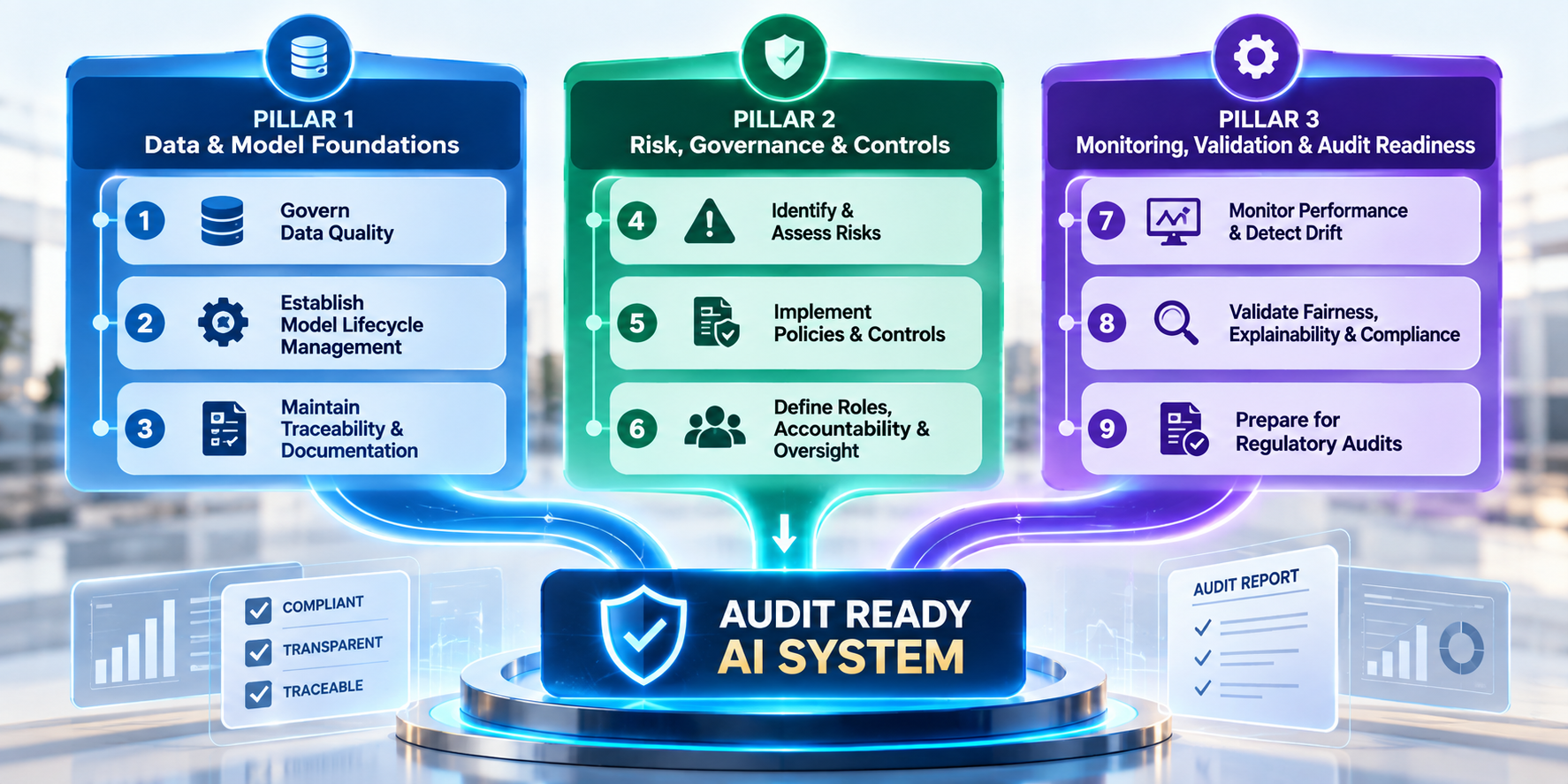
Pillar 1: Oversight and AI inventory
Maintain a complete inventory of every AI system in use, including third party and vendor supplied models.
Assign board and senior management accountability for AI risk, not just a technical owner.
Classify each model by risk materiality, based on impact, complexity and reliance, so oversight effort matches actual risk.
Pillar 2: Lifecycle controls and audit trail
Document data lineage from source system to model input, so every decision can be traced back to where its data came from. This is where data integration consulting services close the gap for institutions running on fragmented ERP, CRM and operational systems.
Build fairness, bias and explainability testing into deployment, not as a retrofit after launch.
Set monitoring thresholds and defined escalation paths, including a way to pause or roll back a model in production.
Pillar 3: Capability and continuous compliance
Build internal capacity, staff who understand both the models and the regulatory expectations, not just external consultants brought in once a year.
Automate compliance evidence collection where possible, since manual audit trail assembly does not scale as model count grows. AI security and compliance services support this layer directly, acting as the engineering execution point rather than a policy document alone.
Treat governance as living infrastructure, reviewed and updated as MAS finalises its guidelines and as models themselves change.
Samta.ai's Veda platform and the Veda AI decision analytics product support pillar two directly by keeping data lineage traceable across connected enterprise systems, which is the foundation an audit trail actually depends on.
Comparing five approaches to AI governance implementation
Approach | Oversight coverage | Audit trail quality | Speed to deployment | Best fit |
No formal governance structure | None | Absent, reconstructed after the fact | Fast initially, blocked at audit | Early prototyping only |
Policy document with no enforcement | Documented, not tracked | Weak, self reported | Medium, false confidence | Organisations starting from zero |
Manual review committee per model | Strong per model reviewed | Moderate, inconsistent format | Slow, bottlenecked on committee capacity | Small model portfolios |
Framework aligned governance, manually maintained | Strong, formally structured | Strong, but labour intensive | Medium, scales poorly | Mid sized institutions |
Three pillar framework with automated lifecycle controls | Strong, systematic | Strong, generated automatically | Fastest once built, scales well | Enterprise and BFSI with multiple models |
The last two rows both meet MAS AIRG style expectations. The difference is whether the audit trail is assembled by hand each time or generated as a byproduct of how the system runs. For a platform level comparison relevant to that automation layer, see Veda versus a general Data Intelligence Platform.
Assess Your AI Model Risk With Confidence
Real world use cases
Regulated bank: credit risk model under supervisory review
A bank's credit scoring model performed well but could not produce a clear data lineage trail when a supervisory review asked where specific input variables originated. The review extended by weeks while the team reconstructed the trail manually. Applying the three pillar structure, with lineage documented at build time rather than reconstructed after the fact, meant the next review took days instead of weeks. See related patterns in Samta.ai's case studies.
General enterprise: internal HR screening model
A large enterprise used an internal AI tool to screen job applications, without formal oversight or bias testing built in. An internal audit flagged the lack of governance as a reputational risk, even though no complaint had been filed yet. Retrofitting pillar one, an inventory entry and named accountable owner, and pillar two, bias testing and monitoring thresholds, closed the gap before it became an external issue. For broader context on governance across use cases beyond BFSI, see AI governance and compliance.
Key risks and failure modes
Treating governance as a one time policy exercise. A framework that is not maintained as models change becomes outdated within months.
No board level accountability. MAS's proposed guidelines specifically expect senior management ownership of AI risk, not just a technical team's informal responsibility.
Audit trails reconstructed after the fact. Manually rebuilding data lineage during a review is slow, error prone, and signals weak governance regardless of the actual model quality.
Governance scoped only to in house built models. Third party and vendor supplied AI falls within the AIRG's proposed scope and needs the same inventory and oversight treatment.
Confusing AI governance with general IT governance. AI specific risks, bias, drift, explainability, need controls that standard IT governance frameworks do not cover.
Underinvesting in capability. A policy without trained staff and automated evidence collection does not scale past a handful of models.
When to formalise a three pillar governance framework, and when a lighter approach works
Formalise the full framework now if:
You operate multiple AI models, including any vendor supplied or third party systems
You are a MAS regulated financial institution preparing for the AIRG's eventual finalisation
A prior audit or review has already flagged gaps in your AI oversight
Your model count is growing faster than your manual review capacity
A lighter approach can work if:
You run a single, low risk, internal only AI tool with no customer facing impact
You are still in early experimentation with no production deployment planned
Formal MAS supervision does not currently apply to your organisation
Turn Your AI Ambitions Into Action

Conclusion
Governance that exists only as a document does not survive an audit. Governance built into how models are developed, monitored and retired does. The three pillar structure above gives a practical starting point that already lines up with where MAS is heading. The next step is finding out which pillar in your own organisation needs the most work.
About Samta
Samta.ai is a Singapore-headquartered AI Product Engineering & Data Intelligence partner helping enterprises build production-grade AI systems for regulated and data-intensive environments.We help organizations move beyond experimentation by engineering scalable, explainable, and enterprise-ready AI solutions from data foundations and model development to workflow automation and deployment.
Our capabilities combine deep AI expertise, data engineering, and product engineering to deliver measurable business impact across FinTech, BFSI, cybersecurity, regulatory technology, and enterprise operations.
Our enterprise AI products power real-world intelligence systems:
• TATVA : AI-driven data intelligence platform for governed analytics, monitoring, and operational insights
• VEDA : Explainable and audit-ready AI decisioning engine built for compliance-sensitive enterprise workflows
• CORA-Property Management Solutions: : Predictive intelligence platform for real-estate pricing, portfolio optimization, and investment analytics
Backed by ecosystem partnerships with Microsoft, Databricks, Snowflake, and AWS, Samta.ai delivers agile, cost-efficient AI engineering with faster turnaround and enterprise-grade scalability. Trusted by enterprises across FinTech, BFSI, and digital transformation initiatives, Samta.ai embeds AI governance, data privacy, and compliance-by-design principles directly into the AI lifecycle , enabling organizations to scale AI with transparency, accountability, and operational control.
Enterprises leveraging Samta.ai automate 65%+ of repetitive data, analytics, and decision workflows while maintaining governance, explainability, and measurable business outcomes. Samta.ai provides the strategic consulting, AI engineering, and data modernization expertise needed to align enterprise operations with next-generation AI transformation goals.
Frequently asked questions
What is AI governance?
AI governance is the combined set of policies, oversight structures and lifecycle controls that determine how an organisation identifies, approves, monitors and retires its AI systems. It differs from model governance, which focuses on a single model, by covering the entire AI inventory and assigning accountability at the board and senior management level, not just at the technical team level.
How does governance speed up AI deployment?
Governance speeds up deployment once an audit trail already exists as a byproduct of how a model is built and monitored, rather than being reconstructed after the fact. Models with lineage, bias testing and monitoring built in from the start clear internal and regulatory review faster than models that need governance retrofitted later. This is the practical basis for governance as enabler rather than obstacle.
What is the MAS AIRG framework?
The MAS AIRG, formally the proposed Guidelines on Artificial Intelligence Risk Management, is a consultation paper published by the Monetary Authority of Singapore on 13 November 2025. It sets out supervisory expectations across board oversight, risk management systems and policies, AI lifecycle controls, and organisational capability, and is intended to complement MAS's existing FEAT principles.
How to implement AI governance?
Start with an inventory of every AI system in use, including vendor and third party models, then assign named accountability at the senior management level. Build lifecycle controls, data lineage, bias testing and monitoring thresholds, into deployment rather than adding them afterward. Finally, invest in staff capability and automated evidence collection so the framework scales as your model count grows.
Is the MAS AIRG mandatory yet?
Not as of this writing. MAS published the guidelines as a consultation paper on 13 November 2025, with the consultation period closing 31 January 2026. As of the most recent public statement available, MAS has said the guidelines are expected to be finalised soon, without giving a specific date. Institutions should treat this as an active planning priority rather than a distant requirement.