
Summarize this post with AI
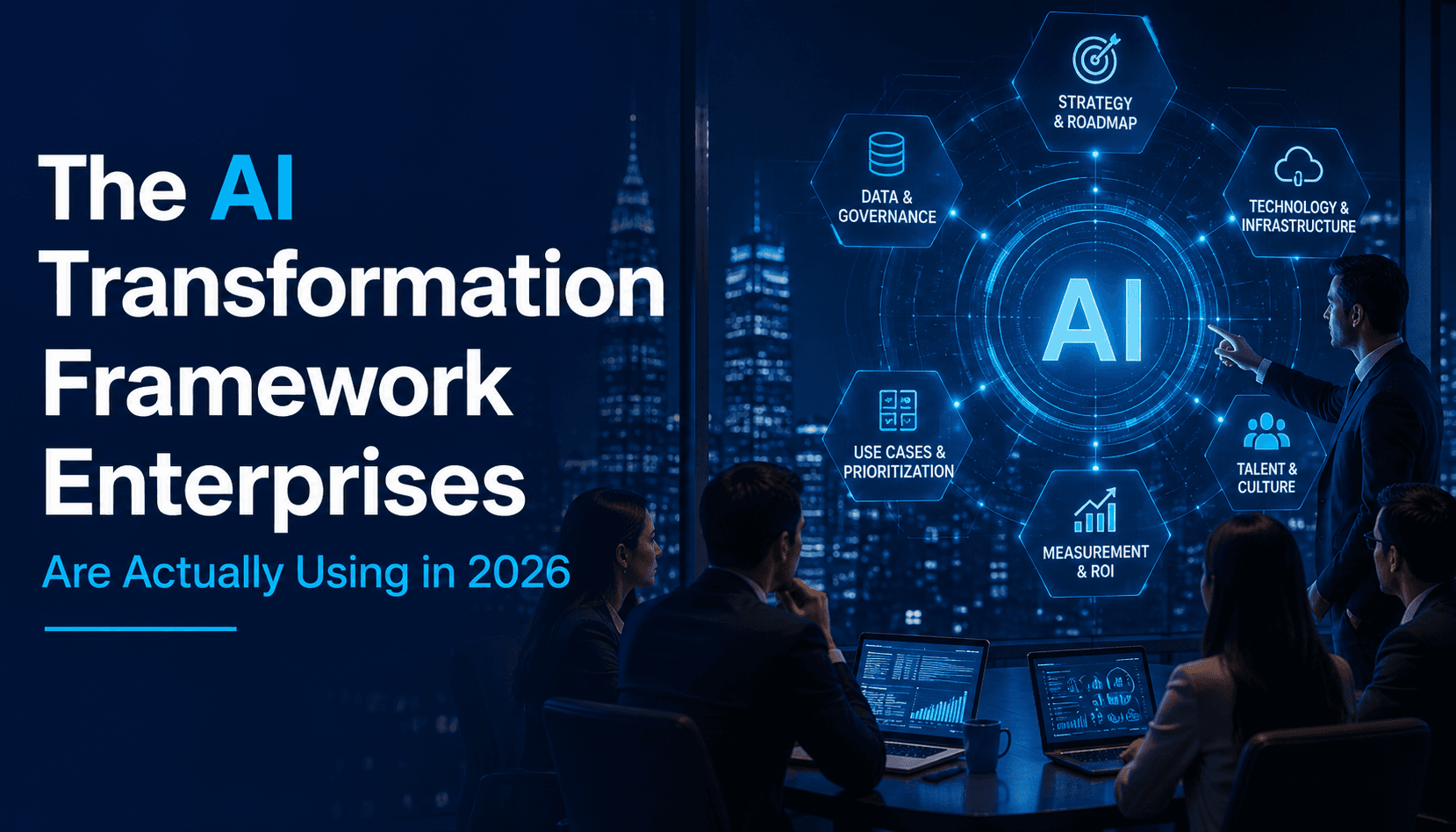
Most AI transformation frameworks published by consultancies describe what AI transformation should look like in theory. The ones enterprises in Singapore and APAC are actually applying in 2026 are built around a different constraint: production deployment within a defined regulatory environment, not aspirational capability maturity in a generic global context. This guide defines the AI transformation framework that BFSI and regulated enterprise organisations are implementing, what each stage requires, where most programs fail, and how to sequence the five stages to reach production AI that delivers measurable business outcomes rather than stalling in pilot purgatory.
AI Transformation Framework:
An AI transformation framework for enterprise organisations in 2026 is a structured five stage model covering: foundation (data governance and infrastructure readiness), use case selection and validation, engineering and deployment (model build, MLOps, governance embedding), scaling across a use case portfolio, and continuous optimisation with regulatory alignment. For BFSI and regulated enterprises in Singapore, the framework must incorporate MAS TRM, PDPA, and FEAT compliance obligations at the engineering stage, not as a separate governance workstream. Enterprise AI transformation models that treat governance as a documentation exercise rather than an engineering requirement consistently fail at the regulatory examination stage regardless of technical model quality.
What Is AI Transformation and Why the Definition Matters
What is AI transformation in enterprise practice: it is the structured process of embedding AI capability across an organisation's data infrastructure, decision processes, operational workflows, and governance structures to produce sustained, measurable business value rather than isolated point solutions.
AI transformation is distinct from AI adoption in three important ways:
Scope: Adoption deploys a tool; transformation changes how decisions are made, how data is governed, and how workflows operate across the organisation.
Depth: Adoption adds an AI feature to an existing process; transformation redesigns the process around AI capability with appropriate governance and human oversight structures.
Accountability: Adoption is measured by tool usage; transformation is measured by business outcomes including revenue impact, cost reduction, risk profile change, and regulatory examination results.
AI for data transformation is the foundational layer: no AI transformation program sustains itself without a governed, unified data infrastructure that provides reliable, auditable inputs to every model the program deploys. The organisations that achieve the highest enterprise AI transformation ROI are those that invest in data infrastructure and governance before they invest in model development. Understanding how modern enterprises build AI capability reveals that the fastest path to production AI is not starting with the most ambitious use case. It is starting with the use case that has the highest data readiness and building the infrastructure foundation that subsequent use cases inherit.
Benchmark Your AI Capabilities Against Industry Best Practices
Why the Framework Is Different in 2026
Three forces have changed what an effective AI transformation strategy roadmap playbook requires compared to 2022 or 2023:
1. Regulatory frameworks have shifted from guidance to enforcement
MAS Technology Risk Management guidelines, RBI AI and ML model risk frameworks, and the EU AI Act's extraterritorial reach are now enforceable obligations in the jurisdictions where most APAC enterprises operate. An AI business transformation framework that does not map every AI use case to specific regulatory controls at the engineering layer is not a 2026 framework. It is a 2021 framework with updated slide branding (Source Required: MAS Technology Risk Management Guidelines).
2. GenAI has created new transformation stages that linear frameworks do not accommodate
Organisations that deployed traditional ML models in 2022 to 2024 are now layering GenAI capabilities on top of existing AI infrastructure. The AI transformation stages required for a GenAI program (prompt engineering, hallucination risk management, output auditing, RAG architecture data governance) are different from those required for supervised ML deployment and must be incorporated into the framework as distinct stages rather than treated as incremental extensions.
3. Enterprise AI adoption is now measurably stratified
Gartner's 2025 enterprise AI survey found that organisations with a formal AI transformation framework are three times more likely to have production AI generating measurable ROI than those without one (Source Required: Gartner Enterprise AI Survey 2025). The gap between organisations with structured frameworks and those without is widening, not converging, as the complexity of production AI governance increases.
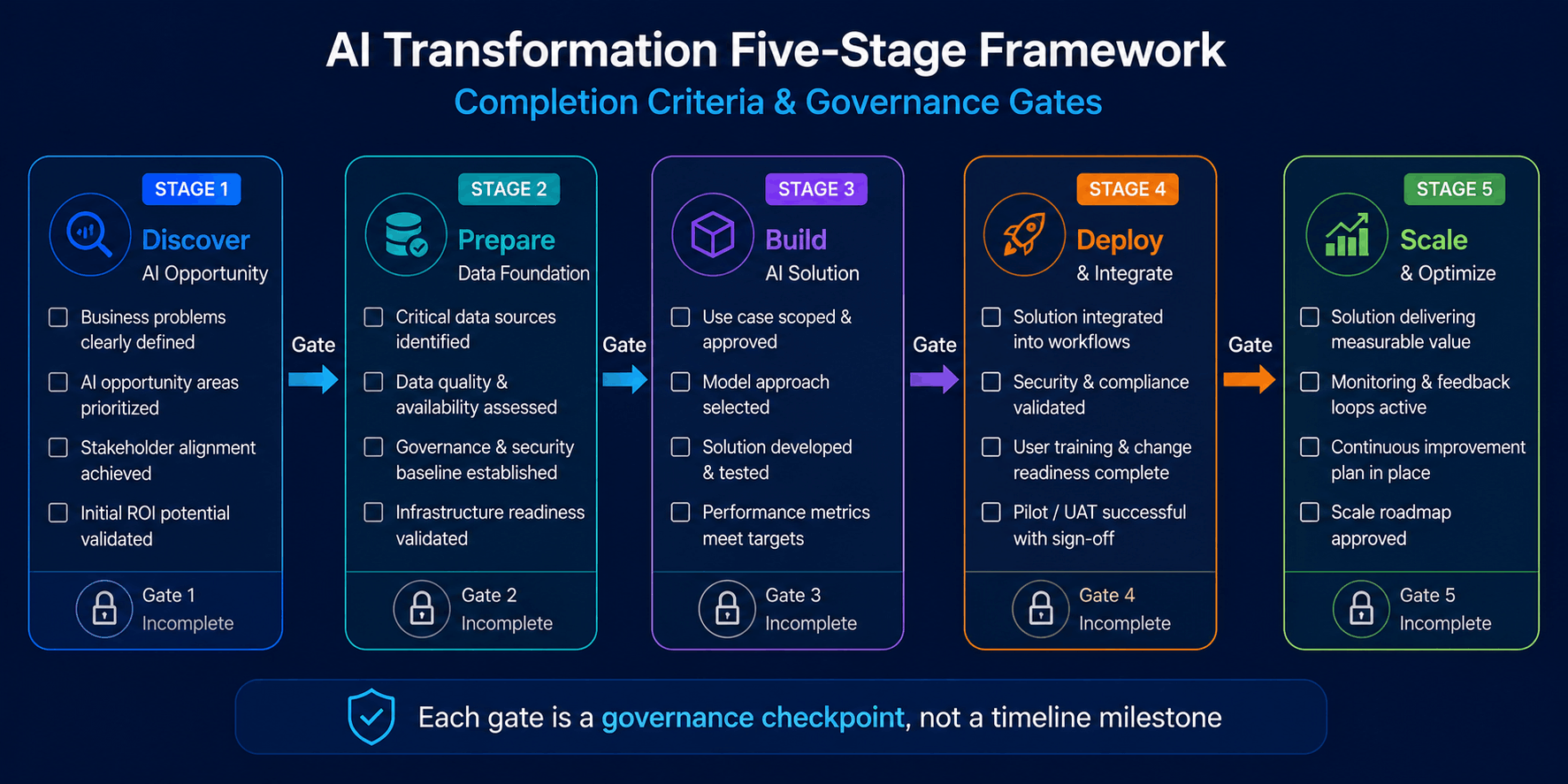
The Five Stage AI Transformation Framework
Stage 1: Foundation Data Governance and Infrastructure Readiness
What it covers: Establishing the governed data infrastructure that every subsequent AI use case depends on. This includes: unified data platform on Snowflake, Databricks, or Microsoft Azure; automated data quality scoring; PDPA consent tracking at the pipeline layer; column level lineage documentation; and access control and audit trail infrastructure.
What most organisations skip: They attempt to run Stage 2 (use case selection) and Stage 3 (model build) before Stage 1 is complete. The result is models built on ungoverned data that require a retroactive data remediation program costing 2x to 4x the original pipeline build cost.
Stage 1 completion criteria: Data quality score of 70% or above across completeness, accuracy, and timeliness for the target use case data domain; lineage documentation from source to storage layer; PDPA consent basis documented for every personal data category in scope.
Samta.ai's data integration consulting services implement Stage 1 on Databricks and Snowflake as the foundation investment that multiplies the ROI of every subsequent AI use case rather than treating it as infrastructure overhead.
Stage 2: Use Case Selection and Validation
What it covers: Identifying, prioritising, and validating AI use cases against three criteria: business value (quantified ROI hypothesis tied to a P&L line), data readiness (Stage 1 completion for the required data domain), and regulatory complexity (mapping of MAS TRM, PDPA, and FEAT obligations for the specific use case).
What most organisations skip: Regulatory complexity mapping. Use cases that appear technically straightforward (credit scoring, fraud detection, insurance underwriting) carry the highest regulatory obligation density and require the most governance infrastructure investment. Failing to map this in Stage 2 creates program stalls in Stage 3 when the compliance team reviews the deployment plan.
Stage 2 completion criteria: A scored use case register with quantified ROI hypotheses, data readiness scores, and regulatory obligation maps for the top three prioritised use cases.
Stage 3: Engineering and Deployment
What it covers: Building the production AI system: data pipeline (if not already built in Stage 1), model development and validation, MLOps infrastructure (CI/CD, model registry, containerised serving), governance layer (model cards, audit trails, explainability APIs), and integration layer connecting model outputs to consuming systems.
What most organisations skip: MLOps infrastructure and governance layer. Both are consistently deferred to Phase 2 in program scope and consistently never built because Phase 2 budgets are reallocated to new use cases before Phase 1 governance is completed.
Stage 3 completion criteria: Production deployment with inference logging active, drift detection configured, audit trail generating, and model card completed before the first live inference.
Samta.ai's digital transformation managed services operate as the engineering execution layer for Stage 3, delivering production AI systems with embedded governance rather than treating model build and governance infrastructure as separate workstreams. The VEDA AI Decision Analytics Platform accelerates Stage 3 for credit risk, fraud detection, and enterprise analytics use cases by providing production ready AI decision infrastructure with governance embedded at the platform layer.
Stage 4: Scaling Across the Use Case Portfolio
What it covers: Extending the data infrastructure, MLOps pipeline, and governance framework built for Use Case 1 to subsequent use cases, reducing the marginal cost and time for each new deployment.
What most organisations underestimate: The reusability of Stage 1 and Stage 3 infrastructure is the primary financial justification for the initial investment. Each subsequent use case deployed on the same platform costs 40% to 60% less to build and govern than the first use case (Source Required: McKinsey Enterprise AI Scaling Research). Organisations that treat each use case as a standalone project lose this compounding efficiency.
Stage 4 completion criteria: A second production use case deployed using the existing Stage 1 data infrastructure and Stage 3 MLOps and governance tooling without requiring new platform investment.
Stage 5: Continuous Optimisation and Regulatory Alignment
What it covers: Continuous model performance management (retraining, drift response, version management), governance currency maintenance (model cards updated for each retraining cycle, audit trails retained to MAS requirements), regulatory alignment updates as MAS TRM, PDPA, and FEAT frameworks evolve, and strategic use case roadmap extension.
What most organisations treat incorrectly: Stage 5 as a steady state operational phase that requires less investment than Stages 1 to 4. In practice, regulatory framework evolution in Singapore and APAC is accelerating, and maintaining alignment with evolving MAS FEAT and VERITAS requirements requires ongoing specialist input at both the consulting and engineering layers. Review why AI transformation governance matters for the specific governance obligations that Stage 5 must satisfy on an ongoing basis, including the model card currency requirements and audit trail retention standards that MAS examinations are increasingly checking at the individual model level.
AI Transformation Framework:
Dimension | Stage 1 (Foundation) | Stage 2 (Use Case) | Stage 3 (Engineering) | Stage 4 (Scaling) | Stage 5 (Optimisation) |
Data Maturity | Governed platform, lineage, quality | Domain specific readiness confirmed | Inference pipeline connected to governed store | Platform extended to new domains | Continuous quality monitoring, drift prevention |
Model Maturity | None required | Use case architecture defined | Production model with MLOps | Second use case on same MLOps stack | Portfolio of governed, monitored models |
Governance Maturity | PDPA consent, lineage tracking | Regulatory obligation map per use case | Model cards, audit trails, explainability APIs | Governance framework reused, not rebuilt | MAS FEAT, VERITAS, TRM current alignment |
Business Value | Foundation investment, no direct value yet | ROI hypothesis validated | First measurable outcome within 90 days | Compounding ROI across use case portfolio | Sustained competitive and regulatory advantage |
Singapore BFSI Risk Level | Low, infrastructure only | Medium, regulatory scoping required | High, MAS TRM examination ready required | Medium, governance scaled not rebuilt | Ongoing, regulatory evolution managed |
Strengthen Your AI Governance with a Risk Assessment
Real World Use Cases: The Framework Applied in Singapore
Use Case 1: BFSI AI Transformation Program, Singapore Bank
A Singapore licensed bank attempted to deploy a credit scoring AI model (Stage 3) without completing Stage 1. The data for the credit model existed across four unintegrated source systems with no lineage tracking and no PDPA consent documentation for bureau data usage. The Stage 3 program was paused 11 weeks into model development when the compliance team identified the governance gap. Completing Stage 1 first (Databricks data platform, lineage documentation, PDPA consent management) added 14 weeks to the program timeline but reduced Stage 3 duration by 8 weeks because model development proceeded on governed, documented data from the start. The BFSI AI transformation maturity framework the bank adopted after this experience made Stage 1 completion a governance gate before any Stage 3 investment is approved.
Use Case 2: Logistics AI Transformation, Regional Enterprise
A regional logistics conglomerate applied the five stage framework from program initiation. Stage 1 (Snowflake data platform across 9 markets) took 16 weeks. Stage 2 (demand forecasting validated as first use case, inventory optimisation as second) took 4 weeks. Stage 3 (demand forecasting model in production) took 14 weeks. Stage 4 began 6 weeks after Stage 3 production deployment, using the same Snowflake platform and MLOps infrastructure for inventory optimisation. Stage 4 time to production: 9 weeks versus 14 weeks for the first use case. The marginal cost reduction on Stage 4 validated the Stage 1 foundation investment in the board's ROI model. This is enterprise AI transformation working as the framework intends: compounding efficiency across use cases rather than treating each deployment as an independent program. Explore enterprise AI engineering in Singapore to understand how the engineering execution layer for Stages 3 and 4 is structured for Singapore enterprise programs.
Key Risks and Failure Modes in AI Transformation Programs
Skipping Stage 1 to accelerate Stage 3: is the single most common and most expensive failure mode. The cost of retrofitting data governance, lineage, and PDPA consent management onto an already deployed model is consistently 3x to 5x the cost of building it correctly in Stage 1.
Treating governance as a Stage 5 activity: rather than a Stage 3 engineering requirement produces models that are technically production ready but regulatory examination failures. MAS examinations now inspect at the model level, not the policy level. A governance policy document without engineering controls behind it does not satisfy examination standards.
Scoping Stage 4 as a separate program: rather than inheriting Stage 1 and Stage 3 infrastructure eliminates the compounding ROI that is the financial case for the Stage 1 foundation investment. Each subsequent use case should take 40% to 60% less time and cost than the first.
Conflating AI adoption with AI transformation: leads organisations to measure success by the number of AI tools deployed rather than by measurable business outcome change. Tool adoption without process redesign and governance embedding is not transformation.
Review the enterprise AI governance framework to understand how governance obligations span all five stages rather than being concentrated at Stage 5, and how AI security and compliance services embed the engineering controls that governance documentation alone cannot provide. Compare how AI compares to traditional development companies at each stage to understand where AI transformation programs require fundamentally different delivery capabilities from standard software development engagements.
Decision Framework: Where Is Your Organisation in the Five Stage Model
You are in Stage 1 when:
No governed, unified data platform exists across your primary AI use case data domains
Data quality, lineage, and PDPA consent documentation are absent or incomplete
AI use case development is blocked waiting for clean, accessible data
You are in Stage 2 when:
A governed data platform exists but no validated use cases with quantified ROI hypotheses and regulatory obligation maps have been produced
Multiple use cases are competing for AI investment without a structured prioritisation framework
You are in Stage 3 when:
A validated use case with data readiness confirmed is ready for model development and production deployment
MLOps infrastructure, governance embedding, and integration layer build are the active workstreams
You are in Stage 4 when:
One production AI use case is delivering measurable outcomes and a second use case is ready to be deployed on the existing infrastructure
You are in Stage 5 when:
Multiple production use cases are running with MLOps monitoring and your primary challenge is regulatory alignment currency and portfolio performance management
Review the AI implementation playbook for the specific deliverables and completion criteria at each stage, and VEDA vs data intelligence platform to understand how platform selection decisions at Stage 1 and Stage 3 affect the cost and complexity of Stage 4 scaling.
Start Your Enterprise AI Transformation Today
Conclusion
The AI transformation framework enterprises are actually using in 2026 is not a five slide strategy deck. It is a five stage engineering and governance program with defined completion criteria at each stage, regulatory controls embedded at Stage 3 rather than deferred to Stage 5, and compounding infrastructure ROI built into the Stage 4 scaling model from the start. Organisations that complete all five stages in the correct sequence with governance embedded at the engineering layer consistently deliver production AI that survives regulatory examination, compounds in value across a growing use case portfolio, and produces measurable business outcomes that justify continued investment. Those that skip stages or defer governance consistently fund expensive remediation programs instead.
About Samta
Samta.ai is a Singapore-headquartered AI Product Engineering & Data Intelligence partner helping enterprises build production-grade AI systems for regulated and data-intensive environments.We help organizations move beyond experimentation by engineering scalable, explainable, and enterprise-ready AI solutions from data foundations and model development to workflow automation and deployment.
Our capabilities combine deep AI expertise, data engineering, and product engineering to deliver measurable business impact across FinTech, BFSI, cybersecurity, regulatory technology, and enterprise operations.
Our enterprise AI products power real-world intelligence systems:
• TATVA : AI-driven data intelligence platform for governed analytics, monitoring, and operational insights
• VEDA : Explainable and audit-ready AI decisioning engine built for compliance-sensitive enterprise workflows
• CORA-Property Management Solutions: : Predictive intelligence platform for real-estate pricing, portfolio optimization, and investment analytics
Backed by ecosystem partnerships with Microsoft, Databricks, Snowflake, and AWS, Samta.ai delivers agile, cost-efficient AI engineering with faster turnaround and enterprise-grade scalability. Trusted by enterprises across FinTech, BFSI, and digital transformation initiatives, Samta.ai embeds AI governance, data privacy, and compliance-by-design principles directly into the AI lifecycle , enabling organizations to scale AI with transparency, accountability, and operational control.
Enterprises leveraging Samta.ai automate 65%+ of repetitive data, analytics, and decision workflows while maintaining governance, explainability, and measurable business outcomes. Samta.ai provides the strategic consulting, AI engineering, and data modernization expertise needed to align enterprise operations with next-generation AI transformation goals.
Frequently Asked Questions
What is an AI transformation framework?
An AI transformation framework is a structured model that sequences the stages an enterprise must complete to embed AI capability sustainably across its data infrastructure, decision processes, and governance structures. A complete framework covers data foundation, use case prioritisation, engineering and deployment, scaling, and continuous optimisation. For Singapore enterprises, the framework must incorporate MAS TRM, PDPA, and FEAT regulatory obligations at the engineering stage, not as a separate governance workstream added after deployment.
What is AI transformation and how is it different from AI adoption?
What is AI transformation versus AI adoption: adoption deploys a specific AI tool or model to an existing process. Transformation restructures data infrastructure, decision workflows, and governance frameworks around AI capability to produce sustained business value at scale. The difference is measurable in business outcomes: adoption produces tool usage metrics; transformation produces revenue impact, cost reduction, and regulatory examination results.
What are the stages of enterprise AI transformation?
AI transformation stages in the 2026 enterprise framework are: Stage 1 (data governance and infrastructure foundation), Stage 2 (use case selection and regulatory obligation mapping), Stage 3 (engineering, deployment, and governance embedding), Stage 4 (scaling across the use case portfolio on shared infrastructure), and Stage 5 (continuous optimisation and regulatory alignment). Each stage has defined completion criteria that serve as governance gates before the next stage investment is approved.
What is an AI business transformation framework and who should own it?
An AI business transformation framework should be co owned by technology leadership (CTO, CDO) for Stages 1 and 3, business leadership (CFO, business unit heads) for Stage 2 use case validation and ROI hypothesis ownership, and risk and compliance leadership (CRO, Chief Compliance Officer) for regulatory obligation mapping across all stages. Frameworks owned exclusively by technology functions consistently under invest in Stage 2 business validation and Stage 5 regulatory alignment because both require non technology leadership accountability.
What is the role of data in AI for data transformation?
AI for data transformation is the foundational dependency: AI models require governed, auditable, and high quality data inputs to produce reliable outputs. Data transformation (building governed pipelines, quality controls, lineage tracking, and consent management) must precede model transformation at scale. Organisations that attempt AI transformation without data transformation consistently stall at Stage 3 because the model development phase reveals data quality gaps that block production deployment.