
Summarize this post with AI
Your security dashboard is green, your SIEM is humming, and your compliance reports are filed. Yet somewhere in your enterprise, 13% of devices are running without a critical security agent, a policy written six months ago has never been enforced, and your SOC team is reconciling asset data across five fragmented tools using a spreadsheet that was outdated before it was finished. This is the central paradox Dean Sysman exposed at the RSA Conference: the security industry has mastered the art of seeing problems while systematically failing to fix them. The shift from visibility to true cybersecurity actionable steps is not a product upgrade. It is a fundamental rethinking of what security means in a modern enterprise.
The Visibility Trap
Security leaders have spent a decade investing in visibility. SIEMs, XDR platforms, cloud security posture tools, identity analytics. The result is an enterprise that can observe more attack surface than ever before and act on less of it.
Sysman draws a sharp distinction between three states that enterprise teams routinely conflate. Visibility means you know an asset exists. Detection means you know something is wrong with it. Actionability means you know who owns it, what the fix is, whether it was applied, and whether it held. Most enterprise security programs have deep competency in the first two and almost none in the third. This is not a tools problem. It is a cyber security strategy and implementation plan problem that requires a structural rethink of how your security organization operates.
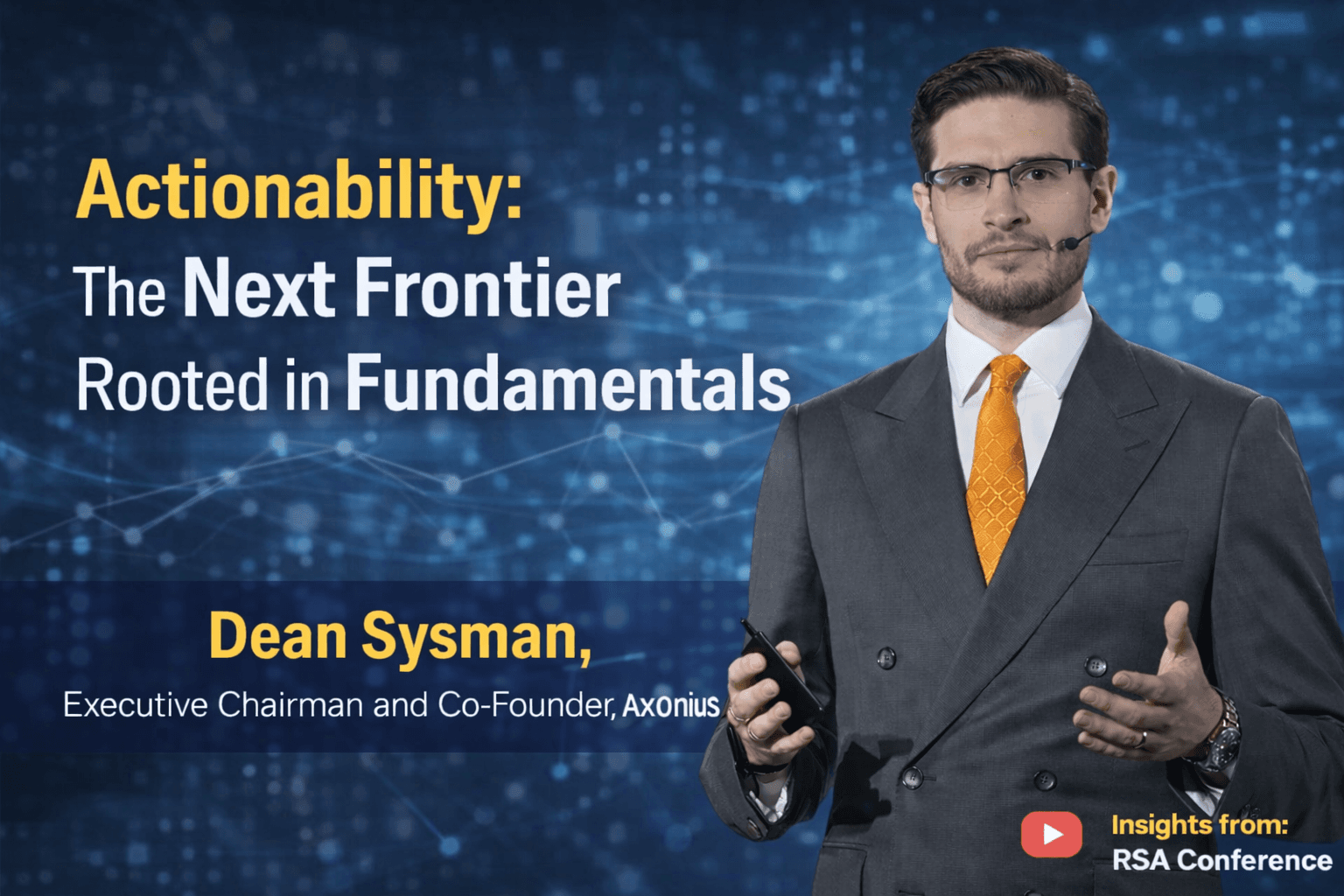
Watch: Actionability: The Next Frontier Rooted in Fundamentals
Insights by Dean Sysman, Executive Chairman and Co-Founder of Axonius, from his keynote at the RSA Conference, "The Future of Cybersecurity: From Visibility to Actionability.
Security Drift: The Silent Killer
Every CISO has a policy document. Almost none have a live, continuous read on whether that policy is enforced across their environment. The gap between what your policy declares and what your environment reflects is security drift, and it compounds silently. A device onboards without the EDR agent. A cloud workload spins up outside approved configuration. An identity is provisioned with excess privileges and never reviewed. None of these trigger an alarm. All of them represent cybersecurity asset visibility gaps invisible to teams focused on inbound threat detection.
Without automated security drift detection, the delta between intent and reality grows every day. By the time a manual audit surfaces the problem, the attack surface has been exposed for months. Understanding how AI governance frameworks apply to security posture management is increasingly critical for teams trying to automate this detection layer at scale.
The 13% Problem
Across billions of assets analyzed by Axonius, approximately 13% of enterprise devices are missing critical security agents. Not in small organizations. In enterprises with mature security programs, dedicated SOC teams, and significant tool spend.
The reason is structural. No single tool has a complete inventory across identity, cloud, endpoint, and network domains simultaneously. Coverage gaps are the predictable outcome of fragmented cyber security functions operating in silos. The real attack surface is the intersection of what all those tools miss, and that intersection is where adversaries operate. This is exactly where a unified AI security and compliance approach provides structural advantage over point solutions.
The Spreadsheet Failure
When no single tool provides a unified view, security teams build spreadsheets. They export data from five platforms, reconcile columns manually, assign ownership by hand, and deliver the result as their cybersecurity action plan example. The problem is not effort. It is physics. By the time the spreadsheet is complete, the environment it describes no longer exists.
Knowing what you have, who owns it, and whether it is protected sounds simple. Proving it continuously at enterprise scale is one of the hardest problems in enterprise AI risk management and security operations. Organizations that have solved this treat the cybersecurity action plan template as a live operational tool generated from real data, not a static document. See how AI risk management models are evolving to address this challenge directly.
AI and Security: When Probabilistic Meets Deterministic
Traditional security systems are deterministic. A firewall rule fires or it does not. AI security challenges enterprise teams because AI does not behave this way. AI models are probabilistic, producing outputs that vary based on context, prompt construction, and model version. When AI touches a security workflow, whether triaging alerts or recommending remediations, the security guarantee changes from deterministic to statistical.
Prompt injection, model drift, and adversarial inputs against AI-assisted SOC tools represent an attack surface that most cybersecurity action plan templates do not yet address. The agentic AI governance framework provides a practical starting point for enterprises trying to govern AI behavior within security-sensitive workflows.
The Cybersecurity Actionability Framework
A complete actionability framework requires five integrated capabilities working together.
Drift Detection is continuous, automated comparison of declared policy against live environment state. Every asset, every configuration, every identity. The moment a device falls out of compliance, the system knows. This is the foundation of every credible cybersecurity enforcement action at enterprise scale.
Ownership Mapping ensures every asset has an owner and every gap has an accountable party. Without it, findings disappear into the organizational void. The cybersecurity enforcement actions that matter are assigned to a named human with a deadline. Review how AI governance KPIs can be adapted to track ownership coverage as a security metric.
Decision Intelligence delivers context-rich information telling security teams not just that a gap exists, but what fixing it requires and what the risk of not fixing it is. This is where AI adds genuine value when governed correctly, directly improving the quality of cybersecurity calls to action across the enterprise.
Automated Execution compresses the time between gap identification and closure from weeks to hours. The workflow automation consulting capability at Samta.ai is specifically designed to build this layer for security operations teams.
Continuous Validation confirms that fixes held at 24 hours, 7 days, and 30 days after remediation. Closing a gap means nothing if it reopens in 48 hours. This is what Sysman calls the final step: proving the fix, not just applying it, referencing the principles outlined in continuous monitoring for AI.
The Human Cost of Inaction
Security teams are not failing because of insufficient skill. They are failing because their systems surface problems faster than humans can respond. The result is decision fatigue, where the correct response to alert 847 of the day is indistinguishable from the incorrect response without context that takes 20 minutes to reconstruct manually. Cognitive overload degrades the quality of cybersecurity calls to action and directly slows remediation. The AI change management strategy required to shift teams from manual triage to governed automation is as important as the technology that enables it.
Security Is Defined by What You Fix
The security industry will keep producing more visibility tools, more dashboards, and more AI-assisted triage. None of that closes the execution gap Sysman identified at RSA and that enterprise data confirms every quarter. The organizations defining the next generation of security leadership are not those with the most comprehensive view of their attack surface. They are those with the most reliable, repeatable, validated process for closing it. Security is not defined by what you see. It is defined by what you fix.
Ready to Move From Visibility to Action?
Samta.ai helps enterprise security teams close the gap between policy and reality with AI-powered governance, automated drift detection, and validated remediation workflows. If your security program can see the problem but struggles to own the fix, the AI security and compliance practice at Samta.ai is built for this challenge. Explore our full services or contact us to book a strategy session with our team today.
About Samta
Samta.ai is an AI Product Engineering & Governance partner for enterprises building production-grade AI in regulated environments.
We help organizations move beyond PoCs by engineering explainable, audit-ready, and compliance-by-design AI systems from data to deployment.
Our enterprise AI products power real-world decision systems:
Tatva : AI-driven data intelligence for governed analytics and insights
VEDA : Explainable, audit-ready AI decisioning built for regulated use cases
Property Management AI : Predictive intelligence for real-estate pricing and portfolio decisions
Trusted across FinTech, BFSI, and enterprise AI, Samta.ai embeds AI governance, data privacy, and automated-decision compliance directly into the AI lifecycle, so teams scale AI without regulatory friction.
Enterprises using Samta.ai automate 65%+ of repetitive data and decision workflows while retaining full transparency and control.
Samta.ai provides the strategic consulting and technical engineering needed to align your human capital with your AI goals, ensuring a frictionless
FAQ
What are cybersecurity actionable steps?
They are specific, owned, validated remediations that close a measurable gap between declared security policy and actual environment state, assigned to named owners with deadlines and validation checkpoints.
What is a cybersecurity action plan template?
A structured framework mapping identified security gaps to remediation tasks, owners, timelines, and validation criteria, ideally generated dynamically from live asset data rather than maintained manually.
How does AI impact cybersecurity risk?
AI introduces probabilistic behavior into deterministic security workflows, creating AI and security issues including prompt manipulation, model drift, and audit gaps that enterprise AI risk management frameworks must explicitly address.
Why do security tools fail without actionability?
Tools that generate findings without connecting them to an owner, a workflow, and a validation loop produce alert volume rather than security outcomes. The cybersecurity calls to action that matter close real gaps in measurable, repeatable ways.