
Summarize this post with AI
A model that scores 94% accuracy in a notebook is not a production-ready AI system. Accuracy is a research metric. Production readiness is an engineering and governance standard and the gap between the two is where most enterprise AI programs stall, spending months in pilot purgatory with technically functional models that cannot be safely deployed, monitored, or defended to a regulator. This guide defines exactly what a production-ready AI system requires across infrastructure, MLOps, governance, and monitoring so engineering and transformation leads can assess where their current programs fall short and what must be built before any model goes live.
Production-Ready AI System:
A production-ready AI system is an AI model and its surrounding engineering infrastructure that meets four standards simultaneously: reliability (the system performs consistently under production load with defined SLAs), observability (every inference, input, and output is logged and monitored for drift and anomaly), governance (model cards, audit trails, explainability outputs, and accountability structures are in place before go-live), and recoverability (the system can be rolled back, retrained, and redeployed without data loss or service disruption). For BFSI and regulated enterprises in APAC, production-ready AI agents and models must also satisfy MAS TRM, PDPA, and sector-specific model risk standards which extend production readiness requirements beyond engineering into compliance infrastructure.
What "Production Ready" Actually Means in AI Engineering
What is a production system in AI is a question with a different answer than what most data science curricula teach. A production system is not the model it is the entire operational environment the model runs within.
Production system characteristics in AI cover seven distinct layers:
Data pipeline: governed, monitored data feeds that deliver clean, versioned inputs to the model at inference time
Model serving infrastructure: containerised model deployment (Docker, Kubernetes) with defined resource allocation, load balancing, and latency SLAs
MLOps pipeline: CI/CD automation for model retraining, validation, staging, and deployment without manual intervention
Monitoring and observability: real-time logging of every inference request, input feature distribution, and output decision, with automated alerting for drift and anomaly
Governance and compliance layer: model cards, audit trails, explainability APIs, and access controls that satisfy regulatory and internal risk requirements
Rollback and recovery: versioned model registry with tested rollback procedures and defined RTO/RPO for model failures
Integration layer: stable, versioned APIs connecting model outputs to consuming systems core banking, ERP, CRM, decisioning engines
The gap between a notebook model and a production-ready AI system is not model quality. It is the presence or absence of all seven of these layers working together. Understanding how modern enterprises build AI capability makes clear that the firms reaching production fastest are those that engineer these layers in parallel with model development not sequentially after model accuracy is achieved.
Get a Clear Picture of Your AI Maturity
Why Production Readiness Standards Have Raised in 2026
Three forces have raised the bar for what counts as production-ready:
1. Regulatory examination now reaches the inference layer
MAS Technology Risk Management guidelines and RBI AI/ML model risk frameworks now require that every inference made by a production AI model can be logged, replayed, and explained. An AI system without inference logging is not production-ready for any regulated BFSI institution in APAC, regardless of its model performance. AI security and compliance requirements have extended from the model into the serving infrastructure.
2. Agentic AI has introduced new production readiness dimensions
Production-ready AI agents systems that take autonomous actions in multi-step workflows require additional production standards that single-inference models do not: action audit trails, human-in-the-loop escalation paths, tool call logging, and failure state recovery. The multi-agent AI engineering production readiness checklist is materially more demanding than the checklist for a single classification or regression model.
3. The cost of production failures has increased
As AI systems are embedded deeper into core operations credit decisioning, fraud detection, customer service the business and regulatory cost of production failures has increased proportionally. A model that produces anomalous outputs for 4 hours before being detected is no longer an engineering incident, it is a potential MAS notification event. Production readiness now includes the monitoring and response infrastructure to detect and contain failures before they become regulatory obligations
The 7-Layer Production Readiness Framework
Use this framework to assess and build a production-ready AI system from the ground up:
Layer 1: Governed Data Pipeline
The data feeding the model at inference time must match the data the model was trained on in schema, quality, and distribution. Implement automated schema validation, feature drift detection, and data quality scoring on every inference batch. Build on Databricks or Snowflake with documented lineage from source to model input.
Layer 2: Containerised Model Serving
Deploy every production model in a Docker container orchestrated by Kubernetes, with defined CPU/GPU resource allocation, horizontal scaling rules, and latency SLAs. Never serve production models from notebook environments or ad hoc scripts. Every model serving endpoint must have a versioned deployment manifest that can reproduce the exact serving environment at any historical date.
Layer 3: MLOps CI/CD Pipeline
Build automated pipelines for model retraining, validation against defined performance thresholds, staged deployment (dev → staging → production), and rollback triggered by performance degradation. Manual deployment steps in a production AI system are reliability risks every human touch point is a potential failure mode and audit gap. Samta.ai's digital transformation managed services implement MLOps pipeline automation on Azure ML, Databricks MLflow, and AWS SageMaker as the engineering execution layer for production deployments.
Layer 4: Monitoring and Observability
Log every inference request: timestamp, input features, model version, output decision, and latency. Implement automated drift detection both input drift (feature distribution shift) and output drift (decision distribution shift) with alerting thresholds defined before go-live. Why AI model monitoring matters for production systems: undetected drift silently degrades model performance before it appears in business metrics, by which point the damage to operational outcomes is already done.
Layer 5: Governance and Compliance Infrastructure
Produce a model card for every production model covering: purpose, training data sources, known limitations, performance thresholds, and accountable owner. Generate audit trails for every inference that can be queried by model version, time period, and decision outcome. Implement explainability APIs SHAP, LIME, or equivalent that can produce feature-level explanations for any individual inference on demand. The VEDA AI Decision Analytics Platform embeds governance infrastructure audit trails, explainability outputs, drift dashboards, and model performance reporting directly into the production serving layer, so compliance documentation is generated automatically rather than maintained manually.
Layer 6: Rollback and Recovery
Maintain a versioned model registry MLflow, SageMaker Model Registry, or Azure ML Registry with every production model version and its associated serving configuration retained. Define and test rollback procedures before go-live: how long does it take to detect a model performance failure, initiate rollback, and restore the prior production version? For BFSI use cases, this RTO target should be under 30 minutes with tested procedures, not aspirational documentation.
Layer 7: Integration Layer Stability
Define stable, versioned API contracts between the model serving layer and every consuming system. API changes that break consuming systems are the most common cause of AI production incidents that are not model-related. Implement contract testing in the CI/CD pipeline and semantic versioning on every model API endpoint. Consuming systems should be isolated from model version changes unless explicitly updated.
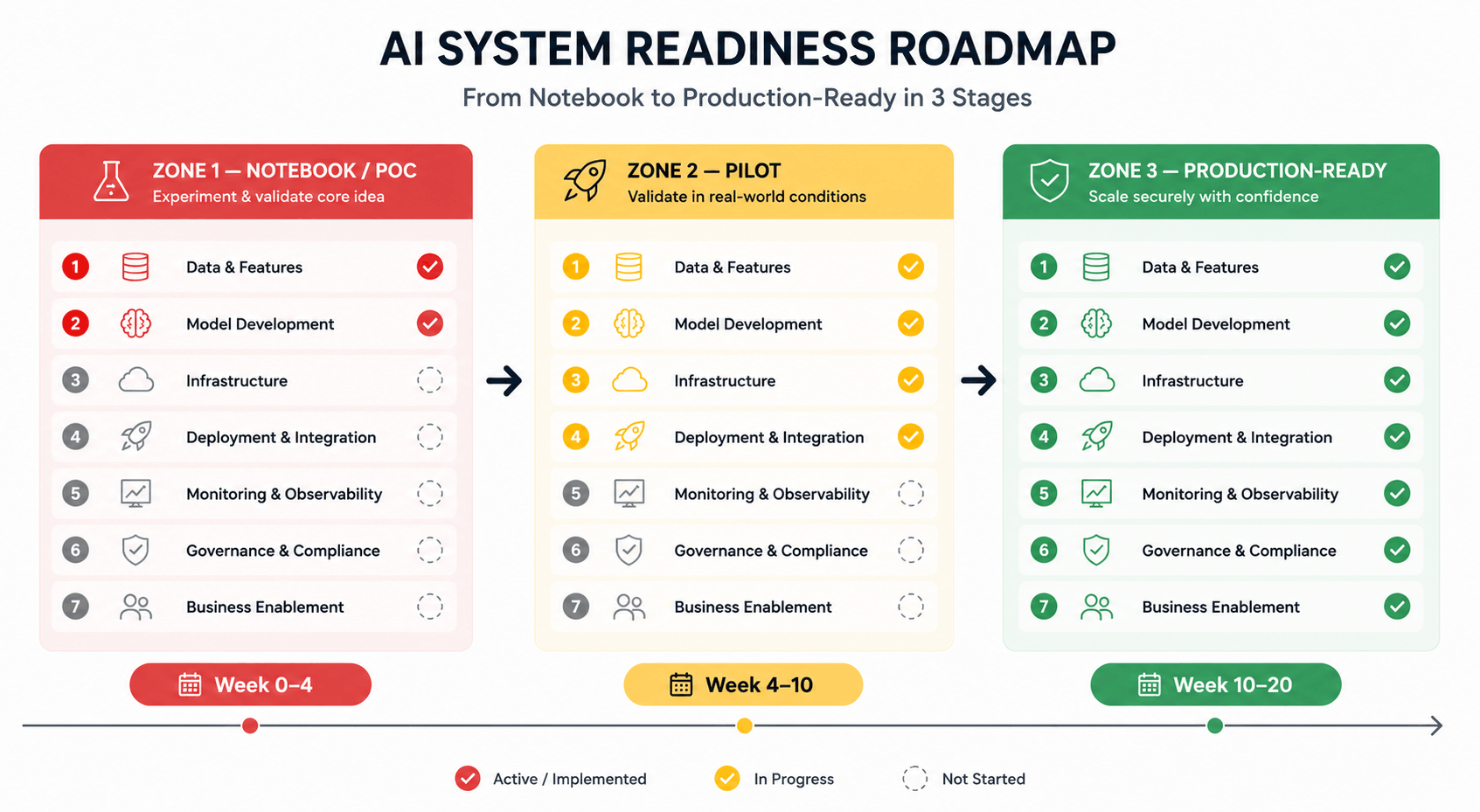
Production-Ready AI System: 5-Column Readiness Comparison
Layer | Notebook / POC Stage | Pilot Stage | Production-Ready | Samta.ai Benchmark |
Data Pipeline | Manual data pulls, no validation | Basic pipeline, no drift detection | Governed, monitored, lineage-tracked | Databricks / Snowflake with automated quality scoring |
Model Serving | Local script or notebook | Manual container, no SLA | Kubernetes-orchestrated, latency SLA defined | Azure ML / SageMaker with auto-scaling |
MLOps CI/CD | None — manual deployment | Partial automation, manual approval | Full CI/CD with automated rollback | MLflow + Azure DevOps, zero-touch deployment |
Monitoring | Offline evaluation only | Basic API health check | Inference logging, drift detection, alerting | Real-time drift dashboards, MAS-compliant audit trail |
Governance | None | Model card draft | Full model card, audit trail, explainability API | VEDA-embedded, examination-ready on demand |
Understand Your Organization's AI Risk Exposure
Real-World Use Cases: Production Readiness in Practice
Use Case 1: Credit Fraud Detection Model, Singapore Bank (BFSI)
A Singapore-licensed bank deployed a gradient boosting fraud detection model that achieved 96% precision in staging. Within 6 weeks of production deployment, the fraud rate the model was designed to detect began changing pattern but no drift detection was in place. The model continued to score at 96% precision on its training distribution while missing 34% of new fraud patterns. The incident was not detected through monitoring; it was detected through a business review 11 weeks after the pattern shift began. Retrofitting inference logging, drift detection, and automated alerting cost SGD 280,000 and required a 3-week model rollback period. Production system characteristics in AI for fraud detection specifically require real-time inference logging and output drift detection configured before go-live not after a pattern shift has already caused operational damage. Review how bridging the AI pilot to production gap is structured to prevent exactly this sequence.
Use Case 2: Demand Forecasting AI, Regional Retailer (General Enterprise)
A regional FMCG company deployed a demand forecasting model on a manual serving script with no containerisation, no rollback procedure, and no inference logging. When a junior data engineer modified the serving script to test a new feature, the production model began outputting stale forecasts but without inference logging, the failure was not detected for 9 days. Inventory decisions made on stale forecasts during that period resulted in SGD 1.4M in excess stock. Rebuilding the serving infrastructure with Kubernetes containerisation, versioned MLflow model registry, automated rollback on performance degradation, and inference audit logging resolved the failure mode entirely. The rebuild took 6 weeks. Explain production systems in AI requirements to non-technical stakeholders using this case: the model was correct and the serving infrastructure was not. The data integration consulting services layer that connects model outputs to ERP and inventory systems requires the same version control and contract testing discipline as the model serving layer itself.
Key Risks and Failure Modes in AI Production Deployment
No inference logging: the single most critical production readiness gap; without inference logs, drift cannot be detected, incidents cannot be investigated, and regulatory audit requirements cannot be satisfied
Manual deployment steps: any manual intervention in the deployment pipeline is a reliability risk and an audit gap; every production deployment must be reproducible from a versioned manifest without human action
Untested rollback: rollback procedures that exist in documentation but have never been tested will fail under the time pressure of a production incident; test rollback in staging before every production deployment
API contract instability: model API changes that break consuming systems without versioning are the most common cause of AI production incidents unrelated to model performance
Governance added post-deployment: model cards, audit trails, and explainability APIs that are planned for "Phase 2" consistently never get built; governance infrastructure must be a go-live gate, not a future deliverable
Compare how production AI architecture decisions affect long-term system reliability in the VEDA vs data intelligence platform comparison where serving infrastructure design choices at build time determine observability and governance capability in production.
Decision Framework: Is Your AI System Production-Ready?
Your system is production-ready when:
All seven layers are in place and have been tested in a staging environment that mirrors production
Drift detection thresholds and alerting owners are defined and configured before go-live
Model card and audit trail infrastructure are generating output in staging
Rollback has been tested end-to-end with a measured RTO
API contracts are versioned and consuming systems have been regression-tested
Your system is not production-ready when:
The model is deployed from a notebook or manual script without containerisation
Inference requests are not logged at the individual prediction level
No drift detection is configured performance is evaluated only through offline metrics
Rollback has not been tested and RTO is undefined
Model card documentation is incomplete or not linked to the serving version
What is an AI-ready workstation versus a production AI system: a workstation is the development environment for building models; a production AI system is the operational infrastructure that serves, monitors, governs, and maintains those models at scale. Confusing the two is how notebook models end up in "production" with none of the surrounding infrastructure they require. Review the how modern enterprises build AI capability framework to understand the full infrastructure build required before any model goes live.
Solve Your AI Challenges With Expert Advice
Conclusion
A production-ready AI system is not defined by the model inside it is defined by the seven engineering and governance layers surrounding it. Inference logging, MLOps automation, drift monitoring, governed data pipelines, compliance infrastructure, versioned rollback, and stable API contracts are not optional enhancements to a deployed model. They are the conditions that make deployment responsible, sustainable, and defensible to regulators, boards, and the operational teams that depend on the system every day. Build all seven layers before go-live. Test them in staging. Treat governance as a deployment gate. That is the standard a production-ready AI system must meet in 2026

About Samta
Samta.ai is a Singapore-headquartered AI Product Engineering & Data Intelligence partner helping enterprises build production-grade AI systems for regulated and data-intensive environments.We help organizations move beyond experimentation by engineering scalable, explainable, and enterprise-ready AI solutions from data foundations and model development to workflow automation and deployment.
Our capabilities combine deep AI expertise, data engineering, and product engineering to deliver measurable business impact across FinTech, BFSI, cybersecurity, regulatory technology, and enterprise operations.
Our enterprise AI products power real-world intelligence systems:
• TATVA : AI-driven data intelligence platform for governed analytics, monitoring, and operational insights
• VEDA : Explainable and audit-ready AI decisioning engine built for compliance-sensitive enterprise workflows
• CORA-Property Management Solutions: : Predictive intelligence platform for real-estate pricing, portfolio optimization, and investment analytics
Backed by ecosystem partnerships with Microsoft, Databricks, Snowflake, and AWS, Samta.ai delivers agile, cost-efficient AI engineering with faster turnaround and enterprise-grade scalability. Trusted by enterprises across FinTech, BFSI, and digital transformation initiatives, Samta.ai embeds AI governance, data privacy, and compliance-by-design principles directly into the AI lifecycle , enabling organizations to scale AI with transparency, accountability, and operational control.
Enterprises leveraging Samta.ai automate 65%+ of repetitive data, analytics, and decision workflows while maintaining governance, explainability, and measurable business outcomes. Samta.ai provides the strategic consulting, AI engineering, and data modernization expertise needed to align enterprise operations with next-generation AI transformation goals.
Frequently Asked Questions
What is a production-ready AI system?
A production-ready AI system is an AI model deployed within a complete operational infrastructure that satisfies four standards: reliability under production load with defined SLAs, observability through inference logging and drift monitoring, governance through model cards and audit trails, and recoverability through versioned rollback. A model that achieves high accuracy in evaluation is not production-ready until all four of these surrounding infrastructure standards are also met.
What is a production system in AI engineering?
What is a production system in AI engineering: it is the full operational environment that serves, monitors, governs, and maintains an AI model at scale including data pipelines, model serving infrastructure, MLOps CI/CD, monitoring and observability, governance and compliance tooling, rollback and recovery systems, and API integration layers. The model itself is one component of a production system, not the system in its entirety.
What are the key production system characteristics in AI?
Production system characteristics in AI include: deterministic, reproducible deployments from versioned manifests; real-time inference logging at the individual prediction level; automated drift detection with defined alerting thresholds; model cards and audit trail generation; versioned rollback capability with tested RTO; stable, versioned API contracts with consuming systems; and governance infrastructure that satisfies regulatory requirements for the specific deployment context.
What makes an AI agent production-ready in 2026?
Production-ready AI agents require additional standards beyond single-inference models: complete action audit trails for every tool call and autonomous decision; human-in-the-loop escalation paths for defined failure states or confidence thresholds; tool call logging with input and output records; failure state recovery that returns the agent to a defined safe state without data corruption; and governance controls that limit the scope of autonomous action to explicitly authorised operations.
What is the difference between a pilot AI system and a production-ready AI system?
A pilot AI system validates that a model can produce useful outputs for a defined use case typically in a controlled environment with manual serving, manual evaluation, and no monitoring infrastructure. A production-ready AI system operates under real load, serves real decisions, generates compliance documentation automatically, detects and alerts on its own performance degradation, and can be rolled back in a defined time window. The engineering effort to move from pilot to production typically equals or exceeds the effort to build the pilot itself.