
Summarize this post with AI
Every CISO walking into a board meeting today carries the same invisible weight: their organization has deployed AI across security operations faster than their AI security Governance framework could follow. When analyzing how ai is used in cybersecurity, the initial pitch was undeniably compelling faster detection, automated response, and drastically reduced analyst fatigue. However, without a cohesive AI cybersecurity strategy anchoring these deployments, what nobody put on the slide deck was the question of what happens when the AI is wrong, when it acts without oversight, and when nobody in the room can explain the decision it just made. That is the hidden risk of agentic AI, and it is not a theoretical concern. It is already reshaping the threat landscape in ways most enterprise security teams are not equipped to measure, govern, or reverse.
TL;DR
Agentic AI systems operating autonomously in security environments create governance gaps that adversaries can exploit before humans even detect them.
The shift from data protection to service continuity means resilience, not just prevention, must now be the governing metric for enterprise cybersecurity.
An effective ai cybersecurity governance strategy requires observable, auditable, and human-verified AI decision loops.
SOC analyst cognitive atrophy driven by over-automation is a structural risk that most organizations are not measuring.
Outcome-based regulation is replacing compliance-first thinking globally, and enterprises unprepared for this shift will face compounding liability.
The organizations that will lead in five years are those building resilience culture today, not just resilience technology.
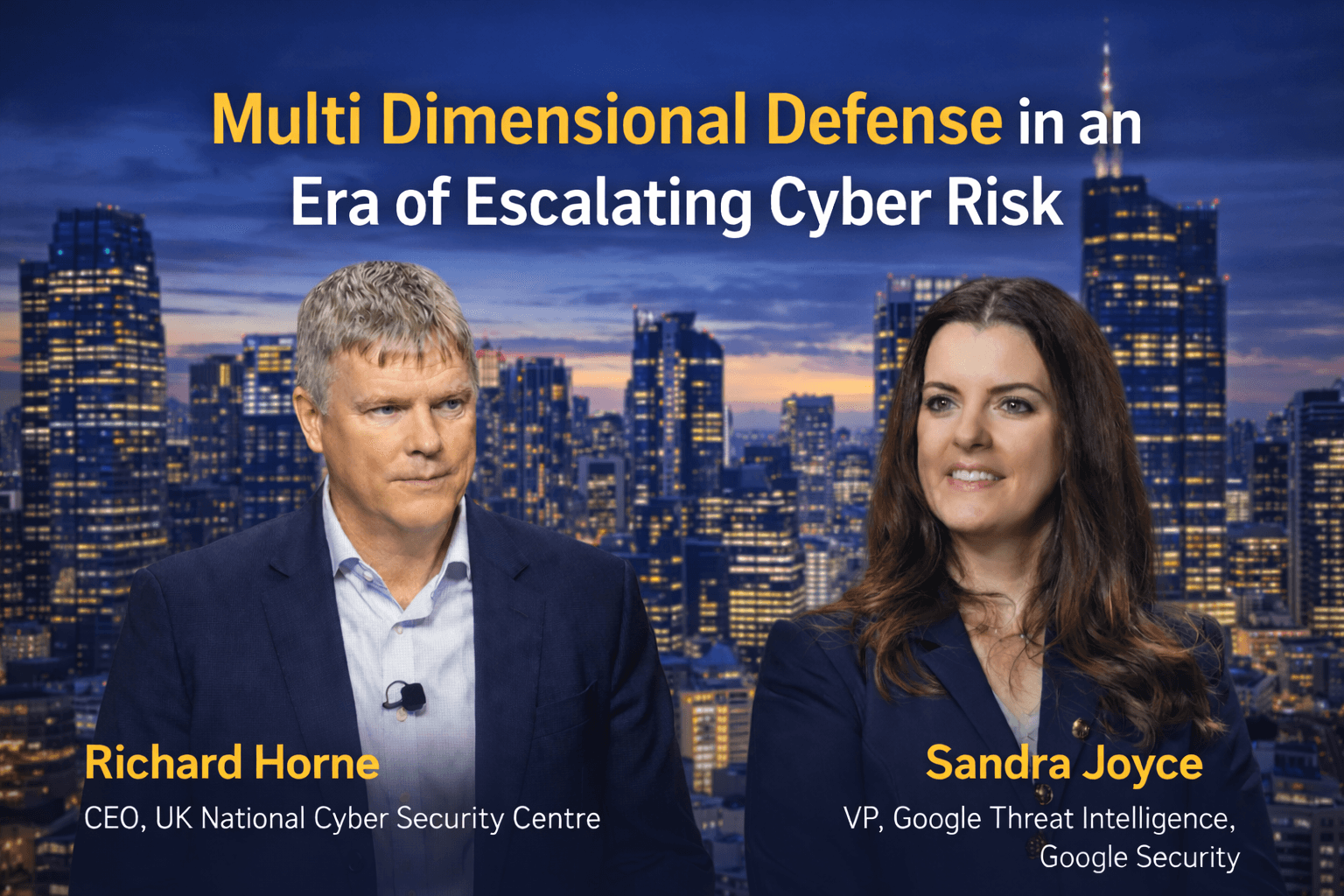
Source: The strategic insights throughout this article draw directly from a recorded discussion between Dr. Richard Horne, CEO of the UK National Cyber Security Centre (NCSC), and Sandra Joyce, VP of Google Threat Intelligence, covering global cyber threat paradigms, the future of AI in defense, and the evolution of cybersecurity leadership. Referenced timestamps are noted inline.
AI Agents vs. Agentic AI: Why the Distinction Is a Governance Fault Line
Most enterprise security teams conflate two fundamentally different concepts. An AI agent is a bounded system given a specific task with defined inputs and outputs. It runs, it reports, a human reviews. An agentic AI system, by contrast, is a self-directing architecture. It perceives its environment, sets subgoals, takes sequences of actions, and adapts based on outcomes, often without a human checkpoint between decisions. In a SOC context, this means an agentic system might autonomously quarantine an endpoint, block a traffic corridor, escalate a response protocol, and update firewall rules in a single chain of actions before any analyst has been notified. The efficiency gains are real. The accountability gap is equally real.
When Sandra Joyce pressed Dr. Richard Horne on the NCSC's approach to ai security and governance during their conversation, his answer was direct and three-part: embrace, secure, and shape. Those three words carry more strategic weight than most AI risk management frameworks published in the past two years combined. Embracing means you deploy. Securing means you build controls around those deployments. Shaping means you participate in how the technology and its regulatory environment evolve. Most enterprises are stuck at step one, calling it innovation, and skipping steps two and three entirely.
Watch: Multi Dimensional Defense in an Era of Escalating Cyber Risk
"The NCSC's position on AI is clear: embrace it, secure it, and shape it. We cannot afford to stand outside this technology. But we also cannot deploy it without building the governance architecture around it from day one." Dr. Richard Horne, CEO, UK National Cyber Security Centre"
The Paradigm Shift: From Prevention to Resilience
One of the most consequential observations in Dr. Horne's presentation was deceptively simple. He noted that the conversation in cybersecurity has fundamentally shifted away from preventing data loss toward ensuring service continuity. This is not a semantic upgrade. It is a complete reorientation of what security success looks like.
Prevention assumes you can build walls high enough. The last decade has comprehensively disproved that assumption. Cyber resilience assumes breach is inevitable and asks a different question: how quickly can your systems recover, adapt, and continue operating? For your overarching AI cybersecurity strategy, this means every AI deployment in your security stack must be evaluated not just for its detection efficacy but for its behavior during a degraded state, a contested environment, or an adversarial manipulation scenario.
Dr. Horne also outlined what he called a multi-dimensional defense approach covering near, mid, and far strategic spaces.The near space addresses immediate operational threats. The mid space involves building industry and government collaboration ecosystems. The far space is about shaping norms, regulation, and technology trajectories before adversaries do. Agentic AI governance must operate across all three spaces simultaneously, not as a compliance checkbox in the near term but as a long-horizon resilience architecture.
Five Critical Risks That Most Governance Frameworks Miss
Risk 01: Cognitive Offloading and Analyst Atrophy
When agentic systems handle triage, correlation, and initial response autonomously, SOC analysts progressively lose the muscle memory of threat judgment. Dr. Horne spoke explicitly about the importance of avoiding burnout in security teams, but the inverse problem is equally dangerous: analysts who are not burned out because they have nothing meaningful to do. When an AI handles 95% of decision-making, the 5% that escalates to a human is typically the most novel, ambiguous, and consequential threat. That is precisely the situation where a cognitively atrophied analyst is least equipped to perform. This is a structural risk hiding inside an efficiency metric.
Risk 02: Unauditable Autonomous Decisions
The core promise of AI governance in cybersecurity is accountability. If an AI system takes an action that causes service disruption, data exposure, or a regulatory violation, someone must be able to reconstruct exactly why that decision was made. Most agentic architectures deployed today cannot provide this audit trail at the granularity regulators will demand under outcome-based frameworks. Dr. Horne's discussion of the shift from compliance to outcome-based regulation is a direct warning: regulators are no longer satisfied with documentation that a process existed. They will ask what outcome the AI produced, and who is responsible for it.
Risk 03: AI-Mediated Threat Escalation
In modern conflict environments, Dr. Horne emphasized the need for resilience on the home front as cyber operations increasingly interweave with geopolitical tensions. (19:09–20:49) An agentic AI system making autonomous response decisions in that environment could inadvertently escalate a situation by misclassifying a state-level probe as a commodity attack, or conversely, treating a critical infrastructure intrusion as routine noise. The geopolitical dimension of autonomous cyber response is not being taken seriously enough in enterprise risk models. A robust ai safety governance framework at the enterprise level now has implications that reach far beyond the corporate perimeter.
Risk 04: Accountability Fragmentation Across the AI Stack
Enterprise AI deployments in security typically involve a foundation model provider, a platform integrator, a deployment team, and an operational team. When an agentic system makes a harmful decision, accountability dissolves across this chain. This is not a hypothetical. It is a governance design failure baked into how the typical AI security Governance framework is currently structured. The answer is not a longer contract. It is an architectural requirement for observable, attributable decision points at every layer of the stack.
Risk 05: Over-Reliance Masquerading as Maturity
Organizations with high AI integration scores in their security audits are increasingly being treated as mature. But high integration without high observability is not maturity. It is sophisticated fragility. Dr. Horne's description of active cyber defense as something that must be industry-led and human-directed is a critical reminder that automation is a capability multiplier, not a replacement for human command authority. The organizations that believe their AI deployment IS their strategy are the ones most vulnerable to cascading failure when the AI encounters an adversary that understands its decision boundaries better than its operators do.
This Is Not an AI Problem. It Is a Cyber Resilience Architecture Problem.
Think of the difference between an autopilot system and a pilot. An autopilot is extraordinary at executing a flight plan within known parameters. A pilot is irreplaceable when those parameters break. Agentic AI is your autopilot. Your governance framework is what ensures a pilot is always in the loop when the parameters change. Most organizations have invested heavily in the autopilot and almost nothing in the override architecture.
The Adaptive AI security Governance framework operationalizes that principle across five pillars:
Pillar 1: Human-in-the-Loop Verification Gates. Define the specific decision thresholds at which autonomous action requires human authorization. These are not general policies. They are architecture-level controls embedded in the agentic system's action space.
Pillar 2: Observable AI Decision Systems. Every consequential action taken by an agentic system must generate a structured, queryable log that maps the input state, the decision chain, and the action taken. Observability is not a post-hoc audit feature. It is a deployment prerequisite.
Pillar 3: Outcome-Based Governance Metrics. Replace compliance checkboxes with resilience outcomes. Measure mean time to human awareness, decision reversal rates, AI confidence score accuracy, and adversarial simulation performance. Align with the regulatory direction Dr. Horne outlined toward outcome-focused frameworks.
Pillar 4: Active Defense Integration Protocols. Active cyber defense requires coordination between AI systems and human decision-makers operating under time pressure. Establish clear command authority hierarchies that define when AI acts, when AI recommends, and when AI defers entirely.
Pillar 5: Continuous Resilience Validation. Red-team your AI systems the same way you red-team your infrastructure. Run adversarial simulations against the agentic system's decision logic. Test its behavior under data poisoning, prompt injection, and environmental manipulation scenarios. Resilience that has never been tested is not resilience. It is optimism.
Ready to see how a robust architecture handles autonomous decisions in real-time?
Book a demo with Samta to explore how our governance solutions secure your AI deployments.
Common Mistakes Enterprises Are Making Right Now
Over-automating the SOC without defining which decisions require permanent human oversight creates accountability vacuums that regulators will eventually fill with penalties. Treating AI deployment as the AI strategy, rather than building the gen ai governance framework, observability, and resilience layers around it, leaves the architecture structurally incomplete. Prioritizing compliance documentation over outcome measurement produces organizations that are technically certified but operationally brittle when facing novel threats. Ignoring collaboration ecosystems is another costly error Dr. Horne explicitly highlighted the strategic value of trust groups, assured providers, and information-sharing networks , and isolated AI deployments cannot benefit from the collective threat intelligence that makes active cyber defense effective. Finally, treating cybersecurity as a technology problem rather than a culture and leadership challenge remains the most persistent mistake of all. In Dr. Horne's framing, the future belongs to organizations that build resilience as an organizational value, not just a technical specification.
The Human Dimension: What AI Cannot Replace
Sandra Joyce asked Dr. Horne what the NCSC looks for in its next generation of talent. His answer was striking: diversity of thought, curiosity, and soft skills. Not technical certifications. Not AI fluency. Curiosity. The capacity to look at an anomaly and ask a question that the model was not trained to ask.
This is the human capability that agentic AI is most at risk of eroding. When analysts spend their careers validating AI decisions rather than making independent judgments, the organizational knowledge base calcifies. The next adversarial technique, by definition, will not match historical patterns. It will be the thing the AI does not recognize. The analyst who has spent three years approving AI recommendations will be the person standing between that novel threat and a catastrophic breach. Building an enterprise artificial intelligence strategy that preserves and strengthens human judgment is not a humanitarian concern. It is a competitive and national security imperative.
Practical Actions for Security Leaders
Implement AI observability infrastructure before expanding autonomous decision authority. Visibility must precede autonomy. Reference the SOC AI Monitoring Guide at Samta.ai for implementation patterns that fit enterprise environments. Red-team your agentic systems with adversarial inputs designed to probe decision boundaries, not just test for known failure modes. Introduce governance checkpoints at each stage of the agentic action chain, particularly at points of irreversibility such as network segmentation, data deletion, or external communication. Build trust-sharing networks with peer organizations and industry groups, since the intelligence that protects your organization tomorrow may come from a partner's encounter with a threat today. Shift your board-level KPIs from AI adoption rates to resilience outcomes including recovery time, human decision accuracy under AI augmentation, and adversarial simulation scores. Consult the ai cybersecurity framework at Samta.ai for a metrics architecture aligned with this approach.
The Macro Stakes: When Enterprise Risk Becomes National Risk
Dr. Horne's framing of cyber in modern conflict is not abstract. Critical infrastructure, financial systems, and communications networks are all targets in state-level adversarial operations, and they are all increasingly dependent on agentic AI systems making autonomous decisions at machine speed. An enterprise whose AI system is manipulated into self-disruption through adversarial inputs does not just experience a business continuity failure. It potentially becomes a vector in a wider campaign against national resilience. The investment imbalance is stark: organizations are pouring capital into AI capability while dramatically underfunding governance layers, human intelligence capacity, and resilience validation systems. This is not a balanced AI security Governance framework for enterprises. It is performance optimized for the demo environment and brittle in the real one.
Conclusion
The organizations that will define the next era of enterprise security are not the ones with the most sophisticated AI. They are the ones that treated governance, human judgment, and resilience architecture with the same urgency they brought to AI deployment itself. The hidden risk of agentic AI is not a bug in the model. It is a gap in the organization. Close the gap before an adversary uses it as a door.
Is your AI deciding faster than your governance can follow?
Powered by our proprietary data platform, Veda, Samta.ai works with enterprise security and AI teams to build real-time observability, governance checkpoints, and resilience validation directly into agentic AI deployments so you move fast without surrendering control or accountability. Whether you are preparing your board on your overall AI cybersecurity strategy or redesigning your SOC for an autonomous AI environment, our team will show you exactly where the gaps are and how to close them before they become incidents.
Request your governance assessment at Samta.ai and take control of what your AI is already deciding.
Frequently Asked Questions
What is the hidden risk of agentic AI in cybersecurity?
The hidden risk of agentic AI is the erosion of human control, decision accountability, and organizational resilience that occurs when autonomous AI systems are deployed in security environments without adequate governance architecture. It is not primarily a technical failure risk but a structural risk that grows as agentic systems take on more consequential decisions without observable, auditable decision trails or human verification gates.
What is an ai cybersecurity governance strategy and why does it matter?
An ai cybersecurity governance strategy is the organizational framework that defines how AI systems are authorized to act within security environments, how their decisions are monitored and audited, and how accountability is maintained when AI-driven actions cause harm. As regulators globally move toward outcome-based accountability, this governance architecture is becoming a legal and operational necessity, not just a best practice.
How can AI be a risk rather than a defense in cybersecurity?
AI becomes a risk when its deployment outpaces the governance and observability infrastructure surrounding it. Specific risk mechanisms include cognitive offloading of human analysts, unauditable autonomous decisions, adversarial manipulation of AI decision logic, accountability fragmentation across the AI supply chain, and over-reliance that creates brittle organizational response capability when the AI encounters a novel threat it was not trained to handle.
What is an AI security Governance framework for cybersecurity?
AnAI security Governance framework for cybersecurity is a structured set of policies, controls, monitoring systems, and governance checkpoints that define how AI-related risks are identified, assessed, mitigated, and reported within a security organization. Effective frameworks include human-in-the-loop verification requirements, observable decision logging, adversarial testing protocols, resilience outcome metrics, and clear accountability ownership across the AI deployment chain. Explore the full framework at the Samta.ai AI Risk Management hub.