
Summarize this post with AI
Most Singapore enterprises that fail AI transformation did not fail at the model level they failed at the readiness level. An AI readiness assessment for enterprises is the structured process that determines whether your data, governance, talent, and infrastructure can actually support the AI program your board has approved before a dollar is spent on model development. This guide covers the frameworks, tools, and assessment methodologies most commonly used by Singapore enterprises in 2026 including what each assesses, where each falls short, and how to structure an AI readiness assessment framework that produces a board-ready output rather than a generic maturity score.
AI Readiness Assessment for Enterprises:
An AI readiness assessment for enterprises in Singapore evaluates five dimensions that determine whether an organisation can deploy and sustain production AI: data readiness (quality, governance, and integration maturity), infrastructure readiness (cloud, compute, and MLOps capability), talent readiness (data engineering, ML engineering, and governance roles), governance readiness (model risk policy, PDPA compliance, and MAS TRM alignment for regulated sectors), and strategy readiness (use case prioritisation, ROI hypothesis, and board-level AI investment mandate). The most widely used AI maturity assessment frameworks in Singapore APAC enterprise context are NIST AI RMF, MIT CISR Digital Maturity Model, and MAS-aligned custom assessments each covering different dimensions and requiring different remediation outputs.
What Is AI Readiness and Why It Is Not the Same as AI Maturity
What is AI readiness versus AI maturity assessment model is a distinction most enterprises miss and it matters for how you structure the assessment and what you do with the output. AI readiness is a point-in-time evaluation of whether your organisation can begin a specific AI initiative now given your current data, infrastructure, talent, and governance state. It answers: can we start, and what must we fix before we do? AI maturity is a longitudinal measurement of how advanced your organisation's AI capability is relative to peers and best practice. It answers: where are we on the capability curve, and where do we want to be in 24 months?
A business AI readiness report should produce both: a readiness verdict for the specific initiative being planned, and a maturity baseline that informs the longer-term capability building roadmap. Organisations that run only a maturity assessment often get a benchmarking result but no actionable remediation plan. Those that run only a readiness check get a go/no-go verdict but no strategic context. Review why an AI readiness assessment matters before committing to any specific framework the assessment type must match the decision you are trying to make.
Ready to Assess Your Enterprise AI Readiness?
Why AI Readiness Assessment Matters More in Singapore in 2026
Three developments have made structured AI assessment a prerequisite rather than an optional pre-project exercise:
1. MAS model risk governance requires documented readiness evidence
MAS Technology Risk Management guidelines expect Singapore financial institutions to demonstrate that AI initiatives were scoped against a documented readiness baseline not initiated reactively. An AI security readiness assessment is increasingly required before any AI model touches regulated data or decisions. Institutions that cannot produce pre-deployment readiness documentation face governance findings during MAS examinations (Source Required: MAS TRM Guidelines).
2. Boards are requiring structured justification before AI investment
CFOs and boards across Singapore enterprise are demanding evidence that AI investment is matched to organisational capability not aspirational roadmaps. A structured AI maturity assessment with quantified gap analysis is now a standard board investment gate for AI programs above SGD 500,000 in scope (Source Required: Gartner Enterprise AI Governance Survey).
3. Failed AI programs are being traced to readiness gaps, not model gaps
McKinsey's analysis consistently shows that 70%+ of enterprise AI programs that fail to reach production do so because of data, talent, or governance gaps that a readiness assessment would have identified before project initiation (Source Required: McKinsey Global AI Survey). The AI readiness assessment tool market has grown precisely because organisations are learning this lesson expensively.
The 5-Dimension AI Readiness Assessment Framework for Singapore Enterprises
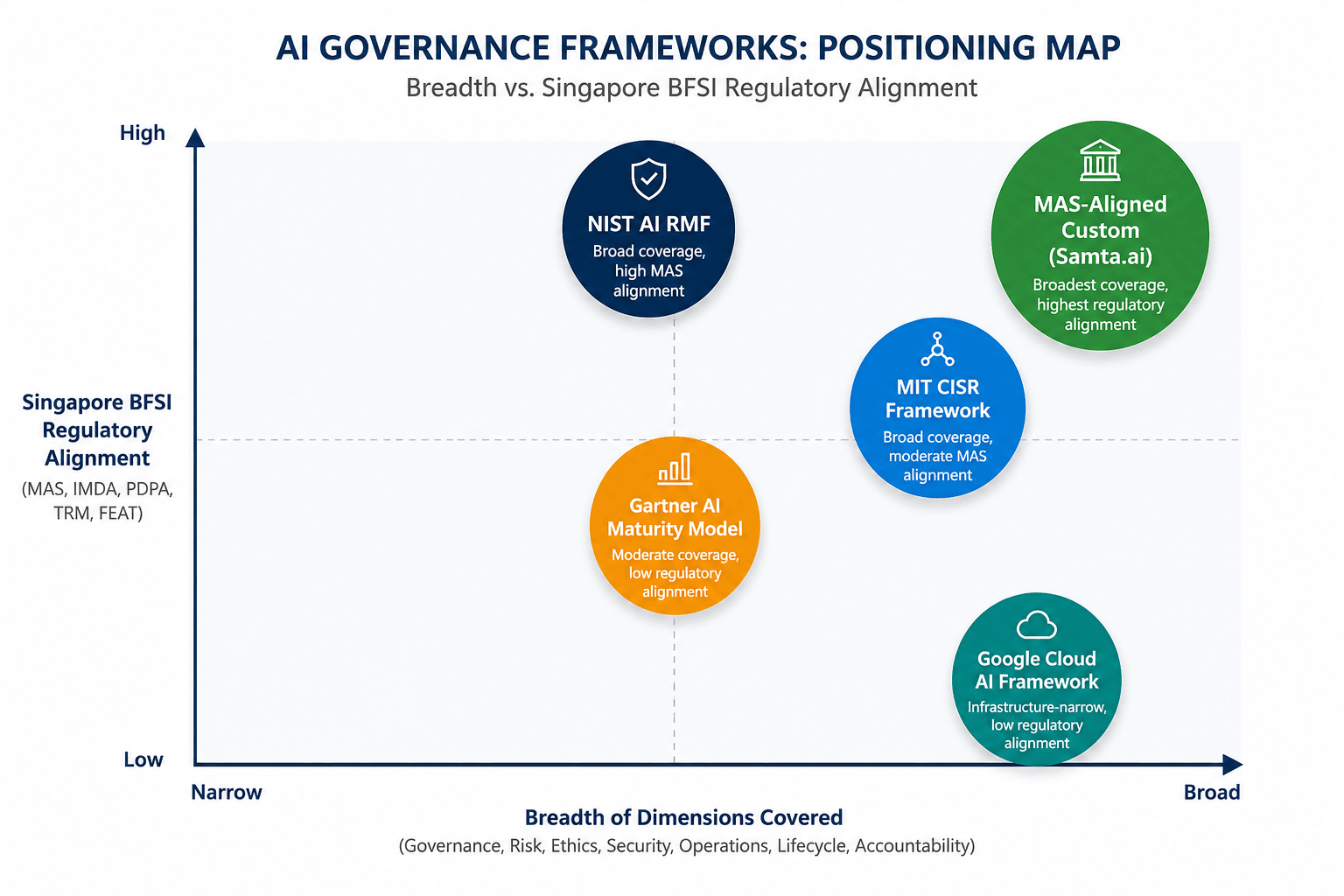
This framework covers the five dimensions that Singapore enterprise and BFSI organisations must assess before committing to an AI program:
Dimension 1: Data Readiness
Assess four data sub-dimensions: completeness (what percentage of required data exists and is accessible), quality (accuracy, consistency, and timeliness scores against defined thresholds), governance (lineage tracking, consent documentation, and access controls in place), and integration (whether data from all required source systems can be unified in a governed pipeline). A data readiness score below 65% on any sub-dimension is a go/no-go blocker for AI model development. Samta.ai's data integration consulting services assess data readiness using automated profiling on Databricks and Snowflake producing a scored, remediable data readiness report rather than a qualitative assessment narrative.
Dimension 2: Infrastructure Readiness
Assess cloud platform maturity (AWS, Azure, GCP or equivalent), compute availability for model training and inference, MLOps tooling (CI/CD pipeline, model registry, containerisation), and monitoring infrastructure (drift detection, inference logging, alerting). An organisation without a governed cloud data platform should not begin AI model development the infrastructure investment must precede the model investment.
Compare AI vs traditional development companies to understand how infrastructure readiness requirements differ between AI-native and legacy technology environments.
Dimension 3: Talent Readiness
Assess whether the five core AI engineering roles are staffed or accessible: data engineer, ML engineer, MLOps engineer, AI/model risk lead, and AI product owner. Map current internal capability against each role and identify whether gaps will be filled by hiring, upskilling, or external consulting engagement. Talent gaps take 6–18 months to close through hiring earlier identification means earlier remediation. Review the AI readiness assessment for CTOs in 2026 framework for a role-by-role talent gap analysis structure.
Dimension 4: Governance Readiness
For regulated enterprises: assess MAS TRM alignment, PDPA consent management capability, model risk policy existence, and named model risk ownership. For general enterprise: assess AI ethics policy, model card documentation standards, and audit trail infrastructure. Governance readiness below a defined threshold should block production deployment not model development. Samta.ai's AI security and compliance services assess governance readiness as a standalone workstream before any model build begins.
Dimension 5: Strategy Readiness
Assess whether the organisation has: a validated use case with a defined ROI hypothesis tied to a P&L line or regulatory metric; a board-level AI investment mandate with a defined time horizon; a prioritised use case roadmap with sequencing logic; and a defined success metric agreed between technology, business, and risk. Strategy readiness is the most frequently skipped assessment dimension and the most common root cause of AI programs that are technically completed but never deliver measurable business value. The 5-step AI readiness framework provides a structured approach to strategy readiness assessment that produces a board-presentable output rather than an internal technology team document.
Commonly Used AI Readiness Assessment Tools and Frameworks in Singapore
Framework 1: NIST AI Risk Management Framework (AI RMF)
The NIST AI RMF provides a four-function structure Map, Measure, Manage, Govern that covers governance and risk readiness comprehensively. It is most applicable to organisations with existing NIST cybersecurity framework alignment and is increasingly referenced alongside MAS TRM for BFSI readiness assessments in Singapore.
Framework 2: MIT CISR Digital Maturity Model
MIT's Centre for Information Systems Research digital maturity model assesses AI readiness across operational backbone and digital platform dimensions. It is widely used for general enterprise readiness benchmarking but requires customisation for BFSI-specific regulatory requirements.
Framework 3: MAS-Aligned Custom Assessment
For Singapore BFSI specifically, the most examination-relevant assessment is a custom framework mapped directly to MAS TRM, FEAT, and VERITAS requirements covering data lineage, model risk policy, PDPA compliance, and audit trail capability. No off-the-shelf framework provides this alignment out of the box. Samta.ai's digital transformation managed services deliver MAS-aligned custom readiness assessments as a structured 4–6 week engagement producing a scored, remediable output across all five dimensions.
Framework 4: Google Cloud AI Readiness Assessment
Google's AI readiness tool assesses infrastructure and data maturity on GCP-native architecture. It is most applicable to organisations already committed to GCP and provides useful infrastructure scoring but limited governance and talent dimension coverage.
Framework 5: Gartner AI Maturity Model
Gartner's five-level AI maturity model (Aware → Active → Operational → Systemic → Transformational) provides a benchmarking baseline for board presentations but does not produce a use-case-specific readiness verdict or a remediable gap analysis. It is best used as a strategic context tool alongside a deeper dimensional assessment.
AI Readiness Assessment for Enterprises: 5-Column Framework Comparison
Framework | Dimensions Covered | Singapore BFSI Alignment | Output Type | Best Used For |
NIST AI RMF | Governance, risk, manage, govern | Strong — maps to MAS TRM | Risk management profile | Regulated sector governance baseline |
MIT CISR Digital Maturity | Data, platform, operations | Moderate — needs customisation | Maturity benchmark | General enterprise strategic context |
MAS-Aligned Custom (Samta.ai) | All 5 dimensions + MAS TRM/FEAT/VERITAS | Native — built for Singapore BFSI | Scored gap analysis + remediation roadmap | BFSI use-case-specific readiness verdict |
Google Cloud AI Readiness | Infrastructure, data | Low — infrastructure-focused | Infrastructure gap report | GCP-committed organisations |
Gartner AI Maturity Model | Strategy, operations, culture | Low — generic global benchmark | Maturity level classification | Board benchmarking and investment justification |
Identify Hidden Risks Across Your AI Models
Real-World Use Cases: AI Readiness Assessment in Singapore Enterprise
Use Case 1: Regional Bank, Singapore (BFSI)
A Singapore-licensed bank was six months into an AI credit decisioning program when its model risk team flagged that no data lineage documentation existed for the training pipeline and no PDPA consent basis had been established for the bureau data being used. The program was paused while governance remediation was completed adding 14 weeks and SGD 320,000 in unplanned cost. A pre-program AI readiness assessment framework assessment specifically Dimension 4 governance readiness would have identified both gaps before project initiation. The bank subsequently adopted a mandatory readiness assessment gate before every AI program initiation, using the AI readiness assessment structure as its internal standard.
Use Case 2: Logistics Conglomerate, Southeast Asia (General Enterprise)
A regional logistics group commissioned an AI demand forecasting program without assessing data readiness first. When model development began, the data engineering team discovered that inventory data across 9 markets existed in 7 different systems with incompatible schemas and no shared product master. The first 4 months of the 12-month program were consumed by unplanned data remediation. A structured AI maturity assessment covering data readiness in Dimension 1 would have surfaced the data integration gap during scoping allowing the program timeline and budget to reflect the true starting point. The AI readiness vs AI maturity distinction is exactly what this use case illustrates: the organisation had sufficient AI maturity ambition but insufficient data readiness to act on it.
Key Risks When AI Readiness Assessment Is Skipped or Done Poorly
Readiness assumed from maturity: high AI maturity scores do not guarantee readiness for a specific use case; a bank can be Gartner Level 4 mature and still have a data lineage gap that blocks a specific model's production deployment
Governance dimension omitted: assessments that cover only data and infrastructure and skip governance readiness produce a misleading go-signal for regulated enterprises; the governance gap is consistently the most expensive to remediate post-deployment
Assessment used as justification, not evaluation: readiness assessments commissioned to justify a program that leadership has already committed to consistently miss critical gaps because the framing predetermines the output
No remediation roadmap produced: assessments that produce a score without a prioritised, sequenced remediation plan are not actionable; the output must specify what to fix, in what order, and at what cost
Single-dimension assessment: assessing only data readiness or only infrastructure readiness without covering talent, governance, and strategy produces partial visibility that creates false confidence
The VEDA AI Data Analytics Platform integrates readiness monitoring into the ongoing AI program tracking data quality, model performance, and governance compliance continuously so that readiness is maintained post-assessment, not just measured at program initiation.
Decision Framework: Which AI Readiness Assessment Approach Fits Your Organisation
Use a MAS-aligned custom assessment when:
Your organisation is a Singapore-regulated financial institution with MAS TRM examination obligations
The planned AI use case involves customer data, credit decisions, fraud detection, or insurance underwriting
Your board requires a readiness-to-invest report before approving AI program funding
Use NIST AI RMF when:
You have existing NIST cybersecurity framework alignment and want to extend it to AI governance
Your organisation operates across multiple jurisdictions and needs a globally recognised framework baseline
Your primary readiness gap is in governance and risk management rather than data or infrastructure
Use a combined maturity plus readiness approach when:
You need both a board-level strategic benchmark and a use-case-specific go/no-go verdict
Your AI program spans multiple use cases with different readiness requirements across the portfolio
You want to track readiness improvement over time as a KPI alongside program delivery milestones
Start Your AI Transformation with Expert Advice
Conclusion
An AI readiness assessment for enterprises is not a formality before an AI program it is the risk management discipline that determines whether your program reaches production or stalls in a data remediation cycle. The frameworks, tools, and methodologies covered in this guide give Singapore enterprise and BFSI leaders a structured basis for evaluating readiness across all five dimensions not just the ones that are easiest to measure. Assess before you invest. Remediate before you build. Govern before you deploy. That sequence consistently produces better AI program outcomes than the alternative.
About Samta
Samta.ai is a Singapore-headquartered AI Product Engineering & Data Intelligence partner helping enterprises build production-grade AI systems for regulated and data-intensive environments.We help organizations move beyond experimentation by engineering scalable, explainable, and enterprise-ready AI solutions from data foundations and model development to workflow automation and deployment.
Our capabilities combine deep AI expertise, data engineering, and product engineering to deliver measurable business impact across FinTech, BFSI, cybersecurity, regulatory technology, and enterprise operations.
Our enterprise AI products power real-world intelligence systems:
• TATVA : AI-driven data intelligence platform for governed analytics, monitoring, and operational insights
• VEDA : Explainable and audit-ready AI decisioning engine built for compliance-sensitive enterprise workflows
• CORA-Property Management Solutions: : Predictive intelligence platform for real-estate pricing, portfolio optimization, and investment analytics
Backed by ecosystem partnerships with Microsoft, Databricks, Snowflake, and AWS, Samta.ai delivers agile, cost-efficient AI engineering with faster turnaround and enterprise-grade scalability. Trusted by enterprises across FinTech, BFSI, and digital transformation initiatives, Samta.ai embeds AI governance, data privacy, and compliance-by-design principles directly into the AI lifecycle , enabling organizations to scale AI with transparency, accountability, and operational control.
Enterprises leveraging Samta.ai automate 65%+ of repetitive data, analytics, and decision workflows while maintaining governance, explainability, and measurable business outcomes. Samta.ai provides the strategic consulting, AI engineering, and data modernization expertise needed to align enterprise operations with next-generation AI transformation goals.
Frequently Asked Questions
What is an AI readiness assessment for enterprises?
An AI readiness assessment for enterprises is a structured evaluation of an organisation's capability to initiate, deploy, and sustain AI programs covering data quality and governance, infrastructure and MLOps maturity, talent availability, governance and regulatory compliance, and strategy and use case readiness. The output is a scored gap analysis and prioritised remediation roadmap not a generic maturity level that gives leadership a specific, actionable investment decision rather than a benchmarking narrative.
What is the difference between AI readiness and AI maturity?
What is AI readiness versus AI maturity assessment model: AI readiness is a point-in-time, use-case-specific evaluation of whether you can start a specific AI initiative now given your current state. AI maturity is a longitudinal benchmark of how advanced your overall AI capability is relative to peers. A mature organisation can still be unready for a specific use case if its data lineage, governance documentation, or talent profile does not match that use case's requirements.
What tools are used for AI readiness assessment in Singapore?
Commonly used AI readiness assessment tools in Singapore include: NIST AI Risk Management Framework for governance and risk dimension assessment; MIT CISR Digital Maturity Model for strategic and operational benchmarking; MAS-aligned custom assessments for BFSI-specific regulatory readiness; Google Cloud AI Readiness for infrastructure-focused evaluation on GCP; and Gartner AI Maturity Model for board-level benchmarking. For Singapore regulated enterprises, MAS-aligned custom assessments consistently produce the most actionable output.
How long does an AI readiness assessment take?
A structured AI readiness assessment framework engagement covering all five dimensions typically takes 3–6 weeks for a mid-to-large Singapore enterprise, depending on the number of use cases being assessed and the complexity of the data and governance environment. Lighter-touch assessments covering only data and infrastructure dimensions can be completed in 2–3 weeks but should not be used as the basis for a full program investment decision without the governance and strategy dimensions also being assessed.
What is an AI security readiness assessment?
An AI security readiness assessment evaluates whether an organisation's AI infrastructure, models, and data pipelines are protected against adversarial ML attacks, data poisoning, model inversion, and prompt injection and whether security controls satisfy MAS TRM, PDPA, and sector-specific obligations. For Singapore BFSI and cybersecurity technology firms, AI security readiness is a distinct assessment layer on top of general AI readiness covering threat modelling, adversarial robustness testing, and regulated data handling controls.