
Summarize this post with AI
Enterprise boardrooms across the globe are signing off on AI governance frameworks, referencing the OECD AI Principles, ticking boxes for EU AI Act compliance, and publishing responsible AI charters that would make any regulator smile. Yet inside those same organizations, agentic AI security risks are multiplying in the dark, models are drifting without detection, and the humans who were supposed to stay in the loop have quietly stepped out because nobody built a mechanism to keep them there. The gap between global policy ambition and enterprise execution is not philosophical it is an active, escalating security and compliance liability that most organizations are dramatically underprepared to confront.
TL;DR: Executive Summary
Policy is not execution. The global AI governance framework landscape has matured significantly, but the enterprise execution layer remains dangerously thin.
Agentic AI rewrites the risk map. Agentic AI security risks are fundamentally different because agents act, chain decisions, and escalate autonomously without waiting for human approval.
Shadow AI is the new shadow IT. Unauthorized model deployments are proliferating faster than any AI risk management platform is currently tracking them.
Human-in-the-loop is governance fiction unless operationally enforced. Most enterprises have it in policy. Almost none have it in workflow.
The fix is not another framework. It is verifiable, continuous governance execution backed by real-time observability and AI compliance software.
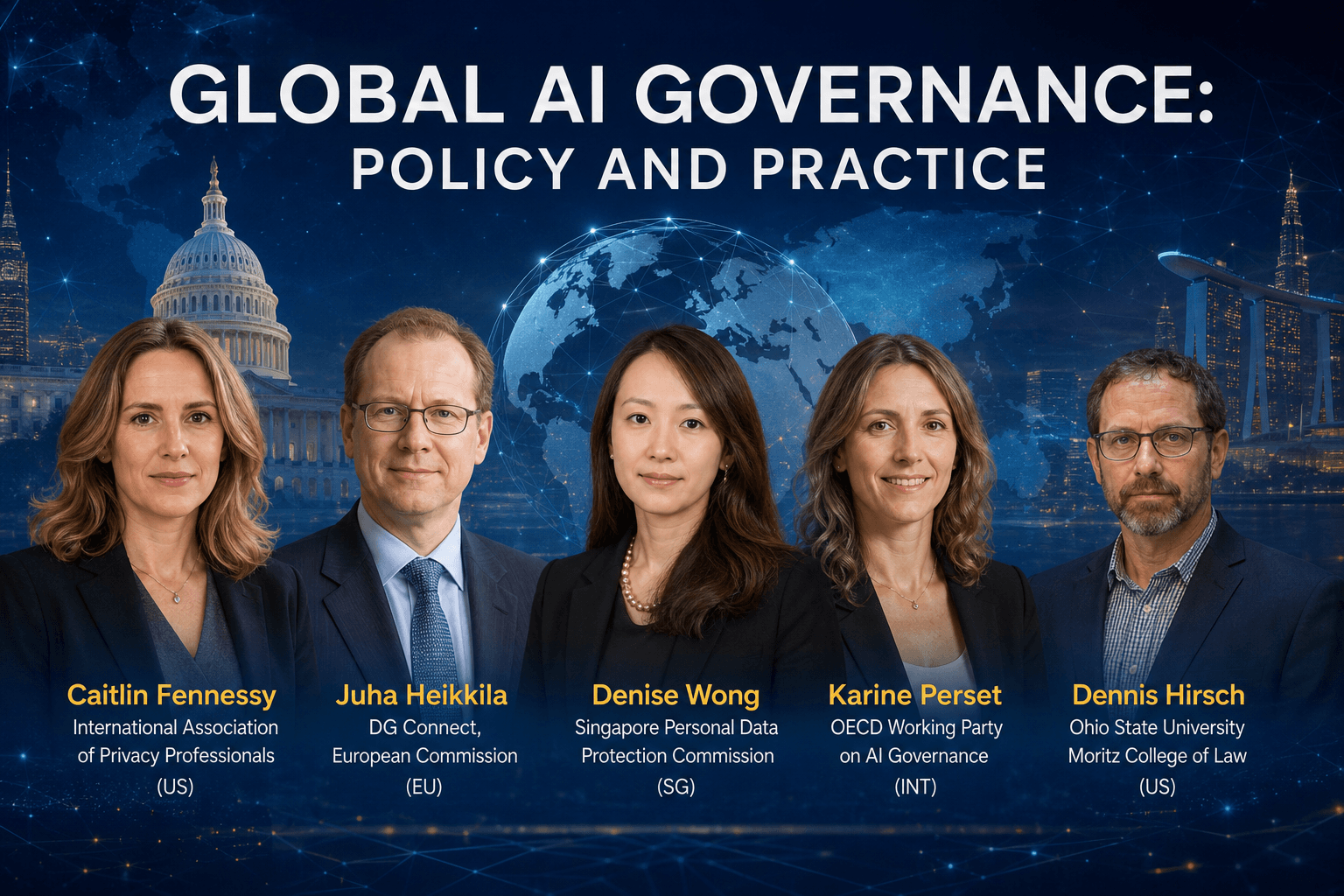
"Global AI Governance: Policy and Practice" CPDP 2023 Featuring Caitlin Fennessy (IAPP, Moderator), Juha Heikkila (European Commission), Denise Wong (Singapore PDPC), Karine Perset (OECD), Dennis Hirsch (Ohio State University)
AI Agents vs Agentic AI Why the Distinction Matters for Your SOC
Most organizations conflate the two terms and pay for it in audit findings. An AI agent performs a bounded task summarize a ticket, classify an email, flag a transaction and its outputs are typically reviewed before action is taken. Agentic AI refers to systems that pursue goals across multi-step sequences, invoke tools, query APIs, modify data, and make cascading decisions without pausing for human review.
In a SOC AI risks context, the difference is critical. An AI agent that flags anomalies for analyst review is manageable. An AI agentic framework that autonomously triages, escalates, and remediates security incidents is operating as decision infrastructure. When that infrastructure fails or drifts, it does not produce a wrong suggestion it executes a wrong action. To understand this distinction further, read Samta.ai's deep-dive on Agentic AI vs Traditional AI Approaches.
The Paradigm Shift Nobody Has Fully Priced In
Dennis Hirsch of Ohio State University, speaking at CPDP 2023, identified the central blind spot: organizations have sophisticated processes for answering "Can we deploy this AI system?" but almost no infrastructure for answering "Should we?" His research identified five components companies genuinely need top-level commitment, substantive standards, management processes, management structures, and culture building. Most enterprises have the first and stop there.
Karine Perset of the OECD reinforced that the OECD AI Principles grounded in equity, human rights, privacy, transparency, and accountability are a foundation, not an execution playbook. The distance between a principle like "accountability" and a technical control like enforced human-in-the-loop AI review for high-stakes automated decisions is enormous, and crossing it requires operational investment most enterprises have not made. For a structured approach to crossing that gap, see Samta.ai's AI Governance Framework 2026 Guide.
"AI is no longer a tool your teams use. It is infrastructure your organization runs on. Governing infrastructure requires observability, not just policy." Samta.ai AI Governance Practice
Six Agentic AI Security Risks Already Inside Your Enterprise
01. Cognitive Offloading When AI systems handle analysis and triage at scale, human operators stop developing the intuition needed to catch model errors. SOC analysts relying on AI risk management tooling for alert prioritization already show reduced proficiency in unassisted threat assessment. When the model fails, the human who was supposed to catch it cannot. This is explored in depth in Samta.ai's guide on AI vs Human Decision-Making.
02. Unauditable Autonomy Black box decisioning inside AI agentic frameworks leaves no interpretable audit trail. When a regulator asks why your system denied that loan or escalated that incident, your team cannot answer. As Juha Heikkila of the European Commission explained at CPDP 2023, under the EU AI Act risk classification for high-risk systems, this is not a minor gap it is a foundational breach of the transparency requirement. Review Samta.ai's EU AI Act Readiness Guide to assess your current exposure.
03. Silent Model Failures Models do not announce when they start performing poorly. Model drift monitoring gaps mean an AI system trained on pre-2024 threat patterns may be classifying today's adversarial signals against an outdated threat landscape — and still returning confident-looking outputs nobody flags until the breach inquiry begins. See why Model Lifecycle Management is a non-negotiable governance control.
04. Accountability Gaps Across Jurisdictions Karine Perset and Juha Heikkila discussed at CPDP 2023 the urgent need for cross-border AI incident reporting frameworks because a model deployed in Singapore, trained in the EU, and serving US enterprise customers triggers regulatory obligations in multiple jurisdictions simultaneously. Most organizations have no mechanism to address even one of them. Samta.ai's NIST AI RMF Implementation Walkthrough provides a starting point for multi-framework alignment.
05. Shadow AI Proliferation Shadow AI discovery is the defining governance challenge of 2026. Business units are deploying LLMs and fine-tuned models outside IT and security visibility. Unlike shadow IT, shadow AI does not just store data it makes decisions on it. Every unauthorized deployment is an ungoverned node in your AI risk surface. Learn how to identify and contain it in Samta.ai's Shadow AI and Model Monitoring Guide.
06. Algorithmic Bias Reinforcement Algorithmic bias mitigation appears in every major framework from OECD to NIST AI RMF. It is almost universally absent from operational programs. When a high-risk AI system makes biased decisions at scale, regulatory exposure and reputational damage compound quietly by design, they surface slowly. Samta.ai's AI Risk Assessment Templates include bias monitoring checkpoints aligned to SR 11-7 and EU AI Act requirements.
The Control Problem, Not the Tooling Problem
The reason enterprises are failing at AI risk management is not a shortage of AI tools. Most have deployed dozens. The failure is no centralized visibility into what those tools are doing, how they are influencing decisions, and whether the humans nominally overseeing them have the context and capacity to intervene meaningfully.
Consider commercial aviation. A modern aircraft is 90% automated. But the pilot is not an afterthought the pilot is the governance layer. They have full instrument visibility, override authority, training protocols, and mandatory incident reporting obligations. Enterprise AI governance programs are deploying the automation without building the cockpit, staffing it without training the pilots, and operating it without incident reporting. Denise Wong of Singapore's PDPC described Singapore's outcome-based model as a "horizontal piece" sectoral regulators can dock into prioritizing agility without sacrificing accountability. That architectural philosophy is exactly what enterprise AI governance needs to replicate internally. Read how Gen AI Governance Controls can operationalize this at scale.
The VEGA Framework: Verifiable Enterprise Governance for Agentic AI
Samta.ai's VEGA Framework translates global policy commitments into operational controls that are implementable, measurable, and auditable not aspirational.
Pillar 1: Observability Real-time visibility into all model inputs, outputs, decisions, and chained actions across every deployment. Shadow AI discovery begins here. No governance without inventory.
Pillar 2: Human-in-the-Loop Enforcement Operationally enforced human-in-the-loop AI checkpoints for decisions above defined risk thresholds. Policy language is not enforcement. Technical gates are.
Pillar 3: Risk Classification Alignment Map every model against EU AI Act risk classification, NIST AI RMF implementation, and model risk management tiers. Know which systems require highest scrutiny before something fails.
Pillar 4: Continuous Validation Automated model drift monitoring, algorithmic bias mitigation checks, and performance degradation alerts running continuously, not periodically. See how AI Model Monitoring operationalizes this pillar.
Pillar 5: Governance Automation Deploy AI compliance software and automated AI governance tools to enforce policies at the model layer, not the policy document layer. Governance embedded in the workflow not bolted on after the fact. Explore Samta.ai's AI Governance Platforms Compared to find the right tooling fit.
Five Governance Failures Most Enterprises Are Making Right Now
01. Treating AI governance as a compliance checkbox. The EU AI Act is not a checklist. Organizations checking boxes without building control infrastructure are producing documented evidence of governance theater.
02. Ignoring shadow AI as an IT problem. Every unregistered model in your environment is an ungoverned decision system operating on your data. This is a CISO problem, not a helpdesk ticket.
03. No centralized AI inventory or visibility layer. You cannot govern what you cannot see. Most enterprises have no single source of truth for what models are deployed, what decisions they influence, and what data they consume. Review the AI Governance Platform Buyer's Guide to identify the visibility gaps in your current stack.
04. Over-trusting black box systems in high-risk decisions. If your organization cannot explain a model's decision to an auditor or regulator, you should not be using that model for that decision. Full stop.
05. Conflating human presence with human oversight. Having a human nominally responsible for an AI-driven process is not oversight. Oversight requires visibility, authority, and the training to exercise it under pressure. The Future of AI Governance report examines how leading enterprises are redesigning oversight structures for agentic environments.
Actions to Take Before Your Next Board Presentation
Deploy a shadow AI discovery scan across your enterprise environment the number of unauthorized model deployments will surprise your CISO. Implement continuous model drift monitoring on every production AI system because silent failures happen at the edges first. Map your AI portfolio against EU AI Act risk tiers and NIST AI RMF categories and identify which systems are operating in high-risk classifications without corresponding controls. Build operationally enforced human-in-the-loop checkpoints actual technical gates, not policy language for all agentic AI decisions above a defined consequence threshold. Integrate AI incident reporting into your existing SOC workflow, aligned to the cross-jurisdictional reporting frameworks OECD and the EU are developing collaboratively. Do not wait for the mandate. Commission a full AI Risk Assessment that covers your complete model inventory including third-party and embedded models you do not directly control.
The Governance Investment Deficit
Enterprises are spending aggressively on AI infrastructure compute, model access, integration, and deployment tooling. Investment in AI risk management platform capabilities, continuous monitoring, compliance alignment, and AI data governance automation represents a fraction of that spend. This is structurally backwards. The higher your AI deployment footprint, the higher your governance investment must scale. Organizations that do not close this gap are not just accepting risk they are amplifying it in direct proportion to their AI ambition. The AI Governance Compliance Guide outlines where the investment imbalance is most acute and where to start correcting it.
Conclusion
The global AI governance framework conversation has reached genuine policy maturity. OECD principles are refined. The EU AI Act is real law. Singapore's model is instructive and exportable. What has not matured is enterprise execution. The organizations that will navigate the next phase agentic AI security risks, foundation model propagation, cross-border accountability will not be the ones with the most sophisticated governance documents. They will be the ones with the most disciplined, observable, and continuously validated governance operations. The gap between knowing what good governance looks like and being able to prove you are doing it is where the real risk lives, and it is widening every quarter you delay.
Is Your AI Governance Built for What Agentic AI Actually Does?
Samta.ai combines real-time AI risk monitoring, automated compliance alignment across EU AI Act, NIST AI RMF, and SR 11-7, with continuous model observability purpose-built for enterprises that need governance to work in production and not just on paper. Start with a 30-minute AI risk assessment and leave with a clear, board-ready picture of your exposure across every deployed model in your environment before your next audit, your next regulatory inquiry, or your next incident forces the conversation.
About Samta
Samta.ai is an AI Product Engineering & Governance partner for enterprises building production-grade AI in regulated environments.
We help organizations move beyond PoCs by engineering explainable, audit-ready, and compliance-by-design AI systems from data to deployment.
Our enterprise AI products power real-world decision systems:
TATVA : AI-driven data intelligence for governed analytics and insights
VEDA : Explainable, audit-ready AI decisioning built for regulated use cases
Property Management AI : Predictive intelligence for real-estate pricing and portfolio decisions
Trusted across FinTech, BFSI, and enterprise AI, Samta.ai embeds AI governance, data privacy, and automated-decision compliance directly into the AI lifecycle, so teams scale AI without regulatory friction.
Enterprises using Samta.ai automate 65%+ of repetitive data and decision workflows while retaining full transparency and control.
Samta.ai provides the strategic consulting and technical engineering needed to align your human capital with your AI goals, ensuring a frictionless.
Frequently Asked Questions
What is a global AI governance framework and why does it matter for enterprise security?
A global AI governance framework is a structured set of principles, standards, and regulatory requirements such as the OECD AI Principles, the EU AI Act, and Singapore's Model AI Governance Framework that define compliance obligations and risk control expectations for every AI system inside a regulated organization. Without aligning to one, enterprises have no defensible baseline when regulators, auditors, or incident investigators come calling.What is the difference between agentic AI and AI agents?
AI agents perform discrete, bounded tasks with defined inputs and outputs. Agentic AI refers to multi-step, goal-pursuing systems that chain actions, invoke tools, and make cascading decisions autonomously. AI risk management for agentic systems requires continuous observability and enforced human-in-the-loop checkpoints that traditional agent-monitoring approaches do not provide.What are the hidden agentic AI security risks most enterprises are not measuring? The highest-impact hidden agentic AI security risks include silent model failures, shadow AI proliferation, cognitive atrophy in human oversight teams, and AI-mediated reality fragmentation where different enterprise functions operate on AI-generated information that is factually incompatible with each other.
How do SOC teams manage AI risks from agentic systems in production?
Managing SOC AI risks requires integrating AI observability into security operations workflows deploying model drift monitoring, enforcing human-in-the-loop review for high-consequence decisions, maintaining a live AI system inventory, and building incident response playbooks aligned to cross-jurisdictional reporting requirements.What is shadow AI and why is it urgent?
Shadow AI discovery refers to identifying AI models deployed without formal IT, security, or governance approval. Unlike shadow IT, shadow AI makes decisions on your data not just stores it. In 2026, most large enterprises have significant ungoverned AI decision-making operating inside their data perimeter without any risk classification, monitoring, or accountability structure in place.