
Summarize this post with AI
Most enterprises talking about agentic workflow automation singapore wide are still describing something narrower, an AI copilot helping one employee move faster, not a process that runs end to end without a human touching each step. That distinction matters more than it sounds. Singapore's agentic AI adoption more than doubled from 22% to 51% between 2025 and 2026, according to ServiceNow's Enterprise AI Maturity Index, but only 10% of enterprises have actually redesigned a process so agents complete multi step business tasks autonomously. Most of the growth is assistive AI wearing an agentic label, not the real thing.
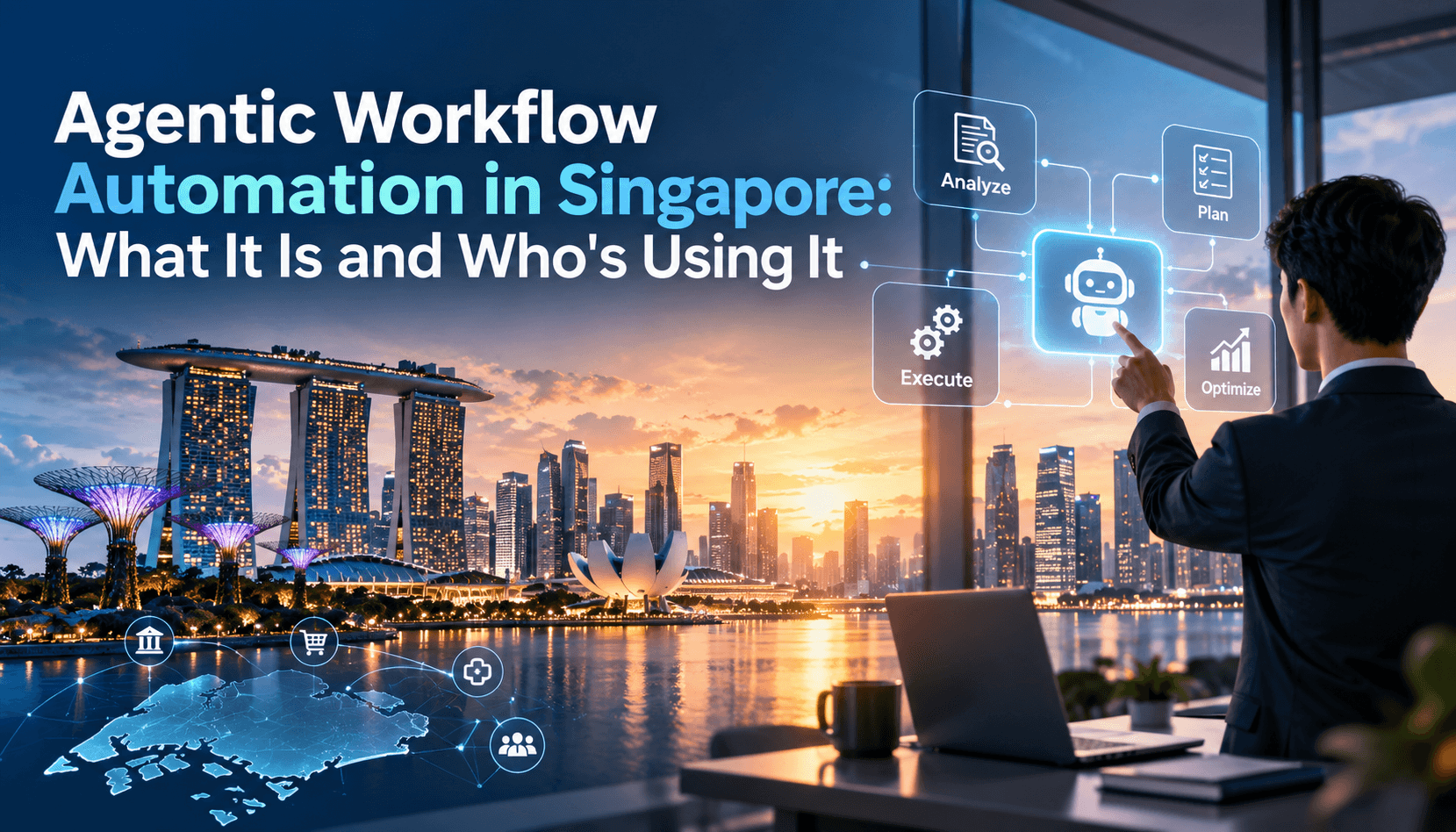
Agentic Workflow Automation Singapore:
Agentic workflow automation singapore enterprises are building involves AI agents that plan, execute, and complete multi step business tasks with minimal human intervention, distinct from assistive AI that helps an individual employee work faster. ServiceNow's 2026 Enterprise AI Maturity Index found Singapore's agentic AI adoption rose to 51% of enterprises, up from 22% the year before, yet only 10% have reworked processes for true end to end autonomous execution, while 33% remain at the assistive, individual support stage. Singapore leads global peers on six of seven AI maturity dimensions but trails specifically on AI enabled workflows, the pillar that converts investment into measurable business return.
What agentic workflow automation actually is
Agentic workflow automation uses AI agents capable of planning a sequence of actions, calling tools, and adapting to outcomes along the way, rather than following a fixed script the way traditional robotic process automation does. Multi agent orchestration extends this further, coordinating several specialized agents, one drafting, another validating, a third executing, across a single business process.
This differs meaningfully from earlier automation approaches. A traditional workflow tool executes the same steps regardless of context. An agentic system can replan when a step fails, request human input at a defined checkpoint, or hand off to another agent mid process. Our guide on how AI powered workflow automation differs from traditional automation covers this distinction in more technical depth, and our overview of agentic AI engineering architecture covers what actually needs to be built to support it.
Why the adoption gap matters now in 2026
Agentic ai adoption in Singapore has a specific shape worth understanding before an institution assumes it is further along than it actually is.
The headline growth number overstates true agentic maturity. Agentic AI adoption more than doubled year over year, but ServiceNow's own researchers note most of that growth reflects assistive use, not autonomous end to end workflows.
Singapore's government has named agentic AI a national priority. Prime Minister Lawrence Wong announced a National AI Council in February 2026 to oversee AI missions across four sectors, advanced manufacturing, connectivity, finance, and healthcare, chosen specifically because they combine high volume workflows with high stakes governance needs.
Financial incentives are accelerating adoption among smaller enterprises. Singapore's Enterprise Innovation Scheme now permits businesses to claim 400% tax deductions on qualifying AI expenditure, capped at S$50,000 annually for 2027 and 2028, specifically to help SMEs move past pilot stage.
Our overview of agentic AI transformation covers how enterprises are sequencing this shift, and our broader AI governance framework for 2026 roadmap covers the governance layer that needs to scale alongside adoption.
How to move from assistive AI to true agentic workflow automation
Closing the gap between adoption headlines and genuine end to end automation follows a consistent progression.
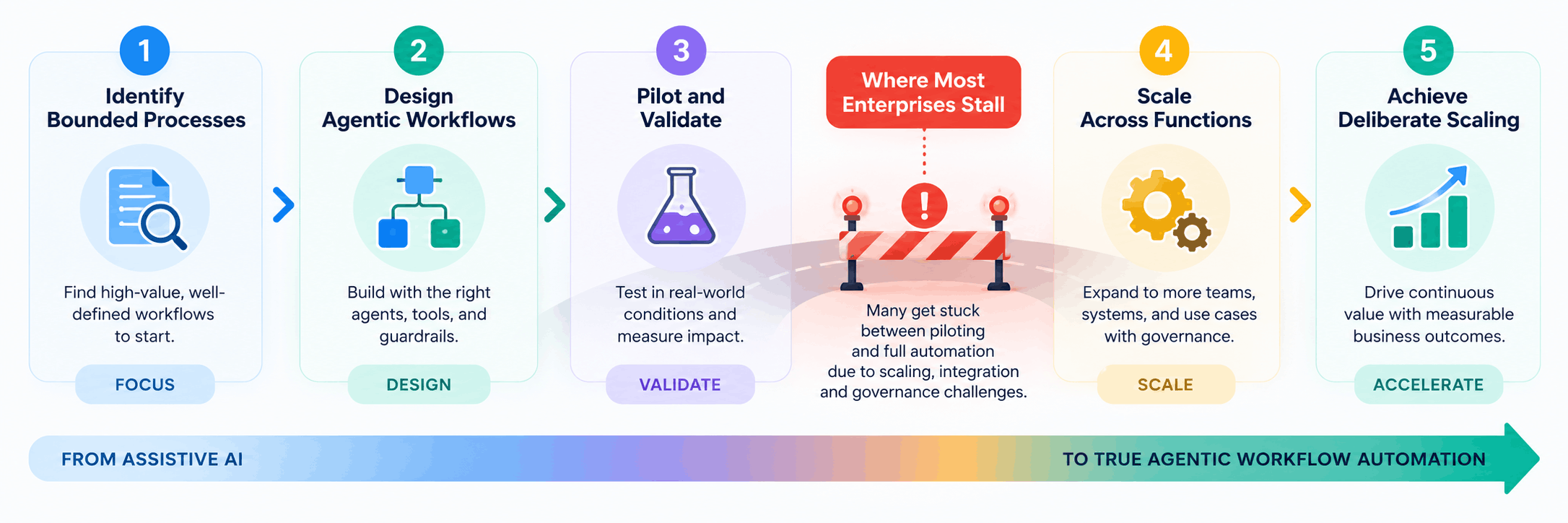
Identify a bounded, repeatable process first. High volume, well defined tasks, invoice processing or lead qualification, are easier starting points than open ended, judgment heavy workflows.
Scope a single agent to a narrow task before orchestrating multiple agents. Multi agent orchestration adds coordination risk that is easier to manage once a single agent's behavior is well understood.
Build human checkpoints into the process design, not as an afterthought. Defining where a human reviews or approves an action before deployment is far easier than retrofitting oversight later.
Test the agent's behavior under failure conditions, not only success paths. An agent that handles the happy path well but has no defined behavior for exceptions is not ready for production.
Scale from a single process to adjacent ones only after the first is stable. The 10% of Singapore enterprises with genuine end to end automation typically reached that point by expanding deliberately, not all at once.
This is where the engineering execution layer matters. Samta.ai builds agentic workflows on the VEDA AI decision analytics platform, integrating with existing Databricks, Snowflake, or Microsoft data infrastructure so agents work against data institutions already trust rather than a separate, disconnected pipeline. Our workflow automation consulting service scopes this progression against an institution's specific processes rather than a generic template, and for institutions further along, our digital transformation managed services take over ongoing operation once an agentic workflow moves past its initial pilot. Institutions weighing whether a general data platform can support this should see how VEDA compares to other data intelligence platforms, and the VEDA platform itself is built to support both the agentic execution layer and the governance evidence agentic AI requires in one system.
Agentic workflow adoption tiers in Singapore at a glance
Adoption Tier | Singapore Enterprise Share | What It Looks Like | Governance Maturity Needed | Typical Use Case |
No Progress | 18% | No formal agentic AI adoption underway | Baseline AI usage policy only | Firms yet to begin AI transformation |
Assistive AI Only | 33% | AI helps individual employees with day to day tasks | Standard AI usage and data handling policy | Copilots, drafting assistance, research support |
Piloting Agentic Workflows | Growing share, between assistive and full automation | Small, controlled agent pilots on a defined task | Pilot specific escalation review and monitoring | Lead qualification, invoice processing pilots |
Partial Workflow Automation | Growing share as pilots mature | Agents handle multi step tasks within a bounded process | Tiered model risk oversight and runtime monitoring | Fraud triage, multi step document processing |
Full End to End Agentic Workflows | 10% | Multi step business tasks completed autonomously end to end | Full agentic governance framework with runtime checkpoints | Cross functional processes redesigned entirely around agents |
Get a Clear View of Your AI Model Risk Exposure
Real world enterprise use cases
BFSI: a bank piloting agentic workflows in fraud triage
A bank in Singapore's finance sector, one of the four sectors named under the National AI Council's AI missions, piloted an agentic workflow to triage suspicious transaction alerts, with agents gathering context and drafting a recommendation before a human analyst made the final call. Working through agentic AI governance considerations early meant the pilot had defined escalation paths from day one, rather than retrofitting them once the pilot proved useful and pressure mounted to scale it quickly.
General enterprise: a manufacturing firm redesigning a procurement process
A manufacturing firm, also named under the National AI Council's priority sectors, moved from assistive AI, used mainly for drafting purchase order summaries, to a genuine agentic workflow that gathers supplier quotes, checks them against procurement policy, and routes exceptions to a human buyer. Reviewing enterprise AI engineering in Singapore helped the firm's technology team scope the transition realistically rather than assuming their existing automation tooling could be relabeled as agentic without rework.
Key risks and failure modes
Relabeling assistive AI as agentic without rebuilding the process. Adding an AI assistant to an existing workflow does not make that workflow agentic, and treating it as such overstates actual maturity.
Orchestrating multiple agents before a single agent's behavior is well understood. Multi agent coordination compounds failure modes that are easier to catch and fix in a single agent context first.
No defined behavior for failure or exception cases. An agent tested only on success paths tends to fail unpredictably in production, exactly where oversight matters most.
Scaling to new processes before the first is stable. Enterprises with genuine end to end automation typically expanded deliberately, not by parallelizing multiple immature pilots at once.
Treating governance as separate from workflow design. Building human checkpoints and escalation paths after deployment is significantly harder than designing them into the process from the outset.
When to pursue agentic automation versus traditional automation
Pursue agentic workflow automation when:
The process involves judgment calls or variable inputs that a fixed script cannot handle well
Failure conditions are well understood enough to define escalation behavior in advance
The task is high volume enough that autonomous execution creates measurable value
Traditional automation may be enough when:
The process is highly standardized with little variation in inputs or required judgment
Governance maturity for autonomous systems is not yet in place
The volume or complexity does not justify the added coordination overhead agentic systems introduce
Our comparison of AI focused development against traditional development companies covers this build decision in more depth for teams evaluating vendors. Reviewing Samta.ai's case studies alongside your own process inventory gives a useful benchmark for which processes are strong agentic candidates.
Take the Next Step Toward AI-Driven Business Growth
Conclusion
Agentic workflow automation singapore enterprises report adopting has grown quickly, but the real number worth tracking is not the 51% headline, it is the 10% actually running autonomous, end to end processes. Enterprises that build governance and oversight into agentic workflows from the start are the ones most likely to move from that assistive majority into genuine automation.
About Samta
Samta.ai is a Singapore-headquartered AI Product Engineering & Data Intelligence partner helping enterprises build production-grade AI systems for regulated and data-intensive environments.We help organizations move beyond experimentation by engineering scalable, explainable, and enterprise-ready AI solutions from data foundations and model development to workflow automation and deployment.
Our capabilities combine deep AI expertise, data engineering, and product engineering to deliver measurable business impact across FinTech, BFSI, cybersecurity, regulatory technology, and enterprise operations.
Our enterprise AI products power real-world intelligence systems:
• TATVA : AI-driven data intelligence platform for governed analytics, monitoring, and operational insights
• VEDA : Explainable and audit-ready AI decisioning engine built for compliance-sensitive enterprise workflows
• CORA-Property Management Solutions: : Predictive intelligence platform for real-estate pricing, portfolio optimization, and investment analytics
Backed by ecosystem partnerships with Microsoft, Databricks, Snowflake, and AWS, Samta.ai delivers agile, cost-efficient AI engineering with faster turnaround and enterprise-grade scalability. Trusted by enterprises across FinTech, BFSI, and digital transformation initiatives, Samta.ai embeds AI governance, data privacy, and compliance-by-design principles directly into the AI lifecycle , enabling organizations to scale AI with transparency, accountability, and operational control.
Enterprises leveraging Samta.ai automate 65%+ of repetitive data, analytics, and decision workflows while maintaining governance, explainability, and measurable business outcomes. Samta.ai provides the strategic consulting, AI engineering, and data modernization expertise needed to align enterprise operations with next-generation AI transformation goals.
Frequently asked questions
What is agentic workflow automation?
Agentic workflow automation uses AI agents that plan, execute, and adapt across a sequence of actions to complete a multi step business task with minimal human intervention, distinct from assistive AI that only helps an individual employee with a single task.
How many Singapore enterprises actually use agentic workflow automation?
ServiceNow's 2026 Enterprise AI Maturity Index found 51% of Singapore enterprises use agentic AI tools in some form, but only 10% have reworked processes for genuine end to end autonomous execution, with most remaining at the assistive AI stage.
What is the difference between assistive AI and agentic workflow automation?
Assistive AI helps an individual employee complete a task faster, such as drafting a document. Agentic workflow automation removes the human from each step of a multi step process, with agents planning and executing the sequence autonomously within defined boundaries.
Which sectors in Singapore are prioritizing agentic AI adoption?
Singapore's National AI Council, announced in February 2026, is overseeing AI missions across four sectors specifically, advanced manufacturing, connectivity, finance, and healthcare, chosen for combining high volume workflows with high stakes governance requirements.
What is multi agent orchestration?
Multi agent orchestration coordinates several specialized AI agents across a single process, such as one agent drafting content, another validating it, and a third executing an action, rather than relying on a single agent to handle every step alone.