
Summarize this post with AI
Most enterprise AI platform decisions fail not because the technology was wrong but because the buyer evaluated demos rather than production capabilities. Worker access to AI rose by 50 percent in 2025, and 40 percent of enterprise applications will be integrated with task-specific AI agents by end of 2026, up from less than 5 percent today, per Gartner. This ai decision intelligence platform buyer's guide gives heads of data and analytics the structured evaluation framework that separates platforms capable of governing enterprise decisions at scale from impressive demos with integration debt hidden underneath. This guide covers what decision intelligence actually requires in 2026, how to evaluate vendors without being steered by their RFP templates, and the five pillars that consistently determine long-term success.
AI Decision Intelligence Platform Buyer's Guide:
According to Gartner's definition, decision intelligence platforms, or DIPs, are software that creates decision-centric solutions supporting, augmenting, and automating decision-making of humans or machines, powered by the composition of data, analytics, knowledge, and AI. The three most important things to get right before engaging any vendor are use case precision, data readiness, and governance requirements organizations that are clear on all three will find shortlisting dramatically more straightforward because most platforms have a genuine strength in a specific mode of decision intelligence rather than being equally capable across all of them. For APAC regulated enterprises, a fourth prerequisite applies: governance architecture must be embedded in the platform from deployment, not retrofitted afterward, because auditors need to trace every AI-influenced decision in credit, fraud, and compliance workflows before any examiner asks for it.
What Is Decision Intelligence and How Does It Differ from Business Intelligence
What is decision intelligence is the first question this buyer's guide must answer precisely, because the category is genuinely different from traditional BI and analytics platforms. Business intelligence answers the question "what happened?" Decision intelligence answers "what should we do next, and what will happen if we do?" According to Elvex's 2026 enterprise decision intelligence framework guide, decision intelligence fills the gap between insight and action by modeling decisions as strategic assets. It captures the relationships between available data, potential actions, constraints, success criteria, and desired outcomes, then automates the process of evaluating options, recommending actions, and learning from results.
A robust decision intelligence tools comparison framework must account for this spectrum: from decision support systems that surface recommendations for human review, to decision automation systems that act autonomously within defined guardrails. Platforms that excel at one end of this spectrum are frequently mismatched to buyers who need the other. For foundational context on how modern enterprises build the data layer that feeds decision intelligence systems, see the how modern enterprises build AI-ready operations guide.
Turn AI Investments into Measurable Outcomes
Why Platform Choice Is More Consequential in 2026
Three forces make the how to choose a decision intelligence platform question more consequential than any prior year.
1. The gap between advisory AI and autonomous AI is now the primary differentiator: McKinsey's AI research indicates that autonomous AI systems deliver significantly higher ROI than advisory-only systems because they eliminate the human bottleneck of reviewing and executing every AI suggestion. Platforms that only surface recommendations without execution capability are delivering half the value chain the market now expects.
2. Shadow AI has made governance a procurement prerequisite, not a post-launch addition: Shadow agents, unsanctioned AI tools deployed by employees without IT approval, now account for over 50 percent of enterprise AI usage, creating security risks that surface as audit findings, data leakage events, and compliance violations. Governance capabilities must be built into the platform, not retrofitted after deployment. Vendors that treat auditability as a post-launch integration will struggle to meet the evaluation criteria of any serious enterprise procurement team in a regulated sector. For a complete breakdown of what enterprise AI governance architecture requires in 2026, see the AI governance framework 2026 guide.
3. APAC regulatory obligations now reach directly into decision systems: For Singapore BFSI enterprises, MAS AI governance expectations require that every AI-influenced decision in credit, fraud, and compliance workflows is explainable, auditable, and traceable. The real-time AI inference guide covers how real-time decision systems connect to these governance obligations, and the top AI use cases guide documents where decision intelligence delivers the highest return in regulated enterprise contexts.
The Evaluation Framework: Five Pillars Before You Buy
Use this sequence from the AINinza 2026 AI vendor evaluation framework to structure your decision intelligence platform evaluation before issuing an RFP.
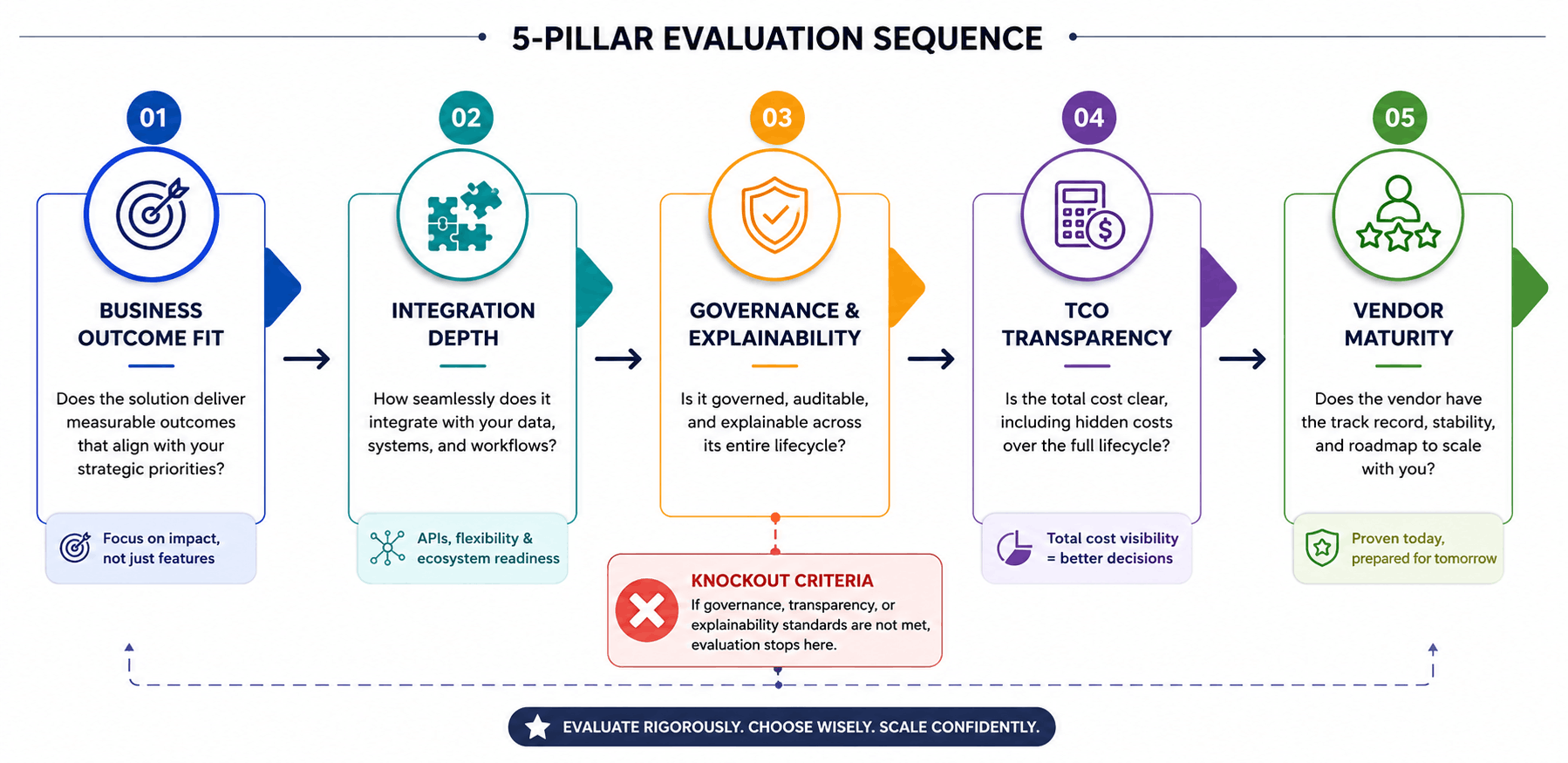
Pillar 1: Business Outcome Fit and Use Case Precision
Map your decision landscape first: identify which business decisions have the greatest impact on revenue, customer satisfaction, operational efficiency, or regulatory risk before engaging any vendor.
Confirm platform mode matches your need: established analytics players like SAS and IBM sit alongside purpose-built decisioning specialists like FICO and Quantexa, newer AI-native platforms like Aera and Diwo, and hybrid planning tools, per the Viewpoint Analysis 2026 decision intelligence software guide. Each has a genuine strength in a specific mode; require vendors to demonstrate capability in your mode, not a generic capability roadmap.
Require production pilots, not proof-of-concept demos: most AI platform vendors can impress in a controlled demo. The harder question is whether the platform holds up when connected to live CRM, risk, and operational systems under real transaction volumes.
Pillar 2: Integration Depth and Data Architecture
Assess execution depth, not connector count: a platform with 200 integrations that only read document titles is less useful than one with 40 integrations that can execute actions within each tool, per Forrester's 2025 Enterprise AI Decision Framework. Integration depth means the platform can execute decisions in your tools, not just retrieve data from them.
Confirm data pipeline support: AI decision systems rely on reliable, accessible enterprise data. Evaluate whether the platform's architecture supports your existing data infrastructure including cloud data platforms such as Databricks, Snowflake, or Microsoft Fabric.
Validate real-time streaming support: static batch decision systems cannot support fraud detection, real-time credit decisioning, or customer-facing AI in 2026 operating environments.
Pillar 3: Governance, Explainability, and Audit Trail
Explainability is critical in regulated industry contexts. You need to defend your decisions to regulators, auditors, and stakeholders. For BFSI enterprises, this means every decision the platform influences must be traceable through the entire execution path including data inputs, model outputs, and escalation points. Pre-committed knockout criteria should include automatic disqualification if there is no audit logging, no documented data policy, no explainability architecture, and no SOC 2 Type II certification. These are non-negotiable filters, not scoring dimensions. Samta.ai's Veda AI decision analytics platform is designed with explainability and governance documentation as platform architecture, not post-launch add-ons. The Veda AI decision analytics platform connects decision outputs to audit trails on Databricks and Snowflake, giving compliance teams in Singapore BFSI environments the documentation MAS examiners expect. The Veda vs data intelligence platform comparison documents how this governance architecture compares against general-purpose decision intelligence platforms.
Pillar 4: Total Cost of Ownership Transparency
Enterprise buyers frequently compare subscription prices and miss the actual cost stack. The evaluation model must include platform or license fees, usage-based costs including tokens, API calls, and storage overages, implementation services, internal engineering and admin time, security and legal review overhead, monitoring and QA effort, and ongoing maintenance including model version migrations. For regulated enterprises, also budget separately for data integration consulting services to connect the decision platform to existing data infrastructure, and AI security compliance services for the governance documentation layer required before any MAS or equivalent regulatory review.
Pillar 5: Vendor Maturity and Post-Implementation Support
Use three-stage evaluation: define must-haves in weeks one to two before any vendor conversation; run 30-minute qualification calls in weeks two to four to eliminate vendors that cannot meet non-negotiables; conduct full pilots with the two or three survivors in weeks four to eight, using pre-defined success criteria such as 25 percent reduction in processing time, under 5 percent critical error rate, and integration with existing systems complete. The winner is not the vendor with the best demo; it is the vendor most likely to survive rollout, governance review, and scale. For the in-house versus partner build decision that often precedes platform selection, see the in-house AI team decision guide.
Decision Intelligence Platform Comparison: What to Evaluate
Evaluation Dimension | What Excellent Looks Like | Red Flag | Verification Method | APAC Regulated Enterprise Requirement |
Use case precision | Platform excels in your specific decision mode: support, augmentation, or automation | Vendor claims equal strength across all decision modes in all industries | Require a production pilot in your specific use case before shortlisting | Credit, fraud, and compliance use cases require decision automation with governance, not advisory-only support |
Integration and execution depth | Executes actions in your tools (CRM, core banking, data warehouse) not just retrieves data; supports Databricks and Snowflake natively | High connector count with read-only access; no execution capability within existing systems | Live demo with your actual data environment, not synthetic sample data | Real-time decision execution required for fraud detection and credit workflows under MAS expectations |
Governance and explainability | Audit trail built into platform architecture; per-decision rationale exportable on demand; SOC 2 Type II certified | Auditability described as a roadmap feature or a post-launch integration; no SSO support; no documented data policy | Request SOC 2 Type II attestation certificate; require a live audit log export during pilot | MAS AI Risk Management Toolkit requires auditability of every AI-influenced financial decision; non-negotiable |
Total cost of ownership | Full cost stack disclosed upfront: platform fee, usage overages, implementation, maintenance, version migration | Base price without overage model; module-based pricing with expensive add-ons for core capabilities | Require a 24-month TCO model in writing before signing any contract | Budget 15 to 20 percent above quoted platform cost for governance and compliance documentation overhead |
Vendor maturity and support | Documented production deployments in your industry; named references at your organization size; post-go-live SLA defined | References limited to pilots; no case studies with quantified outcomes; post-implementation support is self-service only | Three reference calls with production clients in your sector, not pilot clients | Singapore-regulated industry references required; US-only track record insufficient for MAS governance alignment |
Measure Your AI Model Risk Exposure Before Regulators Do
Enterprise Use Cases: Decision Intelligence in Practice
Use Case 1: Singapore Bank Selecting a Credit Decisioning Platform
A Singapore bank's head of data needed a decision intelligence platform for real-time credit risk decisioning across retail and SME lending. The bank applied the five-pillar evaluation: use case required decision automation, not just support; integration needed to connect to three core banking systems; governance required per-decision audit trails exportable for MAS review; TCO modeling revealed a competitor's module-based pricing was 2.3x the headline price at projected transaction volume; and vendor references confirmed only one finalist had production BFSI deployments in Southeast Asia. The selected platform connected to the bank's existing Snowflake data lakehouse through native connectors, with every credit decision generating an explainability record the compliance team could export without engineering involvement. The top AI use cases guide was referenced in the business case to connect platform selection to documented BFSI ROI benchmarks.
Use Case 2: Enterprise Using Decision Intelligence for Supply Chain Optimization
A Singapore logistics enterprise deployed a decision intelligence platform for supply chain routing and inventory optimization. The evaluation prioritized integration execution depth over connector count, confirming the platform could write routing decisions back to the ERP system rather than simply surfacing recommendations for manual input. This converted the platform from advisory AI to autonomous AI, eliminating the human bottleneck of reviewing and executing every routing suggestion. Decision cycle time dropped from 4 hours to 11 minutes for standard routing decisions. The governance layer logged every automated decision for monthly operations review, providing the audit trail needed for internal compliance reporting without requiring a separate documentation process.
Key Risks and Failure Modes
Evaluating on demo quality rather than production readiness: Every vendor can show a slick copiloted workflow and a promise of six-week deployment. The hard question is whether the platform holds up when connected to live systems under real transaction volumes. Require a production pilot before any contract is signed.
Treating governance as a scoring dimension rather than a knockout criterion: No audit logging, no documented data policy, and no explainability architecture are disqualifying conditions for regulated enterprise procurement, not lower scores on an evaluation matrix. Apply knockout criteria before scoring begins.
Confusing connector count with integration depth: Integration depth in 2026 means the platform can execute actions within your tools, not just retrieve data from them. Platforms with high connector counts but read-only access deliver advisory AI that creates a human bottleneck at the execution step.
Missing the full TCO stack: Module-based pricing with a low base cost and expensive add-ons for core capabilities including explainability, audit logging, or real-time streaming is one of the most common budget failure modes in decision intelligence procurement. Require a 24-month TCO model in writing before signing.
Decision Framework: Are You Ready to Select a Decision Intelligence Platform?
Your top three decision use cases are defined by business outcome, not technology capability
Data readiness has been assessed: clean, lineage-tracked data exists for the decisions the platform will influence
Governance requirements are documented: explainability standard, audit trail format, and regulatory alignment confirmed
Knockout criteria are set before any vendor conversation begins: SOC 2 Type II, audit logging, documented data policy
A 24-month TCO model is required from every shortlisted vendor before scoring begins
A production pilot with pre-defined success criteria is planned before any final contract
If fewer than four boxes are checked, the evaluation is not ready to begin and engaging vendors before this foundation is in place will result in the vendor steering the evaluation criteria rather than the buyer.
Get Expert Guidance on Your AI Decision Intelligence Strategy
Conclusion
The ai decision intelligence platform buyer's guide framework in 2026 is built on one core principle: governance architecture that is embedded from day one is the primary differentiator between platforms that survive regulated enterprise deployment and those that create audit exposure at scale. Use case precision, integration execution depth, and 24-month TCO transparency are the three evaluation disciplines that protect heads of data from the most expensive procurement mistakes in this category.
About Samta
Samta.ai is a Singapore-headquartered AI Product Engineering & Data Intelligence partner helping enterprises build production-grade AI systems for regulated and data-intensive environments.We help organizations move beyond experimentation by engineering scalable, explainable, and enterprise-ready AI solutions from data foundations and model development to workflow automation and deployment.
Our capabilities combine deep AI expertise, data engineering, and product engineering to deliver measurable business impact across FinTech, BFSI, cybersecurity, regulatory technology, and enterprise operations.
Our enterprise AI products power real-world intelligence systems:
• TATVA : AI-driven data intelligence platform for governed analytics, monitoring, and operational insights
• VEDA : Explainable and audit-ready AI decisioning engine built for compliance-sensitive enterprise workflows
• CORA-Property Management Solutions: : Predictive intelligence platform for real-estate pricing, portfolio optimization, and investment analytics
Backed by ecosystem partnerships with Microsoft, Databricks, Snowflake, and AWS, Samta.ai delivers agile, cost-efficient AI engineering with faster turnaround and enterprise-grade scalability. Trusted by enterprises across FinTech, BFSI, and digital transformation initiatives, Samta.ai embeds AI governance, data privacy, and compliance-by-design principles directly into the AI lifecycle , enabling organizations to scale AI with transparency, accountability, and operational control.
Enterprises leveraging Samta.ai automate 65%+ of repetitive data, analytics, and decision workflows while maintaining governance, explainability, and measurable business outcomes. Samta.ai provides the strategic consulting, AI engineering, and data modernization expertise needed to align enterprise operations with next-generation AI transformation goals.
Frequently Asked Questions
What is decision intelligence and how is it different from business intelligence?
What is decision intelligence in enterprise AI terms: it is the discipline of connecting data, analytics, AI models, and process automation into a system that moves from observation to action. Business intelligence answers what happened; decision intelligence answers what to do next and executes that recommendation within defined constraints. The gap between advisory decision support and autonomous decision execution is the primary differentiator between platforms in 2026.
What are the most important decision intelligence evaluation criteria for APAC regulated enterprises?
The five most important decision intelligence evaluation criteria for regulated APAC enterprises are: use case precision (does the platform excel in your specific decision mode), integration execution depth (can it act in your tools, not just retrieve data), governance and explainability architecture (is it built in, not retrofitted), total cost of ownership transparency (full 24-month stack, not headline price), and APAC-specific production references (Singapore or ASEAN BFSI deployments, not US-only case studies).
What is a criteria for decision matrix when evaluating decision intelligence platforms?
A criteria for decision matrix for decision intelligence platforms should include knockout criteria applied before scoring: SOC 2 Type II, audit logging, documented data policy, and explainability architecture. Remaining vendors are then scored on business outcome fit, integration depth, governance, TCO, and vendor maturity. Below 65 on a 100-point weighted scorecard is a disqualifying threshold, per AINinza's 2026 enterprise AI evaluation framework.
How do you evaluate decision intelligence platforms without being steered by vendor demos?
Require vendors to answer the same technical, commercial, and operational questions in writing before any demo. Require a production pilot with pre-defined success criteria rather than evaluating on demo quality. Use knockout criteria that disqualify vendors who cannot meet non-negotiables before scoring begins. Vendors that publish structured evaluation frameworks are often attempting to shape procurement criteria before the RFP is written; define your own criteria first.
How does decision intelligence support regulatory compliance in banking and insurance?
Decision intelligence supports regulatory compliance by ensuring every AI-influenced decision follows consistent, documented criteria, maintains appropriate documentation, and complies with regulatory requirements. Explainability becomes critical in regulated contexts because organizations need to defend decisions to regulators, auditors, and stakeholders. For Singapore BFSI firms, this means per-decision audit trails exportable on demand for MAS examiners, not reconstructed after a supervisory request.