

Summarize this post with AI
Building an internal AI team feels like the safe, strategic choice until you calculate the true cost of hiring, retaining, and upskilling AI talent in a market where demand outpaces supply by 4 to 1. The decision between an in-house AI team vs AI consulting partner is one of the highest-stakes choices an enterprise leader will make in 2026. The answer is not universal. It depends on your transformation maturity, data readiness, regulatory obligations, and how fast you need to move. This guide gives you a structured framework to decide without guesswork.
In-House AI Team vs AI Consulting Partner
For most enterprises in APAC, the optimal model in 2026 is a hybrid: a lean internal AI governance and product team supported by a specialist AI consulting partner for engineering execution, model deployment, and regulatory compliance. Pure in-house builds require 18–24 months to reach production maturity and carry significant talent retention risk. Build vs buy AI transformation decisions should be anchored to three variables: time-to-value, total cost of ownership, and governance accountability not headcount preference.
What "Build vs Buy AI Transformation" Actually Means
The build vs buy AI transformation debate is often framed as a binary hire a team or hire a vendor. In practice, enterprise AI decisions sit on a spectrum:
Full in-house: recruit, build, and operate all AI capabilities internally
Consulting-led: engage an AI transformation partner to design, build, and transfer
Hybrid: internal product and governance ownership, external engineering execution
Managed AI services: ongoing AI operations outsourced to a specialist partner
Each model carries different cost structures, speed profiles, and risk exposures. The right answer depends on where your organization sits on the AI maturity curve — which you can assess using a structured AI readiness assessment.
Make Confident AI Decisions with a Free Assessment Report
Why This Decision Is More Consequential in 2026
Three shifts have changed the calculus since 2023:
Talent scarcity is structural: ML engineers and AI architects command USD 180,000–280,000 base salaries in Singapore and Hong Kong (Source Required: Korn Ferry APAC Talent Report). Attrition in AI roles runs 28% annually (Source Required: LinkedIn Workforce Report).
Regulatory requirements demand specialist knowledge: MAS Model Risk Management guidelines, RBI AI/ML frameworks, and emerging EU AI Act obligations require governance expertise that most newly formed in-house teams do not yet possess.
The roi of generative ai is time-sensitive: enterprises that reach production GenAI deployment 12 months ahead of competitors capture disproportionate market advantage. Speed is now a strategic variable, not just a project metric.
Understanding how AI will transform business in your sector requires knowing which model gets you to production fastest with the lowest governance risk not which model feels most "owned."
The 5-Factor Decision Framework: In-House vs Consulting Partner
Before committing to either path, score your organization against these five factors:
Factor 1: Time to Value
In-house: 18–24 months from first hire to production model. Recruiting, onboarding, tooling, and culture-building all precede delivery.
Consulting partner: 3–9 months to first production use case when working with an experienced partner that has pre-built accelerators and reusable frameworks.
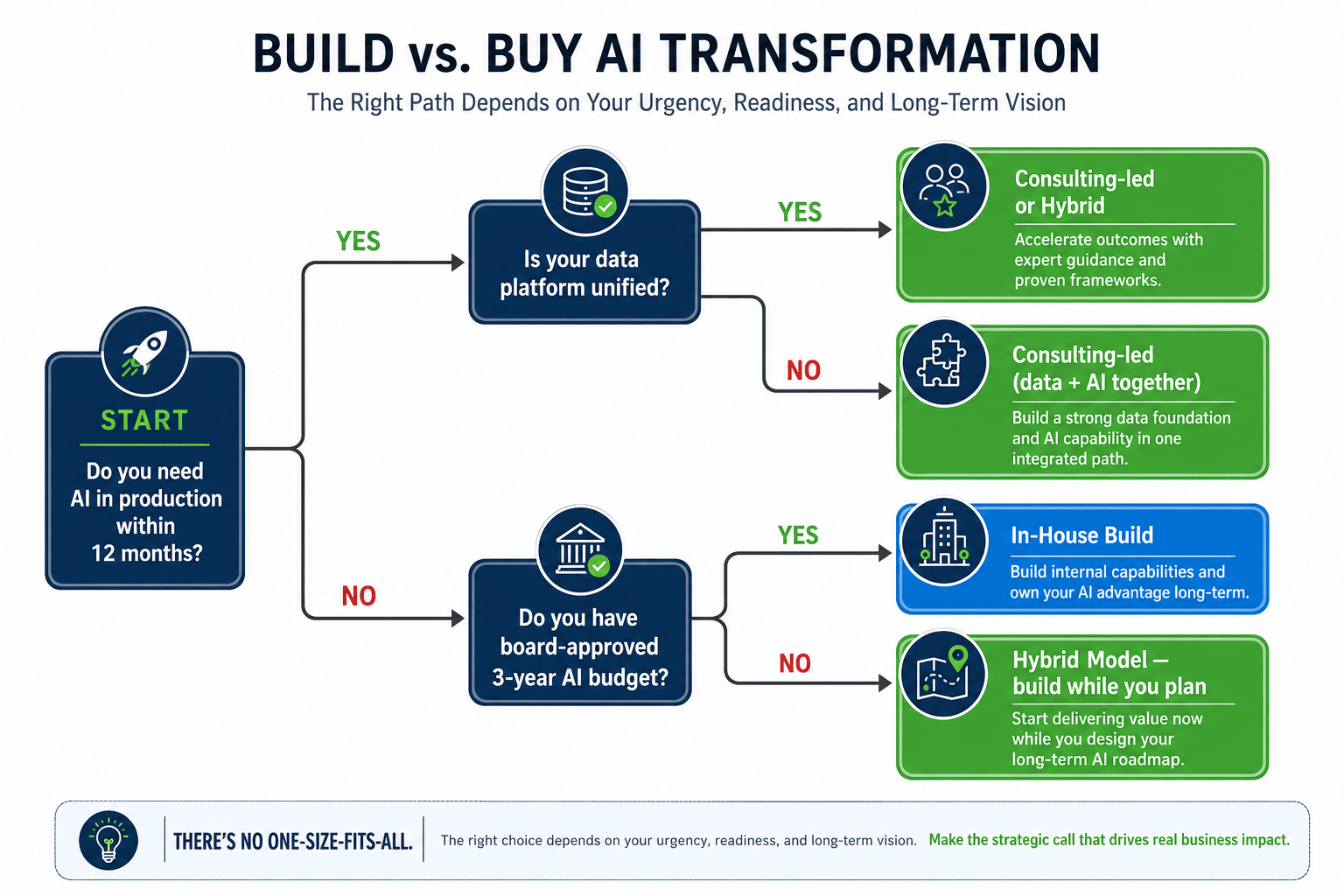
If your board has defined AI milestones within 12 months, in-house build is not a viable primary path. Use your AI transformation roadmap template to validate the timeline your business actually requires.
Factor 2: Total Cost of Ownership
Building an internal AI team of 8–10 people (data scientists, ML engineers, data engineers, AI product manager, risk officer) in Singapore costs USD 2.4M–3.8M annually in salary alone before infrastructure, tooling, and management overhead (Source Required: Korn Ferry). A consulting engagement for equivalent capability typically runs USD 600K–1.4M per year, with no retention risk and no bench cost during low-activity periods.
Factor 3: Data and Infrastructure Readiness
AI based hiring and model deployment both fail without a clean, governed data foundation. If your data sits in more than three unintegrated silos, you need data engineering before AI engineering. Samta.ai's digital transformation managed services team uses Databricks and Snowflake to remediate data infrastructure as part of the AI engagement not as a separate workstream.
Factor 4: Regulatory and Governance Accountability
In regulated sectors BFSI, healthcare, insurance model risk governance cannot be delegated entirely to an external party. You need internal accountability. But building that governance function does not require building the entire engineering function.
The optimal structure: internal Chief AI Officer or AI Risk Lead, supported by a consulting partner that embeds governance tooling such as the VEDA AI Decision Analytics Platform into every model deployed.
Factor 5: Strategic AI Ambition
If AI is a core differentiator in your product or service not just an operational efficiency tool long-term in-house capability is the right destination. But most enterprises should reach that destination via a consulting-led transition, not a cold start. Explore how modern enterprises structure this transition in how modern enterprises build AI capability.
In-House AI Team vs AI Consulting Partner: 5-Column Comparison
Dimension | Full In-House | Consulting-Led | Hybrid Model | Samta.ai Benchmark |
Time to First Production | 18–24 months | 3–9 months | 6–12 months | 6–9 months (BFSI) |
Annual Cost (8–10 FTE equiv.) | USD 2.4M–3.8M | USD 600K–1.4M | USD 1.2M–2.0M | Transparent SOW pricing |
Talent Retention Risk | High (28% attrition) | None | Low–Medium | SLA-backed delivery |
Regulatory Governance | Dependent on hiring | Partner-embedded | Shared accountability | MAS / RBI aligned |
Knowledge Transfer | Inherent | Requires planning | Structured handover | Built into engagement model |
Reduce AI Risk with Actionable Insights
Real-World Use Cases: How Enterprises Have Decided
Use Case 1: Regional Bank, Singapore (BFSI)
A mid-sized bank needed to deploy an AI-driven credit decisioning model within 9 months to meet MAS expectations on explainability. An in-house build was ruled out the talent acquisition timeline alone exceeded the regulatory deadline. The bank engaged an AI consulting partner to deploy a model with embedded audit trails and MAS TRM-aligned documentation. The internal risk team retained governance accountability. Time to production: 7 months. The AI implementation roadmap for enterprise they followed is now a repeatable internal playbook. AI consulting vs hiring AI team in this context: consulting won on every dimension speed, compliance, and cost.
Use Case 2: Logistics Conglomerate, Southeast Asia (General Enterprise)
A regional logistics group wanted to build AI-powered route optimization and demand forecasting. They had a 3-year horizon and wanted the capability permanently in-house. They started with a consulting-led build for the first two use cases, using that engagement to upskill 4 internal data engineers and establish governance protocols. By Month 18, the internal team owned operations. The consulting partner reduced scope progressively a textbook hybrid model transition. This is how AI will transform business sustainably: capability transfer, not perpetual dependency.
AI Implementation Playbook Get the enterprise framework for structuring your in-house vs consulting decision with TCO calculators and governance templates.
Key Risks in Each Model
In-house risks:
Talent cliff: if two or three key hires leave, the program stalls
Tool fragmentation: internal teams build bespoke tooling that creates technical debt
Governance blind spots: teams optimizing for model performance miss regulatory obligations
Slow iteration: internal bureaucracy slows deployment cycles
Consulting partner risks:
Knowledge lock-in: IP and model logic remain with the vendor without explicit transfer clauses
Context gap: external teams lack deep domain knowledge in Year 1
Dependency risk: over-reliance on external partners delays internal capability building
How AI and automation transformation programs fail most often: they choose one model and stick to it rigidly, instead of evolving the model as internal maturity grows. Review your AI transformation consulting approach in Singapore to understand how structured engagements are designed to transition control over time.
Decision Checklist: Which Model Fits Your Organization?
Choose a consulting partner if:
You need production AI within 12 months
Your data infrastructure is not yet unified
You operate in a regulated industry with active model risk scrutiny
Your board has not yet approved a multi-year AI talent investment
Choose in-house if:
AI is a core product differentiator, not just an efficiency driver
You have a 3+ year investment horizon approved by the board
You already have a data platform (Snowflake, Databricks, Azure) in production
You can attract and retain senior AI talent at competitive compensation
Choose hybrid if:
You want long-term ownership but need to move now
You want governance accountability internally but engineering velocity externally
You are in BFSI or another regulated sector requiring ongoing model risk oversight
Validate Your AI Architecture Before You Invest
Conclusion
The in-house AI team vs AI consulting partner decision is not about pride of ownership it is about the fastest, most governable path to AI-generated business value. For most enterprises in 2026, that path runs through a consulting-led or hybrid model first, with a structured transition to internal ownership over 18–36 months. Build the governance layer internally from day one. Let a specialist partner accelerate the engineering. Measure outcomes continuously. That is the formula that consistently delivers AI and automation transformation at enterprise scale without the talent risk, the timeline risk, or the regulatory exposure of a cold in-house start.
About Samta
Samta.ai is a Singapore-headquartered AI Product Engineering & Data Intelligence partner helping enterprises build production-grade AI systems for regulated and data-intensive environments.We help organizations move beyond experimentation by engineering scalable, explainable, and enterprise-ready AI solutions from data foundations and model development to workflow automation and deployment.
Our capabilities combine deep AI expertise, data engineering, and product engineering to deliver measurable business impact across FinTech, BFSI, cybersecurity, regulatory technology, and enterprise operations.
Our enterprise AI products power real-world intelligence systems:
• TATVA : AI-driven data intelligence platform for governed analytics, monitoring, and operational insights
• VEDA : Explainable and audit-ready AI decisioning engine built for compliance-sensitive enterprise workflows
• CORA-Property Management Solutions: : Predictive intelligence platform for real-estate pricing, portfolio optimization, and investment analytics
Backed by ecosystem partnerships with Microsoft, Databricks, Snowflake, and AWS, Samta.ai delivers agile, cost-efficient AI engineering with faster turnaround and enterprise-grade scalability. Trusted by enterprises across FinTech, BFSI, and digital transformation initiatives, Samta.ai embeds AI governance, data privacy, and compliance-by-design principles directly into the AI lifecycle , enabling organizations to scale AI with transparency, accountability, and operational control.
Enterprises leveraging Samta.ai automate 65%+ of repetitive data, analytics, and decision workflows while maintaining governance, explainability, and measurable business outcomes. Samta.ai provides the strategic consulting, AI engineering, and data modernization expertise needed to align enterprise operations with next-generation AI transformation goals.
Frequently Asked Questions
What is the main difference between an in-house AI team and an AI consulting partner?
An in-house AI team is a permanently employed group of data scientists, ML engineers, and AI product managers who build and operate AI systems inside your organization. An AI consulting partner is an external specialist firm engaged to design, build, and deploy AI — typically with a knowledge transfer component. The core tradeoff is speed and cost (consulting) versus long-term ownership and institutional knowledge (in-house).
How much does it cost to build an in-house AI team in APAC?
For a functional 8–10 person AI team in Singapore or Hong Kong, expect USD 2.4M–3.8M annually in fully loaded salary costs, plus USD 400K–800K in infrastructure and tooling (Source Required: Korn Ferry APAC Talent Report). Total Year 1 investment including recruitment and onboarding typically exceeds USD 3.5M before a single model reaches production.
How is AI being used in hiring decisions today?
AI based hiring tools including resume screening models, interview scoring systems, and candidate fit algorithms are in active use across APAC enterprises. However, how AI is being used in hiring is itself subject to increasing regulatory scrutiny: MAS and Singapore's PDPA both require explainability and bias testing for AI systems that affect employment decisions.
What should a knowledge transfer clause look like in an AI consulting engagement?
A robust knowledge transfer clause should specify: (1) all model code delivered to client repositories on project completion; (2) model cards and documentation produced for every deployed model; (3) a minimum number of internal staff trained to operate and retrain the model; (4) a 90-day hypercare period post-handover. Without these terms, build vs buy AI transformation engagements frequently result in permanent vendor dependency.
Can a consulting partner help with AI governance and regulatory compliance?
Yes and for regulated industries, this is one of the primary reasons to engage a consulting partner rather than build in-house initially. Specialist partners bring pre-built MAS TRM, RBI, and EU AI Act compliance frameworks that would take an in-house team 12–18 months to develop independently. Governance tooling embedded at the model layer not bolted on afterward is the standard for how AI will transform business in regulated sectors.