
Summarize this post with AI
Enterprises that skip a structured AI readiness assessment framework and move directly to model development consistently spend the first four to six months of their AI program remediating data quality gaps, governance omissions, and talent deficits that the assessment would have identified in four weeks. The cost of that remediation routinely exceeds the assessment investment by a factor of ten. This guide gives Singapore CTOs, CDOs, and transformation leads a complete six dimension AI readiness assessment framework with a scoring rubric and free template structure, calibrated to the regulatory and market conditions of 2026.
AI Readiness Assessment Framework:
A complete AI readiness assessment framework in 2026 evaluates six dimensions that determine whether an organisation can initiate, deploy, and sustain production AI: data readiness, infrastructure and MLOps readiness, talent readiness, governance and regulatory readiness, strategy and use case readiness, and organisational change readiness. Each dimension is scored on a 0 to 100 scale with defined criteria at four maturity bands. For Singapore BFSI and regulated enterprise, the governance and data dimensions are weighted higher than in general enterprise assessments because MAS TRM, PDPA, and FEAT obligations must be satisfied before any AI model can enter production, regardless of how strong the other four dimensions score.
What Is AI Readiness and How Does This Framework Work
What is AI readiness in practical terms: it is the current organisational capability to initiate a specific AI use case and bring it to production within a defined timeline, at a defined cost, with a governance standard that satisfies internal risk teams and external regulators. Readiness for artificial intelligence is not a fixed organisational state. It is use case specific and changes over time as data is remediated, talent is hired, governance frameworks are built, and infrastructure is deployed. An organisation can be ready for a demand forecasting AI use case and simultaneously unready for a credit risk AI use case because the governance and data readiness requirements differ substantially between the two.
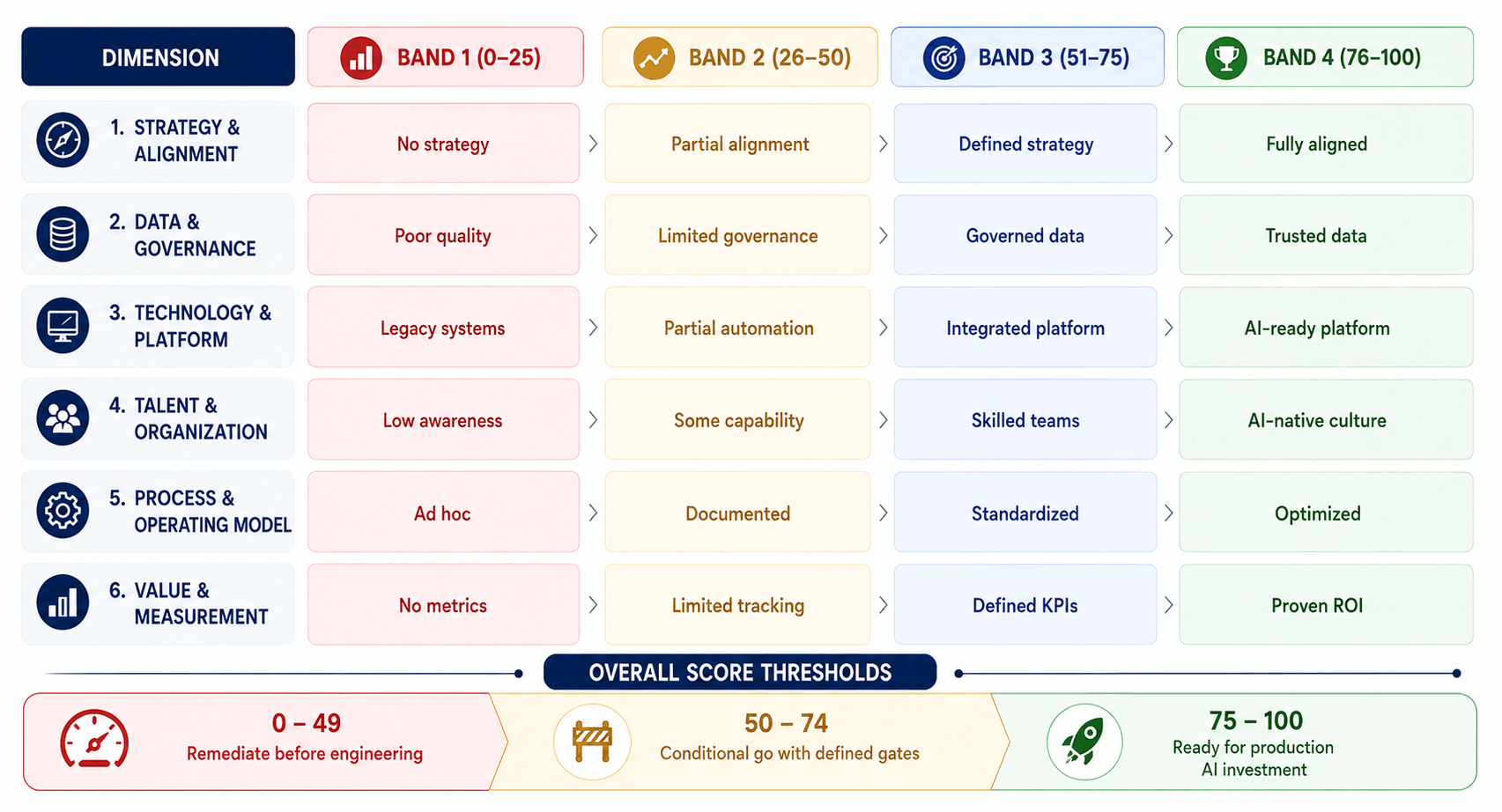
The AI maturity assessment model this framework is built on uses four maturity bands per dimension:
Band 1 (0 to 25): Foundational: the dimension does not exist or exists only in conceptual form
Band 2 (26 to 50): Developing: the dimension exists partially but has critical gaps that block production AI deployment
Band 3 (51 to 75): Operational: the dimension is functional for the target use case with minor gaps requiring active remediation
Band 4 (76 to 100): Advanced: the dimension is fully operational, governed, and scalable across a use case portfolio
An overall readiness score below 60 across all six dimensions indicates that the organisation should prioritise remediation before engineering investment. A score above 75 indicates that a well scoped first use case can proceed to engineering with a defined governance gate before production deployment. Review why an AI readiness assessment matters before any engineering investment is committed, and what your AI readiness score means for investment sequencing decisions.
Ready to Build AI That Delivers Business Value?
Why This Framework Matters More in 2026
Three conditions make a structured AI adoption readiness framework more consequential than it was in prior years:
1. Board investment gates now require quantified readiness evidence
CFOs and investment committees across Singapore enterprise are requiring quantified readiness assessments before approving AI program budgets above SGD 500,000. A readiness score with dimension level gap analysis and a remediation cost estimate is now a standard board investment gate document, not an optional pre project exercise (Source Required: Gartner Enterprise AI Investment Governance Survey).
2. MAS model risk examination requires documented readiness evidence
MAS Technology Risk Management examinations increasingly request documentation showing that AI programs were initiated against a documented readiness baseline rather than reactively. Institutions that can show a pre program readiness assessment with defined governance gates demonstrate a model risk management posture that examination teams view more favourably than those that cannot (Source Required: MAS Technology Risk Management Guidelines).
3. The cost of readiness gaps discovered in engineering is compounding
Data remediation costs discovered during model development consistently run 2 to 4 times the cost of data quality assessment during readiness evaluation. Governance gaps discovered during pre production review require architecture rebuilds that are 3 to 5 times more expensive than building governance correctly from the start. Early identification is not overhead. It is the cheapest form of risk management available in an AI program.
The Six Dimension AI Readiness Assessment Framework
Dimension 1: Data Readiness
What it measures: The quality, availability, governance, and integration maturity of data required for the target AI use case.
Scoring criteria:
Band 1: Data exists in multiple unintegrated systems, no quality metrics, no lineage documentation
Band 2: Data is accessible in a central platform but quality scores are below 65%, lineage is partial
Band 3: Data quality score 65 to 80%, automated quality monitoring exists, lineage tracks to source systems
Band 4: Data quality score above 80%, column level lineage automated, PDPA consent tracking propagated through pipeline, training data versioning in place
Weight for Singapore BFSI: 25% of total readiness score due to MAS TRM data lineage requirements. Samta.ai's data integration consulting services assess data readiness using automated profiling on Databricks and Snowflake, producing a scored, dimension level gap analysis with remediation cost estimates, not a qualitative narrative.
Dimension 2: Infrastructure and MLOps Readiness
What it measures: The maturity of cloud platform, compute infrastructure, model serving capability, CI/CD pipeline, and monitoring tooling.
Scoring criteria:
Band 1: No cloud data platform, models served from notebooks or local scripts
Band 2: Cloud platform exists (Azure, AWS, GCP) but no MLOps tooling, model serving is manual
Band 3: MLOps tooling exists (MLflow, SageMaker, Azure ML) but no automated CI/CD or drift monitoring
Band 4: Full CI/CD pipeline, containerised serving (Kubernetes), automated drift detection, model registry with rollback capability
AI ready infrastructure at Band 4 is the technical prerequisite for sustained production AI. Organisations at Band 1 or 2 should budget infrastructure build before model development begins.
Dimension 3: Talent Readiness
What it measures: The availability and depth of the five core AI engineering roles required for production AI.
Scoring criteria:
Band 1: No data engineering, ML engineering, or AI governance roles in the organisation
Band 2: One or two AI related roles exist but MLOps and model risk are absent
Band 3: Data engineers and ML engineers exist, MLOps capability is partial, no dedicated AI governance role
Band 4: All five roles staffed or accessible: data engineer, ML engineer, MLOps engineer, AI model risk lead, AI product owner
Talent gaps at Band 1 or 2 have two resolution paths: hiring (6 to 18 months) or external engineering engagement (4 to 8 weeks). Time to production is the primary variable that determines which path is right. Review AI ready data engineering talent requirements to understand what Band 4 data engineering capability requires at the practitioner level.
Dimension 4: Governance and Regulatory Readiness
What it measures: The maturity of AI model risk policy, MAS TRM alignment, PDPA consent management, FEAT assessment capability, and audit trail infrastructure.
Scoring criteria:
Band 1: No AI model risk policy, no governance owner, no PDPA AI mapping
Band 2: Policy exists but no engineering controls behind it, no independent validation process, no FEAT assessment
Band 3: Policy exists with named governance owner, independent validation process defined, PDPA mapped to AI use cases
Band 4: Engineering layer governance in place: automated audit trails, individual level FEAT explainability, drift monitoring with defined thresholds, Board level AI risk reporting
Weight for Singapore BFSI: 25% of total readiness score. Governance readiness at Band 1 or 2 is a production deployment blocker for regulated use cases regardless of how high other dimensions score.
Samta.ai's AI security and compliance services assess governance readiness as a standalone workstream with a specific MAS TRM, FEAT, and PDPA gap analysis output.
Dimension 5: Strategy and Use Case Readiness
What it measures: The clarity of the AI use case definition, ROI hypothesis, regulatory obligation mapping, and executive sponsorship.
Scoring criteria:
Band 1: Multiple competing AI ideas with no formal prioritisation, no ROI hypothesis, no executive sponsor
Band 2: One use case identified but no quantified ROI hypothesis, no regulatory obligation map, technology team only sponsor
Band 3: Use case defined with quantified ROI hypothesis, regulatory obligations mapped, business unit sponsor identified
Band 4: Use case fully scoped with data requirements confirmed, ROI hypothesis approved by finance, regulatory obligations mapped to specific engineering controls, joint technology and business ownership
Strategy readiness at Band 1 indicates that a readiness assessment itself is premature. Use case clarification and executive alignment must precede a formal readiness evaluation. Review which tools and frameworks are used to assess AI readiness in Singapore to understand how strategy readiness feeds into the broader framework selection decision.
Dimension 6: Organisational Change Readiness
What it measures: The organisation's capacity to adopt AI model outputs into operational workflows, including process redesign, training, and change management.
Scoring criteria:
Band 1: No change management plan, operational teams unaware of AI program
Band 2: Change management plan exists but not resourced, operational team awareness is passive
Band 3: Change management resourced, operational team training planned, workflow integration design underway
Band 4: Operational team training completed for target use case, workflow integration tested, adoption KPIs defined and baselined
Change readiness at Band 1 or 2 does not block model development but consistently produces AI programs where technically excellent models achieve less than 40% operational adoption, collapsing realised ROI below the investment case.
AI Readiness Assessment Scoring Rubric:
Dimension | Band 1 (0 to 25) | Band 2 (26 to 50) | Band 3 (51 to 75) | Band 4 (76 to 100) |
Data Readiness | Siloed, unclean, no lineage | Central platform, quality below 65% | Quality 65 to 80%, automated monitoring | Quality above 80%, column lineage, PDPA tracked |
Infrastructure and MLOps | Notebooks, no cloud ML platform | Cloud exists, no MLOps tooling | MLOps tooling, no CI/CD | Full CI/CD, containerised serving, drift monitoring |
Talent Readiness | No AI engineering roles | 1 to 2 roles, MLOps and risk absent | Data and ML engineers, partial MLOps | All five roles staffed or accessible |
Governance and Regulatory | No policy, no owner | Policy only, no engineering controls | Policy with owner, validation process defined | Engineering layer governance, audit trails, FEAT explainability |
Strategy and Use Case | Competing ideas, no ROI hypothesis | One use case, no quantified ROI | ROI hypothesis, regulatory map, business sponsor | Fully scoped, finance approved, joint ownership |
Change Readiness | No plan, no awareness | Plan exists, not resourced | Training planned, workflow integration designing | Training complete, adoption KPIs baselined |
Identify Hidden Risks Across Your AI Models
Real World Use Cases
Use Case 1: AI Readiness Assessment, Singapore Bank (BFSI)
A Singapore retail bank commissioned a six dimension readiness assessment before committing to a credit risk AI program. Results: Data Readiness 42 (Band 2, no column level lineage), Infrastructure 61 (Band 3), Talent 38 (Band 2, no MLOps engineer), Governance 29 (Band 2, policy only), Strategy 68 (Band 3), Change 55 (Band 3). Overall score: 49. Investment recommendation: 14 weeks of data and governance remediation before engineering investment, with parallel MLOps engineer hiring or engagement. The assessment prevented an estimated SGD 480,000 in retroactive data and governance remediation that the previous peer institution had funded mid program. Explore how similar BFSI program assessments are structured in Samta.ai case studies and review the AI readiness assessment framework for the specific evaluation methodology Samta.ai applies to BFSI programs.
Use Case 2: AI Readiness Assessment, Regional Logistics Group (General Enterprise)
A regional logistics conglomerate assessed readiness for a demand forecasting AI program across 9 APAC markets. Results: Data Readiness 31 (Band 2, data in 7 unintegrated systems), Infrastructure 58 (Band 3), Talent 44 (Band 2), Governance 62 (Band 3, non regulated), Strategy 72 (Band 3), Change 48 (Band 2). Overall score: 53. Investment recommendation: Databricks data unification program as Stage 1 before model development, parallel talent engagement for MLOps capability, and change management program resourcing before model completion. Stage 1 data unification investment: SGD 420,000. Stage 2 model development and deployment: SGD 680,000. Without the readiness assessment, Stage 2 would have begun first, creating a data remediation program mid engineering that would have extended total program duration by an estimated 7 months.
The VEDA AI Data Analytics Platform was deployed in Stage 2 on the unified Databricks data foundation, with the readiness assessment data quality baseline used as the starting benchmark for ongoing platform monitoring. Compare VEDA against alternative platforms in VEDA vs data intelligence platform to understand how platform selection decisions at readiness stage affect Stage 2 deployment cost.
Key Risks When AI Readiness Assessment Is Done Poorly
Single dimension assessment treated as full readiness: is the most common error. Organisations that assess only data quality or only infrastructure readiness and receive positive results proceed to engineering with false confidence that other dimensions have not been examined. All six dimensions must be scored before any go or no go investment decision.
Self assessment without independent scoring: produces consistently inflated scores across all six dimensions. Internal teams have structural incentives to overstate readiness to support program approval. Independent assessment using automated profiling tools and structured interviews with technical practitioners produces more accurate dimension scores.
Readiness assessment used to justify a predetermined decision: rather than to evaluate genuine readiness produces assessments that confirm the program will succeed regardless of what the data shows. Assessment integrity requires that the output is acted on, including a decision to delay, when dimension scores indicate that proceeding would create avoidable remediation cost.
No remediation roadmap produced from the assessment: leaves the organisation with a score but no action plan. An assessment without a prioritised, sequenced, costed remediation roadmap for dimensions scoring below Band 3 is not a complete readiness assessment deliverable.
Reassessment not scheduled: means that dimension scores from the initial assessment become stale as remediation programs progress. Readiness scores should be updated at defined program milestones, not treated as a static pre program output.
Decision Framework: When to Run an AI Readiness Assessment
Run a full six dimension assessment when:
An AI program above SGD 300,000 in scope is being considered for board investment approval
A previous AI program stalled or failed and the root cause has not been formally identified
MAS examination is scheduled within 12 months and AI governance readiness has not been formally evaluated
Multiple competing AI use cases require prioritisation based on readiness profile, not just business value
Run a targeted single dimension assessment when:
One specific dimension is known to be the primary program risk and a deep dive is required before remediation investment is committed
A data readiness assessment is needed before a Databricks or Snowflake platform selection decision
A governance readiness assessment is needed before a pre examination remediation program is scoped
Defer the assessment when:
Strategy Dimension scores Band 1, meaning no use case has been identified and no ROI hypothesis exists. Assessment is premature without a defined use case to assess against.
Accelerate Your AI Journey with Expert Consulting

Conclusion
The AI readiness assessment framework in this guide is designed to prevent the most expensive mistake in enterprise AI programs: committing engineering budget to a use case before the data, governance, infrastructure, and talent dimensions that determine whether that investment reaches production are understood and addressed. Six dimensions, scored honestly against defined criteria, with a prioritised remediation roadmap as the mandatory output, is what separates an assessment that produces action from one that produces a score and nothing else. Run it before you invest. Update it at every major program milestone. Treat low dimension scores as investment priorities, not program blockers.
About Samta
Samta.ai is a Singapore-headquartered AI Product Engineering & Data Intelligence partner helping enterprises build production-grade AI systems for regulated and data-intensive environments.We help organizations move beyond experimentation by engineering scalable, explainable, and enterprise-ready AI solutions from data foundations and model development to workflow automation and deployment.
Our capabilities combine deep AI expertise, data engineering, and product engineering to deliver measurable business impact across FinTech, BFSI, cybersecurity, regulatory technology, and enterprise operations.
Our enterprise AI products power real-world intelligence systems:
• TATVA : AI-driven data intelligence platform for governed analytics, monitoring, and operational insights
• VEDA : Explainable and audit-ready AI decisioning engine built for compliance-sensitive enterprise workflows
• CORA-Property Management Solutions: : Predictive intelligence platform for real-estate pricing, portfolio optimization, and investment analytics
Backed by ecosystem partnerships with Microsoft, Databricks, Snowflake, and AWS, Samta.ai delivers agile, cost-efficient AI engineering with faster turnaround and enterprise-grade scalability. Trusted by enterprises across FinTech, BFSI, and digital transformation initiatives, Samta.ai embeds AI governance, data privacy, and compliance-by-design principles directly into the AI lifecycle , enabling organizations to scale AI with transparency, accountability, and operational control.
Enterprises leveraging Samta.ai automate 65%+ of repetitive data, analytics, and decision workflows while maintaining governance, explainability, and measurable business outcomes. Samta.ai provides the strategic consulting, AI engineering, and data modernization expertise needed to align enterprise operations with next-generation AI transformation goals.
Frequently Asked Questions
What is an AI readiness assessment framework?
An AI readiness assessment framework is a structured evaluation model that scores an organisation across multiple dimensions of AI capability to determine whether it can initiate, deploy, and sustain production AI for a specific use case. A complete framework produces a dimension level score, a maturity band classification, a gap analysis identifying specific blockers, and a prioritised remediation roadmap with cost and timeline estimates for each gap.
What are AI readiness assessment tools and which are used in Singapore?
AI readiness assessment tools in Singapore include: automated data profiling tools (Great Expectations, Databricks Data Quality) for data dimension scoring, MLOps maturity checklists aligned to NIST AI RMF for infrastructure dimension scoring, and MAS TRM and FEAT compliance maps for governance dimension scoring. No single off the shelf tool covers all six dimensions. The most complete assessments combine automated tooling for data and infrastructure dimensions with structured practitioner interviews for talent, governance, strategy, and change dimensions.
What is the difference between AI readiness and AI maturity?
What is AI readiness versus AI maturity assessment: AI readiness is a point in time, use case specific evaluation of whether your organisation can act on a specific AI initiative now given its current state. AI maturity assessment model measurement is a longitudinal benchmark of overall AI capability relative to peers. Readiness answers can we start this use case now; maturity answers where are we on the overall capability curve. Most organisations need a readiness assessment before program initiation and a maturity assessment for board strategic reporting.
How is an AI readiness assessment framework scored?
An AI adoption readiness framework scoring rubric assigns each dimension a score from 0 to 100 across four maturity bands: Foundational (0 to 25), Developing (26 to 50), Operational (51 to 75), and Advanced (76 to 100). The overall readiness score is a weighted average across all six dimensions, with data and governance dimensions weighted more heavily for regulated BFSI use cases. An overall score below 60 indicates that remediation should precede engineering investment.
What does AI ready infrastructure mean in practice?
AI ready infrastructure means a cloud data platform (Snowflake, Databricks, or Microsoft Azure) with MLOps tooling (MLflow, SageMaker, Azure ML) that supports automated model training, containerised serving (Kubernetes or Docker), model registry with versioning, and drift monitoring with automated alerting. An organisation whose AI models are served from Jupyter notebooks or manual deployment scripts does not have AI ready infrastructure regardless of how capable the models themselves are.